

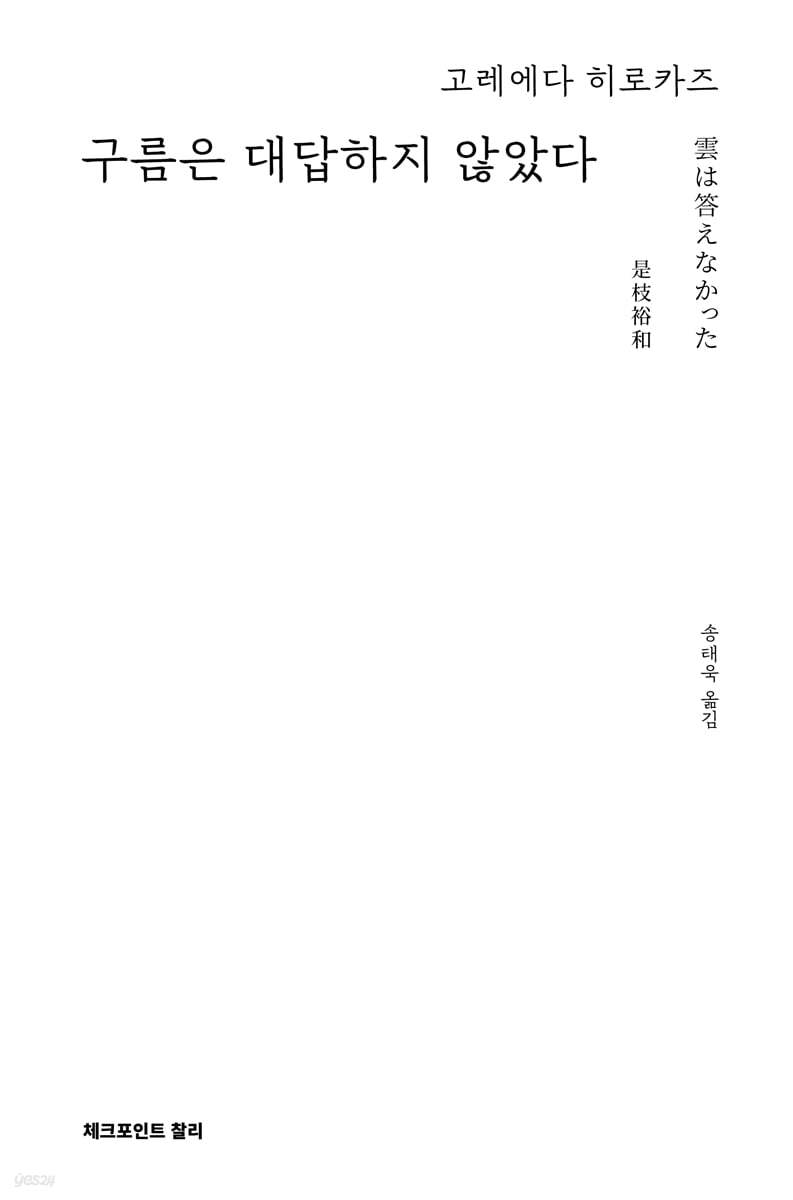
The clouds did not answer
 |
Description
Book Introduction
“We often hear that everything about an author is contained in their first work, whether it’s a film or a novel.
If that's true, then for me, that work is not my film debut, but clearly this book, The Clouds Didn't Answer."
On March 12, 1991, a documentary program titled [However… Towards an Era of Abandoning Welfare] was broadcast on Fuji Television in Japan.
The person who planned the program is Hirokazu Koreeda, a director who currently represents the Japanese film industry.
It was the first documentary that he, who was a television director at the time, took charge of from planning to reporting and editing.
The 47-minute broadcast that day ended, but there was still a story to tell.
The reporting had to continue, and the stories that could not be fully broadcast were compiled into a book.
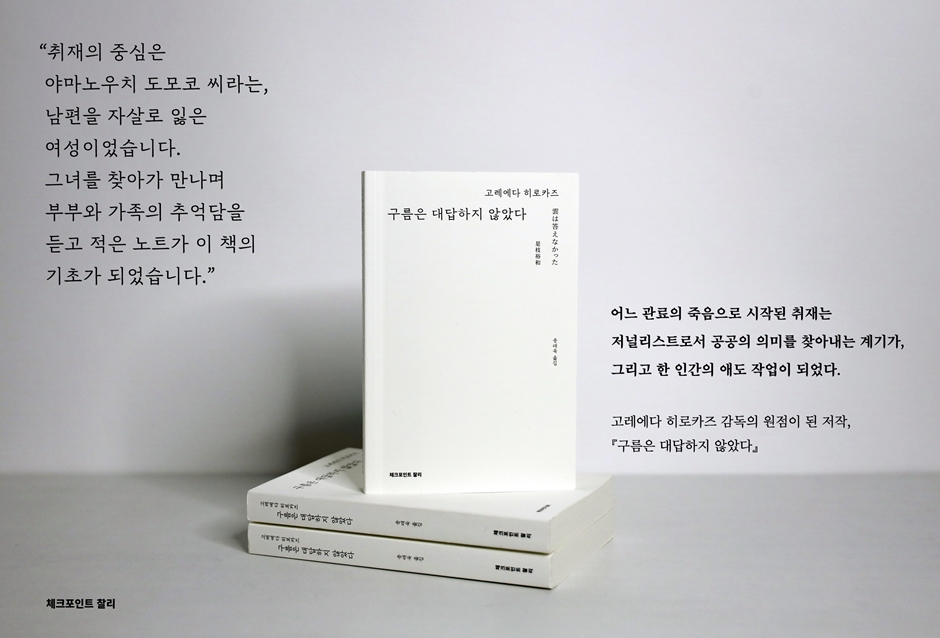
Toyonori Yamanouchi, an official from the Ministry of the Environment.
He was the person responsible for the Minamata disease case that shook Japanese society, and he took his own life during the lawsuit between the government and the victims.
While the death of the bureaucrat was continuously reported in the social affairs section and was receiving public attention, Hirokazu Koreeda, who was preparing a documentary on social welfare issues, began to investigate Yamanouchi's past position as head of welfare administration.
However, as I continued to report, I became more curious about the life of a human being named Toyonori Yamanouchi, not a high-ranking official.
A story and a small note from his wife.
There was a reason why we had to continue reporting even after the broadcast.
What did the word "but" that Yamanouchi wrote down, the "cloud" in his heart, mean?
What did Hirokazu Koreeda see beyond the situation of death?
And so, 『The Clouds Did Not Answer』 was completed.
If that's true, then for me, that work is not my film debut, but clearly this book, The Clouds Didn't Answer."
On March 12, 1991, a documentary program titled [However… Towards an Era of Abandoning Welfare] was broadcast on Fuji Television in Japan.
The person who planned the program is Hirokazu Koreeda, a director who currently represents the Japanese film industry.
It was the first documentary that he, who was a television director at the time, took charge of from planning to reporting and editing.
The 47-minute broadcast that day ended, but there was still a story to tell.
The reporting had to continue, and the stories that could not be fully broadcast were compiled into a book.
Toyonori Yamanouchi, an official from the Ministry of the Environment.
He was the person responsible for the Minamata disease case that shook Japanese society, and he took his own life during the lawsuit between the government and the victims.
While the death of the bureaucrat was continuously reported in the social affairs section and was receiving public attention, Hirokazu Koreeda, who was preparing a documentary on social welfare issues, began to investigate Yamanouchi's past position as head of welfare administration.
However, as I continued to report, I became more curious about the life of a human being named Toyonori Yamanouchi, not a high-ranking official.
A story and a small note from his wife.
There was a reason why we had to continue reporting even after the broadcast.
What did the word "but" that Yamanouchi wrote down, the "cloud" in his heart, mean?
What did Hirokazu Koreeda see beyond the situation of death?
And so, 『The Clouds Did Not Answer』 was completed.
- You can preview some of the book's contents.
Preview
index
On the occasion of publication
Chief's will
Chapter 1 Memory
Chapter 2 Relief
Chapter 3 Phone
Chapter 4 Back view
Chapter 5: The Price
Chapter 6 Mistakes
Chapter 7: The Table
Chapter 8 Absence
Chapter 9: Returning Home
Chapter 10 Conclusion
Chapter 11: Forgetting
Chapter 12 Reunion
Yamanouchi Toyonori Chronology
Book review
Paperback review
Chief's will
Chapter 1 Memory
Chapter 2 Relief
Chapter 3 Phone
Chapter 4 Back view
Chapter 5: The Price
Chapter 6 Mistakes
Chapter 7: The Table
Chapter 8 Absence
Chapter 9: Returning Home
Chapter 10 Conclusion
Chapter 11: Forgetting
Chapter 12 Reunion
Yamanouchi Toyonori Chronology
Book review
Paperback review
Detailed image
Into the book
Even now, more than 20 years later, I still think about the word "public," which she used to suggest to me as a basis for reporting.
---From “On the Publication”
The diary entry written on September 6th is so scribbled that it is illegible in some places.
It is unusual for Yamanouchi, who rarely picks up a brush in an emotional state, to read his emotional agitation directly in his writing.
---From "Memory"
Yamanouchi's observations on the welfare field hit the nail on the head.
As he pointed out, there were ongoing disputes between caseworkers and welfare recipients in the social welfare field.
The reality is that in the field, only mental theories without any professional technology are running rampant.
---From "Mistake"
He wanted to somehow forget the sense of loss and defeat that was accumulating within him.
But his seriousness did not allow him to turn his eyes away from it.
---From "Oblivion"
I hope that readers of this book, like myself, will find that encountering the life and death of Toyonori Yamanouchi will provide them with an opportunity to deepen their thinking about their relationship with their profession, how they cultivate their skills in that field, and how they face the times.
---From “On the Publication”
The diary entry written on September 6th is so scribbled that it is illegible in some places.
It is unusual for Yamanouchi, who rarely picks up a brush in an emotional state, to read his emotional agitation directly in his writing.
---From "Memory"
Yamanouchi's observations on the welfare field hit the nail on the head.
As he pointed out, there were ongoing disputes between caseworkers and welfare recipients in the social welfare field.
The reality is that in the field, only mental theories without any professional technology are running rampant.
---From "Mistake"
He wanted to somehow forget the sense of loss and defeat that was accumulating within him.
But his seriousness did not allow him to turn his eyes away from it.
---From "Oblivion"
I hope that readers of this book, like myself, will find that encountering the life and death of Toyonori Yamanouchi will provide them with an opportunity to deepen their thinking about their relationship with their profession, how they cultivate their skills in that field, and how they face the times.
---From the "Paperback Review"
Publisher's Review
“Everything is contained in the debut work.”
Hirokazu Koreeda says:
'Everything is contained in the debut work.'
This book is like the starting point of his unique perspective, attitude, and world that is revealed throughout his film works.
It is not significant just because it is the first work.
It is because of the sense of kinship I felt while covering the life of a man named Toyonori Yamanouchi and the changes that occurred within me.
What is reporting, what is the subject of reporting, what is the public, what is humanity, what is welfare?
What I discovered beyond the bureaucrat's death left countless questions in my mind, and they became the perspectives through which I later looked at objects, events, and works.
Before making his feature film debut, director Koreeda produced documentaries dealing with social welfare issues.
This book, written based on the content of the interview at the time, was first published in Japan in 1992 under the title “However… A High-ranking Welfare Official, The Trajectory of Death.”
The resonance of a man who was both a bureaucrat and a pure being, with his calling and ideals he sought to uphold, but also the weakness he felt in the gap between himself and reality, was conveyed to the world through Director Koreeda.
The book was republished twice over the years with different titles and content.
From the time he first focused on the death of a bureaucrat to the time he began to interview a human being, with a different perspective, and even after publication and republication, Director Koreeda continues to ask himself and his readers questions.
This is the reason why a book that was published a long time ago has been translated and published in Korean now, 30 years later.
Finally, there is one more important story left.
This is the story of Tomoko, the only woman left in the world.
Yamanouchi's 53 years of life were marked by a life lived together as a married couple.
The process of listening to the past stories of Yamanouchi and his wife was like accompanying the wife in her mourning process for the loss of her husband.
As we concluded our journey, I was finally able to respond to Yamanouchi's farewell message.
What questions will you ask and what answers will you leave behind as you close the last chapter of "The Clouds Didn't Answer"?
I hope that this book will resonate with you in many different ways.
Hirokazu Koreeda says:
'Everything is contained in the debut work.'
This book is like the starting point of his unique perspective, attitude, and world that is revealed throughout his film works.
It is not significant just because it is the first work.
It is because of the sense of kinship I felt while covering the life of a man named Toyonori Yamanouchi and the changes that occurred within me.
What is reporting, what is the subject of reporting, what is the public, what is humanity, what is welfare?
What I discovered beyond the bureaucrat's death left countless questions in my mind, and they became the perspectives through which I later looked at objects, events, and works.
Before making his feature film debut, director Koreeda produced documentaries dealing with social welfare issues.
This book, written based on the content of the interview at the time, was first published in Japan in 1992 under the title “However… A High-ranking Welfare Official, The Trajectory of Death.”
The resonance of a man who was both a bureaucrat and a pure being, with his calling and ideals he sought to uphold, but also the weakness he felt in the gap between himself and reality, was conveyed to the world through Director Koreeda.
The book was republished twice over the years with different titles and content.
From the time he first focused on the death of a bureaucrat to the time he began to interview a human being, with a different perspective, and even after publication and republication, Director Koreeda continues to ask himself and his readers questions.
This is the reason why a book that was published a long time ago has been translated and published in Korean now, 30 years later.
Finally, there is one more important story left.
This is the story of Tomoko, the only woman left in the world.
Yamanouchi's 53 years of life were marked by a life lived together as a married couple.
The process of listening to the past stories of Yamanouchi and his wife was like accompanying the wife in her mourning process for the loss of her husband.
As we concluded our journey, I was finally able to respond to Yamanouchi's farewell message.
What questions will you ask and what answers will you leave behind as you close the last chapter of "The Clouds Didn't Answer"?
I hope that this book will resonate with you in many different ways.
GOODS SPECIFICS
- Publication date: December 19, 2022
- Page count, weight, size: 280 pages | 280g | 120*183*19mm
- ISBN13: 9791198045300
- ISBN10: 1198045302
You may also like
카테고리
korean


korean

![GQ KOREA Mark (Monthly): December [2025]](http://librairie.coreenne.fr/cdn/shop/files/8ef265dbbfbf186523ed75ba7319009d.jpg?v=1765340328&width=3840)


