

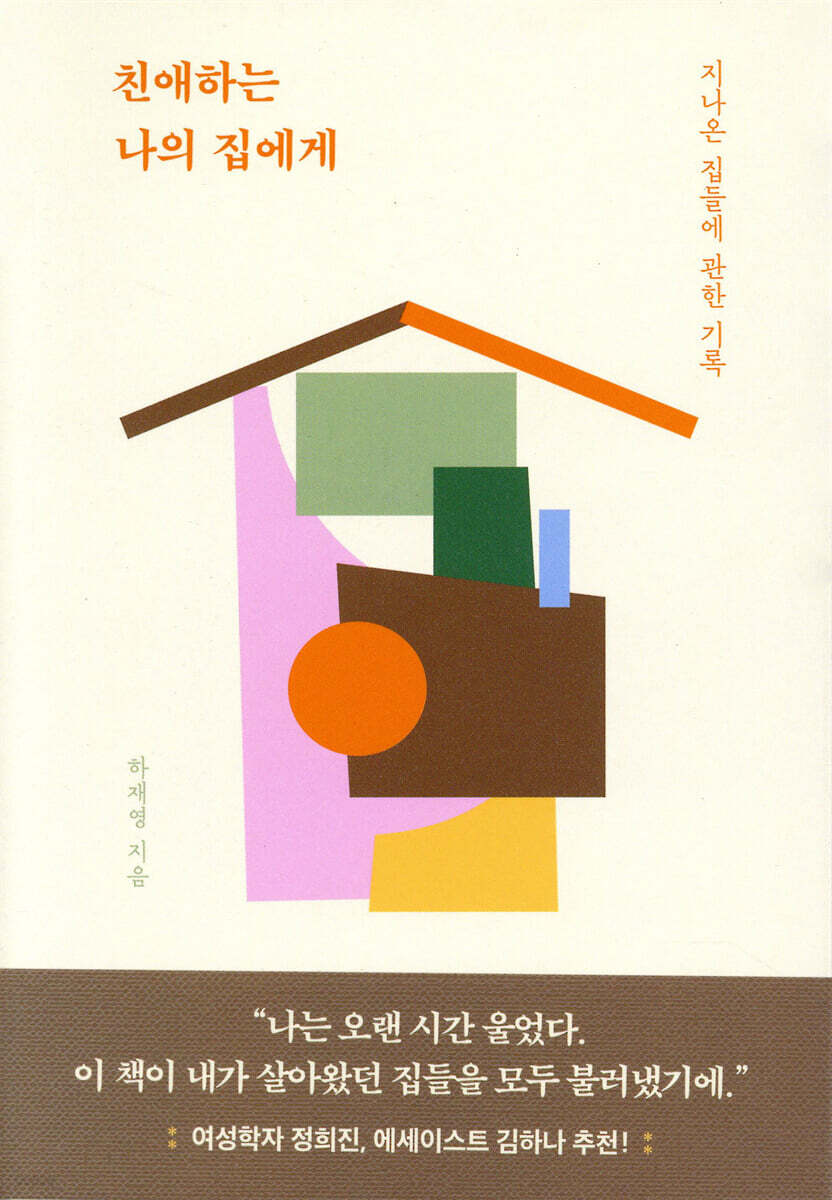
To my dear home
 |
Description
Book Introduction
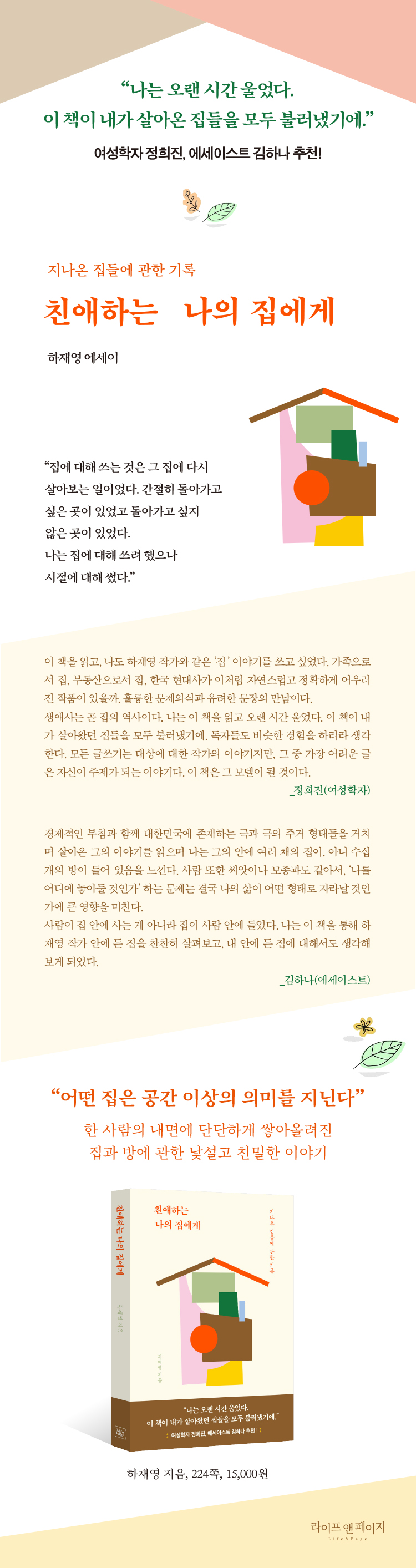
“I cried for a long time.
“Because this book brought back all the houses I’ve lived in.”
Recommended by feminist scholar Jeong Hee-jin and essayist Kim Ha-na!
Solidly built up inside a person
A strange and intimate story about home and room
A long-standing topic in Korean society: ‘home.’
Since when has our society only viewed houses as real estate and a means of financial investment?
This simplistic view makes us forget that the home is a complexly intertwined setting of social meanings and symbols, and a space of emotional memory.
It fails to account for the enormous impact that home as a place and space has on a person's life.
Author Ha Jae-young, who was praised for opening a new horizon for Korean non-fiction with his previous work, “The Death of a Dog No One Hates,” has returned with an essay about home.
In his new work, “To My Dear Home,” he uses flowing sentences to describe the influence the houses and rooms he has lived in throughout his life have had on him.
The author's childhood memories of Daegu's former colonial houses, the luxury villas in Suseong-gu, once called the "Gangnam of Daegu," and moving into increasingly smaller houses due to his father's business failure, the nine rooms in Gangbuk and the studio apartment in Sillim-dong he lived in after moving to Seoul in his 20s, the multi-family house in Geumho-dong that was passed over for redevelopment, the two-room apartment in Haengsin-dong where he achieved true independence in his 30s, his newlywed home in Jeongbalsan, and even the old villa he repaired and settled in at the foot of Bukhansan - the author's experiences of Daegu and Seoul unfold like a river, intertwined with modern Korean history.
In the process, the author flexibly explores the multi-layered and essential meaning and value of home, including family and home, women and home, self-independence and home, and class and home.
Through this book, we will finally be able to face the long-pending question, "What does home mean to me?"
“Because this book brought back all the houses I’ve lived in.”
Recommended by feminist scholar Jeong Hee-jin and essayist Kim Ha-na!
Solidly built up inside a person
A strange and intimate story about home and room
A long-standing topic in Korean society: ‘home.’
Since when has our society only viewed houses as real estate and a means of financial investment?
This simplistic view makes us forget that the home is a complexly intertwined setting of social meanings and symbols, and a space of emotional memory.
It fails to account for the enormous impact that home as a place and space has on a person's life.
Author Ha Jae-young, who was praised for opening a new horizon for Korean non-fiction with his previous work, “The Death of a Dog No One Hates,” has returned with an essay about home.
In his new work, “To My Dear Home,” he uses flowing sentences to describe the influence the houses and rooms he has lived in throughout his life have had on him.
The author's childhood memories of Daegu's former colonial houses, the luxury villas in Suseong-gu, once called the "Gangnam of Daegu," and moving into increasingly smaller houses due to his father's business failure, the nine rooms in Gangbuk and the studio apartment in Sillim-dong he lived in after moving to Seoul in his 20s, the multi-family house in Geumho-dong that was passed over for redevelopment, the two-room apartment in Haengsin-dong where he achieved true independence in his 30s, his newlywed home in Jeongbalsan, and even the old villa he repaired and settled in at the foot of Bukhansan - the author's experiences of Daegu and Seoul unfold like a river, intertwined with modern Korean history.
In the process, the author flexibly explores the multi-layered and essential meaning and value of home, including family and home, women and home, self-independence and home, and class and home.
Through this book, we will finally be able to face the long-pending question, "What does home mean to me?"
- You can preview some of the book's contents.
Preview
index
1.
Dark Heritage: What Does Home Mean to Me? (Bukseong-ro, Jung-gu, Daegu)
2.
The Prestigious Era: A Space of Class Divided by Streets and Walls (Beomeo-dong, Suseong-gu, Daegu)
3 Orchid Valley and the Rolling Skull - The World of Each Person (Sillim-dong, Gwanak-gu, Seoul)
4.
Egon Schiele and Louis Vuitton: The Unmasking of Reality (Geumho-dong, Seongdong-gu, Seoul)
5.
A home worthy of the name - the hard work (1 Haengsin-dong, Deogyang-gu, Goyang-si)
6.
Confession: A Person Who Is Okay to Be Alone (2 Haengsin-dong, Deogyang-gu, Goyang-si)
7.
The Master of the Study - My Place, My Mother's Place (Jeongbalsan-dong, Ilsandong-gu, Goyang-si)
8.
Good Daughter _ The Summer We Got to Know Each Other (1 Gugi-dong, Jongno-gu, Seoul)
9.
Walkers: What Comes After Loss (2 Gugi-dong, Jongno-gu, Seoul)
10.
My First Home - A Memories I Want to Relive (3 Gugi-dong, Jongno-gu, Seoul)
Recommended Reading: The House Inside Me / Kim Ha-na
Author's Note
Reference book
Dark Heritage: What Does Home Mean to Me? (Bukseong-ro, Jung-gu, Daegu)
2.
The Prestigious Era: A Space of Class Divided by Streets and Walls (Beomeo-dong, Suseong-gu, Daegu)
3 Orchid Valley and the Rolling Skull - The World of Each Person (Sillim-dong, Gwanak-gu, Seoul)
4.
Egon Schiele and Louis Vuitton: The Unmasking of Reality (Geumho-dong, Seongdong-gu, Seoul)
5.
A home worthy of the name - the hard work (1 Haengsin-dong, Deogyang-gu, Goyang-si)
6.
Confession: A Person Who Is Okay to Be Alone (2 Haengsin-dong, Deogyang-gu, Goyang-si)
7.
The Master of the Study - My Place, My Mother's Place (Jeongbalsan-dong, Ilsandong-gu, Goyang-si)
8.
Good Daughter _ The Summer We Got to Know Each Other (1 Gugi-dong, Jongno-gu, Seoul)
9.
Walkers: What Comes After Loss (2 Gugi-dong, Jongno-gu, Seoul)
10.
My First Home - A Memories I Want to Relive (3 Gugi-dong, Jongno-gu, Seoul)
Recommended Reading: The House Inside Me / Kim Ha-na
Author's Note
Reference book
Detailed image
Into the book
“When we started living in Bukseong-ro, my mother was only thirty years old.
What does it mean to live alone with a different surname in a household where family members share the same surname? While Western traditions dictate that married women take their husband's surname, Korean traditions dictate that married women retain their original surname.
However, this is not because Korean society regards women as independent beings, but because it leaves women of non-Korean descent as permanent outsiders within the family.”
--- p.25 From “Dark Heritage_What is home to me?”
“Measuring poverty requires a comparison point, either one’s own past or someone else’s present.
The day I visited my friend's house, who lives alone in a 30-pyeong apartment in Mapo, I was poor.
“The day I saw the small room in Nangok, just a few stops away from my studio apartment, I wasn’t poor.”
--- p.59 From “The Valley of Orchids and the Rolling Skeleton_The World of Each Person’s Own Life”
“It was the first time I had ever said something like that to a man.
I always waited for the person I liked to like me back.
If the other person didn't like me, I waited for someone else to come along.
The reason why I, who used to be passive in relationships, was able to confess to Beomjun first was because, unlike before when I was dependent on men, I was now someone who was okay with being alone.
“It was okay to be alone, so it was okay to be rejected.”
--- p.115 From “Confession_A person who is okay being alone”
“Having your own space means securing your own time.
Conversely, not having your own space means that your personal time can be interrupted at any time.
Mom's reading, thinking, and resting were often interrupted.
“When my grandmother tells me to do chores, when my dad says he’s hungry, or when my brother and I ask for something trivial.”
--- p.132 From “The Master of the Study_My Place, My Mother’s Place”
“Many, if not all, of my desires stem from where I lived.
“Like the desire to write, the rejection of fixed gender roles, the attachment to having one’s own room and place.”
--- p.181 From "The Walkers_What Comes After Loss"
“Writing about a house was like living in it again.
There were places I desperately wanted to return to, and places I never wanted to return to.
To be precise, it is not the space but the time that one wants to return to or does not want to return to.
A time that has been given the qualification of a story because it has become the past.
“I tried to write about home, but I ended up writing about the times.”
What does it mean to live alone with a different surname in a household where family members share the same surname? While Western traditions dictate that married women take their husband's surname, Korean traditions dictate that married women retain their original surname.
However, this is not because Korean society regards women as independent beings, but because it leaves women of non-Korean descent as permanent outsiders within the family.”
--- p.25 From “Dark Heritage_What is home to me?”
“Measuring poverty requires a comparison point, either one’s own past or someone else’s present.
The day I visited my friend's house, who lives alone in a 30-pyeong apartment in Mapo, I was poor.
“The day I saw the small room in Nangok, just a few stops away from my studio apartment, I wasn’t poor.”
--- p.59 From “The Valley of Orchids and the Rolling Skeleton_The World of Each Person’s Own Life”
“It was the first time I had ever said something like that to a man.
I always waited for the person I liked to like me back.
If the other person didn't like me, I waited for someone else to come along.
The reason why I, who used to be passive in relationships, was able to confess to Beomjun first was because, unlike before when I was dependent on men, I was now someone who was okay with being alone.
“It was okay to be alone, so it was okay to be rejected.”
--- p.115 From “Confession_A person who is okay being alone”
“Having your own space means securing your own time.
Conversely, not having your own space means that your personal time can be interrupted at any time.
Mom's reading, thinking, and resting were often interrupted.
“When my grandmother tells me to do chores, when my dad says he’s hungry, or when my brother and I ask for something trivial.”
--- p.132 From “The Master of the Study_My Place, My Mother’s Place”
“Many, if not all, of my desires stem from where I lived.
“Like the desire to write, the rejection of fixed gender roles, the attachment to having one’s own room and place.”
--- p.181 From "The Walkers_What Comes After Loss"
“Writing about a house was like living in it again.
There were places I desperately wanted to return to, and places I never wanted to return to.
To be precise, it is not the space but the time that one wants to return to or does not want to return to.
A time that has been given the qualification of a story because it has become the past.
“I tried to write about home, but I ended up writing about the times.”
--- p.198 From “The First Home_Memories I Want to Recreate”
Publisher's Review
Questions for this runaway era
“What is home to me?”
In this chaotic pandemic era, the meaning of home has become even more special.
Even so, the desire for real estate called a home and the behavior that fuels that desire are causing frustration and anxiety for countless people.
"Dear Home" is special in that it makes us realize the essential value of home in such a chaotic time.
This is the autobiographical story of a woman who experienced the extremes of housing in South Korea along with economic ups and downs, but it has the powerful power to make readers reflect on their own homes and personal histories.
Some people will feel nostalgic after reading this book, while others will encounter the reality of today.
The power of this book to take readers on a journey into their own past and present lies in the author's honest confessions and the excellent writing skills that support them.
He delicately weaves a narrative of memories surrounding his home in a language that suits his inner self.
The author, who debuted with short stories and published two novels, writes about how he decided to live as a “writing laborer” by “writing to make a living” in order to maintain his home, and his calmly written memories of trying to hide his shabby reality are enough to evoke human sympathy.
“Choosing a place is choosing the background of your life.”
The author confesses that the dozens of rooms he has lived in have shaped his identity and desires.
This would be no different for anyone.
“Inside each person is a house in which he has lived.” After reading this book, readers will ponder what kind of house is inside them.
Within the ‘physical place’ called home
A literary attempt to assess the 'symbolic position' of women!
His writing is also a story of a woman's growth as seen through her home.
The author's journey to find 'a room of one's own' and 'one's own place' is another important axis of this book.
It starts from the life that women, represented by the mothers' generation, had to endure.
The author painfully realizes that his mother, who took care of the household alone for a large family including his grandfather, grandmother, and three uncles during his childhood, not only did she not have her own space and time at home, but she was not even called by her own name, other than daughter-in-law, wife, and mother.
“It breaks my heart to think back to one day when I was living in the house on Bukseong-ro, when I went around looking for my mother in the living room and kitchen and felt that she was not ‘where she was supposed to be’ and ‘doing what she was supposed to do.’
“I never thought that my mother’s place, my mother’s work, could be somewhere else, something else.”_Page 142
That realization leads to reflection on 'a room of one's own'.
For him, ‘a room of one’s own’ is not simply a desire for physical space, but rather “a desire to be recognized as oneself.”
It seems that the long-standing attachment to ‘my own place’ has finally found its answer by not simply setting up a study but becoming a person who “tells my narrative with my own voice” in that space.
And his appearance inspires many who do not yet have their own place.
As essayist Kim Ha-na wrote in the introduction, “each person has a home within them that they have lived in,” and “when they express it in their own voice, it can be transferred to the lives of others.”
“What is home to me?”
In this chaotic pandemic era, the meaning of home has become even more special.
Even so, the desire for real estate called a home and the behavior that fuels that desire are causing frustration and anxiety for countless people.
"Dear Home" is special in that it makes us realize the essential value of home in such a chaotic time.
This is the autobiographical story of a woman who experienced the extremes of housing in South Korea along with economic ups and downs, but it has the powerful power to make readers reflect on their own homes and personal histories.
Some people will feel nostalgic after reading this book, while others will encounter the reality of today.
The power of this book to take readers on a journey into their own past and present lies in the author's honest confessions and the excellent writing skills that support them.
He delicately weaves a narrative of memories surrounding his home in a language that suits his inner self.
The author, who debuted with short stories and published two novels, writes about how he decided to live as a “writing laborer” by “writing to make a living” in order to maintain his home, and his calmly written memories of trying to hide his shabby reality are enough to evoke human sympathy.
“Choosing a place is choosing the background of your life.”
The author confesses that the dozens of rooms he has lived in have shaped his identity and desires.
This would be no different for anyone.
“Inside each person is a house in which he has lived.” After reading this book, readers will ponder what kind of house is inside them.
Within the ‘physical place’ called home
A literary attempt to assess the 'symbolic position' of women!
His writing is also a story of a woman's growth as seen through her home.
The author's journey to find 'a room of one's own' and 'one's own place' is another important axis of this book.
It starts from the life that women, represented by the mothers' generation, had to endure.
The author painfully realizes that his mother, who took care of the household alone for a large family including his grandfather, grandmother, and three uncles during his childhood, not only did she not have her own space and time at home, but she was not even called by her own name, other than daughter-in-law, wife, and mother.
“It breaks my heart to think back to one day when I was living in the house on Bukseong-ro, when I went around looking for my mother in the living room and kitchen and felt that she was not ‘where she was supposed to be’ and ‘doing what she was supposed to do.’
“I never thought that my mother’s place, my mother’s work, could be somewhere else, something else.”_Page 142
That realization leads to reflection on 'a room of one's own'.
For him, ‘a room of one’s own’ is not simply a desire for physical space, but rather “a desire to be recognized as oneself.”
It seems that the long-standing attachment to ‘my own place’ has finally found its answer by not simply setting up a study but becoming a person who “tells my narrative with my own voice” in that space.
And his appearance inspires many who do not yet have their own place.
As essayist Kim Ha-na wrote in the introduction, “each person has a home within them that they have lived in,” and “when they express it in their own voice, it can be transferred to the lives of others.”
GOODS SPECIFICS
- Publication date: December 8, 2020
- Page count, weight, size: 224 pages | 280g | 135*195*14mm
- ISBN13: 9791197024160
- ISBN10: 1197024166
You may also like
카테고리
korean


korean

![GQ KOREA Mark (Monthly): December [2025]](http://librairie.coreenne.fr/cdn/shop/files/8ef265dbbfbf186523ed75ba7319009d.jpg?v=1765340328&width=3840)


