

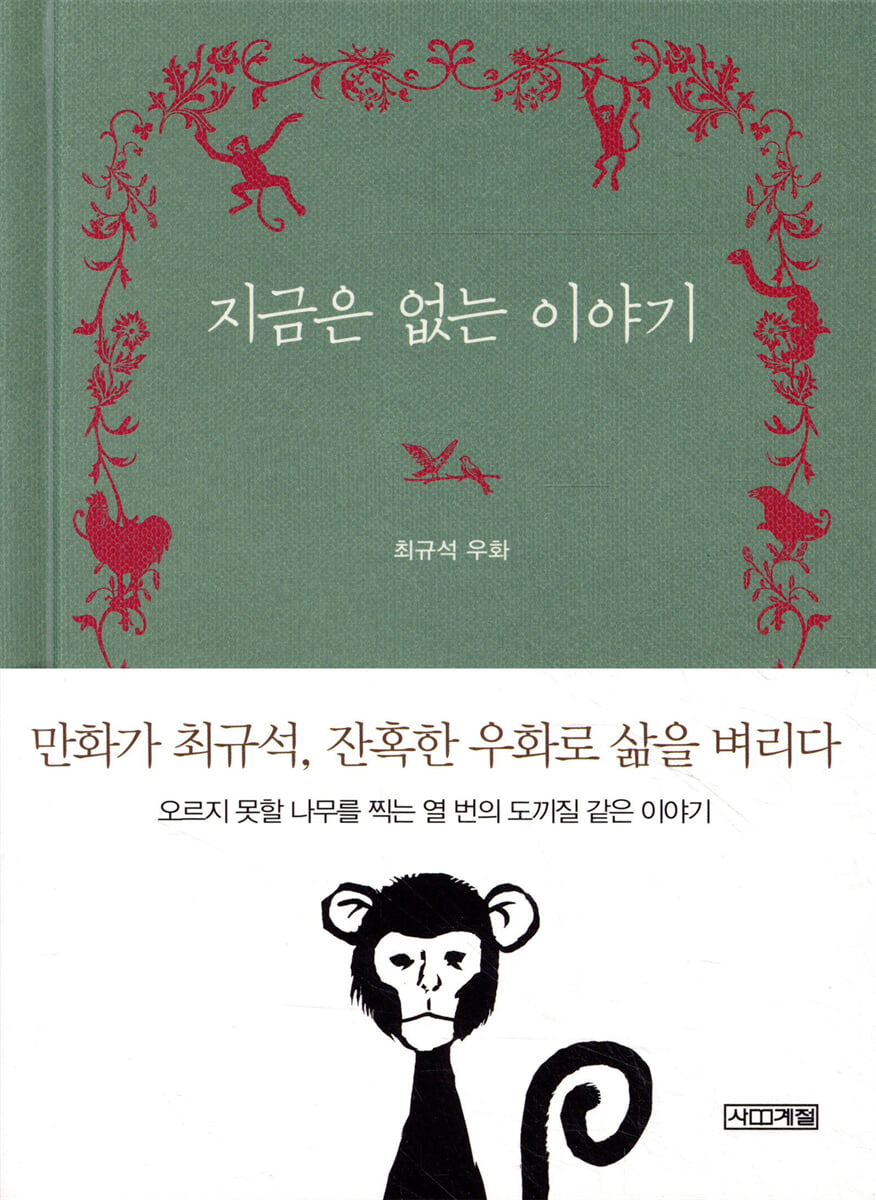
A story that doesn't exist now
 |
Description
Book Introduction
New fables created by cartoonist Choi Gyu-seok in his own unique way.
When we think of fables, we usually think of stories created thousands or hundreds of years ago, such as Aesop's Fables or La Fontaine's Fables. But such fables consistently blame everything, good or bad, on the individual. Modern fables also teach that the world and others are not at fault, and that survival depends solely on how well you conduct yourself. Cartoonist Choi Gyu-seok decided to tell the true stories of the countless realities that exist within us today, even though no one is talking about them, and began drawing this work. In "The Story That Doesn't Exist Now," the unfair reality of a person who has to lose every time because of an injury in a village where everything is decided by rock-paper-scissors ("Rock-Paper-Scissors") makes us think about how the "law" is applied to the weak in our society, and the process of the order of the forest, which naturally circulates on its own, being destroyed ("Forest") satirizes the social system that forces us to participate in competition even if we don't want to. In addition, it uses various allegories to explain the absurd and irrational social reality. As fables personify plants, animals, or other objects and convey satire and lessons through their actions, various characters appear in Choi Gyu-seok's fables. The messages of the short fables he writes through implication and metaphor are different from those of existing fables. It reminds us of the social problems we face, such as the Hanjin Heavy Industries and Construction crisis and the issue of irregular workers, and also presents a new framework for how to view and solve such social problems. It also criticizes the uncomfortable desire of individuals to be superior and to not be able to unite with the weak. "The Story That Doesn't Exist Now," a story we desperately need now that overturns all existing fables, will offer a variety of perspectives that allow us to look at our current reality in a new way. ▷Go to the "No Longer Story" video |
- You can preview some of the book's contents.
Preview
Publisher's Review
A story like ten blows of an axe that cuts down a tree that cannot be climbed
A world filled with stories telling us to stop complaining and just survive on our own.
It challenges the existing framework that places all responsibility on individuals as if it were natural.
Cartoonist Choi Gyu-seok presents a new and diverse framework for viewing the world through his own fables.
“I hope that even a few of these stories will survive and, like many other fables, float around the world as anonymous tales, appropriately used in appropriate situations, like ten blows of an axe that cuts down a tree that cannot be climbed.” From the Author’s Note
Cartoonist Choi Gyu-seok Becomes a Master of Fables
Cartoonist Choi Gyu-seok published a collection of fables.
When we think of fables, we usually think of stories that were created thousands or hundreds of years ago, such as Aesop's Fables or La Fontaine's Fables.
But such fables consistently blame everything, good or bad, on the individual.
Even the modern-day fables that have been pouring out recently teach that the world and other people are not at fault, and that you can only survive by handling yourself well.
If cheese suddenly disappears, don't worry about why it disappeared or who took it, but quickly go find another cheese. If life doesn't go well no matter how much you overcome hardships with laughter and positivity, it's because your positivity wasn't enough.
Books that comfort young people also advise them to adapt to the current social system, not fall behind in competition, and survive to the end, rather than reminding them of the absurdity of the reality they face.
Choi Gyu-seok complains that such stories only provide people with one perspective on their situation or situation.
So, I decided to tell the true stories of the countless realities that exist within us right now, even though no one is talking about them.
It is about putting the brakes on the frame that makes people perceive everything as the fault of individuals while overlooking the problems of social structure or system.
Through “Stories That No Longer Exist,” he presents new fables created in his own way.
A story we desperately need right now
The poor and unfortunate boy lived his whole life working hard, 'enduring and forgiving' everything that tormented him as the angel instructed, but in the end, he died alone, poor and unhappy. ("The Unhappy Boy") It was of no use realizing with his last breath that he had been deceived his entire life.
The angel's words whispered to the boy whenever he felt anger and despair, "You must be patient and forgive first.
Then someday those kids will also repent of their mistakes.” “Cheer up.
Each of those people has their own suffering.
They are all poor people.
“But you still have me,” is a cheap and hollow consolation that still abounds in our society.
Because of such social norms, unequal living conditions are still reduced to individual problems.
In a town where everything is decided by rock-paper-scissors, the unfair reality of a person who injures his hand and is forced to lose every time ("Rock-Paper-Scissors") makes us think about how the so-called "law" is applied to the weak today, and the process of destroying the order of the forest, which naturally circulates on its own ("Forest") satirizes a social system that forces people to participate in competition regardless of their desire.
In addition, it uses various allegories to explain the absurd and irrational social reality.
As fables personify plants, animals, or other objects and convey satire and lessons through their actions, various characters appear in Choi Gyu-seok's fables.
The titles themselves are quite allegorical, such as “The Giant,” “The Monster,” “The Wolf and the Goat,” “The Crow,” and “The Frog in the Pot.”
However, the message he conveys through implication and metaphor is different from that of existing fables.
The monsters that started living among humans at some point started imitating humans and trying to befriend them, which made people angry.
People try their best to show how inferior monsters are and how superior they are, but the monsters always imitate humans in their own way. ("Monster") What method did people ultimately choose to avoid being treated the same as monsters?
This fable can be read as a satire on the self-consciousness of the so-called "intellectuals," or it can also be read as an attitude taken by the haves and the wealthy nation towards the have-nots and the poor nation.
Also, various interpretations are possible depending on the reader's situation.
There are many works that sharply show the structural contradictions of our society, such as "Two Monkeys," which deals with what happens when the owner of two monkeys who worked equally under the same conditions unequally gives them different amounts of food.
These fables remind us of the social problems we face, such as the Hanjin Heavy Industries and Construction crisis and the issue of irregular workers, and they also suggest a new framework for how to view and solve such problems.
It also criticizes the uncomfortable desire of individuals to be superior and to not be able to unite with each other, even among the weak.
Let's watch "The Farm Workers".
The workers on the farm receive wages ranging from ten to fifty nyang, depending on the work they do and their skills.
And the foreman who manages all the workers receives a wage of a thousand nyang.
Farm work is rough, so all the workers wear sturdy boots that cost five nyang each.
Except for the workers who received ten nyang, which was barely enough to make a living.
As the farm harvest improves, the farm owner decides to raise the wages of the workers who receive ten nyang from twelve nyang.
Then the workers who received fifteen nyangs a day complained.
Why? It's because of the boots.
The workers who received fifteen nyang were proud of wearing the same boots as all the other workers who earned more than them, even though their clothes were shabby.
But when the workers who received ten nyang receive twelve nyang and buy those boots, their sense of superiority disappears.
If you try to raise the wages of those who receive fifteen nyang in this way, the other workers will complain.
In the end, workers who found a way to make themselves happy and not make others feel dissatisfied say this.
“Then it would be better to just give it to the foreman.
“That person has so much money that it wouldn’t even be noticeable if he received a few more nyang anyway, so who would be dissatisfied?” (p. 77)
"The Wolf and the Goat" clearly shows how the solidarity of members of an organization or society can break down.
"The Story That Doesn't Exist Now," a story we desperately need now that overturns all existing fables, presents various perspectives that allow us to look at the reality we face in a new way.
A true fable of our time
The fable "A Story That Doesn't Exist Now" by author Choi Gyu-seok, who attempts new experiments every time he publishes a work, is the second volume of the "1318 Cartoonist Series" that was newly released last year by Sageseoul Publishing.
The first volume, "A Little Ambiguous to Cry About," is also a work by Choi Gyu-seok. It depicts the depressing reality of Korean youth through his signature self-deprecating humor and hypocritical sarcasm, set in an art academy's college entrance exam class.
This book won the grand prize at the 2010 Bucheon International Comics Awards for its fun and artistic quality, and the grand prize in the children's and youth category at the 51st Korea Publishing Culture Awards.
Some of the fables included in 『Stories That Don't Exist Now』 were redrawn and re-illustrated from the series "Stories as Small as a Booger" in the children's humanities magazine 『The Whale Said That』.
Here we have added new fables in comic form and short stories made up entirely of text.
Choi Gyu-seok sharply delves into the issues of our time through humor and emotion, and while satirizing our society, he also maintains a strong faith in people and the world.
"The Story That Doesn't Exist Now," a work that shines with the literary achievements of cartoonist Choi Gyu-seok and features colorful, well-crafted illustrations, is a true fable of our times that, when read slowly and repeatedly, prompts reflection on the reality in which we stand.
A world filled with stories telling us to stop complaining and just survive on our own.
It challenges the existing framework that places all responsibility on individuals as if it were natural.
Cartoonist Choi Gyu-seok presents a new and diverse framework for viewing the world through his own fables.
“I hope that even a few of these stories will survive and, like many other fables, float around the world as anonymous tales, appropriately used in appropriate situations, like ten blows of an axe that cuts down a tree that cannot be climbed.” From the Author’s Note
Cartoonist Choi Gyu-seok Becomes a Master of Fables
Cartoonist Choi Gyu-seok published a collection of fables.
When we think of fables, we usually think of stories that were created thousands or hundreds of years ago, such as Aesop's Fables or La Fontaine's Fables.
But such fables consistently blame everything, good or bad, on the individual.
Even the modern-day fables that have been pouring out recently teach that the world and other people are not at fault, and that you can only survive by handling yourself well.
If cheese suddenly disappears, don't worry about why it disappeared or who took it, but quickly go find another cheese. If life doesn't go well no matter how much you overcome hardships with laughter and positivity, it's because your positivity wasn't enough.
Books that comfort young people also advise them to adapt to the current social system, not fall behind in competition, and survive to the end, rather than reminding them of the absurdity of the reality they face.
Choi Gyu-seok complains that such stories only provide people with one perspective on their situation or situation.
So, I decided to tell the true stories of the countless realities that exist within us right now, even though no one is talking about them.
It is about putting the brakes on the frame that makes people perceive everything as the fault of individuals while overlooking the problems of social structure or system.
Through “Stories That No Longer Exist,” he presents new fables created in his own way.
A story we desperately need right now
The poor and unfortunate boy lived his whole life working hard, 'enduring and forgiving' everything that tormented him as the angel instructed, but in the end, he died alone, poor and unhappy. ("The Unhappy Boy") It was of no use realizing with his last breath that he had been deceived his entire life.
The angel's words whispered to the boy whenever he felt anger and despair, "You must be patient and forgive first.
Then someday those kids will also repent of their mistakes.” “Cheer up.
Each of those people has their own suffering.
They are all poor people.
“But you still have me,” is a cheap and hollow consolation that still abounds in our society.
Because of such social norms, unequal living conditions are still reduced to individual problems.
In a town where everything is decided by rock-paper-scissors, the unfair reality of a person who injures his hand and is forced to lose every time ("Rock-Paper-Scissors") makes us think about how the so-called "law" is applied to the weak today, and the process of destroying the order of the forest, which naturally circulates on its own ("Forest") satirizes a social system that forces people to participate in competition regardless of their desire.
In addition, it uses various allegories to explain the absurd and irrational social reality.
As fables personify plants, animals, or other objects and convey satire and lessons through their actions, various characters appear in Choi Gyu-seok's fables.
The titles themselves are quite allegorical, such as “The Giant,” “The Monster,” “The Wolf and the Goat,” “The Crow,” and “The Frog in the Pot.”
However, the message he conveys through implication and metaphor is different from that of existing fables.
The monsters that started living among humans at some point started imitating humans and trying to befriend them, which made people angry.
People try their best to show how inferior monsters are and how superior they are, but the monsters always imitate humans in their own way. ("Monster") What method did people ultimately choose to avoid being treated the same as monsters?
This fable can be read as a satire on the self-consciousness of the so-called "intellectuals," or it can also be read as an attitude taken by the haves and the wealthy nation towards the have-nots and the poor nation.
Also, various interpretations are possible depending on the reader's situation.
There are many works that sharply show the structural contradictions of our society, such as "Two Monkeys," which deals with what happens when the owner of two monkeys who worked equally under the same conditions unequally gives them different amounts of food.
These fables remind us of the social problems we face, such as the Hanjin Heavy Industries and Construction crisis and the issue of irregular workers, and they also suggest a new framework for how to view and solve such problems.
It also criticizes the uncomfortable desire of individuals to be superior and to not be able to unite with each other, even among the weak.
Let's watch "The Farm Workers".
The workers on the farm receive wages ranging from ten to fifty nyang, depending on the work they do and their skills.
And the foreman who manages all the workers receives a wage of a thousand nyang.
Farm work is rough, so all the workers wear sturdy boots that cost five nyang each.
Except for the workers who received ten nyang, which was barely enough to make a living.
As the farm harvest improves, the farm owner decides to raise the wages of the workers who receive ten nyang from twelve nyang.
Then the workers who received fifteen nyangs a day complained.
Why? It's because of the boots.
The workers who received fifteen nyang were proud of wearing the same boots as all the other workers who earned more than them, even though their clothes were shabby.
But when the workers who received ten nyang receive twelve nyang and buy those boots, their sense of superiority disappears.
If you try to raise the wages of those who receive fifteen nyang in this way, the other workers will complain.
In the end, workers who found a way to make themselves happy and not make others feel dissatisfied say this.
“Then it would be better to just give it to the foreman.
“That person has so much money that it wouldn’t even be noticeable if he received a few more nyang anyway, so who would be dissatisfied?” (p. 77)
"The Wolf and the Goat" clearly shows how the solidarity of members of an organization or society can break down.
"The Story That Doesn't Exist Now," a story we desperately need now that overturns all existing fables, presents various perspectives that allow us to look at the reality we face in a new way.
A true fable of our time
The fable "A Story That Doesn't Exist Now" by author Choi Gyu-seok, who attempts new experiments every time he publishes a work, is the second volume of the "1318 Cartoonist Series" that was newly released last year by Sageseoul Publishing.
The first volume, "A Little Ambiguous to Cry About," is also a work by Choi Gyu-seok. It depicts the depressing reality of Korean youth through his signature self-deprecating humor and hypocritical sarcasm, set in an art academy's college entrance exam class.
This book won the grand prize at the 2010 Bucheon International Comics Awards for its fun and artistic quality, and the grand prize in the children's and youth category at the 51st Korea Publishing Culture Awards.
Some of the fables included in 『Stories That Don't Exist Now』 were redrawn and re-illustrated from the series "Stories as Small as a Booger" in the children's humanities magazine 『The Whale Said That』.
Here we have added new fables in comic form and short stories made up entirely of text.
Choi Gyu-seok sharply delves into the issues of our time through humor and emotion, and while satirizing our society, he also maintains a strong faith in people and the world.
"The Story That Doesn't Exist Now," a work that shines with the literary achievements of cartoonist Choi Gyu-seok and features colorful, well-crafted illustrations, is a true fable of our times that, when read slowly and repeatedly, prompts reflection on the reality in which we stand.
GOODS SPECIFICS
- Publication date: November 25, 2011
- Format: Hardcover book binding method guide
- Page count, weight, size: 200 pages | 334g | 130*178*20mm
- ISBN13: 9788958285861
- ISBN10: 8958285869
You may also like
카테고리
korean


korean

![GQ KOREA Mark (Monthly): December [2025]](http://librairie.coreenne.fr/cdn/shop/files/8ef265dbbfbf186523ed75ba7319009d.jpg?v=1765340328&width=3840)


