

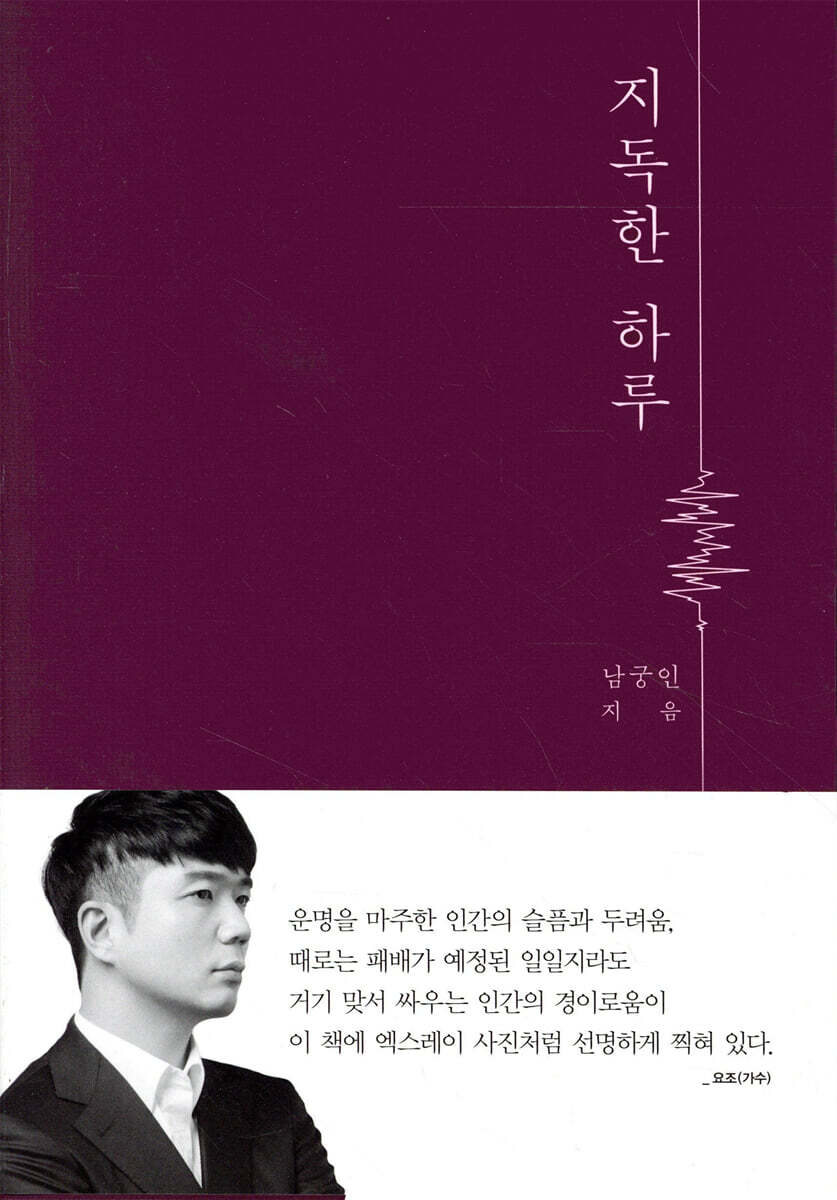
A terrible day
 |
Description
Book Introduction
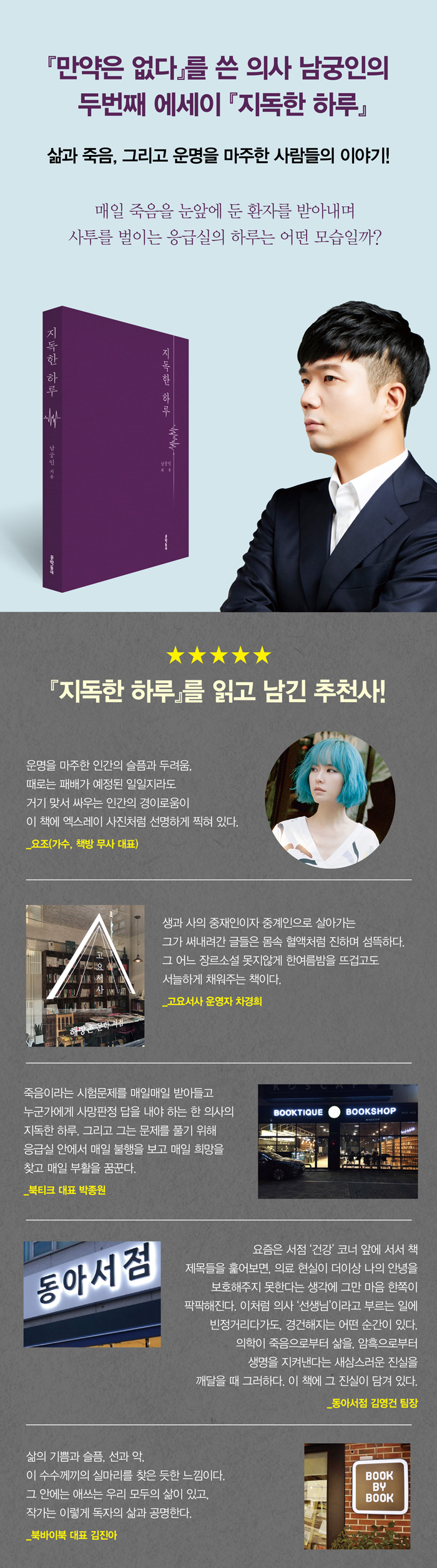
The second book by Namgung In, the author of “There is No If”!
Where life and death intersect like a lie
Another human heart that holds onto human life
“The sadness and fear of humans facing their fate, and the wonder of humans fighting against what is sometimes a destined defeat, are captured in this book as clearly as an X-ray.” _Yojo (singer)
His day is miserable.
The daily fear of death is excruciating, the urgent task of bringing a patient who is on the brink of death back to life is excruciating, and the inevitable task of having to say goodbye again and again to a patient who has left this world is excruciating.
"A Terrible Day" is the second collection of essays by Namgung In, an emergency room doctor who struggles every day to treat patients facing death.
It contains the pain and anxieties felt as a human being in a desperate situation where life and death are at stake, and reflections on human life and society through the 'predestined reality' of death.
Death is a fate that all humans must accept at some point, but for him, an emergency medicine doctor, that fate strikes in an even more urgent way.
This is because the emergency room is the final destination for those who have encountered various incidents, accidents, or sudden tragedies in the deep night when the city is asleep.
As a doctor, Namgung In must face this fate with his patients every day.
Some people dramatically regained their lives, while others, despite all the efforts of medical staff, ultimately had to face the end of their lives.
Where life and death intersect like a lie
Another human heart that holds onto human life
“The sadness and fear of humans facing their fate, and the wonder of humans fighting against what is sometimes a destined defeat, are captured in this book as clearly as an X-ray.” _Yojo (singer)
His day is miserable.
The daily fear of death is excruciating, the urgent task of bringing a patient who is on the brink of death back to life is excruciating, and the inevitable task of having to say goodbye again and again to a patient who has left this world is excruciating.
"A Terrible Day" is the second collection of essays by Namgung In, an emergency room doctor who struggles every day to treat patients facing death.
It contains the pain and anxieties felt as a human being in a desperate situation where life and death are at stake, and reflections on human life and society through the 'predestined reality' of death.
Death is a fate that all humans must accept at some point, but for him, an emergency medicine doctor, that fate strikes in an even more urgent way.
This is because the emergency room is the final destination for those who have encountered various incidents, accidents, or sudden tragedies in the deep night when the city is asleep.
As a doctor, Namgung In must face this fate with his patients every day.
Some people dramatically regained their lives, while others, despite all the efforts of medical staff, ultimately had to face the end of their lives.
- You can preview some of the book's contents.
Preview
index
Prologue: The Moment of Death, Drawing the Line
A terrible day
Facing an in-flight disturbance incident
Meet the Devil
Building rapport
Diary of the first day of internship
One kidney
Seven men burned alive
The world they live in
How to Cross the Storm and Stress
Is there 119 there?
Earthquake Responders
Do you know 'plowing'?
The Work of a Bright Surgical Intern
Why was it Yangyang of all places?
Fire department doctor
Is death equal?
An eleven-year-old boy with a 'smooth brain'
A child trapped in the blazing sun
1 meter boundary
a shattered body
The Reality of Major Trauma Centers
Loneliness Diary
There is no if
Last Christmas
Epilogue: Remembering Jeong Woo-cheol
A terrible day
Facing an in-flight disturbance incident
Meet the Devil
Building rapport
Diary of the first day of internship
One kidney
Seven men burned alive
The world they live in
How to Cross the Storm and Stress
Is there 119 there?
Earthquake Responders
Do you know 'plowing'?
The Work of a Bright Surgical Intern
Why was it Yangyang of all places?
Fire department doctor
Is death equal?
An eleven-year-old boy with a 'smooth brain'
A child trapped in the blazing sun
1 meter boundary
a shattered body
The Reality of Major Trauma Centers
Loneliness Diary
There is no if
Last Christmas
Epilogue: Remembering Jeong Woo-cheol
Detailed image
Publisher's Review
A human being, a doctor, facing a patient at the crossroads of life and death.
'sorry.
'Rest in peace, please.' I finally got up.
It felt like I was going to fall into an endless sleep.
(Page 235)
In such a desperate moment, where life and death seemed like a lie, the author was a doctor who always took a deep breath and made a cool-headed decision, but of course, he was also human.
This book contains the true essence of a human being who bites his lips and endures sorrow, a human being who can only hope for a miracle in the face of tragedy.
In the image of a human being who, like any other patient, suffers and feels lonely, and constantly questions whether his decisions were right, and in the image of a human being who, despite suffering endless fatigue from going back and forth between extremes every night, stays by the patient's side with superhuman strength and his eyes shine brightly, we glimpse the beauty of all human existence that dares to resist to the end even in the face of predetermined defeat.
Meanwhile, the epilogue, 'Remembering Jeong Woo-cheol', also contains a story about a special colleague who trained at the same hospital as the author.
He was a colleague who dreamed of becoming a surgeon and cared for patients more devotedly than anyone else, but he was diagnosed with terminal cancer at the age of 32, just after completing his training.
He went from being a doctor to a patient overnight, but from that moment on, he lived the rest of his life as a doctor who understood his patients' hearts more deeply than anyone else, as another patient who encouraged them, and gave courage to many others.
I have a duty to save the life that is fading away from death, which all medical science can reveal.
It was clearly my fault for making him feel even a little more of that sharp, piercing pain from his heart, and for leaving him to his own devices, thereby increasing his chances of death.
(…) This is a painful thing that I desperately want to avoid.
For a moment, it occurred to me that all the patients were wearing masks to make me suffer.
But enduring that suffering was something I had to do my whole life.
(Page 19)
Arms, legs, kidneys, brain, intestines.
There was so much to protect, but gradually the tension eased and an obsessive fatigue poured in.
I fought against the fatigue, obsessively thinking about the fluids and decompression in my head, the cause of my still-unknown bowel distension.
I held on by adjusting the pressure, changing the fluid, pressing on the stomach, and changing the breathing settings in real time, which didn't make much difference.
But the condition did not improve at all.
I just felt like a person who was yearning and waiting for a miracle.
(Page 231)
We often see in TV dramas cases where people cannot accept the death of their mother or father.
They cry out, “Why did a perfectly healthy person die?” “Wasn’t there something wrong with this?” and, unable to accept the shocking truth, they cry out as if they were going to grab the doctor by the collar.
But in reality, this is rarely the case.
Most guardians swallow their tears and give up as soon as they hear the death sentence.
It is not so much a matter of trust in hospitals or doctors, but rather a matter of everyone's understanding that human life can end at any time and that life is ultimately finite.
This should be called trust in death.
It is.
(pages 232, 233)
Is death equal? In this absurd world.
He also asks what kind of society and world it should be in which such weak and mortal humans live together.
In his eyes, as he struggles to save his life, this world is still unreasonable.
One of the people he sees most frequently in the emergency room is the 119 rescue workers.
However, those who rescue people from fires and transport emergency patients are still treated unfairly, even though their role is directly related to public safety.
Because firefighters are local government officials rather than special civil servants, there are many aspects of the fire organization that are outside of comprehensive national management ("The World They Live In").
And that's not all.
In Korea, there is still a severe shortage of trauma centers capable of receiving critically ill patients, so many people who have been injured in traffic accidents still die without being able to receive proper treatment ("The Reality of Severe Trauma Centers").
Cases of child abuse encountered in hospitals ("Meet the Devil") and the story of a pitiful child suffering from a rare disease ("The Eleven-Year-Old with a 'Smooth Brain'") were also captured in his warm interest in the world.
I was a little surprised when he said the word law.
I don't think the law can solve this problem.
But despite the wrongdoings of adults and the absurdity of society, life somehow survives.
Even if you trample the roots with your hooves, the tenacious life will eventually sprout again.
It seemed as though this young life would eventually recover with its body still clearly scarred.
(Pages 62, 63)
The daily lives of ordinary interns, extremely human and witty.
Meanwhile, in addition to such heavy topics, this book also contains many humane anecdotes about the experiences of a freshman medical student who goes through internships, residency, and eventually becomes a full-fledged specialist.
They go through surgical internships and become 'belly scrubbers' who quickly disinfect patients' belly buttons before surgery, and they also acquire the mobility to run to the call at any time, even though they suffer from chronic sleep deprivation.
After those times, he also became a doctor.
The emergency room environment is still poor.
There was even an incident where I was slapped in the face for no reason by a drunken thug who came to the emergency room.
But he couldn't resist because he had to protect the patient and hope that the sterilized wound would remain intact.
No matter how many days await him when extreme fatigue comes crashing down on him like an obsession, his dream remains the same.
Just like the medical school professor I saw briefly in the elevator once, I will become a doctor who knows how to understand the hearts and minds of patients who are in pain and lonely before their bodies, always gently touching their foreheads.
Recommendation
I did something else a few times while reading.
I was boiling towels that had become very dirty recently, and whenever the foam was about to overflow, I opened the pot lid once. That's what I did.
I was so sad that I felt like I was going to overflow, so I stopped reading and opened my mailbox out of the blue. It was about to overflow again, so I stopped reading and went to drink a glass of water.
Just reading it left me feeling as if I had been running around in the emergency room all night, so I had to lie down and rest for a while after finishing the last chapter.
I dare to imagine what it would be like to live a day where life and death are at stake, saving someone and failing to save someone else.
Did he write these words because he felt like something was overflowing?
I wonder if I would write whenever I felt like I couldn't bear it anymore.
His writing allows us to honestly look for the first time at the sadness and wonder of life, something we had previously ignored because we lacked the courage or reason to look into it in our indifferent daily lives.
The sadness and fear of humans facing their fate, and the wonder of humans fighting against what is sometimes a destined defeat, are captured in this book as clearly as an X-ray photograph.
_ Yojo (singer)
'sorry.
'Rest in peace, please.' I finally got up.
It felt like I was going to fall into an endless sleep.
(Page 235)
In such a desperate moment, where life and death seemed like a lie, the author was a doctor who always took a deep breath and made a cool-headed decision, but of course, he was also human.
This book contains the true essence of a human being who bites his lips and endures sorrow, a human being who can only hope for a miracle in the face of tragedy.
In the image of a human being who, like any other patient, suffers and feels lonely, and constantly questions whether his decisions were right, and in the image of a human being who, despite suffering endless fatigue from going back and forth between extremes every night, stays by the patient's side with superhuman strength and his eyes shine brightly, we glimpse the beauty of all human existence that dares to resist to the end even in the face of predetermined defeat.
Meanwhile, the epilogue, 'Remembering Jeong Woo-cheol', also contains a story about a special colleague who trained at the same hospital as the author.
He was a colleague who dreamed of becoming a surgeon and cared for patients more devotedly than anyone else, but he was diagnosed with terminal cancer at the age of 32, just after completing his training.
He went from being a doctor to a patient overnight, but from that moment on, he lived the rest of his life as a doctor who understood his patients' hearts more deeply than anyone else, as another patient who encouraged them, and gave courage to many others.
I have a duty to save the life that is fading away from death, which all medical science can reveal.
It was clearly my fault for making him feel even a little more of that sharp, piercing pain from his heart, and for leaving him to his own devices, thereby increasing his chances of death.
(…) This is a painful thing that I desperately want to avoid.
For a moment, it occurred to me that all the patients were wearing masks to make me suffer.
But enduring that suffering was something I had to do my whole life.
(Page 19)
Arms, legs, kidneys, brain, intestines.
There was so much to protect, but gradually the tension eased and an obsessive fatigue poured in.
I fought against the fatigue, obsessively thinking about the fluids and decompression in my head, the cause of my still-unknown bowel distension.
I held on by adjusting the pressure, changing the fluid, pressing on the stomach, and changing the breathing settings in real time, which didn't make much difference.
But the condition did not improve at all.
I just felt like a person who was yearning and waiting for a miracle.
(Page 231)
We often see in TV dramas cases where people cannot accept the death of their mother or father.
They cry out, “Why did a perfectly healthy person die?” “Wasn’t there something wrong with this?” and, unable to accept the shocking truth, they cry out as if they were going to grab the doctor by the collar.
But in reality, this is rarely the case.
Most guardians swallow their tears and give up as soon as they hear the death sentence.
It is not so much a matter of trust in hospitals or doctors, but rather a matter of everyone's understanding that human life can end at any time and that life is ultimately finite.
This should be called trust in death.
It is.
(pages 232, 233)
Is death equal? In this absurd world.
He also asks what kind of society and world it should be in which such weak and mortal humans live together.
In his eyes, as he struggles to save his life, this world is still unreasonable.
One of the people he sees most frequently in the emergency room is the 119 rescue workers.
However, those who rescue people from fires and transport emergency patients are still treated unfairly, even though their role is directly related to public safety.
Because firefighters are local government officials rather than special civil servants, there are many aspects of the fire organization that are outside of comprehensive national management ("The World They Live In").
And that's not all.
In Korea, there is still a severe shortage of trauma centers capable of receiving critically ill patients, so many people who have been injured in traffic accidents still die without being able to receive proper treatment ("The Reality of Severe Trauma Centers").
Cases of child abuse encountered in hospitals ("Meet the Devil") and the story of a pitiful child suffering from a rare disease ("The Eleven-Year-Old with a 'Smooth Brain'") were also captured in his warm interest in the world.
I was a little surprised when he said the word law.
I don't think the law can solve this problem.
But despite the wrongdoings of adults and the absurdity of society, life somehow survives.
Even if you trample the roots with your hooves, the tenacious life will eventually sprout again.
It seemed as though this young life would eventually recover with its body still clearly scarred.
(Pages 62, 63)
The daily lives of ordinary interns, extremely human and witty.
Meanwhile, in addition to such heavy topics, this book also contains many humane anecdotes about the experiences of a freshman medical student who goes through internships, residency, and eventually becomes a full-fledged specialist.
They go through surgical internships and become 'belly scrubbers' who quickly disinfect patients' belly buttons before surgery, and they also acquire the mobility to run to the call at any time, even though they suffer from chronic sleep deprivation.
After those times, he also became a doctor.
The emergency room environment is still poor.
There was even an incident where I was slapped in the face for no reason by a drunken thug who came to the emergency room.
But he couldn't resist because he had to protect the patient and hope that the sterilized wound would remain intact.
No matter how many days await him when extreme fatigue comes crashing down on him like an obsession, his dream remains the same.
Just like the medical school professor I saw briefly in the elevator once, I will become a doctor who knows how to understand the hearts and minds of patients who are in pain and lonely before their bodies, always gently touching their foreheads.
Recommendation
I did something else a few times while reading.
I was boiling towels that had become very dirty recently, and whenever the foam was about to overflow, I opened the pot lid once. That's what I did.
I was so sad that I felt like I was going to overflow, so I stopped reading and opened my mailbox out of the blue. It was about to overflow again, so I stopped reading and went to drink a glass of water.
Just reading it left me feeling as if I had been running around in the emergency room all night, so I had to lie down and rest for a while after finishing the last chapter.
I dare to imagine what it would be like to live a day where life and death are at stake, saving someone and failing to save someone else.
Did he write these words because he felt like something was overflowing?
I wonder if I would write whenever I felt like I couldn't bear it anymore.
His writing allows us to honestly look for the first time at the sadness and wonder of life, something we had previously ignored because we lacked the courage or reason to look into it in our indifferent daily lives.
The sadness and fear of humans facing their fate, and the wonder of humans fighting against what is sometimes a destined defeat, are captured in this book as clearly as an X-ray photograph.
_ Yojo (singer)
GOODS SPECIFICS
- Date of publication: July 21, 2017
- Page count, weight, size: 260 pages | 366g | 145*210*20mm
- ISBN13: 9788954646284
- ISBN10: 895464628X
You may also like
카테고리
korean


korean

![GQ KOREA Mark (Monthly): December [2025]](http://librairie.coreenne.fr/cdn/shop/files/8ef265dbbfbf186523ed75ba7319009d.jpg?v=1765340328&width=3840)


