

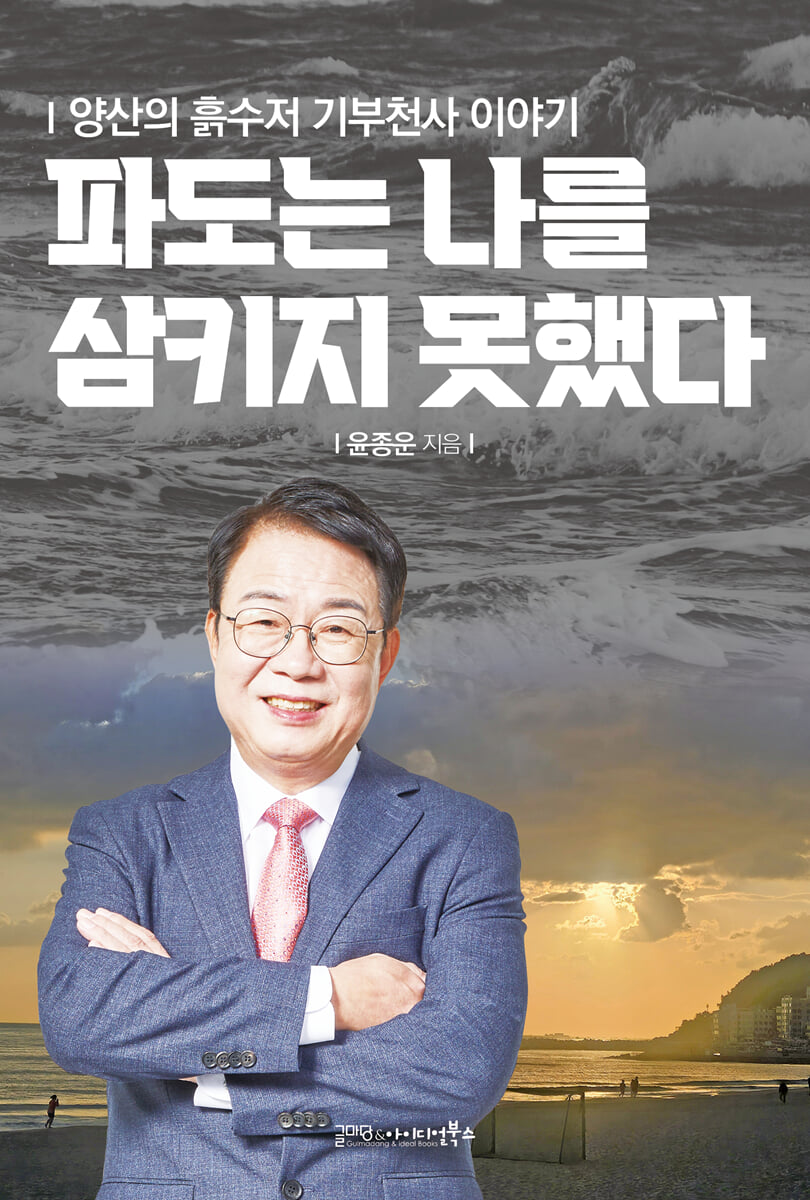
The waves couldn't swallow me
 |
Description
Book Introduction
Shining shoes, delivering coal briquettes and newspapers, doing odd jobs, and going to night school.
And it is a moving story of human victory and struggle that tells the story of how he overcame his battle with tuberculosis, started his career as a banker, and never gave up, built a great business and lived a beautiful life as a philanthropic angel.
Just as his hometown, Gamcheon-dong, once the poorest neighborhood in Busan, has now been reborn as Korea's Santorini, 'Gamcheon Culture Village', and has become a center of K-tourism that attracts the attention of the world's leading media outlets.
All eyes are on Yoon Jong-woon…
It will be the big and small waves that come into life.
The waves that came into my life may have carved my form, but they could not swallow me up.
The time I spent struggling to keep my bearings in the midst of strong waves and harsh winds shaped who I am today.
This book is a record of those traces, written with heart.
It is also the story of those who supported me through difficult times.
- When publishing a book
And it is a moving story of human victory and struggle that tells the story of how he overcame his battle with tuberculosis, started his career as a banker, and never gave up, built a great business and lived a beautiful life as a philanthropic angel.
Just as his hometown, Gamcheon-dong, once the poorest neighborhood in Busan, has now been reborn as Korea's Santorini, 'Gamcheon Culture Village', and has become a center of K-tourism that attracts the attention of the world's leading media outlets.
All eyes are on Yoon Jong-woon…
It will be the big and small waves that come into life.
The waves that came into my life may have carved my form, but they could not swallow me up.
The time I spent struggling to keep my bearings in the midst of strong waves and harsh winds shaped who I am today.
This book is a record of those traces, written with heart.
It is also the story of those who supported me through difficult times.
- When publishing a book
index
When publishing a book
Part 1: Childhood / Fragments of Faded Memories
1.
A town where time has stopped
2.
How to walk on the eight characters
3.
Crooked legs, straight person
4.
Poverty came riding on gold
5.
A heart in a loaf of bread
6.
Above nine thousand meters above sea level
7.
Nothing is more satisfying than memories.
8.
A child who does not exist in this world
9.
Sisters on the Other Side of the Mirror
10.
Love of a Worm-Eaten Leaf
Part 2 Puberty/ In the Swamp of Poverty
1.
White rubber shoes and black sneakers
2.
A child waiting for spring
3.
Happiness comes from very small things
4.
The crime of poverty
5.
A place where the sun lingers
6.
shoeshine boy
7.
Wearing wet shoes
8.
The wind blew that day
9.
The blue remains
10.
The extraordinary in the ordinary
Part 3: Youth/The Middle of Life
1.
dark adaptation
2.
Miracles start from two feet
3.
Cosmos her
4.
we
5.
nevertheless
6.
“I was lucky.”
7.
Heart in an Envelope
8.
holding your little hand
9.
Life, its earnestness
10.
A life of capital
Part 4 Middle Age/ Enduring the Wind.
1.
Long distance running
2.
The reed lives with the wind
3.
Let your guard down
4.
“Mandako”
5.
wet fallen leaves
6.
The power of the headwind
7.
Again, start
8.
Greed and true intentions
9.
Put on their shoes
10.
The Heart of the Root
Part 1: Childhood / Fragments of Faded Memories
1.
A town where time has stopped
2.
How to walk on the eight characters
3.
Crooked legs, straight person
4.
Poverty came riding on gold
5.
A heart in a loaf of bread
6.
Above nine thousand meters above sea level
7.
Nothing is more satisfying than memories.
8.
A child who does not exist in this world
9.
Sisters on the Other Side of the Mirror
10.
Love of a Worm-Eaten Leaf
Part 2 Puberty/ In the Swamp of Poverty
1.
White rubber shoes and black sneakers
2.
A child waiting for spring
3.
Happiness comes from very small things
4.
The crime of poverty
5.
A place where the sun lingers
6.
shoeshine boy
7.
Wearing wet shoes
8.
The wind blew that day
9.
The blue remains
10.
The extraordinary in the ordinary
Part 3: Youth/The Middle of Life
1.
dark adaptation
2.
Miracles start from two feet
3.
Cosmos her
4.
we
5.
nevertheless
6.
“I was lucky.”
7.
Heart in an Envelope
8.
holding your little hand
9.
Life, its earnestness
10.
A life of capital
Part 4 Middle Age/ Enduring the Wind.
1.
Long distance running
2.
The reed lives with the wind
3.
Let your guard down
4.
“Mandako”
5.
wet fallen leaves
6.
The power of the headwind
7.
Again, start
8.
Greed and true intentions
9.
Put on their shoes
10.
The Heart of the Root
Into the book
Amnam-dong, Seo-gu, Busan.
'Boy's House', overlooking the sea in front of Songdo, is a child and youth daycare center well known for its soccer team and orchestra activities.
At the same time, Amnam-dong is also the place where the ‘Sisters of Mary’ were founded.
So this place is also evaluated as the birthplace of Korean welfare.
In 1957, after the war had ended, an American priest set foot on the devastated land of Korea.
Aloysius Schwartz, what he saw of Korea was horrific.
The streets were filled with orphaned children, and people were starving.
After becoming a priest in the Busan Diocese, he began to actively engage in relief work for the poor, and one of the centers of this work was Amnam-dong.
--- p.28
From then on, I went out to the village entrance and waited for my mother, whether it was hot or cold.
As the sun began to set, I stood at the end of the alley and gazed into the distance.
To be a little more honest, I wasn't waiting for my mother, I was waiting for the bread she might bring in her arms.
Later, I could tell whether there would be bread or not just by looking at my mother's gait or expression.
When a mother had something to give to her child, her expression became brighter and her steps became lighter.
--- p.31
What is the name of the highest mountain in the world?
To borrow a literary expression, the answer is 'Maekryeong'.
It is commonly called 'Barley Pass'.
The veteran poet Hwang Geum-chan recited [Barley Pass] like this:
Everest is Asia's mountain/ Mont Blanc is Europe/ Wasca is America's/ There is Kilimanjaro in Africa/ These mountains are far away/ We have not buried any bones/ But Korea's barley hill is high./ It is so high that many people cried and went there, and starved and crossed it/ How many people died and could not cross it/ Korea's barley hill/ Nine thousand meters above sea level, an insurmountable fate...
The poet described Borigogae as being nine thousand meters above sea level, higher than Mount Everest, the highest peak in the world.
The pass, where many people died while crossing, is an intangible pass that clearly existed in this land that went through Japanese colonial rule and war.
To get over that pass, which was also called the Spring Poverty Period, people survived on grass roots and tree bark, and at school, many students filled their hungry stomachs with water.
Because they filled their stomachs with indigestible roots and tree bark, they often suffered from severe constipation.
The expression 'poor enough to tear your anus' comes from the fact that during the barley harvest, people suffered from severe constipation to the point where their anus would tear and bleed.
--- p.34
When I got home, my mother was standing at the door.
When my mother saw my empty lunchbox, she stroked my head without saying anything.
That evening, I had to starve again.
Of course I didn't complain.
Rather, I was grateful.
I had such a delicious lunch, I felt shameless about wanting to eat it for dinner.
I was still in a state of joy and excitement until I fell asleep that day.
It was the first happiness in my life.
--- p.45
My older sister, who was six years older than me, and my younger sister, who was three years older than me, inherited my mother's ability to make a living as a breadwinner for the family and also took care of the household chores.
It wasn't just my family's case.
At that time, women's resilience to ensure their families' survival was incredible.
A young girl walked through the market carrying a wooden sign, and a young mother came to the market carrying a nursing baby.
The saying, 'If you go to the market, there are only women', made my nose bleed bright red one day.
Startled, I hurriedly found a wet towel and held it under my older sister's nose, sobbing.
--- p.58
A little over 20,000 won stained with the sweat and blood of my sisters.
It may seem like an absurd amount of money by today's standards, but back then it was a very precious commodity.
On the days when my older sisters received their paychecks, a sack of rice would be placed on one side of the kitchen.
Rice! Not porridge, but real rice! A sack filled with pearl-white grains.
Just looking at it gave me peace of mind.
For the time being, I was able to eat.
--- p.60
If you deliver one briquette, it costs 2 won.
I delivered a total of 100 sheets that day and earned 200 won.
At eleven, it was the first money I earned.
I held the money tightly and went to the market.
What should I buy with this money? I pondered it countless times along the way.
Since I didn't have much money, I had to choose food that was cheap and had a lot of food.
After much thought, I came up with the idea of soybean paste.
The residue left over from making tofu.
It was cheaper than tofu and the taste was amazing.
Best of all, the whole family could share it together.
I bought four packs of soybean paste for two hundred won.
Both hands were heavy.
It was a really pleasant weight.
--- p.74
One house, two houses, three houses, ten houses, twenty houses… .
I ran harder and faster to forget the cold.
As the heavy bag, which seemed to be filled with rocks, began to become lighter, my heart also began to feel lighter.
But the legs, on the contrary, became heavier and heavier.
My legs were shaking and my calves were aching from climbing up and down so many stairs.
Perhaps because the soles of the rubber shoes were thin, I could feel the unevenness of the floor as if I was standing on a pressure plate.
It was several times more difficult on rainy or snowy days.
To prevent the newspapers from getting wet, I had to wrap them individually in plastic, and the process required me to wake up at 4 a.m.
--- p.91
After finishing delivering the newspaper, I went straight to school.
It took more than an hour to walk from the supply depot to the school.
When I arrived at school, I went straight to the tap because of the thirst and hunger that came over me.
I lowered my head under the faucet and gulped down the ice-cold water on my empty stomach.
My teeth were sore.
My stomach grew cold and my body trembled.
It seemed like the fatigue was going away a little.
Every time I moved, the water inside me sloshed and danced.
--- p.92
The school did whatever it took to collect the tuition.
Even though it was a form of oppression of a human's human rights and trampled on the ego of an adolescent child, leaving an unknown trauma within him, he did not care at all.
His thighs were bruised and purple from being beaten so badly with a club, and he was slapped so hard that the blood vessels in his cheeks burst.
I was beaten mercilessly with the attendance book until my ears were ringing, and my palms were hit with a bamboo stick until they bled.
It's like that, right, right, right, and again...
--- p.108
I was shining the bank tellers' shoes and eavesdropping on their conversations.
Talk about housing prices, talk about the economy, talk about education, talk about politics… .
Their every word was like a small window into a world I didn't know about.
A pair of well-made shoes, a shiny suit, the strong scent of skin lotion, a watch gleaming on your wrist…
I started sneaking peeks at things like that and getting curious, 'How much money do these people make a month?'
At first, the curiosity was small, but it gradually began to inflate like a balloon filled with air, and soon it reached the point where it burst with a 'pop' and flew out of my mouth.
--- p.147
At 11 p.m., after class ended and I left the school gate, another long period of review began.
Every day was a repetition of the same day.
Waking up at dawn to deliver newspapers, shining shoes from 4 to 5 in the afternoon, attending school from 6:30 to 11, and reviewing until past midnight.
I sleep for hours and wake up at dawn to deliver newspapers… .
It was physically difficult for me because I couldn't eat properly every day and could only sleep for three hours.
There were times when I stumbled and my vision became dizzy.
There were countless instances of me stumbling while climbing the stairs.
But I endured all of that with only my mental strength.
It was desperate.
Studying might be my first and last chance.
That desperation led me to the newsagent, to the shoebox, to the school.
--- p.171
Six intense months passed like that.
180 days.
It was a short time if it was short and a long time if it was long.
The report cards came out a week after the first exam of the second semester.
The ranking of the entire school written in it is 5.
I was ranked 5th in the whole school.
Last semester, I took the exam and ranked 640th out of 650… .
It was a change so great that it could be called a miracle.
--- p.174
After thinking about it for a few days, I decided to go to the construction site.
The term 'luck' is often used to refer to 'something whose outcome is predetermined and cannot be changed by human power'.
But paradoxically, the Chinese character for luck means ‘to move’ or ‘to move.’
That is, luck is not something that is permanently still or fixed, but something that I can move or shift on my own.
It was a day job called 'Nogada'.
'Boy's House', overlooking the sea in front of Songdo, is a child and youth daycare center well known for its soccer team and orchestra activities.
At the same time, Amnam-dong is also the place where the ‘Sisters of Mary’ were founded.
So this place is also evaluated as the birthplace of Korean welfare.
In 1957, after the war had ended, an American priest set foot on the devastated land of Korea.
Aloysius Schwartz, what he saw of Korea was horrific.
The streets were filled with orphaned children, and people were starving.
After becoming a priest in the Busan Diocese, he began to actively engage in relief work for the poor, and one of the centers of this work was Amnam-dong.
--- p.28
From then on, I went out to the village entrance and waited for my mother, whether it was hot or cold.
As the sun began to set, I stood at the end of the alley and gazed into the distance.
To be a little more honest, I wasn't waiting for my mother, I was waiting for the bread she might bring in her arms.
Later, I could tell whether there would be bread or not just by looking at my mother's gait or expression.
When a mother had something to give to her child, her expression became brighter and her steps became lighter.
--- p.31
What is the name of the highest mountain in the world?
To borrow a literary expression, the answer is 'Maekryeong'.
It is commonly called 'Barley Pass'.
The veteran poet Hwang Geum-chan recited [Barley Pass] like this:
Everest is Asia's mountain/ Mont Blanc is Europe/ Wasca is America's/ There is Kilimanjaro in Africa/ These mountains are far away/ We have not buried any bones/ But Korea's barley hill is high./ It is so high that many people cried and went there, and starved and crossed it/ How many people died and could not cross it/ Korea's barley hill/ Nine thousand meters above sea level, an insurmountable fate...
The poet described Borigogae as being nine thousand meters above sea level, higher than Mount Everest, the highest peak in the world.
The pass, where many people died while crossing, is an intangible pass that clearly existed in this land that went through Japanese colonial rule and war.
To get over that pass, which was also called the Spring Poverty Period, people survived on grass roots and tree bark, and at school, many students filled their hungry stomachs with water.
Because they filled their stomachs with indigestible roots and tree bark, they often suffered from severe constipation.
The expression 'poor enough to tear your anus' comes from the fact that during the barley harvest, people suffered from severe constipation to the point where their anus would tear and bleed.
--- p.34
When I got home, my mother was standing at the door.
When my mother saw my empty lunchbox, she stroked my head without saying anything.
That evening, I had to starve again.
Of course I didn't complain.
Rather, I was grateful.
I had such a delicious lunch, I felt shameless about wanting to eat it for dinner.
I was still in a state of joy and excitement until I fell asleep that day.
It was the first happiness in my life.
--- p.45
My older sister, who was six years older than me, and my younger sister, who was three years older than me, inherited my mother's ability to make a living as a breadwinner for the family and also took care of the household chores.
It wasn't just my family's case.
At that time, women's resilience to ensure their families' survival was incredible.
A young girl walked through the market carrying a wooden sign, and a young mother came to the market carrying a nursing baby.
The saying, 'If you go to the market, there are only women', made my nose bleed bright red one day.
Startled, I hurriedly found a wet towel and held it under my older sister's nose, sobbing.
--- p.58
A little over 20,000 won stained with the sweat and blood of my sisters.
It may seem like an absurd amount of money by today's standards, but back then it was a very precious commodity.
On the days when my older sisters received their paychecks, a sack of rice would be placed on one side of the kitchen.
Rice! Not porridge, but real rice! A sack filled with pearl-white grains.
Just looking at it gave me peace of mind.
For the time being, I was able to eat.
--- p.60
If you deliver one briquette, it costs 2 won.
I delivered a total of 100 sheets that day and earned 200 won.
At eleven, it was the first money I earned.
I held the money tightly and went to the market.
What should I buy with this money? I pondered it countless times along the way.
Since I didn't have much money, I had to choose food that was cheap and had a lot of food.
After much thought, I came up with the idea of soybean paste.
The residue left over from making tofu.
It was cheaper than tofu and the taste was amazing.
Best of all, the whole family could share it together.
I bought four packs of soybean paste for two hundred won.
Both hands were heavy.
It was a really pleasant weight.
--- p.74
One house, two houses, three houses, ten houses, twenty houses… .
I ran harder and faster to forget the cold.
As the heavy bag, which seemed to be filled with rocks, began to become lighter, my heart also began to feel lighter.
But the legs, on the contrary, became heavier and heavier.
My legs were shaking and my calves were aching from climbing up and down so many stairs.
Perhaps because the soles of the rubber shoes were thin, I could feel the unevenness of the floor as if I was standing on a pressure plate.
It was several times more difficult on rainy or snowy days.
To prevent the newspapers from getting wet, I had to wrap them individually in plastic, and the process required me to wake up at 4 a.m.
--- p.91
After finishing delivering the newspaper, I went straight to school.
It took more than an hour to walk from the supply depot to the school.
When I arrived at school, I went straight to the tap because of the thirst and hunger that came over me.
I lowered my head under the faucet and gulped down the ice-cold water on my empty stomach.
My teeth were sore.
My stomach grew cold and my body trembled.
It seemed like the fatigue was going away a little.
Every time I moved, the water inside me sloshed and danced.
--- p.92
The school did whatever it took to collect the tuition.
Even though it was a form of oppression of a human's human rights and trampled on the ego of an adolescent child, leaving an unknown trauma within him, he did not care at all.
His thighs were bruised and purple from being beaten so badly with a club, and he was slapped so hard that the blood vessels in his cheeks burst.
I was beaten mercilessly with the attendance book until my ears were ringing, and my palms were hit with a bamboo stick until they bled.
It's like that, right, right, right, and again...
--- p.108
I was shining the bank tellers' shoes and eavesdropping on their conversations.
Talk about housing prices, talk about the economy, talk about education, talk about politics… .
Their every word was like a small window into a world I didn't know about.
A pair of well-made shoes, a shiny suit, the strong scent of skin lotion, a watch gleaming on your wrist…
I started sneaking peeks at things like that and getting curious, 'How much money do these people make a month?'
At first, the curiosity was small, but it gradually began to inflate like a balloon filled with air, and soon it reached the point where it burst with a 'pop' and flew out of my mouth.
--- p.147
At 11 p.m., after class ended and I left the school gate, another long period of review began.
Every day was a repetition of the same day.
Waking up at dawn to deliver newspapers, shining shoes from 4 to 5 in the afternoon, attending school from 6:30 to 11, and reviewing until past midnight.
I sleep for hours and wake up at dawn to deliver newspapers… .
It was physically difficult for me because I couldn't eat properly every day and could only sleep for three hours.
There were times when I stumbled and my vision became dizzy.
There were countless instances of me stumbling while climbing the stairs.
But I endured all of that with only my mental strength.
It was desperate.
Studying might be my first and last chance.
That desperation led me to the newsagent, to the shoebox, to the school.
--- p.171
Six intense months passed like that.
180 days.
It was a short time if it was short and a long time if it was long.
The report cards came out a week after the first exam of the second semester.
The ranking of the entire school written in it is 5.
I was ranked 5th in the whole school.
Last semester, I took the exam and ranked 640th out of 650… .
It was a change so great that it could be called a miracle.
--- p.174
After thinking about it for a few days, I decided to go to the construction site.
The term 'luck' is often used to refer to 'something whose outcome is predetermined and cannot be changed by human power'.
But paradoxically, the Chinese character for luck means ‘to move’ or ‘to move.’
That is, luck is not something that is permanently still or fixed, but something that I can move or shift on my own.
It was a day job called 'Nogada'.
--- p.189
Publisher's Review
“Painter Lee Su-eok, a first-generation painter representing the history of modern Korean art, recorded the turbulent times of our country with his brush.
In particular, the 1952 work "The Shoe Shine Boy" portrayed the pain of the times by expressing the bare face of the world swept by war.
The moment I saw this work, I was reminded of my old days.
That poor child's feelings came to me in their entirety.
The clear common denominator I had with that boy caused a sense of kinship to blossom within me.
The common denominator is poverty and ‘shoe shiner’… ” - from the text
In particular, the 1952 work "The Shoe Shine Boy" portrayed the pain of the times by expressing the bare face of the world swept by war.
The moment I saw this work, I was reminded of my old days.
That poor child's feelings came to me in their entirety.
The clear common denominator I had with that boy caused a sense of kinship to blossom within me.
The common denominator is poverty and ‘shoe shiner’… ” - from the text
GOODS SPECIFICS
- Date of issue: November 20, 2025
- Page count, weight, size: 320 pages | 152*223*30mm
- ISBN13: 9791193096147
- ISBN10: 1193096146
You may also like
카테고리
korean


korean

![GQ KOREA Mark (Monthly): December [2025]](http://librairie.coreenne.fr/cdn/shop/files/8ef265dbbfbf186523ed75ba7319009d.jpg?v=1765340328&width=3840)


