![Le Monde Diplomatique (Monthly): December [2025]](http://librairie.coreenne.fr/cdn/shop/files/d89a9f4a33f3dc3e3951daa1e8ea7aa5.jpg?v=1765445911&width=3840)

Le Monde Diplomatique (Monthly): December [2025]
 |
Description
Book Introduction
[Book Introduction]
A monthly magazine published in 27 languages and 84 international editions worldwide, as a sister publication of France's Le Monde.
Le Monde Diplomatique, a sister publication of the French daily Le Monde, famous for its journalism philosophy of "Tell the truth, the whole truth and nothing but the truth," and a current affairs magazine specializing in international relations, is a leading independent alternative media outlet that advocates universal human rights, democracy, equality and philanthropy, environmental conservation, and anti-war peace through in-depth analysis and novel questioning of international issues.
Le Monde Diplomatique, which American scholar Noam Chomsky called a “window on the world,” goes beyond exposing the violence of neoliberal globalization to actively participate in real-world social movements, such as focusing on the activities of NGOs for alternative globalization such as “ATTAC” and the “World Social Forum (WSF)” and the activities of global media watchdogs to block the neoliberal logic and tyranny of the large media.
“The question we ask is simple,” says publisher and editor Serge Alimi.
"Who else but us would devote two pages to Zambian miners, the Chinese navy, and Latvian society while consistently pursuing universal interests for the world? Our writers have never been invited to the banquet of the century, are not entangled with the pharmaceutical industry lobby, and have no ties to the major media outlets," he said, expressing the editorial staff's resolve to confront the neoliberal order.
Le Monde Diplomatique, nicknamed "Le Diplo" among Korean readers, is currently published in 27 languages and 84 international editions with a circulation of over 2.4 million copies as of 2014, and is also meeting Korean readers through its relaunch in October 2008 (see www.ilemonde.com).
This magazine presents a variety of topics in depth through contributions from world-renowned scholars and renowned contributors, including Ignacio Ramonet, Régis Debré, André Gorz, Jean Chenault, Ricardo Petrella, Noam Chomsky, Jacques Derrida, Eric Hobsbawm, Slavoj Žižek, and Alain Badiou.
A monthly magazine published in 27 languages and 84 international editions worldwide, as a sister publication of France's Le Monde.
Le Monde Diplomatique, a sister publication of the French daily Le Monde, famous for its journalism philosophy of "Tell the truth, the whole truth and nothing but the truth," and a current affairs magazine specializing in international relations, is a leading independent alternative media outlet that advocates universal human rights, democracy, equality and philanthropy, environmental conservation, and anti-war peace through in-depth analysis and novel questioning of international issues.
Le Monde Diplomatique, which American scholar Noam Chomsky called a “window on the world,” goes beyond exposing the violence of neoliberal globalization to actively participate in real-world social movements, such as focusing on the activities of NGOs for alternative globalization such as “ATTAC” and the “World Social Forum (WSF)” and the activities of global media watchdogs to block the neoliberal logic and tyranny of the large media.
“The question we ask is simple,” says publisher and editor Serge Alimi.
"Who else but us would devote two pages to Zambian miners, the Chinese navy, and Latvian society while consistently pursuing universal interests for the world? Our writers have never been invited to the banquet of the century, are not entangled with the pharmaceutical industry lobby, and have no ties to the major media outlets," he said, expressing the editorial staff's resolve to confront the neoliberal order.
Le Monde Diplomatique, nicknamed "Le Diplo" among Korean readers, is currently published in 27 languages and 84 international editions with a circulation of over 2.4 million copies as of 2014, and is also meeting Korean readers through its relaunch in October 2008 (see www.ilemonde.com).
This magazine presents a variety of topics in depth through contributions from world-renowned scholars and renowned contributors, including Ignacio Ramonet, Régis Debré, André Gorz, Jean Chenault, Ricardo Petrella, Noam Chomsky, Jacques Derrida, Eric Hobsbawm, Slavoj Žižek, and Alain Badiou.
- You can preview some of the book's contents.
Preview
index
index]
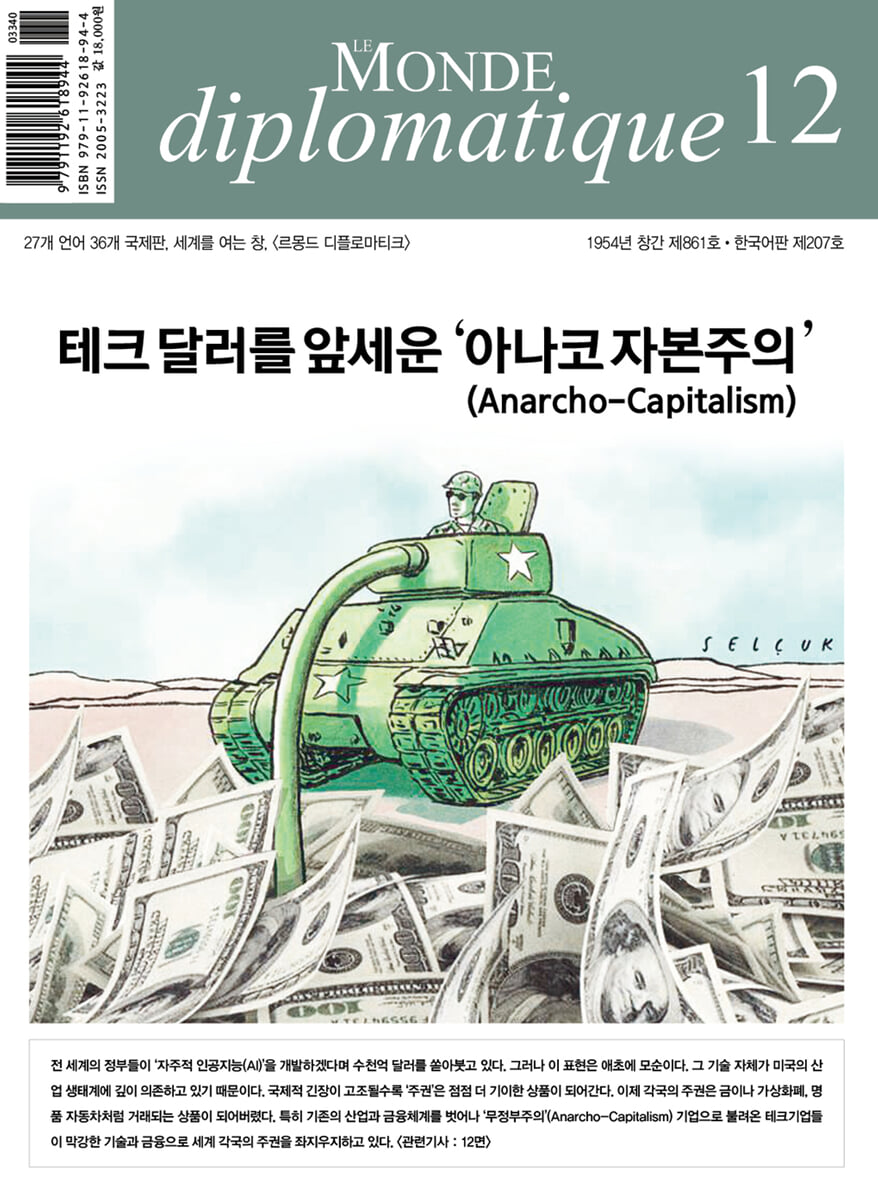
Anarcho-capitalism powered by tech dollars
■ Column of the Month
Benoit Breville | He deserves the Nobel Prize!
Sung Il-kwon | What's more urgent than becoming an AI powerhouse is restoring ethics.
■ Focus
Julia Hayes & Klaus Mülhan | The West's Distortion of China's World War II Victory
Evgeny Morozov | 'Anarcho-Capitalism' Driven by Tech Dollars
■ Information
Francesca Bria | The Empire's "New Tech Conqueror" Who Seizes the Military
Thomas C.
Juskyam | The city's surveillance network that destroys anonymity and privacy
■ History
Ellen Richard | NATO's Continued Eastward Blitz: Washington's Strategy
■ Global Village
Seth Harp | Is the US military's 'weakness' due to excessive diversity?
Pierre Lambert | The EU Security Chief's Dangerous Play with Fire: Fueling European Anxiety
Laurent Bonelli | French police force civilian control in the war on drugs
Gilbert Ashkar | The political winner of all this tragedy is Netanyahu!
Nitzan Perelman Becker | Israel's Left and Far Right Don't Feel the Pain of Others
Maurice Lemoine | Honduras' leftist government faces a backlash from the US and the old regime.
Maël Mariette & Frank Puppo | Why the Right Is Back in Bolivia
Hugo Laurent | Gagauzia: Surviving in the Cracks Between Russia and Moldova
Jean-Arnaud Derand | Lessons from the Old Yugoslavia: What Makes a Good Peace?
■ Culture
Alain Deneau | M'Boko's Tennis Star Overshadows the West's Exploitation of African Resources
Emmanuel Venet | Where Does French Psychiatry Stand Now?
François Begaudeau | Israeli Film Directors Talk About Israel
Mathilde Rusigné | African Dance: "Alive and Vanishing"
Ali Shibani | René Marant, the writer who documented the silence of colonialism
Evelyn Piéyé | French Theory of Tribal Thought That Rejected the Enlightenment
Jean-Arnaud Deren | The Brilliant Adventures of History
■ Korean Peninsula
Lee Bong-su | If we lose in the "Struggle for Memory," tragedy will repeat itself.
Jeong Min-ah | Small Stories in the Dark: A New Path for Korean Cinema
Kang Eun-young & Kang Hye-young | [Serial] Jean-Jacques Goldman, the anti-star more beloved than the stars themselves
Benoit Breville
French publisher, PhD in history.
He served as a professor at the University of Quebec, a researcher at the Institute of 20th Century Social History at the University of Paris 1, and editor-in-chief of the French edition.
It critically analyzes urban poverty, social policy, press freedom and censorship, global economics, and technological power.
His major works include 『Les mondes insurges.
Altermanuel d'histoire contemporaine The world of rebellion.
His publications include 『Alternative Handbook of Modern History』(co-authored, 2014), 『Manuel d'histoire critique Handbook of Critical History』(2014), etc.
Anarcho-capitalism powered by tech dollars
■ Column of the Month
Benoit Breville | He deserves the Nobel Prize!
Sung Il-kwon | What's more urgent than becoming an AI powerhouse is restoring ethics.
■ Focus
Julia Hayes & Klaus Mülhan | The West's Distortion of China's World War II Victory
Evgeny Morozov | 'Anarcho-Capitalism' Driven by Tech Dollars
■ Information
Francesca Bria | The Empire's "New Tech Conqueror" Who Seizes the Military
Thomas C.
Juskyam | The city's surveillance network that destroys anonymity and privacy
■ History
Ellen Richard | NATO's Continued Eastward Blitz: Washington's Strategy
■ Global Village
Seth Harp | Is the US military's 'weakness' due to excessive diversity?
Pierre Lambert | The EU Security Chief's Dangerous Play with Fire: Fueling European Anxiety
Laurent Bonelli | French police force civilian control in the war on drugs
Gilbert Ashkar | The political winner of all this tragedy is Netanyahu!
Nitzan Perelman Becker | Israel's Left and Far Right Don't Feel the Pain of Others
Maurice Lemoine | Honduras' leftist government faces a backlash from the US and the old regime.
Maël Mariette & Frank Puppo | Why the Right Is Back in Bolivia
Hugo Laurent | Gagauzia: Surviving in the Cracks Between Russia and Moldova
Jean-Arnaud Derand | Lessons from the Old Yugoslavia: What Makes a Good Peace?
■ Culture
Alain Deneau | M'Boko's Tennis Star Overshadows the West's Exploitation of African Resources
Emmanuel Venet | Where Does French Psychiatry Stand Now?
François Begaudeau | Israeli Film Directors Talk About Israel
Mathilde Rusigné | African Dance: "Alive and Vanishing"
Ali Shibani | René Marant, the writer who documented the silence of colonialism
Evelyn Piéyé | French Theory of Tribal Thought That Rejected the Enlightenment
Jean-Arnaud Deren | The Brilliant Adventures of History
■ Korean Peninsula
Lee Bong-su | If we lose in the "Struggle for Memory," tragedy will repeat itself.
Jeong Min-ah | Small Stories in the Dark: A New Path for Korean Cinema
Kang Eun-young & Kang Hye-young | [Serial] Jean-Jacques Goldman, the anti-star more beloved than the stars themselves
Benoit Breville
French publisher, PhD in history.
He served as a professor at the University of Quebec, a researcher at the Institute of 20th Century Social History at the University of Paris 1, and editor-in-chief of the French edition.
It critically analyzes urban poverty, social policy, press freedom and censorship, global economics, and technological power.
His major works include 『Les mondes insurges.
Altermanuel d'histoire contemporaine The world of rebellion.
His publications include 『Alternative Handbook of Modern History』(co-authored, 2014), 『Manuel d'histoire critique Handbook of Critical History』(2014), etc.
Detailed image

Into the book
He deserves the Nobel Prize!
Benoit Breville | Publisher of the French edition
U.S. President Theodore Roosevelt, a believer in “stick diplomacy” (from the phrase “speak softly and carry a big stick”), viewed Latin America as a “backyard” in which the United States could intervene at will.
If there was even the slightest threat to American interests, he would not hesitate to send in the Marines.
The targets were Honduras, the Dominican Republic, and Cuba.
In 1903, Washington secured strategic control over the future Panama Canal by supporting the secession of Panama, then just a province of Colombia.
And three years later, Roosevelt was awarded the Nobel Peace Prize for his mediation of the Russo-Japanese War.
What's more urgent than becoming an AI powerhouse is restoring ethics.
Seong Il-kwon | Korean edition publisher
I can't help but laugh when I see critical reports about cheating on college campuses these days.
The stench of corruption and injustice permeates virtually every sector—politics, economics, society, education—so is a university an exception? It might sound a bit harsh to the students, professors, and researchers who silently work in the library, but today's universities are no longer "universities."
It is the final result of the values that adults have abandoned first.
China's World War II victory distorted by the West
Julia Haess | Founder of the German Institute for Chinese Economic Studies
Klaus Mülhan | Professor of Modern and Contemporary History, Free University of Berlin
As Beijing held a grand ceremony to commemorate the 80th anniversary of the victory over Japan, Western media outlets began releasing interpretations that downplayed or denied the Chinese Communist Party's (PCC) role in World War II.
Some media outlets have dismissed China's participation in the anti-Japanese war as an "exaggerated political myth," even going so far as to claim that "China played no role in the war."
On September 4, the European Union's High Representative for Foreign Affairs and Security Policy, Kaja Kallas, expressed surprise when Russian officials mentioned Moscow and Beijing as among the "victorious powers" of 1945.
Publisher's Review
[Publisher's Review]
What is the true nature of the power that rules the world?
The December issue has a rare consistency.
Writings from different continents and agendas converge around a single axis: 'new forms of power.'
Cover stories and focuses, global articles, publisher's perspectives, and culture and history sections all trace the "narrative of power" being reconstructed in today's world.
What is ruling the world today? In the cover story, "Is the weakness of the US military due to diversity?" (by Seth Harf), the author directly addresses the argument recently raised by US military leaders that "the weakness of the military organization is due to diversity policies, obesity, and lack of training."
This debate, which was reignited by the speech of the US Secretary of Defense, is ostensibly about 'improving military culture', but in reality it is a reappearance of the political struggle of the American right wing, that is, the Culture War?
The discourse on weakening America's military power repeats an old pattern.
Responsibility is shifted from structural problems to shifting social values, and the empire's strategic failures are explained away through the easy enemy of "increasing internal diversity."
From oil dollars to 'tech dollars'
Related articles include: 'Anarcho-capitalism with a tech dollar', 'A new way of ruling the empire with weaponized AI', and 'The rapid spread of surveillance cities'.
'America's Self-Deception That Blames Diversity for Its War Failure' and other topics form the axis of the December issue.
Next, in 'China's World War II Victory Distorted by the West', it is shown that the West has been distorting and erasing history about China, following Russia.
This article reveals how a narrative distorted by international politics functions as a diplomatic weapon and distorts historical truth.
Among the most notable articles in this issue is Yevgeny Morozov's "Anarcho-Capitalism with the Techdollar."
Morozov exposes a current situation in which provocative and creative tech companies from Silicon Valley have replaced the US military and security power, and the "sovereignty" of countries around the world is bought and sold like a commodity.
Morozov points out that “governments around the world are touting ‘autonomous AI,’ but the technology itself is dependent on the US industrial ecosystem.”
The point is that now it is not the 'petrodollar' but the 'tech dollar' that is dominating the world.
Especially as the importance of technology grows, today's empire is ruled not by the US Navy or Air Force, but by AWS, Azure, and NVIDIA.
This explains the “weakening of the US military” mentioned in the cover story from a completely different angle.
It is not the military, but a complex of technology and finance that will form America's new empire.
The strengthening of anti-democratic nature in Western society
In the Global Village section, journalist Pierre Lambert provides a detailed analysis of the already well-known hardline remarks of EU High Military Representative Kaya Kallas in his article, “The EU Diplomatic Chief’s Dangerous Playing with Fire.”
This is directly connected to the focus's point of "reinforcing the Western self-narrative."
In 'France's War on Drugs and the Politicization of Security', Laurent Bonelli exposes how France uses security issues as a political mobilization device.
This is directly connected to Morozov's “controlled economy.”
It is a critique of the state's work of reconstructing citizens into 'datafied bodies' in the name of safety.
Middle East expert Gilbert Ashkar recently diagnosed the Israeli-Palestinian conflict by saying, “The winner of this whole tragedy is Netanyahu.”
He then points out how the offensive by the United States, the right wing, and traditional elites in Honduras, Bolivia, and Gagauzia has brought about tragedy.
Ellen Richard analyzes how NATO's eastward expansion policy, which has been aimed at nagging Russia, has been carried out under Washington's meticulous strategy.
Traces how the West's NATO expansion strategy has been repeated in the name of "security."
The commercialization of exoticism and the collapse of tradition
The cultural section then explores how power operates in the realms of emotion, tradition, and image.
This study examines how African and non-Western performing arts have been consumed in the formation of national identity, diplomatic showcases, and the global cultural marketplace.
However, since the 1980s, this tradition has become fixed as a 'heritagized' image rather than a living practice of the community.
The still popular 'African traditional dance' classes in France do not lead to a process of understanding tradition, but rather to the commercialization of 'exotisme', turning non-Western cultures into static images under the label of 'authentic tradition'.
Just as technological power manages data and bodies, cultural power manages ‘tradition’ and ‘identity’ through images.
The Unfinished War of Memories
The Korean Peninsula section (Bongsu Lee) reveals the unique power structure of Korean society, namely the 'political war over memory.'
Unlike Germany, Korea's historical issues have become an ongoing political struggle due to a lack of reflection on the part of the leadership, incomplete investigations into the truth, a lack of education, and active "memory attacks" by conservatives and the far right.
The December 3rd Civil War, the distortion of the Jeju April 3rd Incident, the Lee Bak School, and the establishment of statues and museums for Syngman Rhee and Park Chung-hee are all evidence of historical distortion.
In this month's column, Benoit Breville, publisher of the French edition, and Seong Il-kwon, publisher of the Korean edition, confront the "ethical vacuum" and "political manipulation."
In "He Deserves the Nobel Prize!", Benoit Breville exposes the "fiction of the reward system" created by Western elite discourse, using a style that alternates mockery and criticism, and doggedly dissects how the Nobel Prize system packages the flow of global politics and public opinion.
In his article, “What’s more urgent than becoming an AI powerhouse is the restoration of ethics,” Seong Il-kwon diagnoses that in a world where AI, surveillance, war, and violence intersect, the problem is not technology, but the collapse of ethics.
The December issue does not focus on "international politics far away," but rather on "the multifaceted nature of technological power that is reshaping our daily lives and internal structures," and emphasizes the restoration of ethics.
The December issue is not simply a magazine that compiles international politics and technology criticism.
It is a massive map that comprehensively encompasses culture, memory, events, images, bodies, data, and traditions, analyzing how global power infiltrates every area of life.
Today's empires do not exist only outside their borders.
It operates silently in our cities, memories, data, traditions, democracy, and culture.
What is the true nature of the power that rules the world?
The December issue has a rare consistency.
Writings from different continents and agendas converge around a single axis: 'new forms of power.'
Cover stories and focuses, global articles, publisher's perspectives, and culture and history sections all trace the "narrative of power" being reconstructed in today's world.
What is ruling the world today? In the cover story, "Is the weakness of the US military due to diversity?" (by Seth Harf), the author directly addresses the argument recently raised by US military leaders that "the weakness of the military organization is due to diversity policies, obesity, and lack of training."
This debate, which was reignited by the speech of the US Secretary of Defense, is ostensibly about 'improving military culture', but in reality it is a reappearance of the political struggle of the American right wing, that is, the Culture War?
The discourse on weakening America's military power repeats an old pattern.
Responsibility is shifted from structural problems to shifting social values, and the empire's strategic failures are explained away through the easy enemy of "increasing internal diversity."
From oil dollars to 'tech dollars'
Related articles include: 'Anarcho-capitalism with a tech dollar', 'A new way of ruling the empire with weaponized AI', and 'The rapid spread of surveillance cities'.
'America's Self-Deception That Blames Diversity for Its War Failure' and other topics form the axis of the December issue.
Next, in 'China's World War II Victory Distorted by the West', it is shown that the West has been distorting and erasing history about China, following Russia.
This article reveals how a narrative distorted by international politics functions as a diplomatic weapon and distorts historical truth.
Among the most notable articles in this issue is Yevgeny Morozov's "Anarcho-Capitalism with the Techdollar."
Morozov exposes a current situation in which provocative and creative tech companies from Silicon Valley have replaced the US military and security power, and the "sovereignty" of countries around the world is bought and sold like a commodity.
Morozov points out that “governments around the world are touting ‘autonomous AI,’ but the technology itself is dependent on the US industrial ecosystem.”
The point is that now it is not the 'petrodollar' but the 'tech dollar' that is dominating the world.
Especially as the importance of technology grows, today's empire is ruled not by the US Navy or Air Force, but by AWS, Azure, and NVIDIA.
This explains the “weakening of the US military” mentioned in the cover story from a completely different angle.
It is not the military, but a complex of technology and finance that will form America's new empire.
The strengthening of anti-democratic nature in Western society
In the Global Village section, journalist Pierre Lambert provides a detailed analysis of the already well-known hardline remarks of EU High Military Representative Kaya Kallas in his article, “The EU Diplomatic Chief’s Dangerous Playing with Fire.”
This is directly connected to the focus's point of "reinforcing the Western self-narrative."
In 'France's War on Drugs and the Politicization of Security', Laurent Bonelli exposes how France uses security issues as a political mobilization device.
This is directly connected to Morozov's “controlled economy.”
It is a critique of the state's work of reconstructing citizens into 'datafied bodies' in the name of safety.
Middle East expert Gilbert Ashkar recently diagnosed the Israeli-Palestinian conflict by saying, “The winner of this whole tragedy is Netanyahu.”
He then points out how the offensive by the United States, the right wing, and traditional elites in Honduras, Bolivia, and Gagauzia has brought about tragedy.
Ellen Richard analyzes how NATO's eastward expansion policy, which has been aimed at nagging Russia, has been carried out under Washington's meticulous strategy.
Traces how the West's NATO expansion strategy has been repeated in the name of "security."
The commercialization of exoticism and the collapse of tradition
The cultural section then explores how power operates in the realms of emotion, tradition, and image.
This study examines how African and non-Western performing arts have been consumed in the formation of national identity, diplomatic showcases, and the global cultural marketplace.
However, since the 1980s, this tradition has become fixed as a 'heritagized' image rather than a living practice of the community.
The still popular 'African traditional dance' classes in France do not lead to a process of understanding tradition, but rather to the commercialization of 'exotisme', turning non-Western cultures into static images under the label of 'authentic tradition'.
Just as technological power manages data and bodies, cultural power manages ‘tradition’ and ‘identity’ through images.
The Unfinished War of Memories
The Korean Peninsula section (Bongsu Lee) reveals the unique power structure of Korean society, namely the 'political war over memory.'
Unlike Germany, Korea's historical issues have become an ongoing political struggle due to a lack of reflection on the part of the leadership, incomplete investigations into the truth, a lack of education, and active "memory attacks" by conservatives and the far right.
The December 3rd Civil War, the distortion of the Jeju April 3rd Incident, the Lee Bak School, and the establishment of statues and museums for Syngman Rhee and Park Chung-hee are all evidence of historical distortion.
In this month's column, Benoit Breville, publisher of the French edition, and Seong Il-kwon, publisher of the Korean edition, confront the "ethical vacuum" and "political manipulation."
In "He Deserves the Nobel Prize!", Benoit Breville exposes the "fiction of the reward system" created by Western elite discourse, using a style that alternates mockery and criticism, and doggedly dissects how the Nobel Prize system packages the flow of global politics and public opinion.
In his article, “What’s more urgent than becoming an AI powerhouse is the restoration of ethics,” Seong Il-kwon diagnoses that in a world where AI, surveillance, war, and violence intersect, the problem is not technology, but the collapse of ethics.
The December issue does not focus on "international politics far away," but rather on "the multifaceted nature of technological power that is reshaping our daily lives and internal structures," and emphasizes the restoration of ethics.
The December issue is not simply a magazine that compiles international politics and technology criticism.
It is a massive map that comprehensively encompasses culture, memory, events, images, bodies, data, and traditions, analyzing how global power infiltrates every area of life.
Today's empires do not exist only outside their borders.
It operates silently in our cities, memories, data, traditions, democracy, and culture.
GOODS SPECIFICS
- Date of issue: November 28, 2025
- Page count, weight, size: 128 pages | 205*285*6mm
- ISBN13: 9791192618944
- ISBN10: 1192618947
You may also like
카테고리
korean


korean

![GQ KOREA Mark (Monthly): December [2025]](http://librairie.coreenne.fr/cdn/shop/files/8ef265dbbfbf186523ed75ba7319009d.jpg?v=1765340328&width=3840)


