![Gutnit No. 6: Care Society [2023]](http://librairie.coreenne.fr/cdn/shop/files/38dbe66b738e9f8893611b56655453ca.jpg?v=1765326532&width=3840)

Gutnit No. 6: Care Society [2023]
 |
Description
Book Introduction
『Gutnit』, a novel magazine that compiles one thematic essay and three short stories each season, focusing on a specific topic that cannot be overlooked in our times.
Issue 6 includes an essay by An Jin-a, an associate professor at Okinawa International University, on the keyword “care society,” and a short story by Kim Bon, Oh Han-gi, and Yoon Hae-seo.
Issue 6 includes an essay by An Jin-a, an associate professor at Okinawa International University, on the keyword “care society,” and a short story by Kim Bon, Oh Han-gi, and Yoon Hae-seo.
- You can preview some of the book's contents.
Preview
index
It's okay to drive slowly | Anjina
The snake is chasing | Kim Bon
Forest Experience | Oh Han-gi
Transformation | Yun Hae-seo
The snake is chasing | Kim Bon
Forest Experience | Oh Han-gi
Transformation | Yun Hae-seo
Detailed image
Into the book
But there is no bus that can run forever.
Just as our lives are the sum total of irreversible moments, so too is today's Korean society.
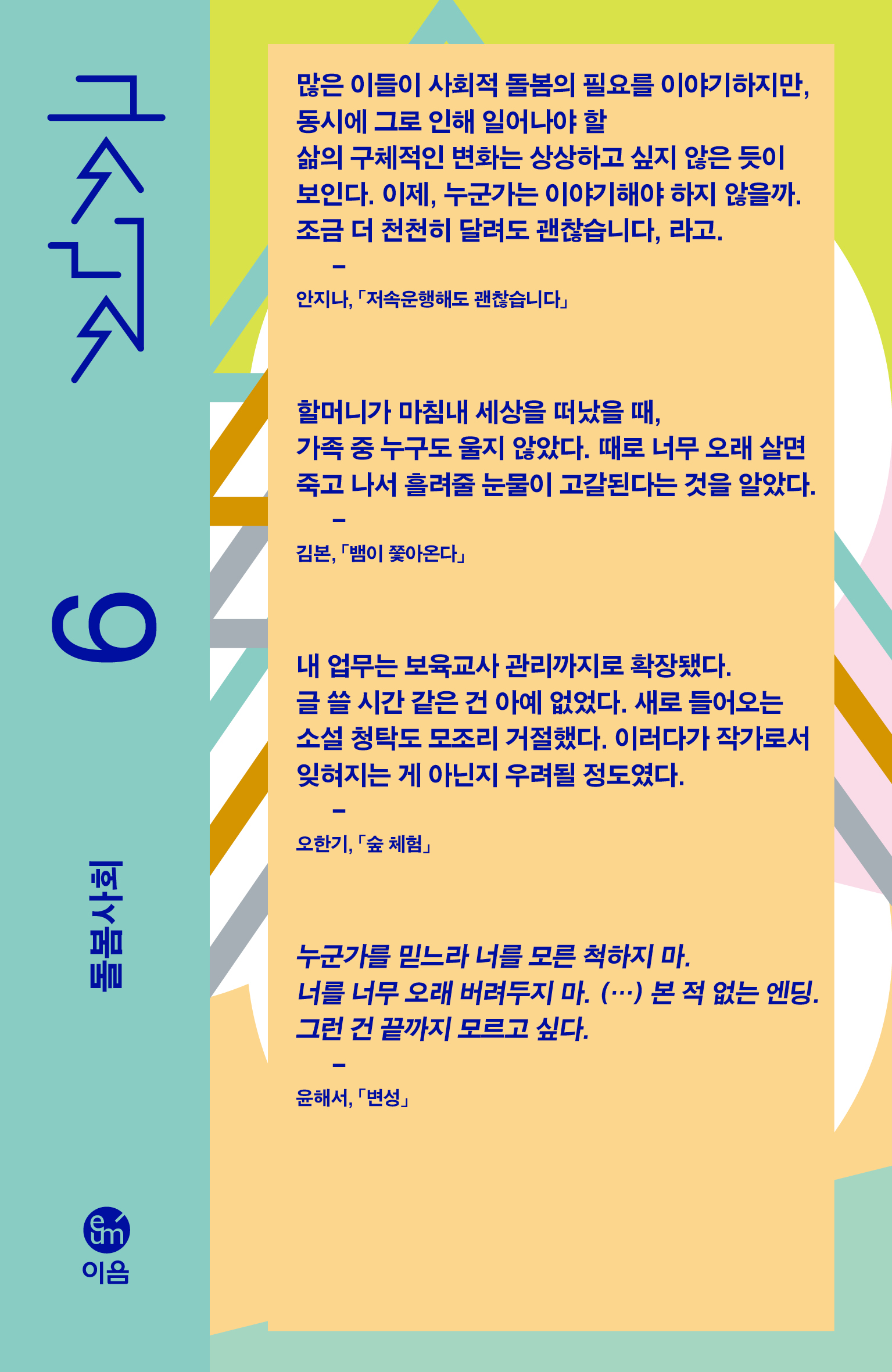
Many people worry about low birth rates and an aging population and talk about the need for social care, but at the same time, they seem unwilling to imagine the specific changes in life that will result from these changes.
But we are already beginning to see the results.
So now, shouldn't someone speak up?
It's okay to run a little slower, he said.
_Anjina, "It's okay to drive slowly."
--- p.12
I know the look on my mother's face when she looks at my grandmother, who whines and writhes like a little child.
I know what it looks like when you give them medicine at the appointed time and clean up their soiled diapers and bedding.
But I can't remember my mother's face at that moment, looking at me and my family eating.
Kim Bon, "The Snake Is Chasing"
--- p.53
My grandmother was sent to a nursing home a year before she died.
The last time I visited, he didn't even recognize me.
In fact, there was nothing left that Grandma could recognize.
My grandmother carried a flat, dirty buckwheat pillow with her wherever she went and called it "dust."
When my grandmother finally passed away, no one in the family cried.
Sometimes I find that if you live too long, you run out of tears to shed when you die.
Kim Bon, "The Snake Is Chasing"
--- p.54~55
Excuse me, can I look after the child for a moment?
This is not a daycare center, it's a stationery store...
Only after asking once more did I come to my senses and answer.
I'm in a hurry because something is going on
I turned on the CCTV.
A woman who appeared to be in her forties was talking on the phone with a child who appeared to be in elementary school.
The child was busy running around and looking at toys, and the child's mother's expression looked anxious.
Can you see me?
The child's mother waved her hands in front of the CCTV.
Yes, I can see it… …
I'm a regular here...
The child's mother said.
Now that I think about it, it looks familiar, like I've seen it on CCTV a few times.
At some point, the child's mother started to complain.
The story was about a second child at daycare who was sick and needed to go to a university hospital, but there was no suitable place to leave the first child.
I completely agree.
Oh Han-gi, "Forest Experience"
--- p.94~95
Because there is nothing I can do but starve.
I'm starving.
He closes the lid of the bottle and throws it into a bag full of weeds.
The sound of a weeder is heard nearby.
It's quiet.
Crows are sitting on distant perches.
A bell rings in his pocket.
He puts down the bag, takes off the glove on his right hand, and answers the phone.
okay.
He hung up the phone, put the phone in his pocket, took off the glove on his left hand and put it in his back pocket, and walked quickly to the starting point of B501.
I put on my bag, grab the weeder, and go down the slope.
An old man sitting on a long chair.
An old man with a hunched back, thin, slightly bald head, white hair, and freckles covering his face.
I took the plastic out of my bag.
Is it a potato?
Is it an egg?
I took out something boiled and carefully looked around for a while before taking a bite.
And again.
Standing on the slope, Loki arrives.
A white truck is visible at the bottom of the slope.
A newbie is standing in front of a truck.
Loki.
Loki follows him to the front of the truck.
The newbie takes a snack out of his pocket and hands it to Loki.
What can you be sure of? Loki's tongue briefly touches the newcomer's finger.
It tickles.
_Yoon Hae-seo, "Transformation"
Just as our lives are the sum total of irreversible moments, so too is today's Korean society.
Many people worry about low birth rates and an aging population and talk about the need for social care, but at the same time, they seem unwilling to imagine the specific changes in life that will result from these changes.
But we are already beginning to see the results.
So now, shouldn't someone speak up?
It's okay to run a little slower, he said.
_Anjina, "It's okay to drive slowly."
--- p.12
I know the look on my mother's face when she looks at my grandmother, who whines and writhes like a little child.
I know what it looks like when you give them medicine at the appointed time and clean up their soiled diapers and bedding.
But I can't remember my mother's face at that moment, looking at me and my family eating.
Kim Bon, "The Snake Is Chasing"
--- p.53
My grandmother was sent to a nursing home a year before she died.
The last time I visited, he didn't even recognize me.
In fact, there was nothing left that Grandma could recognize.
My grandmother carried a flat, dirty buckwheat pillow with her wherever she went and called it "dust."
When my grandmother finally passed away, no one in the family cried.
Sometimes I find that if you live too long, you run out of tears to shed when you die.
Kim Bon, "The Snake Is Chasing"
--- p.54~55
Excuse me, can I look after the child for a moment?
This is not a daycare center, it's a stationery store...
Only after asking once more did I come to my senses and answer.
I'm in a hurry because something is going on
I turned on the CCTV.
A woman who appeared to be in her forties was talking on the phone with a child who appeared to be in elementary school.
The child was busy running around and looking at toys, and the child's mother's expression looked anxious.
Can you see me?
The child's mother waved her hands in front of the CCTV.
Yes, I can see it… …
I'm a regular here...
The child's mother said.
Now that I think about it, it looks familiar, like I've seen it on CCTV a few times.
At some point, the child's mother started to complain.
The story was about a second child at daycare who was sick and needed to go to a university hospital, but there was no suitable place to leave the first child.
I completely agree.
Oh Han-gi, "Forest Experience"
--- p.94~95
Because there is nothing I can do but starve.
I'm starving.
He closes the lid of the bottle and throws it into a bag full of weeds.
The sound of a weeder is heard nearby.
It's quiet.
Crows are sitting on distant perches.
A bell rings in his pocket.
He puts down the bag, takes off the glove on his right hand, and answers the phone.
okay.
He hung up the phone, put the phone in his pocket, took off the glove on his left hand and put it in his back pocket, and walked quickly to the starting point of B501.
I put on my bag, grab the weeder, and go down the slope.
An old man sitting on a long chair.
An old man with a hunched back, thin, slightly bald head, white hair, and freckles covering his face.
I took the plastic out of my bag.
Is it a potato?
Is it an egg?
I took out something boiled and carefully looked around for a while before taking a bite.
And again.
Standing on the slope, Loki arrives.
A white truck is visible at the bottom of the slope.
A newbie is standing in front of a truck.
Loki.
Loki follows him to the front of the truck.
The newbie takes a snack out of his pocket and hands it to Loki.
What can you be sure of? Loki's tongue briefly touches the newcomer's finger.
It tickles.
_Yoon Hae-seo, "Transformation"
--- p.130~131
Publisher's Review
Stories can't tell us directly how others feel, but they can help us imagine how we might feel in their situations.
That is the power of empathy that stories possess.
Abstract arguments can provide some background, but stories are what get to the point directly and poignantly.
The novel magazine 『Gutnit』 believes in the power of such stories.
The story connects the world we live in with the world that is clearly there but is not easily visible and that we try to avoid seeing.
『Gutnit』 presents readers with one thematic essay and three short stories centered on specific topics and keywords that cannot be overlooked in our time.
*
In the spring of 2021, it was revealed to the world that a son in his twenties neglected his father in his fifties for eight days, ultimately causing his death from pneumonia and other causes of severe malnutrition.
My father, who was hospitalized in September of the previous year with symptoms of deep cerebral hemorrhage and subarachnoid hemorrhage, received treatment for seven months, but was discharged on April 23rd due to financial burden.
After being discharged, my father was unable to move on his own due to paralysis of his left arm and leg, and was unable to eat normal food. However, the young son did not provide his father with any prescribed medication after being discharged, and only provided him with ten therapeutic meals for a week, instead of the three he needed a day to provide nutrition.
From May 1st onwards, for eight days, they stopped providing therapeutic food and water and did not enter the victim's room at all. Eventually, the young man's father died from pneumonia and other causes while suffering from severe malnutrition.
But that wasn't the entire story of the 'unfilial son' who starved his father to death.
The young man had lived alone with his father for over ten years after his mother left home, and he had to bear the arduous burden of caring for her alone.
In addition, it was revealed that he ran out of money to pay the 20 million won in surgery and hospital bills, and was behind on all his payments, including rent, gas, electricity, and phone bills. He even sent messages to people around him asking for 20,000 won to borrow because he had no money to buy rice.
He tried to find a job somehow, and to save money, he even ate 'discarded' food from convenience stores that was nearing its expiration date, but the financial difficulties continued, and it is said that his father eventually called his son and said, "I'm sorry. Live happily doing what you want from now on," and "Don't come into the room until then."
While my son spent his time crying in my room, my father eventually passed away.
This incident has caused much concern in our society.
But this is not the only extreme case.
We have seen news of husbands and mothers taking extreme measures while caring for their wives with dementia, or their children with intellectual disabilities.
Most children spend a lot of time with caregivers, such as nannies and daycare centers, rather than with their parents, and there are many problems that arise in various care facilities.
『Gutnit』 No. 6 talks about the ‘care society.’
The days when caregiving issues were a family affair are long gone.
With the aging population, the elderly population, and the increase in single-person households, various types of care are already issues that society and the nation must address together, and one day, or soon, they may become my own problem.
『Gutnit』 No. 6 presents three unique and problematic stories surrounding the issue of 'care,' which has already become a problem for every individual.
Associate Professor An Jin-a, who teaches comparative culture and comparative literature at Okinawa International University and focuses on issues such as generational conflict, disease and death, and gender that appear in Korean and Japanese geriatric literature, points out various problems of care that emerge in a society that is changing at a rapid pace through her essay, “It’s Okay to Drive Slowly,” and suggests that we might be able to slow down our society a little, recalling the slow buses in Japan.
The author asks us whether we can slow down a bit and talk about care and consideration for people, not just on an individual level but also on a social and national level.
Kim Bon's novel "The Snake Is Chasing" makes us think about various issues of care through the diverse stories of three generations of the young narrator's family.
From my father who passed away in an unexpected accident, to my mother who suddenly ended up living with her in-laws, to my grandmother who was suddenly diagnosed with dementia, to my uncle and aunt who still live with their parents, each of these stories represents the stories of many generations in our society.
After a time when I was young, my story of meeting my grandmother and her husband who grew up with her enters another era.
Yoon Hae-seo's novel "Transformation" is a work that stands out for its unique poetic style and original writing style.
As another voice interrupts the ordinary routine of 'him', a cemetery caretaker, readers are transported to another dimension, going back and forth between 'him's' present and the voice's time and space.
That is the power of empathy that stories possess.
Abstract arguments can provide some background, but stories are what get to the point directly and poignantly.
The novel magazine 『Gutnit』 believes in the power of such stories.
The story connects the world we live in with the world that is clearly there but is not easily visible and that we try to avoid seeing.
『Gutnit』 presents readers with one thematic essay and three short stories centered on specific topics and keywords that cannot be overlooked in our time.
*
In the spring of 2021, it was revealed to the world that a son in his twenties neglected his father in his fifties for eight days, ultimately causing his death from pneumonia and other causes of severe malnutrition.
My father, who was hospitalized in September of the previous year with symptoms of deep cerebral hemorrhage and subarachnoid hemorrhage, received treatment for seven months, but was discharged on April 23rd due to financial burden.
After being discharged, my father was unable to move on his own due to paralysis of his left arm and leg, and was unable to eat normal food. However, the young son did not provide his father with any prescribed medication after being discharged, and only provided him with ten therapeutic meals for a week, instead of the three he needed a day to provide nutrition.
From May 1st onwards, for eight days, they stopped providing therapeutic food and water and did not enter the victim's room at all. Eventually, the young man's father died from pneumonia and other causes while suffering from severe malnutrition.
But that wasn't the entire story of the 'unfilial son' who starved his father to death.
The young man had lived alone with his father for over ten years after his mother left home, and he had to bear the arduous burden of caring for her alone.
In addition, it was revealed that he ran out of money to pay the 20 million won in surgery and hospital bills, and was behind on all his payments, including rent, gas, electricity, and phone bills. He even sent messages to people around him asking for 20,000 won to borrow because he had no money to buy rice.
He tried to find a job somehow, and to save money, he even ate 'discarded' food from convenience stores that was nearing its expiration date, but the financial difficulties continued, and it is said that his father eventually called his son and said, "I'm sorry. Live happily doing what you want from now on," and "Don't come into the room until then."
While my son spent his time crying in my room, my father eventually passed away.
This incident has caused much concern in our society.
But this is not the only extreme case.
We have seen news of husbands and mothers taking extreme measures while caring for their wives with dementia, or their children with intellectual disabilities.
Most children spend a lot of time with caregivers, such as nannies and daycare centers, rather than with their parents, and there are many problems that arise in various care facilities.
『Gutnit』 No. 6 talks about the ‘care society.’
The days when caregiving issues were a family affair are long gone.
With the aging population, the elderly population, and the increase in single-person households, various types of care are already issues that society and the nation must address together, and one day, or soon, they may become my own problem.
『Gutnit』 No. 6 presents three unique and problematic stories surrounding the issue of 'care,' which has already become a problem for every individual.
Associate Professor An Jin-a, who teaches comparative culture and comparative literature at Okinawa International University and focuses on issues such as generational conflict, disease and death, and gender that appear in Korean and Japanese geriatric literature, points out various problems of care that emerge in a society that is changing at a rapid pace through her essay, “It’s Okay to Drive Slowly,” and suggests that we might be able to slow down our society a little, recalling the slow buses in Japan.
The author asks us whether we can slow down a bit and talk about care and consideration for people, not just on an individual level but also on a social and national level.
Kim Bon's novel "The Snake Is Chasing" makes us think about various issues of care through the diverse stories of three generations of the young narrator's family.
From my father who passed away in an unexpected accident, to my mother who suddenly ended up living with her in-laws, to my grandmother who was suddenly diagnosed with dementia, to my uncle and aunt who still live with their parents, each of these stories represents the stories of many generations in our society.
After a time when I was young, my story of meeting my grandmother and her husband who grew up with her enters another era.
Yoon Hae-seo's novel "Transformation" is a work that stands out for its unique poetic style and original writing style.
As another voice interrupts the ordinary routine of 'him', a cemetery caretaker, readers are transported to another dimension, going back and forth between 'him's' present and the voice's time and space.
GOODS SPECIFICS
- Date of issue: December 20, 2023
- Page count, weight, size: 136 pages | 130*200*20mm
- ISBN13: 9772951413062
- ISBN10: 29514134
You may also like
카테고리
korean


korean

![GQ KOREA Mark (Monthly): December [2025]](http://librairie.coreenne.fr/cdn/shop/files/8ef265dbbfbf186523ed75ba7319009d.jpg?v=1765340328&width=3840)


