![Gutnit No. 5: Debt [2023]](http://librairie.coreenne.fr/cdn/shop/files/08522ca73033798f9afab8b3377c5620.jpg?v=1765326546&width=3840)

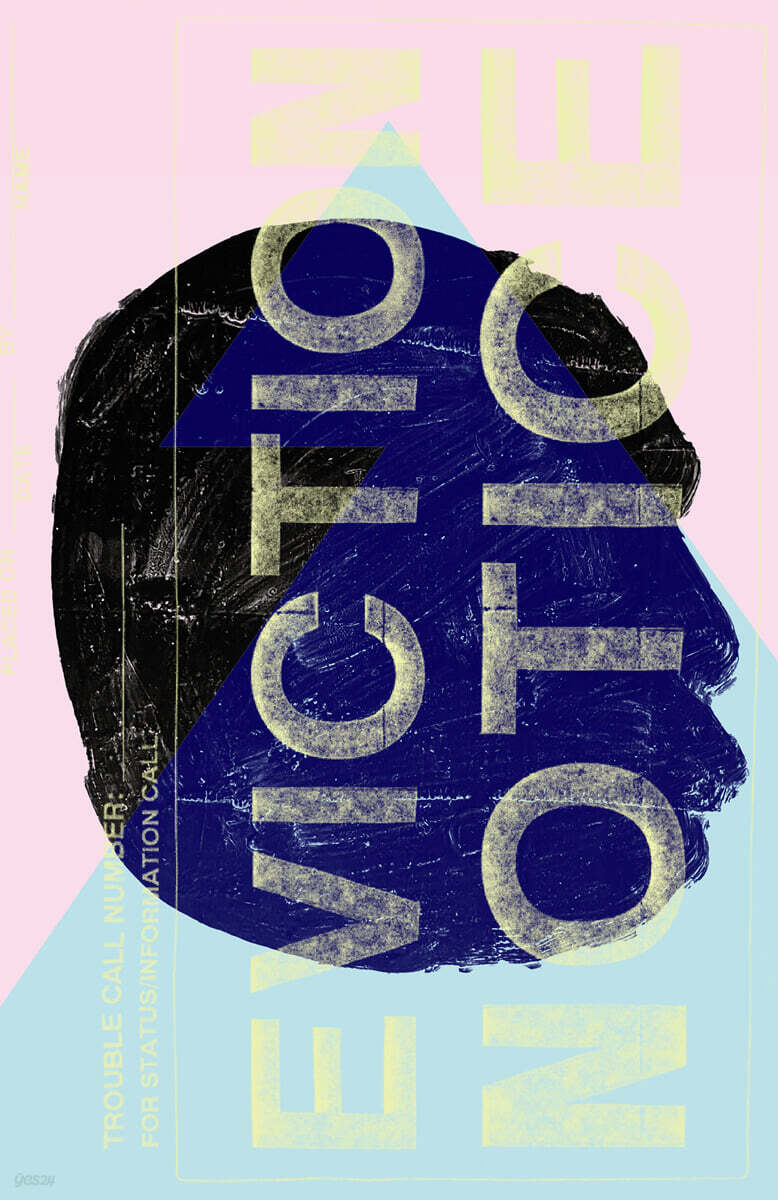
Gutnit No. 5: Debt [2023]
 |
Description
Book Introduction
『Gutnit』, a novel magazine that compiles one thematic essay and three short stories each season, focusing on a specific topic that cannot be overlooked in the Lee era.
Issue 5 contains an essay on the topic of 'debt' by Professor Kim Joo-hee of the Chamirisa College of Liberal Arts at Deoksung Women's University, and short stories by Yang Seon-hyeong, Wi Su-jeong, and Yoon Seong-hee.
Issue 5 contains an essay on the topic of 'debt' by Professor Kim Joo-hee of the Chamirisa College of Liberal Arts at Deoksung Women's University, and short stories by Yang Seon-hyeong, Wi Su-jeong, and Yoon Seong-hee.
- You can preview some of the book's contents.
Preview
index
Poor Man, Don't Die | Kim Joo-hee
Counterfeit Money and Tulips | Yang Seon-hyeong
Home | Wi Su-jeong
Time Capsule | Yoon Seong-hee
Counterfeit Money and Tulips | Yang Seon-hyeong
Home | Wi Su-jeong
Time Capsule | Yoon Seong-hee
Detailed image
Into the book
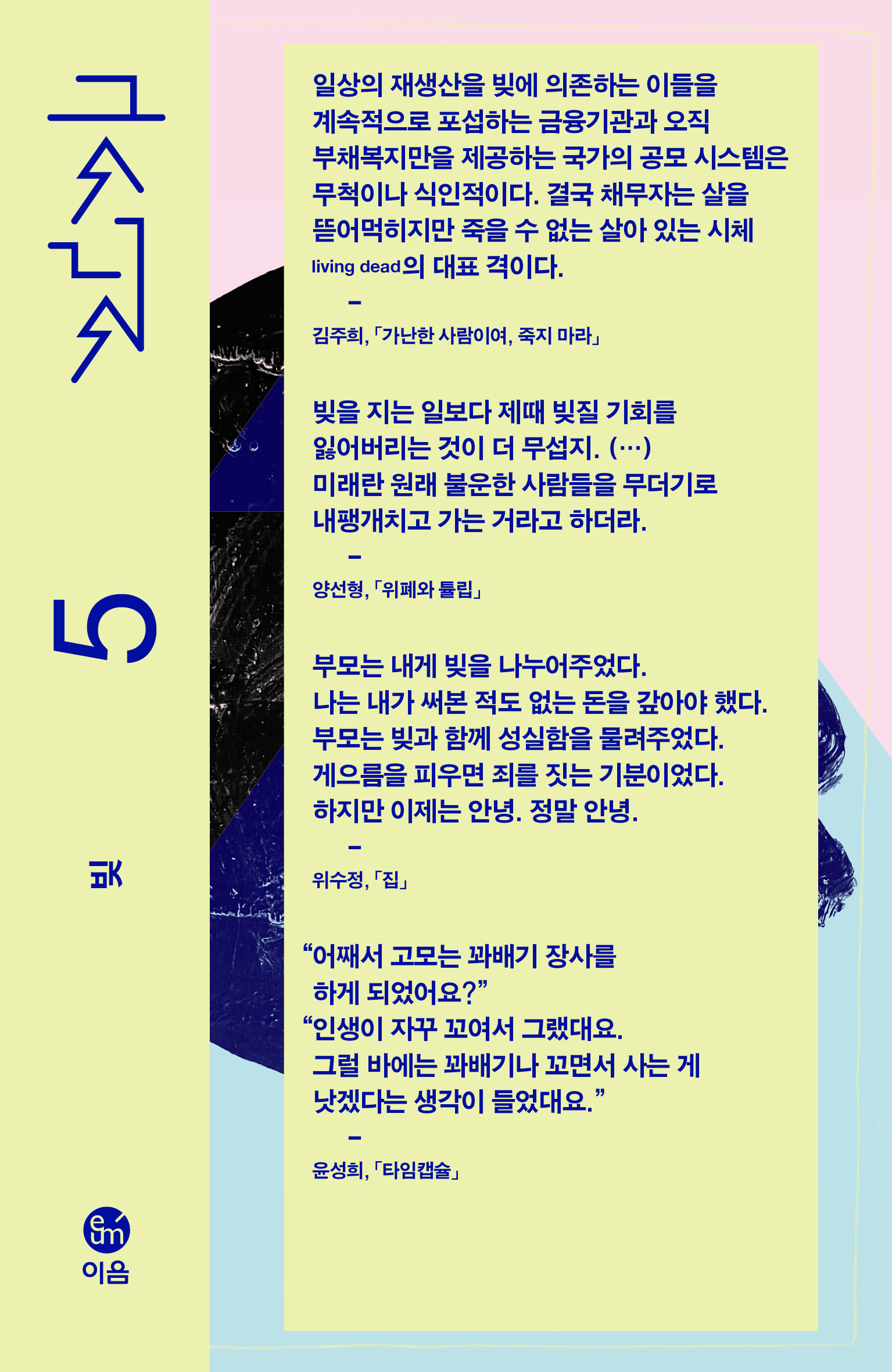
Nancy Fraser, a feminist political philosopher, has coined the term “cannibal capitalism” to describe the problematic social system we face today.
It is like a snake that eats its own tail and destroys itself, relying not only on exploitation in the sphere of production but also on exploiting the social sphere outside it.
It is also a very apt description of capitalism, which becomes fat and then self-destructs because there is nothing left to eat.
The system of financial institutions that continuously subjugate those who depend on debt for their daily reproduction and the state that only provides debt welfare are extremely cannibalistic.
Ultimately, the debtor is the epitome of a living dead who cannot die even though his flesh is eaten.
It is time to pay attention to the new faces of the resistance movement, including Seonhee.
---p.11 Kim Joo-hee, from “Poor People, Don’t Die”
My creditors want me to be healthy.
I hope I am comfortable and hard-working.
The future events that my creditors loathe and fear are my death or disappearance, my wandering or helplessness, my illness or my capriciousness.
Because my days of safe survival and reliable labor, all the wonderful activities I undertake to take responsibility for and build myself up, are equivalent to the interest they will receive in the future.
A person who can accurately predict the future, a sound person with a strong will and a detailed blueprint for his or her own life, is the model debtor who can collect principal and interest without harm.
The creditors want me to live forever and convert the eternity given to me into money.
The most shocking nightmare and revenge I could inflict on my creditors would be to be transformed into a bloody lump of flesh, barely able to breathe, or a vegetable with an oxygen mask attached to its face.
---p.40 Yang Seon-hyeong, from “Counterfeiting and Tulips”
I went to the ATM every day to withdraw money.
There is a daily withdrawal limit, so I withdraw the amount I want each day and put it deep in my bag.
(……)
I walked around under the hot sun until my feet were burning, but it was fun.
Whenever I looked at the clock, it was always night or dawn.
A time when parents are asleep.
Time not to call me.
My parents gave me a share of the debt.
I was just using cotton I had never used before.
I had to pay the money back.
My parents passed down honesty along with debt.
Being lazy felt like a sin.
But now goodbye.
Really goodbye.
But still, I kept thinking about my parents.
I look at my watch, thinking I should make a phone call. It's late at night or early in the morning.
I felt a cycle of anxiety and relief… …and now it was fading away.
---pp.66-67 Wi Su-jeong, from “Home”
I didn't steal much.
If you knew how much money banks make in a day, it would be like dust.
So, it's close to 0.
You probably won't even know it's gone.
I tried to say it jokingly, as if it were nothing special.
As light as possible.
Like singing.
Humming.
So I drank a lot of whiskey too.
So that your voice doesn't shake.
So that your earlobes don't burn.
---pp.86-87 Wi Su-jeong, from “Home”
Mr. Geoha added that in his late twenties, he had a major business failure and almost died.
The debt kept growing and growing until it became impossible to repay.
I went to a meat restaurant alone with the thought of having a delicious meal before I die.
It was not meal time, so there were no customers, but the owner of the store was sitting in the hall watching a volleyball game.
While waiting for the food after ordering the pork belly for two people, the man also watched the volleyball game.
A player came in as a substitute to serve and ended up hitting the back of the head of a teammate.
The player who was hit in the back of the head fell to the ground and was unable to get up for a while.
“When I saw that, I suddenly thought of your aunt.
I touched the scar on my forehead and strangely, I felt courageous.
So I was able to get back on my feet.” I asked Mr. Geometry to give my father, who always failed in business, a chance to touch his scar just once.
Mr. Geometry said he would do that.
(……) “There’s something I’m curious about.
“Why did you start selling donuts, Aunt?” the man asked.
“It was because my life kept getting twisted.
In that case, I thought it would be better to live by twisting donuts.
By the way, when is your birthday? If you go to your aunt's store on your birthday, they'll make you a long-awaited donut made by twisting it ten times.
“You should definitely go and try it.” To my words, Mr. Kiha replied that he would definitely go since his birthday is next week.
It is like a snake that eats its own tail and destroys itself, relying not only on exploitation in the sphere of production but also on exploiting the social sphere outside it.
It is also a very apt description of capitalism, which becomes fat and then self-destructs because there is nothing left to eat.
The system of financial institutions that continuously subjugate those who depend on debt for their daily reproduction and the state that only provides debt welfare are extremely cannibalistic.
Ultimately, the debtor is the epitome of a living dead who cannot die even though his flesh is eaten.
It is time to pay attention to the new faces of the resistance movement, including Seonhee.
---p.11 Kim Joo-hee, from “Poor People, Don’t Die”
My creditors want me to be healthy.
I hope I am comfortable and hard-working.
The future events that my creditors loathe and fear are my death or disappearance, my wandering or helplessness, my illness or my capriciousness.
Because my days of safe survival and reliable labor, all the wonderful activities I undertake to take responsibility for and build myself up, are equivalent to the interest they will receive in the future.
A person who can accurately predict the future, a sound person with a strong will and a detailed blueprint for his or her own life, is the model debtor who can collect principal and interest without harm.
The creditors want me to live forever and convert the eternity given to me into money.
The most shocking nightmare and revenge I could inflict on my creditors would be to be transformed into a bloody lump of flesh, barely able to breathe, or a vegetable with an oxygen mask attached to its face.
---p.40 Yang Seon-hyeong, from “Counterfeiting and Tulips”
I went to the ATM every day to withdraw money.
There is a daily withdrawal limit, so I withdraw the amount I want each day and put it deep in my bag.
(……)
I walked around under the hot sun until my feet were burning, but it was fun.
Whenever I looked at the clock, it was always night or dawn.
A time when parents are asleep.
Time not to call me.
My parents gave me a share of the debt.
I was just using cotton I had never used before.
I had to pay the money back.
My parents passed down honesty along with debt.
Being lazy felt like a sin.
But now goodbye.
Really goodbye.
But still, I kept thinking about my parents.
I look at my watch, thinking I should make a phone call. It's late at night or early in the morning.
I felt a cycle of anxiety and relief… …and now it was fading away.
---pp.66-67 Wi Su-jeong, from “Home”
I didn't steal much.
If you knew how much money banks make in a day, it would be like dust.
So, it's close to 0.
You probably won't even know it's gone.
I tried to say it jokingly, as if it were nothing special.
As light as possible.
Like singing.
Humming.
So I drank a lot of whiskey too.
So that your voice doesn't shake.
So that your earlobes don't burn.
---pp.86-87 Wi Su-jeong, from “Home”
Mr. Geoha added that in his late twenties, he had a major business failure and almost died.
The debt kept growing and growing until it became impossible to repay.
I went to a meat restaurant alone with the thought of having a delicious meal before I die.
It was not meal time, so there were no customers, but the owner of the store was sitting in the hall watching a volleyball game.
While waiting for the food after ordering the pork belly for two people, the man also watched the volleyball game.
A player came in as a substitute to serve and ended up hitting the back of the head of a teammate.
The player who was hit in the back of the head fell to the ground and was unable to get up for a while.
“When I saw that, I suddenly thought of your aunt.
I touched the scar on my forehead and strangely, I felt courageous.
So I was able to get back on my feet.” I asked Mr. Geometry to give my father, who always failed in business, a chance to touch his scar just once.
Mr. Geometry said he would do that.
(……) “There’s something I’m curious about.
“Why did you start selling donuts, Aunt?” the man asked.
“It was because my life kept getting twisted.
In that case, I thought it would be better to live by twisting donuts.
By the way, when is your birthday? If you go to your aunt's store on your birthday, they'll make you a long-awaited donut made by twisting it ten times.
“You should definitely go and try it.” To my words, Mr. Kiha replied that he would definitely go since his birthday is next week.
---p.82 Yoon Seong-hee, from "Time Capsule"
Publisher's Review
Stories can't tell us directly how others feel, but they can help us imagine how we might feel in their situations.
That is the power of empathy that stories possess.
Abstract arguments can provide some background, but stories are what get to the point directly and poignantly.
The novel magazine 『Gutnit』 believes in the power of such stories.
The story connects the world we live in with the world that is clearly there but is not easily visible and that we try to avoid seeing.
『Gutnit』 presents readers with one thematic essay and three short stories centered on specific topics and keywords that cannot be overlooked in our time.
*
Household debt exceeded 1,862 trillion won in the second quarter of 2023, an increase of 9.5 trillion won compared to the end of the previous quarter, and households' repayment capacity continues to decline.
Household loans from the five major banks in August jumped the most in 1 year and 9 months. According to the ultra-financial sector this month (September 2023), the household loan balance of the five major banks (KB Kookmin, Shinhan, Hana, Woori, and NH Nonghyup) at the end of last month was tallied at 680.812 trillion won.
This is an increase of 1.5912 trillion won in one month compared to the end of July (679.2208 trillion won), and the balance of household loans has increased for four consecutive months since May, and the increase in August was the largest in 1 year and 9 months since November 2021 (2.3622 trillion won).
In particular, in the case of housing mortgage loans, which have been driving the recent increase in household loans, the amount jumped by KRW 2.1122 trillion (KRW 512.8875 trillion → KRW 514.9997 trillion) in August alone, and it is said that the monthly increase in housing mortgage loans exceeding KRW 2 trillion is the first time in eight months since December 2022 (KRW 2.3782 trillion).
The household debt-to-GDP ratio has surpassed 100 percent, surpassing the "red line" warned by the International Monetary Fund (IMF). It may be natural that speculations about a September crisis, an October crisis, and a December crisis are emerging.
『Gutnit』 No. 5 talks about 'debt'.
Household debt, one of the major risk factors threatening the Korean economy, was first referred to as a "time bomb" 20 years ago. Now, experts predict that it is only a matter of time before this bomb explodes, and as its scale has grown, its explosive power will be uncontrollable.
Due to the recent rise in loan interest rates and exchange rate hikes, debt is increasing, and problems such as people giving up on paying their debts and the younger generation defaulting on their loans are no longer recent phenomena.
Starting with student loans, we are already living as 'debtors' in our twenties.
『Gutnit』 No. 5 presents three unique and problematic stories about our lives surrounding the topic of 'debt,' which has become a problem for most of the people.
Kim Joo-hee, a professor at the Chamirisa College of Liberal Arts at Deoksung Women's University, begins her essay, "Poor People, Don't Die," with an episode from her own experience as an activist.
The lives of the poor, who cannot die because they are poor, and who should never die, ultimately become prey to the growing size of creditors and financial institutions. The duplicity of those who lure the poor with the promise of overcoming poverty and profit from them naturally makes us think about the nature of debt.
This article clearly shows the reality of debtors who end up becoming living dead, whose flesh is eaten away but cannot die, and it also makes us think again about how we should proceed in the future.
Yang Seon-hyeong's novel "Counterfeit Money and Tulips" is a work that clearly displays the author's unique personality.
The refined sentences that create a unique form of novel that reads like a fable, a novel by a novelist, or as if speaking directly to the reader create a unique rhythm.
In the story that follows that rhythm, the author naturally reveals the theme.
This work explores in a completely new way the reality of our lives, where we carry around worthless pieces of paper, a currency that is worth less than the paper itself.
Wi Su-jeong's novel "House" is the story of a narrator who inherited poverty and honesty.
Maybe that's the case for most of us.
In the story of a few days of traveling far away with a lover, the reader naturally learns what the narrator did in the place he left.
I don't know where the speaker, who has sent his lover back to where he came from, can find a comfortable place to rest.
The author's question, as revealed in the author's note, is "Are the things we owe and the effort we expend to repay them equal to the value of what we borrow?"
How much difference can there be?
“What is value?” may be a question we ponder every day.
Yoon Seong-hee's novel "Time Capsule" is a warm work that makes me smile without realizing it.
Even with the heavy subject of 'debt' as the backdrop, the author's unique style of always presenting stories that move forward with positivity toward humanity and life is clearly demonstrated.
It would be nice to follow the speaker who opens his eyes in a ger set up in the yard of the country house he went to with his father who had no choice but to return to the countryside due to debt, and mutters, “It looks like stars,” looking at the sky visible through the hole in the ger, and repeats in a small voice.
That is the power of empathy that stories possess.
Abstract arguments can provide some background, but stories are what get to the point directly and poignantly.
The novel magazine 『Gutnit』 believes in the power of such stories.
The story connects the world we live in with the world that is clearly there but is not easily visible and that we try to avoid seeing.
『Gutnit』 presents readers with one thematic essay and three short stories centered on specific topics and keywords that cannot be overlooked in our time.
*
Household debt exceeded 1,862 trillion won in the second quarter of 2023, an increase of 9.5 trillion won compared to the end of the previous quarter, and households' repayment capacity continues to decline.
Household loans from the five major banks in August jumped the most in 1 year and 9 months. According to the ultra-financial sector this month (September 2023), the household loan balance of the five major banks (KB Kookmin, Shinhan, Hana, Woori, and NH Nonghyup) at the end of last month was tallied at 680.812 trillion won.
This is an increase of 1.5912 trillion won in one month compared to the end of July (679.2208 trillion won), and the balance of household loans has increased for four consecutive months since May, and the increase in August was the largest in 1 year and 9 months since November 2021 (2.3622 trillion won).
In particular, in the case of housing mortgage loans, which have been driving the recent increase in household loans, the amount jumped by KRW 2.1122 trillion (KRW 512.8875 trillion → KRW 514.9997 trillion) in August alone, and it is said that the monthly increase in housing mortgage loans exceeding KRW 2 trillion is the first time in eight months since December 2022 (KRW 2.3782 trillion).
The household debt-to-GDP ratio has surpassed 100 percent, surpassing the "red line" warned by the International Monetary Fund (IMF). It may be natural that speculations about a September crisis, an October crisis, and a December crisis are emerging.
『Gutnit』 No. 5 talks about 'debt'.
Household debt, one of the major risk factors threatening the Korean economy, was first referred to as a "time bomb" 20 years ago. Now, experts predict that it is only a matter of time before this bomb explodes, and as its scale has grown, its explosive power will be uncontrollable.
Due to the recent rise in loan interest rates and exchange rate hikes, debt is increasing, and problems such as people giving up on paying their debts and the younger generation defaulting on their loans are no longer recent phenomena.
Starting with student loans, we are already living as 'debtors' in our twenties.
『Gutnit』 No. 5 presents three unique and problematic stories about our lives surrounding the topic of 'debt,' which has become a problem for most of the people.
Kim Joo-hee, a professor at the Chamirisa College of Liberal Arts at Deoksung Women's University, begins her essay, "Poor People, Don't Die," with an episode from her own experience as an activist.
The lives of the poor, who cannot die because they are poor, and who should never die, ultimately become prey to the growing size of creditors and financial institutions. The duplicity of those who lure the poor with the promise of overcoming poverty and profit from them naturally makes us think about the nature of debt.
This article clearly shows the reality of debtors who end up becoming living dead, whose flesh is eaten away but cannot die, and it also makes us think again about how we should proceed in the future.
Yang Seon-hyeong's novel "Counterfeit Money and Tulips" is a work that clearly displays the author's unique personality.
The refined sentences that create a unique form of novel that reads like a fable, a novel by a novelist, or as if speaking directly to the reader create a unique rhythm.
In the story that follows that rhythm, the author naturally reveals the theme.
This work explores in a completely new way the reality of our lives, where we carry around worthless pieces of paper, a currency that is worth less than the paper itself.
Wi Su-jeong's novel "House" is the story of a narrator who inherited poverty and honesty.
Maybe that's the case for most of us.
In the story of a few days of traveling far away with a lover, the reader naturally learns what the narrator did in the place he left.
I don't know where the speaker, who has sent his lover back to where he came from, can find a comfortable place to rest.
The author's question, as revealed in the author's note, is "Are the things we owe and the effort we expend to repay them equal to the value of what we borrow?"
How much difference can there be?
“What is value?” may be a question we ponder every day.
Yoon Seong-hee's novel "Time Capsule" is a warm work that makes me smile without realizing it.
Even with the heavy subject of 'debt' as the backdrop, the author's unique style of always presenting stories that move forward with positivity toward humanity and life is clearly demonstrated.
It would be nice to follow the speaker who opens his eyes in a ger set up in the yard of the country house he went to with his father who had no choice but to return to the countryside due to debt, and mutters, “It looks like stars,” looking at the sky visible through the hole in the ger, and repeats in a small voice.
GOODS SPECIFICS
- Date of issue: September 15, 2023
- Page count, weight, size: 136 pages | 130*200*20mm
- ISBN13: 9772951413055
- ISBN10: 29514134
You may also like
카테고리
korean


korean

![GQ KOREA Mark (Monthly): December [2025]](http://librairie.coreenne.fr/cdn/shop/files/8ef265dbbfbf186523ed75ba7319009d.jpg?v=1765340328&width=3840)


