![Manières de Bouar (Quarterly): Vol. 12 [2023]](http://librairie.coreenne.fr/cdn/shop/files/65aa9348168e7668d210ee4830d04510.jpg?v=1765326560&width=3840)

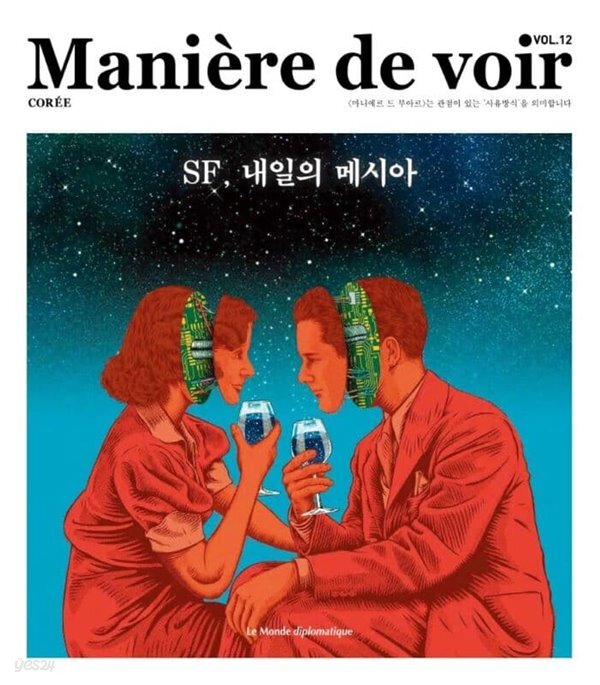
Manières de Bouar (Quarterly): Vol. 12 [2023]
 |
Description
Book Introduction
[Publisher's Review]
In the past, science fiction tended to be somewhat neglected.
I assumed that the readers of this childish novel featuring green dwarves and giant rockets would be teenagers with social issues.
Later, using slightly more toned-down language, he dismissed science fiction as a world for geeks and taciturn bookworms.
Now the contempt for it being considered a minority genre has disappeared, and the perception that it was subtly classified as something for "youth" has also disappeared.
In addition, since 2017, October has been designated as "Month of the Speculative Novel," and with the support of the French National Bibliographic Center, various sales and cultural events are being held to stimulate sales of related works.
Fantasy has been a huge success because it uses general terms that encompass a wide range of literature without sounding childish.
Amidst war and chaos, humanity needs a new science fiction myth.
The Ukraine War, the Israel-Palestine Conflict, the China-India-Pakistan Border War, the Myanmar Civil War, the Western Sahara Conflict, the China-Taiwan Conflict, the Korean Peninsula Crisis, the China-Russia vs. the US-Japan Conflict, the Turkish Earthquake and the Climate Crisis, the Financial Crisis, the Skyrocketing Prices and Hardships of Life, the Economic Recession and Unemployment, Loneliness and Solitude, and Suicide and Murder…
In the 19th century, Victor Hugo questioned, “Will the future ever come?” amidst the continuing, harsh darkness of the French Revolution. However, the modern society in which we live seems poised to collapse at any moment due to the crises that threaten us at every moment.
It is not easy to look ahead to the world 'after' the crisis.
Although humanity can observe galaxies billions of light-years away with the Gaia space telescope, it has no answers about the near future.
Large bookstores are filled with thick philosophical books, essays, and novels that contain humanity's long-standing concerns and reflections, but their content is empty when it comes to finding answers to the current crisis.
I search for novels that most realistically reflect reality, reading works by famous authors or works wrapped in literary award-winning ribbons like gift wrapping paper, but all I find is the dullness of the mediocre notions produced by the "literary powers."
While a stellar track record of winning literary awards or New Year's literary contests may be welcomed in the established literary world, it doesn't seem to be particularly useful in alleviating the anxiety of readers weary from economic hardship, unemployment, loneliness, and isolation.
The utopian yearning for a future that will be different, even if it is more bleak than the present, has led to a surge in science fiction (SF), a genre that conventional literature would find difficult to imagine.
Recently, the most successful and notable works both domestically and internationally are science fiction novels and webtoons that transcend the walls of reality or where reality and fiction intersect.
It is a cultural trend for popular science fiction novels and webtoons to be made into movies or dramas.
The reason young readers and audiences are so enthusiastic about science fiction is because of its provocativeness and revolutionary nature.
James Cameron's series, including , , , , etc., are revolutionary in that they have non-human creatures of the author's imagination solve the sins committed by humans.
Perhaps it feels like an anthropological revolution is blossoming in science fiction.
The appeal of science fiction lies in imagining the impossible, pioneering unknown paths, and twisting reality and facts to expose the contradictions of capitalism.
It may be impossible to break down the wall of capitalism, which is so solid that there is not even a single pinhole.
Just as Alain Badiou and Slavoj Zizek have proposed the communist imagination as a solution to the contradictions of capitalism, perhaps science fiction imagination allows us to forget the bleak reality of the future that lies ahead.
"SF, Tomorrow's Messiah" will present readers with a provocative and revolutionary vision that will lift the curtain of crisis tightly draped over the bleakness of capitalism, offering new possibilities for social transformation.
In the past, science fiction tended to be somewhat neglected.
I assumed that the readers of this childish novel featuring green dwarves and giant rockets would be teenagers with social issues.
Later, using slightly more toned-down language, he dismissed science fiction as a world for geeks and taciturn bookworms.
Now the contempt for it being considered a minority genre has disappeared, and the perception that it was subtly classified as something for "youth" has also disappeared.
In addition, since 2017, October has been designated as "Month of the Speculative Novel," and with the support of the French National Bibliographic Center, various sales and cultural events are being held to stimulate sales of related works.
Fantasy has been a huge success because it uses general terms that encompass a wide range of literature without sounding childish.
Amidst war and chaos, humanity needs a new science fiction myth.
The Ukraine War, the Israel-Palestine Conflict, the China-India-Pakistan Border War, the Myanmar Civil War, the Western Sahara Conflict, the China-Taiwan Conflict, the Korean Peninsula Crisis, the China-Russia vs. the US-Japan Conflict, the Turkish Earthquake and the Climate Crisis, the Financial Crisis, the Skyrocketing Prices and Hardships of Life, the Economic Recession and Unemployment, Loneliness and Solitude, and Suicide and Murder…
In the 19th century, Victor Hugo questioned, “Will the future ever come?” amidst the continuing, harsh darkness of the French Revolution. However, the modern society in which we live seems poised to collapse at any moment due to the crises that threaten us at every moment.
It is not easy to look ahead to the world 'after' the crisis.
Although humanity can observe galaxies billions of light-years away with the Gaia space telescope, it has no answers about the near future.
Large bookstores are filled with thick philosophical books, essays, and novels that contain humanity's long-standing concerns and reflections, but their content is empty when it comes to finding answers to the current crisis.
I search for novels that most realistically reflect reality, reading works by famous authors or works wrapped in literary award-winning ribbons like gift wrapping paper, but all I find is the dullness of the mediocre notions produced by the "literary powers."
While a stellar track record of winning literary awards or New Year's literary contests may be welcomed in the established literary world, it doesn't seem to be particularly useful in alleviating the anxiety of readers weary from economic hardship, unemployment, loneliness, and isolation.
The utopian yearning for a future that will be different, even if it is more bleak than the present, has led to a surge in science fiction (SF), a genre that conventional literature would find difficult to imagine.
Recently, the most successful and notable works both domestically and internationally are science fiction novels and webtoons that transcend the walls of reality or where reality and fiction intersect.
It is a cultural trend for popular science fiction novels and webtoons to be made into movies or dramas.
The reason young readers and audiences are so enthusiastic about science fiction is because of its provocativeness and revolutionary nature.
James Cameron's series, including , , , , etc., are revolutionary in that they have non-human creatures of the author's imagination solve the sins committed by humans.
Perhaps it feels like an anthropological revolution is blossoming in science fiction.
The appeal of science fiction lies in imagining the impossible, pioneering unknown paths, and twisting reality and facts to expose the contradictions of capitalism.
It may be impossible to break down the wall of capitalism, which is so solid that there is not even a single pinhole.
Just as Alain Badiou and Slavoj Zizek have proposed the communist imagination as a solution to the contradictions of capitalism, perhaps science fiction imagination allows us to forget the bleak reality of the future that lies ahead.
"SF, Tomorrow's Messiah" will present readers with a provocative and revolutionary vision that will lift the curtain of crisis tightly draped over the bleakness of capitalism, offering new possibilities for social transformation.
[Publisher's Review]
In the past, science fiction tended to be somewhat neglected.
I assumed that readers of this childish novel featuring green dwarves and giant rockets would be teenagers with social issues.
Later, using slightly more toned-down language, he dismissed science fiction as a world for geeks and taciturn bookworms.
Now the contempt that used to label it as a minority genre has disappeared, and the perception that it was subtly classified as something for "youth" has also disappeared.
In addition, since 2017, October has been designated as "Month of the Speculative Novel," and with the support of the French National Bibliographic Center, various sales and cultural events are being held to stimulate sales of related works.
Fantasy has been a huge success because it uses general terms that encompass a wide range of literature without sounding childish.
Amidst war and chaos, humanity needs a new science fiction myth.
The Ukraine War, the Israel-Palestine Conflict, the China-India-Pakistan Border War, the Myanmar Civil War, the Western Sahara Conflict, the China-Taiwan Conflict, the Korean Peninsula Crisis, the China-Russia vs. the US-Japan Conflict, the Turkish Earthquake and the Climate Crisis, the Financial Crisis, the Skyrocketing Prices and Hardships of Life, the Economic Recession and Unemployment, Loneliness and Solitude, and Suicide and Murder…
In the 19th century, Victor Hugo questioned, “Will the future ever come?” amidst the continuing, harsh darkness of the French Revolution. However, the modern society in which we live seems poised to collapse at any moment due to the crises that threaten us at every moment.
It is not easy to look ahead to the world 'after' the crisis.
Although humanity can observe galaxies billions of light-years away with the Gaia space telescope, it has no answers about the near future.
Large bookstores are filled with thick philosophical books, essays, and novels that contain humanity's long-standing concerns and reflections, but their content is empty when it comes to finding answers to the current crisis.
I search for novels that most realistically reflect reality, reading works by famous authors or works wrapped in literary award-winning ribbons like gift wrapping paper, but all I find is the dullness of the mediocre notions produced by the "literary powers."
While a stellar track record of winning literary awards or New Year's literary contests may be welcomed in the established literary world, it doesn't seem to be particularly useful in alleviating the anxiety of readers weary from economic hardship, unemployment, loneliness, and isolation.
The utopian yearning for a future that will be different, even if it is more bleak than the present, has led to a surge in science fiction (SF), a genre that conventional literature would find difficult to imagine.
Recently, the most successful and notable works both domestically and internationally are science fiction novels and webtoons that transcend the walls of reality or where reality and fiction intersect.
It is a cultural trend for popular science fiction novels and webtoons to be made into movies or dramas.
The reason young readers and audiences are so enthusiastic about science fiction is because of its provocativeness and revolutionary nature.
James Cameron's series, including , , , , etc., are revolutionary in that they have non-human creatures of the author's imagination solve the sins committed by humans.
Perhaps it feels like an anthropological revolution is blossoming in science fiction.
The appeal of science fiction lies in imagining the impossible, pioneering unknown paths, and twisting reality and facts to expose the contradictions of capitalism.
It may be impossible to break down the wall of capitalism, which is so solid that there is not even a single pinhole.
Just as Alain Badiou and Slavoj Zizek have proposed the communist imagination as a solution to the contradictions of capitalism, perhaps science fiction imagination allows us to forget the bleak reality of the future that lies ahead.
"SF, Tomorrow's Messiah" will present readers with a provocative and revolutionary vision that will lift the curtain of crisis tightly draped over the bleakness of capitalism, offering new possibilities for social transformation.
[Publisher's Review]
In the past, science fiction tended to be somewhat neglected.
I assumed that the readers of this childish novel featuring green dwarves and giant rockets would be teenagers with social issues.
Later, using slightly more toned-down language, he dismissed science fiction as a world for geeks and taciturn bookworms.
Now the contempt that used to label it as a minority genre has disappeared, and the perception that it was subtly classified as something for "youth" has also disappeared.
In addition, since 2017, October has been designated as "Month of the Speculative Novel," and with the support of the French National Bibliographic Center, various sales and cultural events are being held to stimulate sales of related works.
Fantasy has been a huge success because it uses general terms that encompass a wide range of literature without sounding childish.
Amidst war and chaos, humanity needs a new science fiction myth.
The Ukraine War, the Israel-Palestine Conflict, the China-India-Pakistan Border War, the Myanmar Civil War, the Western Sahara Conflict, the China-Taiwan Conflict, the Korean Peninsula Crisis, the China-Russia vs. the US-Japan Conflict, the Turkish Earthquake and the Climate Crisis, the Financial Crisis, the Skyrocketing Prices and Hardships of Life, the Economic Recession and Unemployment, Loneliness and Solitude, and Suicide and Murder…
In the 19th century, Victor Hugo questioned, “Will the future ever come?” amidst the continuing, harsh darkness of the French Revolution. However, the modern society in which we live seems poised to collapse at any moment due to the crises that threaten us at every moment.
It is not easy to look ahead to the world 'after' the crisis.
Although humanity can observe galaxies billions of light-years away with the Gaia space telescope, it has no answers about the near future.
Large bookstores are filled with thick philosophical books, essays, and novels that contain humanity's long-standing concerns and reflections, but their content is empty when it comes to finding answers to the current crisis.
I search for novels that most realistically reflect reality, reading works by famous authors or works wrapped in literary award-winning ribbons like gift wrapping paper, but all I find is the dullness of the mediocre notions produced by the "literary powers."
While a stellar track record of winning literary awards or New Year's literary contests may be welcomed in the established literary world, it doesn't seem to be particularly useful in alleviating the anxiety of readers weary from economic hardship, unemployment, loneliness, and isolation.
The utopian yearning for a future that will be different, even if it is more bleak than the present, has led to a surge in science fiction (SF), a genre that conventional literature would find difficult to imagine.
Recently, the most successful and notable works both domestically and internationally are science fiction novels and webtoons that transcend the walls of reality or where reality and fiction intersect.
It is a cultural trend for popular science fiction novels and webtoons to be made into movies or dramas.
The reason young readers and audiences are so enthusiastic about science fiction is because of its provocativeness and revolutionary nature.
James Cameron's series, including , , , , etc., are revolutionary in that they have non-human creatures of the author's imagination solve the sins committed by humans.
Perhaps it feels like an anthropological revolution is blossoming in science fiction.
The appeal of science fiction lies in imagining the impossible, pioneering unknown paths, and twisting reality and facts to expose the contradictions of capitalism.
It may be impossible to break down the wall of capitalism, which is so solid that there is not even a single pinhole.
Just as Alain Badiou and Slavoj Zizek have proposed the communist imagination as a solution to the contradictions of capitalism, perhaps science fiction imagination allows us to forget the bleak reality of the future that lies ahead.
"SF, Tomorrow's Messiah" will present readers with a provocative and revolutionary vision that will lift the curtain of crisis tightly draped over the bleakness of capitalism, offering new possibilities for social transformation.
In the past, science fiction tended to be somewhat neglected.
I assumed that readers of this childish novel featuring green dwarves and giant rockets would be teenagers with social issues.
Later, using slightly more toned-down language, he dismissed science fiction as a world for geeks and taciturn bookworms.
Now the contempt that used to label it as a minority genre has disappeared, and the perception that it was subtly classified as something for "youth" has also disappeared.
In addition, since 2017, October has been designated as "Month of the Speculative Novel," and with the support of the French National Bibliographic Center, various sales and cultural events are being held to stimulate sales of related works.
Fantasy has been a huge success because it uses general terms that encompass a wide range of literature without sounding childish.
Amidst war and chaos, humanity needs a new science fiction myth.
The Ukraine War, the Israel-Palestine Conflict, the China-India-Pakistan Border War, the Myanmar Civil War, the Western Sahara Conflict, the China-Taiwan Conflict, the Korean Peninsula Crisis, the China-Russia vs. the US-Japan Conflict, the Turkish Earthquake and the Climate Crisis, the Financial Crisis, the Skyrocketing Prices and Hardships of Life, the Economic Recession and Unemployment, Loneliness and Solitude, and Suicide and Murder…
In the 19th century, Victor Hugo questioned, “Will the future ever come?” amidst the continuing, harsh darkness of the French Revolution. However, the modern society in which we live seems poised to collapse at any moment due to the crises that threaten us at every moment.
It is not easy to look ahead to the world 'after' the crisis.
Although humanity can observe galaxies billions of light-years away with the Gaia space telescope, it has no answers about the near future.
Large bookstores are filled with thick philosophical books, essays, and novels that contain humanity's long-standing concerns and reflections, but their content is empty when it comes to finding answers to the current crisis.
I search for novels that most realistically reflect reality, reading works by famous authors or works wrapped in literary award-winning ribbons like gift wrapping paper, but all I find is the dullness of the mediocre notions produced by the "literary powers."
While a stellar track record of winning literary awards or New Year's literary contests may be welcomed in the established literary world, it doesn't seem to be particularly useful in alleviating the anxiety of readers weary from economic hardship, unemployment, loneliness, and isolation.
The utopian yearning for a future that will be different, even if it is more bleak than the present, has led to a surge in science fiction (SF), a genre that conventional literature would find difficult to imagine.
Recently, the most successful and notable works both domestically and internationally are science fiction novels and webtoons that transcend the walls of reality or where reality and fiction intersect.
It is a cultural trend for popular science fiction novels and webtoons to be made into movies or dramas.
The reason young readers and audiences are so enthusiastic about science fiction is because of its provocativeness and revolutionary nature.
James Cameron's series, including , , , , etc., are revolutionary in that they have non-human creatures of the author's imagination solve the sins committed by humans.
Perhaps it feels like an anthropological revolution is blossoming in science fiction.
The appeal of science fiction lies in imagining the impossible, pioneering unknown paths, and twisting reality and facts to expose the contradictions of capitalism.
It may be impossible to break down the wall of capitalism, which is so solid that there is not even a single pinhole.
Just as Alain Badiou and Slavoj Zizek have proposed the communist imagination as a solution to the contradictions of capitalism, perhaps science fiction imagination allows us to forget the bleak reality of the future that lies ahead.
"SF, Tomorrow's Messiah" will present readers with a provocative and revolutionary vision that will lift the curtain of crisis tightly draped over the bleakness of capitalism, offering new possibilities for social transformation.
[Publisher's Review]
In the past, science fiction tended to be somewhat neglected.
I assumed that the readers of this childish novel featuring green dwarves and giant rockets would be teenagers with social issues.
Later, using slightly more toned-down language, he dismissed science fiction as a world for geeks and taciturn bookworms.
Now the contempt that used to label it as a minority genre has disappeared, and the perception that it was subtly classified as something for "youth" has also disappeared.
In addition, since 2017, October has been designated as "Month of the Speculative Novel," and with the support of the French National Bibliographic Center, various sales and cultural events are being held to stimulate sales of related works.
Fantasy has been a huge success because it uses general terms that encompass a wide range of literature without sounding childish.
Amidst war and chaos, humanity needs a new science fiction myth.
The Ukraine War, the Israel-Palestine Conflict, the China-India-Pakistan Border War, the Myanmar Civil War, the Western Sahara Conflict, the China-Taiwan Conflict, the Korean Peninsula Crisis, the China-Russia vs. the US-Japan Conflict, the Turkish Earthquake and the Climate Crisis, the Financial Crisis, the Skyrocketing Prices and Hardships of Life, the Economic Recession and Unemployment, Loneliness and Solitude, and Suicide and Murder…
In the 19th century, Victor Hugo questioned, “Will the future ever come?” amidst the continuing, harsh darkness of the French Revolution. However, the modern society in which we live seems poised to collapse at any moment due to the crises that threaten us at every moment.
It is not easy to look ahead to the world 'after' the crisis.
Although humanity can observe galaxies billions of light-years away with the Gaia space telescope, it has no answers about the near future.
Large bookstores are filled with thick philosophical books, essays, and novels that contain humanity's long-standing concerns and reflections, but their content is empty when it comes to finding answers to the current crisis.
I search for novels that most realistically reflect reality, reading works by famous authors or works wrapped in literary award-winning ribbons like gift wrapping paper, but all I find is the dullness of the mediocre notions produced by the "literary powers."
While a stellar track record of winning literary awards or New Year's literary contests may be welcomed in the established literary world, it doesn't seem to be particularly useful in alleviating the anxiety of readers weary from economic hardship, unemployment, loneliness, and isolation.
The utopian yearning for a future that will be different, even if it is more bleak than the present, has led to a surge in science fiction (SF), a genre that conventional literature would find difficult to imagine.
Recently, the most successful and notable works both domestically and internationally are science fiction novels and webtoons that transcend the walls of reality or where reality and fiction intersect.
It is a cultural trend for popular science fiction novels and webtoons to be made into movies or dramas.
The reason young readers and audiences are so enthusiastic about science fiction is because of its provocativeness and revolutionary nature.
James Cameron's series, including , , , , etc., are revolutionary in that they have non-human creatures of the author's imagination solve the sins committed by humans.
Perhaps it feels like an anthropological revolution is blossoming in science fiction.
The appeal of science fiction lies in imagining the impossible, pioneering unknown paths, and twisting reality and facts to expose the contradictions of capitalism.
It may be impossible to break down the wall of capitalism, which is so solid that there is not even a single pinhole.
Just as Alain Badiou and Slavoj Zizek have proposed the communist imagination as a solution to the contradictions of capitalism, perhaps science fiction imagination allows us to forget the bleak reality of the future that lies ahead.
"SF, Tomorrow's Messiah" will present readers with a provocative and revolutionary vision that will lift the curtain of crisis tightly draped over the bleakness of capitalism, offering new possibilities for social transformation.
[Book Introduction]
Le Monde Korea's quarterly magazine, Le Monde Diplomatique, was launched in November 1987 as a bimonthly magazine by Le Monde's subsidiary, Le Monde Diplomatique. Since then, it has focused on diagnosing one theme per issue across various fields, including culture and arts, climate change, ecology, gender, animals, energy, resources, international conflicts, conspiracies, religion, and popular music.
It has been loved as a must-read for French baccalaureate students, university students, graduate students, and researchers.
The Korean version has been published to great acclaim as a quarterly magazine since last fall.
[Book Introduction]
Le Monde Korea's quarterly magazine, Le Monde Diplomatique, was launched in November 1987 as a bimonthly magazine by Le Monde's subsidiary, Le Monde Diplomatique. Since then, it has focused on diagnosing one theme per issue across various fields, including culture and arts, climate change, ecology, gender, animals, energy, resources, international conflicts, conspiracies, religion, and popular music.
It has been loved as a must-read for French baccalaureate students, university students, graduate students, and researchers.
The Korean version has been published to great acclaim as a quarterly magazine since last fall.
Le Monde Korea's quarterly magazine, Le Monde Diplomatique, was launched in November 1987 as a bimonthly magazine by Le Monde's subsidiary, Le Monde Diplomatique. Since then, it has focused on diagnosing one theme per issue across various fields, including culture and arts, climate change, ecology, gender, animals, energy, resources, international conflicts, conspiracies, religion, and popular music.
It has been loved as a must-read for French baccalaureate students, university students, graduate students, and researchers.
The Korean version has been published to great acclaim as a quarterly magazine since last fall.
[Book Introduction]
Le Monde Korea's quarterly magazine, Le Monde Diplomatique, was launched in November 1987 as a bimonthly magazine by Le Monde's subsidiary, Le Monde Diplomatique. Since then, it has focused on diagnosing one theme per issue across various fields, including culture and arts, climate change, ecology, gender, animals, energy, resources, international conflicts, conspiracies, religion, and popular music.
It has been loved as a must-read for French baccalaureate students, university students, graduate students, and researchers.
The Korean version has been published to great acclaim as a quarterly magazine since last fall.
[About the Author]
♣ Evelyne Pieiller

♣ Evelyne Pieiller
Detailed image
GOODS SPECIFICS
- Date of issue: July 17, 2023
- Page count, weight, size: 200 pages | 210*240mm
- ISBN13: 9791192618340
You may also like
카테고리
korean


korean

![GQ KOREA Mark (Monthly): December [2025]](http://librairie.coreenne.fr/cdn/shop/files/8ef265dbbfbf186523ed75ba7319009d.jpg?v=1765340328&width=3840)


