

Top 1 Non-Fiction Reading Background Knowledge Volume 1
 |
Description
Book Introduction
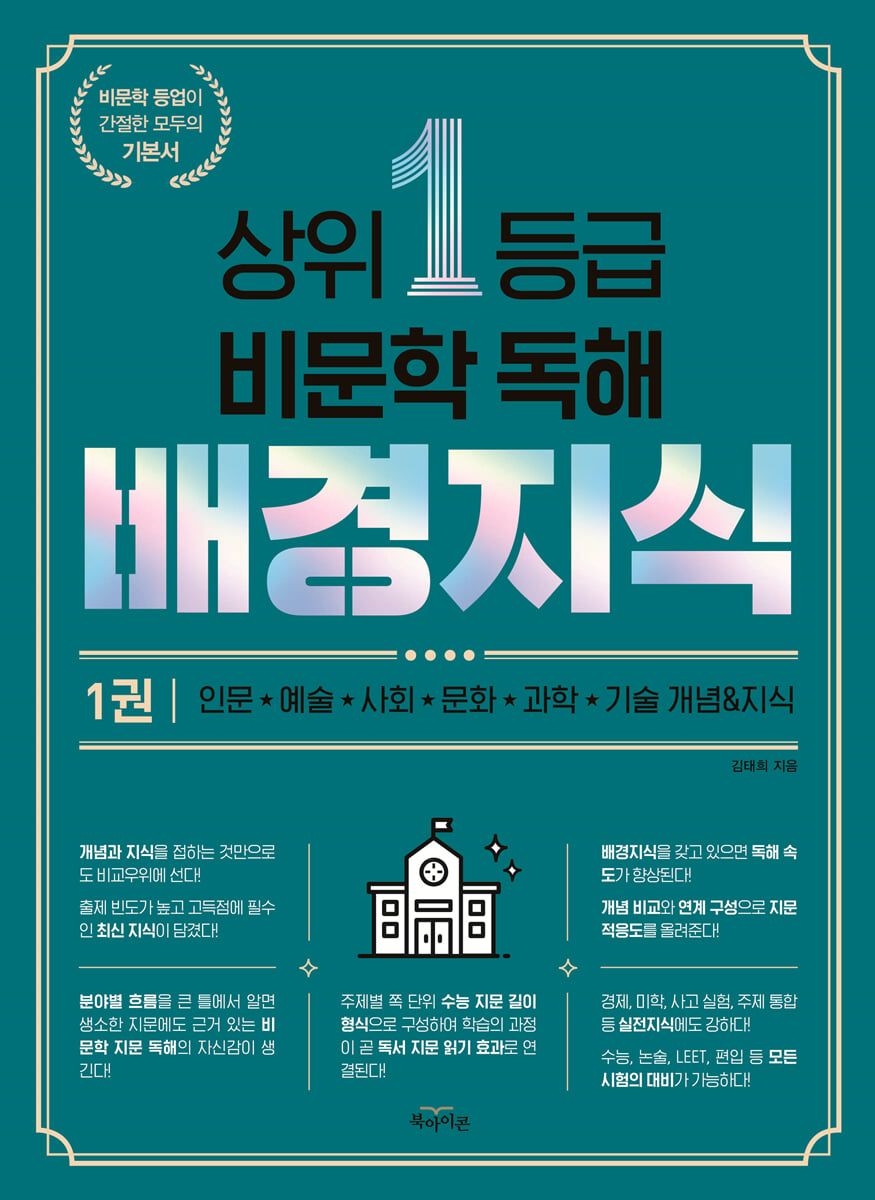
Just being exposed to concepts and knowledge will give you a comparative advantage!
Contains the latest knowledge that is frequently tested and essential for achieving high scores!
If you understand the general flow of each field, you will gain confidence in reading non-fiction texts based on facts, even if they are unfamiliar.
By organizing the length of the college entrance exam passages by topic, the learning process is directly connected to the effect of reading the reading passages.
It enables systematic learning and fundamental understanding by concentrating background knowledge in humanities and arts, society and culture, and science and technology.
Learning concepts and knowledge is the process of reading comprehension practice, and reading comprehension becomes effective.
By learning the expected background knowledge of the questions on the exam, you can prepare for all exams, including the CSAT, essay test, LEET, transfer exam, and civil service exam.
It contains the latest concepts of modern thought that are increasingly appearing on exams and are essential for achieving high scores.
Adaptability to texts can be improved by learning the length of texts in the form of concepts, page-by-page comparisons, and thematic sections.
It is composed of practical knowledge such as philosophical thought, artistic aesthetic theory, economic principles, thought experiments, and topic integration.
Contains the latest knowledge that is frequently tested and essential for achieving high scores!
If you understand the general flow of each field, you will gain confidence in reading non-fiction texts based on facts, even if they are unfamiliar.
By organizing the length of the college entrance exam passages by topic, the learning process is directly connected to the effect of reading the reading passages.
It enables systematic learning and fundamental understanding by concentrating background knowledge in humanities and arts, society and culture, and science and technology.
Learning concepts and knowledge is the process of reading comprehension practice, and reading comprehension becomes effective.
By learning the expected background knowledge of the questions on the exam, you can prepare for all exams, including the CSAT, essay test, LEET, transfer exam, and civil service exam.
It contains the latest concepts of modern thought that are increasingly appearing on exams and are essential for achieving high scores.
Adaptability to texts can be improved by learning the length of texts in the form of concepts, page-by-page comparisons, and thematic sections.
It is composed of practical knowledge such as philosophical thought, artistic aesthetic theory, economic principles, thought experiments, and topic integration.
index
Preface - Genealogy of Philosophy and Thought
01 The flow of Western philosophical thought
02 The flow of ancient Western philosophical thought
03 The flow of Western modern philosophical thought
04 Five Thinkers Who Led 20th-Century Western Modern Philosophy
05 Central Thinkers of Western Modern and Contemporary Philosophy
06 The ideological currents of phenomenology, existentialism, and structuralism
07 Currents of Thought in Modern Analytical Philosophy and Philosophy of Science
〈Table of Contents, Volume 2〉
1.
All the isms of the world, --Ron 50
01 Platonism
02 Aristotelianism
03 Neoplatonism
04 Rationalism
05 Empiricism
06 Idealism
07 Materialism
08 Realism
09 Nominalism
10 Epistemology
11 Ontology
12 Monism and Dualism
13 Skepticism
14 Determinism
15 Teleology and Mechanism
16 Relativism
17 Liberalism
18 Utilitarianism
19 Individualism
20 Totalitarianism
21 Democracy
22 Socialism
23 Conservatism
24 Progressivism
25 Republicanism
26 Nationalism
27 Multiculturalism
28 Orientalism
29 Naturalism
30 Positivism
31 Pragmatism
32 Humanism
33 Phenomenology
34 Existentialism
35 Structuralism
36 Poststructuralism
37 Neo-Marxism
38 Analytical Philosophy
39 Philosophy of Science
40 Philosophy of Mind
41 Psychoanalytic Theory
42 Postmodernism
43 Avant-garde
44 Imitation
45 Metaethics
46 Game Theory
47 Reductionism
48 Paradigm Theory
49 Theory of Relativity
50 Quantum Mechanics
2.
Concept vs. Concept, Knowledge vs. Knowledge Comparison 50
01 Understanding Human Nature (1): Two Views of Humanity in History - Rational and Social Nature and Impulsive and Selfish Nature / Humanities and Arts
02 Understanding Human Nature (2): Evolutionary Biological Perspective - Selfishness, Altruism, Reciprocal Altruism / Humanities and Arts
03 Motivation of Human Behavior (1): Free Will and Determinism / Humanities and Arts
04 Motivation of Human Behavior (2): Rational Rationality and Bounded Rationality/Humanities and Arts
05 Motivation of Human Behavior (3): Moral Man and Immoral Society/Humanities and Arts
06 Proof of God's Existence: Ontological Proof, Teleological Proof, Cosmological Proof, Moral Proof, Anthropological Proof/Humanities and Arts
07 Three Methods of Epistemological Semantics: Objective Cognition, Subjective Cognition, and Phenomenological Cognition/Humanities and Arts
08 Three Perspectives on Mind-Body Dualism: Interactionism, Parallelism, and Epiphenomenalism / Humanities and Arts
09 Three theories of truth judgment: correspondence theory, coherence theory, and pragmatic theory / Humanities and Arts
10 Various Perspectives on Relativism: Epistemological Relativism, Ethical Relativism, Scientific Relativism, Cultural Relativism/Humanities and Arts
11 The Essence of the Mind: Substance Theory, Action Theory, Holistic Theory / Humanities and Arts
12 Irrationalist Perspectives on Truth: Philosophy of Life and Hermeneutics/Humanities and Arts
13 Eastern and Western Perceptions of Essence and Substance: Form and Matter, Reason and Energy / Humanities and Arts
14 Judgmental Ability: Factual Judgment, Value Judgment, Moral Judgment/Humanities and Arts
15 Moral Theories: Teleological Ethics (Consequentialism) and Deontological Ethics (Motivationalism) / Humanities and Arts
16 Basic Principles of Logical Thinking: The Law of Identity, the Law of Contradiction, and the Law of the Excluded Middle/Humanities and Arts
17 Two Variables of Logical Interpretation: Correlation and Causality / Humanities and Arts
18 Two Aspects of Correct Argumentation: Deductive and Inductive Reasoning/Humanities and Arts
19 Two Principles of Artistic Reproduction: Similarity and Analogy/Humanities and Arts
20 Three Perspectives on the Recognition of Works of Art: Mimeticism, Expressionism, and Formalism/Humanities and Arts
21 Classification of Modern Art: Abstract Art, Figurative Art, and Non-Figurative Art / Humanities and Arts
22 Understanding Modern Society: Pluralism and Communitarian Pluralism/Humanities and Arts
23 Various interpretations of popular culture: class culture theory, ideology theory, popular culture theory, hegemony theory/ Society and culture
24 Compatibility of Freedom and Equality: Equality of Opportunity and Equality of Outcome/Society and Culture
25 Perspectives on Justice: Formal Justice, Substantive Justice, Justice as Fairness/Society and Culture
26 Three perspectives on distributive justice: liberalism, utilitarianism, and egalitarianism/Society and culture
27 Two Perspectives on Decision-Making: Groupthink and Collective Intelligence/Society and Culture
28 Three theories for understanding social and cultural phenomena: functionalism, conflict theory, and symbolic interactionism/Society and Culture
29 Two Theories for Understanding Society: Social Realism and Social Nominalism/Society and Culture
30 Various Perspectives on National Identity: Fundamentalism, Situationism, and Historical Culturalism/Society and Culture
31 Two Aspects of Cost-Benefit Analysis (1): Opportunity Cost and Discount Rate/Society and Culture
32 Two Aspects of Cost-Benefit Analysis (2): Present Value and Future Value/Society and Culture
33 The Impact of Increased Government Spending on Economic Growth: Multiplier and Crowding-Out Effects/Society and Culture
34 Historical Perception: Facts and Interpretation/Society and Culture
35 Perspectives on Law: Commands, Norms, Authority/Society and Culture
36 The Purpose of Punishment from an Ethical Perspective: Retributivism and Preventiveism/Society and Culture
37 Three Perspectives on International Society: Realism, Liberalism, and Structuralism/Society and Culture
38 Perspectives on Science and Technology: Instrumentalism, Technological Determinism, Social Determinism/ Science and Technology
39 Two Methods of Scientific Truth-Seeking: Essentialist View of Science and Modern Philosophy of Science/Science and Technology
40 Scientific Inquiry Methods: Inductive Methodology, Hypothetico-Deductive Methodology, Falsificationist Methodology/ Science and Technology
41 Four Aspects of Modern Scientific Theory: Popper's Falsificationism, Kuhn's Theory of Scientific Revolutions, Lakatos's Rational Eclecticism, and Feyerabend's Methodological Pluralism/ Science and Technology
42 Information Transmission Methods: The Difference Between Digital and Analog / Science and Technology
43 Two Perspectives on Scientific Realism: Scientific Realism and Anti-Realism/ Science and Technology
44 Distinguishing Science from Non-Science: Verifiability and Falsifiability / Science and Technology
45 Constant concepts in science: physical constants, gravitational constant, Hubble constant/ Science and Technology
46 Three Aspects of Constructivism: Constructivist Research Paradigm, Social Constructivism, Constructivist Learning Theory/Science and Technology
47 Research Methodology in Human Behavior: Understanding and Explaining / Science and Technology
48 The Reality of Light: Particle Theory and Wave Theory / Science and Technology
49 The four fundamental forces of nature: gravity, electromagnetism, strong force, and weak force/ Science and Technology
50 Spatial Concepts: Three-Dimensional and Four-Dimensional Space/ Science and Technology
3.
The World's Fundamental Questions and Answers 20
01 Humans: Plato, Aristotle, Aquinas, Hobbes, Hume, Kant, Marx, Freud, Sartre, Cassirer
02 Universals: Plato and Aristotle/ Aquinas/ Hobbes/ Kant/ Marcuse
03 Essence: Plato/Aristotle/Spinoza/Locke/Husserl/Derrida
04 Entity: Aristotle/ Descartes/ Spinoza/ Locke/ Leibniz
05 Ideas: Plato/ Descartes/ Locke/ Hume/ Kant/ Hegel
06 Perception: Heraclitus/Plato/Descartes/Locke/Kant/Sartre
07 Perception: Empedocles/ Locke/ Berkeley/ Merleau-Ponty
08 Existence: Parmenides/Aristotle/Descartes/Spinoza/Heidegger/Lacan
09 Truth: Socrates/Aquinas/Hegel/Nietzsche/James
10 Reason: Plato/Aristotle/Descartes/Kant/Hegel/Adorno/Horkheimer
11. Mind: Anaxagoras/Plato/Descartes/Spinoza/Hegel/Ryle
12 Power: Plato/Machiavelli/Hobbes/Arendt/Foucault/Habermas
13 Definitions: Aristotle/Rousseau/Mill/Raws/Nozick/Walzer
14 Freedom: Spinoza/Kant/Hegel/Mill/Sartre/Isaiah Berlin
15 Languages: Frege/Saussure/Heidegger/Wittgenstein/Derrida
16 Beauty: Plato/Aristotle/Kant/Hegel/Benjamin
17 Hours: Augustine/Kant/Hegel/Bergson/Einstein/Merleau-Ponty
18 Love: Plato/ Spinoza/ Schopenhauer/ Bataille/ Martha Nussbaum/ Erich Fromm
19 Happiness: Aristotle/Epicurus/Augustine/Spinoza/Adam Smith/Kant/Mill
20 Death: Plato/Epicurus/Kierkegaard/Heidegger/Sartre
4.
50 Key Words of Modern Thought
01 The Core of 21st Century Thought - The Ontological Turn
02 Negative Dialectics… Theodor Adorno
03 Gestel… Martin Heidegger
04 Episteme… Michel Foucault
05 Multitude… Antonio Negri and Michael Hart
06 Ideology…Louis Althusser
07 Grammatology… Jacques Derrida
08 Rhizome… Gilles Deleuze and Felix Guattari
09 Simulacra… Gilles Deleuze and Jean Baudrillard
10 Myths… Roland Barthes
11. The Ethics of the Other… Emmanuel Levinas
12 Anti-Intellectualism … Richard Hofstadter
13 Effective Altruism… Peter Singer
14 Posthumanism… Rosi Braidotti
15 Transhumanism… Nick Bostrom
16 The Anthropocene… Paul Crutzen
17 Speculative Realism… Quentin Meillassoux
18 Neorealism… Marcus Gabriel
19. Non-materialism… Graham Harman
20 New Materialism … Manuel DeLanda and Rosi Braidotti
21 Functionalism… David Armstrong
22 Eliminationism… Paul Churchland
23 Naturalistic Dualism … David Chalmers
24 Biological Naturalism… John Rogers
25 Affordances… James Gibson
26 Modal Semantics … Saul Kripke
27 Gettier Problem… Edmund Gettier
28 Frame Problem… Daniel Dennett
29 Semantic Externalism… Hilary Putnam
30 Habitus… Pierre Bourdieu
31. The Justice of the Hitters… Axel Honneth
32 Antifragile… Nassim Taleb
33 Conceptual Hybridity… Jill Fauconnier and Mark Turner
34 Social Systems Theory… Nicholas Luhmann
35 The Collective Unconscious… Carl Gustav Jung
36 Mirror Stages… Jacques Lacan
37 Senkonomics… Amartya Sen
38 Homo Deus… Yuval Harari
39 Historical Apriori … Friedrich Kittler
40 Homo Sacer … Giorgio Agamben
41 Sharing Economy…Laurence Lessig
42 Singularity… Ray Kurzweil
43 Hours of Unreality… John McTaggart
44 Xenofeminism… Laboria Cubenics Group
45 Neo-Pragmatism… Richard Rorty
46 Filter Bubble… Ellie Fraser
47 Anti-Natalism… David Beneita
48 Feminist Art Theory… Estella Lotter
49 Speech Acts … John Austin
50 Intension and Extension… Louis Elmslev
01 The flow of Western philosophical thought
02 The flow of ancient Western philosophical thought
03 The flow of Western modern philosophical thought
04 Five Thinkers Who Led 20th-Century Western Modern Philosophy
05 Central Thinkers of Western Modern and Contemporary Philosophy
06 The ideological currents of phenomenology, existentialism, and structuralism
07 Currents of Thought in Modern Analytical Philosophy and Philosophy of Science
〈Table of Contents, Volume 2〉
1.
All the isms of the world, --Ron 50
01 Platonism
02 Aristotelianism
03 Neoplatonism
04 Rationalism
05 Empiricism
06 Idealism
07 Materialism
08 Realism
09 Nominalism
10 Epistemology
11 Ontology
12 Monism and Dualism
13 Skepticism
14 Determinism
15 Teleology and Mechanism
16 Relativism
17 Liberalism
18 Utilitarianism
19 Individualism
20 Totalitarianism
21 Democracy
22 Socialism
23 Conservatism
24 Progressivism
25 Republicanism
26 Nationalism
27 Multiculturalism
28 Orientalism
29 Naturalism
30 Positivism
31 Pragmatism
32 Humanism
33 Phenomenology
34 Existentialism
35 Structuralism
36 Poststructuralism
37 Neo-Marxism
38 Analytical Philosophy
39 Philosophy of Science
40 Philosophy of Mind
41 Psychoanalytic Theory
42 Postmodernism
43 Avant-garde
44 Imitation
45 Metaethics
46 Game Theory
47 Reductionism
48 Paradigm Theory
49 Theory of Relativity
50 Quantum Mechanics
2.
Concept vs. Concept, Knowledge vs. Knowledge Comparison 50
01 Understanding Human Nature (1): Two Views of Humanity in History - Rational and Social Nature and Impulsive and Selfish Nature / Humanities and Arts
02 Understanding Human Nature (2): Evolutionary Biological Perspective - Selfishness, Altruism, Reciprocal Altruism / Humanities and Arts
03 Motivation of Human Behavior (1): Free Will and Determinism / Humanities and Arts
04 Motivation of Human Behavior (2): Rational Rationality and Bounded Rationality/Humanities and Arts
05 Motivation of Human Behavior (3): Moral Man and Immoral Society/Humanities and Arts
06 Proof of God's Existence: Ontological Proof, Teleological Proof, Cosmological Proof, Moral Proof, Anthropological Proof/Humanities and Arts
07 Three Methods of Epistemological Semantics: Objective Cognition, Subjective Cognition, and Phenomenological Cognition/Humanities and Arts
08 Three Perspectives on Mind-Body Dualism: Interactionism, Parallelism, and Epiphenomenalism / Humanities and Arts
09 Three theories of truth judgment: correspondence theory, coherence theory, and pragmatic theory / Humanities and Arts
10 Various Perspectives on Relativism: Epistemological Relativism, Ethical Relativism, Scientific Relativism, Cultural Relativism/Humanities and Arts
11 The Essence of the Mind: Substance Theory, Action Theory, Holistic Theory / Humanities and Arts
12 Irrationalist Perspectives on Truth: Philosophy of Life and Hermeneutics/Humanities and Arts
13 Eastern and Western Perceptions of Essence and Substance: Form and Matter, Reason and Energy / Humanities and Arts
14 Judgmental Ability: Factual Judgment, Value Judgment, Moral Judgment/Humanities and Arts
15 Moral Theories: Teleological Ethics (Consequentialism) and Deontological Ethics (Motivationalism) / Humanities and Arts
16 Basic Principles of Logical Thinking: The Law of Identity, the Law of Contradiction, and the Law of the Excluded Middle/Humanities and Arts
17 Two Variables of Logical Interpretation: Correlation and Causality / Humanities and Arts
18 Two Aspects of Correct Argumentation: Deductive and Inductive Reasoning/Humanities and Arts
19 Two Principles of Artistic Reproduction: Similarity and Analogy/Humanities and Arts
20 Three Perspectives on the Recognition of Works of Art: Mimeticism, Expressionism, and Formalism/Humanities and Arts
21 Classification of Modern Art: Abstract Art, Figurative Art, and Non-Figurative Art / Humanities and Arts
22 Understanding Modern Society: Pluralism and Communitarian Pluralism/Humanities and Arts
23 Various interpretations of popular culture: class culture theory, ideology theory, popular culture theory, hegemony theory/ Society and culture
24 Compatibility of Freedom and Equality: Equality of Opportunity and Equality of Outcome/Society and Culture
25 Perspectives on Justice: Formal Justice, Substantive Justice, Justice as Fairness/Society and Culture
26 Three perspectives on distributive justice: liberalism, utilitarianism, and egalitarianism/Society and culture
27 Two Perspectives on Decision-Making: Groupthink and Collective Intelligence/Society and Culture
28 Three theories for understanding social and cultural phenomena: functionalism, conflict theory, and symbolic interactionism/Society and Culture
29 Two Theories for Understanding Society: Social Realism and Social Nominalism/Society and Culture
30 Various Perspectives on National Identity: Fundamentalism, Situationism, and Historical Culturalism/Society and Culture
31 Two Aspects of Cost-Benefit Analysis (1): Opportunity Cost and Discount Rate/Society and Culture
32 Two Aspects of Cost-Benefit Analysis (2): Present Value and Future Value/Society and Culture
33 The Impact of Increased Government Spending on Economic Growth: Multiplier and Crowding-Out Effects/Society and Culture
34 Historical Perception: Facts and Interpretation/Society and Culture
35 Perspectives on Law: Commands, Norms, Authority/Society and Culture
36 The Purpose of Punishment from an Ethical Perspective: Retributivism and Preventiveism/Society and Culture
37 Three Perspectives on International Society: Realism, Liberalism, and Structuralism/Society and Culture
38 Perspectives on Science and Technology: Instrumentalism, Technological Determinism, Social Determinism/ Science and Technology
39 Two Methods of Scientific Truth-Seeking: Essentialist View of Science and Modern Philosophy of Science/Science and Technology
40 Scientific Inquiry Methods: Inductive Methodology, Hypothetico-Deductive Methodology, Falsificationist Methodology/ Science and Technology
41 Four Aspects of Modern Scientific Theory: Popper's Falsificationism, Kuhn's Theory of Scientific Revolutions, Lakatos's Rational Eclecticism, and Feyerabend's Methodological Pluralism/ Science and Technology
42 Information Transmission Methods: The Difference Between Digital and Analog / Science and Technology
43 Two Perspectives on Scientific Realism: Scientific Realism and Anti-Realism/ Science and Technology
44 Distinguishing Science from Non-Science: Verifiability and Falsifiability / Science and Technology
45 Constant concepts in science: physical constants, gravitational constant, Hubble constant/ Science and Technology
46 Three Aspects of Constructivism: Constructivist Research Paradigm, Social Constructivism, Constructivist Learning Theory/Science and Technology
47 Research Methodology in Human Behavior: Understanding and Explaining / Science and Technology
48 The Reality of Light: Particle Theory and Wave Theory / Science and Technology
49 The four fundamental forces of nature: gravity, electromagnetism, strong force, and weak force/ Science and Technology
50 Spatial Concepts: Three-Dimensional and Four-Dimensional Space/ Science and Technology
3.
The World's Fundamental Questions and Answers 20
01 Humans: Plato, Aristotle, Aquinas, Hobbes, Hume, Kant, Marx, Freud, Sartre, Cassirer
02 Universals: Plato and Aristotle/ Aquinas/ Hobbes/ Kant/ Marcuse
03 Essence: Plato/Aristotle/Spinoza/Locke/Husserl/Derrida
04 Entity: Aristotle/ Descartes/ Spinoza/ Locke/ Leibniz
05 Ideas: Plato/ Descartes/ Locke/ Hume/ Kant/ Hegel
06 Perception: Heraclitus/Plato/Descartes/Locke/Kant/Sartre
07 Perception: Empedocles/ Locke/ Berkeley/ Merleau-Ponty
08 Existence: Parmenides/Aristotle/Descartes/Spinoza/Heidegger/Lacan
09 Truth: Socrates/Aquinas/Hegel/Nietzsche/James
10 Reason: Plato/Aristotle/Descartes/Kant/Hegel/Adorno/Horkheimer
11. Mind: Anaxagoras/Plato/Descartes/Spinoza/Hegel/Ryle
12 Power: Plato/Machiavelli/Hobbes/Arendt/Foucault/Habermas
13 Definitions: Aristotle/Rousseau/Mill/Raws/Nozick/Walzer
14 Freedom: Spinoza/Kant/Hegel/Mill/Sartre/Isaiah Berlin
15 Languages: Frege/Saussure/Heidegger/Wittgenstein/Derrida
16 Beauty: Plato/Aristotle/Kant/Hegel/Benjamin
17 Hours: Augustine/Kant/Hegel/Bergson/Einstein/Merleau-Ponty
18 Love: Plato/ Spinoza/ Schopenhauer/ Bataille/ Martha Nussbaum/ Erich Fromm
19 Happiness: Aristotle/Epicurus/Augustine/Spinoza/Adam Smith/Kant/Mill
20 Death: Plato/Epicurus/Kierkegaard/Heidegger/Sartre
4.
50 Key Words of Modern Thought
01 The Core of 21st Century Thought - The Ontological Turn
02 Negative Dialectics… Theodor Adorno
03 Gestel… Martin Heidegger
04 Episteme… Michel Foucault
05 Multitude… Antonio Negri and Michael Hart
06 Ideology…Louis Althusser
07 Grammatology… Jacques Derrida
08 Rhizome… Gilles Deleuze and Felix Guattari
09 Simulacra… Gilles Deleuze and Jean Baudrillard
10 Myths… Roland Barthes
11. The Ethics of the Other… Emmanuel Levinas
12 Anti-Intellectualism … Richard Hofstadter
13 Effective Altruism… Peter Singer
14 Posthumanism… Rosi Braidotti
15 Transhumanism… Nick Bostrom
16 The Anthropocene… Paul Crutzen
17 Speculative Realism… Quentin Meillassoux
18 Neorealism… Marcus Gabriel
19. Non-materialism… Graham Harman
20 New Materialism … Manuel DeLanda and Rosi Braidotti
21 Functionalism… David Armstrong
22 Eliminationism… Paul Churchland
23 Naturalistic Dualism … David Chalmers
24 Biological Naturalism… John Rogers
25 Affordances… James Gibson
26 Modal Semantics … Saul Kripke
27 Gettier Problem… Edmund Gettier
28 Frame Problem… Daniel Dennett
29 Semantic Externalism… Hilary Putnam
30 Habitus… Pierre Bourdieu
31. The Justice of the Hitters… Axel Honneth
32 Antifragile… Nassim Taleb
33 Conceptual Hybridity… Jill Fauconnier and Mark Turner
34 Social Systems Theory… Nicholas Luhmann
35 The Collective Unconscious… Carl Gustav Jung
36 Mirror Stages… Jacques Lacan
37 Senkonomics… Amartya Sen
38 Homo Deus… Yuval Harari
39 Historical Apriori … Friedrich Kittler
40 Homo Sacer … Giorgio Agamben
41 Sharing Economy…Laurence Lessig
42 Singularity… Ray Kurzweil
43 Hours of Unreality… John McTaggart
44 Xenofeminism… Laboria Cubenics Group
45 Neo-Pragmatism… Richard Rorty
46 Filter Bubble… Ellie Fraser
47 Anti-Natalism… David Beneita
48 Feminist Art Theory… Estella Lotter
49 Speech Acts … John Austin
50 Intension and Extension… Louis Elmslev
Publisher's Review
Having background knowledge improves your reading speed!
Increase fingerprint adaptability through concept comparison and linking!
It is also strong in practical knowledge such as economics, aesthetics, thought experiments, and topic integration!
You can prepare for all exams, including the CSAT, essay, LEET, and transfer exams!
1.
Integrate background knowledge in humanities and arts, society and culture, and science and technology to enable systematic learning and fundamental understanding.
The reading section of the CSAT covers a variety of fields, including humanities and arts, society and culture, science and technology, and subject integration.
Accordingly, we have included a comprehensive overview of concepts and knowledge across all reading areas in the Korean language section of the College Scholastic Ability Test.
You will be able to directly see how concepts and concepts, knowledge and knowledge are expanding and diversifying, intertwining and overlapping with each other.
Since the 'context' is located at that point of contact, you will be able to fully understand the concept just by grasping and understanding this.
And you will be able to read any passage that uses different 'subjects' and 'topics' in the CSAT and essay without any difficulty.
2.
Learning concepts and knowledge is the process of reading comprehension practice, which leads to the effect of reading reading passages.
The Korean language section of the CSAT requires background knowledge beyond common sense in all areas of reading.
It can be said that the speed of reading a text is determined by the level of this background knowledge.
Therefore, it is important to learn concepts and knowledge in each reading area to increase your reading speed.
Having some knowledge of the topic will make the text much more visible and easier to interpret.
This book presents and presents the vast knowledge and profound thoughts accumulated over thousands of years of human history, organized by topic into a page-by-page format similar to the length of the CSAT passages, so that the learning process can be directly linked to the effectiveness of reading the passages.
This will help you understand the meaning of any other core concepts you encounter without difficulty.
3.
You can prepare for all exams, including the CSAT, essay test, LEET, transfer exam, and civil service exam, by learning the background knowledge expected on the exam.
When you encounter a passage on an unfamiliar topic in an exam, you may feel confused.
While it's necessary to read a variety of topics on a regular basis, having even a little background knowledge in any field can help you feel more at ease and focus better.
To this end, we have designed the exam so that students can learn background knowledge on past and anticipated exam questions in areas such as humanities, philosophy, arts, science, technology, economics, and subject integration, which they find particularly difficult.
This book not only allows for effective preparation for all subject areas, but also for various exams that require concepts and knowledge, such as the CSAT, essay writing, LEET, transfer, and civil service exams.
4.
Includes the latest concepts of modern thought that are increasingly appearing on the exam and are essential for achieving high scores.
It contains all the latest concepts from modern thinkers.
In fact, the frequency of questions in this section has been increasing recently, and the reason for this is, more than anything else, to make students feel unfamiliar with the content of the text and thus increase their ability to differentiate.
Just being exposed to the content of the text will give you a comparative advantage over other students.
The more concepts like this one, the more background knowledge you need to activate to make the text more readable.
Therefore, it is necessary to make an effort to become familiar with the concepts covered here, and doing so is absolutely necessary to achieve a high score on the CSAT.
5.
Improving text adaptation through concept comparison and linking, and learning the length of the text in a topic-by-topic format.
It is structured so that you can understand how the essential knowledge covered in the curriculum is subdivided and developed according to comparative arguments for each key concept.
If we consider that one important way to logically read a text is to understand the text's contrasting structure, that is, to "compare" the core content of the text with each other, and if we consider that the examiner's intention is actually focused on that part, we must read while examining the layers of comparison.
Just by doing this kind of practice, you will be able to understand how the content of the actual CSAT passages is varied in meaning and expression depending on the concept.
6.
Practical knowledge composition including philosophical thought, aesthetic theory of art, economic principles, thought experiments, and topic integration.
In 'All the Isms of the World' and 'Art Trends and Aesthetic Theories', the flow of thought and theories are understood.
In 'Philosophy of Language and Logic', 'Modern Ethics', 'Oriental Thought', and 'Philosophy of Law', the focus was on establishing a viewpoint through understanding the issues.
In 'Economics,' we have helped students understand concepts and relationships that they find difficult, and in 'Philosophy, Psychology, Science, and Economic Thought Experiments,' we have systematically presented psychological theories, terminology, and various thought experiments.
Through this, it is possible to understand the concepts, perspectives, knowledge, theories, and arguments of each field and discipline, and through comparison of concepts and knowledge, it is possible to gain a perspective on the structure and operating principles of philosophy and thought, art and aesthetics, society and culture, and science and technology.
We also organized the types of topic integration and the importance of learning background knowledge.
Increase fingerprint adaptability through concept comparison and linking!
It is also strong in practical knowledge such as economics, aesthetics, thought experiments, and topic integration!
You can prepare for all exams, including the CSAT, essay, LEET, and transfer exams!
1.
Integrate background knowledge in humanities and arts, society and culture, and science and technology to enable systematic learning and fundamental understanding.
The reading section of the CSAT covers a variety of fields, including humanities and arts, society and culture, science and technology, and subject integration.
Accordingly, we have included a comprehensive overview of concepts and knowledge across all reading areas in the Korean language section of the College Scholastic Ability Test.
You will be able to directly see how concepts and concepts, knowledge and knowledge are expanding and diversifying, intertwining and overlapping with each other.
Since the 'context' is located at that point of contact, you will be able to fully understand the concept just by grasping and understanding this.
And you will be able to read any passage that uses different 'subjects' and 'topics' in the CSAT and essay without any difficulty.
2.
Learning concepts and knowledge is the process of reading comprehension practice, which leads to the effect of reading reading passages.
The Korean language section of the CSAT requires background knowledge beyond common sense in all areas of reading.
It can be said that the speed of reading a text is determined by the level of this background knowledge.
Therefore, it is important to learn concepts and knowledge in each reading area to increase your reading speed.
Having some knowledge of the topic will make the text much more visible and easier to interpret.
This book presents and presents the vast knowledge and profound thoughts accumulated over thousands of years of human history, organized by topic into a page-by-page format similar to the length of the CSAT passages, so that the learning process can be directly linked to the effectiveness of reading the passages.
This will help you understand the meaning of any other core concepts you encounter without difficulty.
3.
You can prepare for all exams, including the CSAT, essay test, LEET, transfer exam, and civil service exam, by learning the background knowledge expected on the exam.
When you encounter a passage on an unfamiliar topic in an exam, you may feel confused.
While it's necessary to read a variety of topics on a regular basis, having even a little background knowledge in any field can help you feel more at ease and focus better.
To this end, we have designed the exam so that students can learn background knowledge on past and anticipated exam questions in areas such as humanities, philosophy, arts, science, technology, economics, and subject integration, which they find particularly difficult.
This book not only allows for effective preparation for all subject areas, but also for various exams that require concepts and knowledge, such as the CSAT, essay writing, LEET, transfer, and civil service exams.
4.
Includes the latest concepts of modern thought that are increasingly appearing on the exam and are essential for achieving high scores.
It contains all the latest concepts from modern thinkers.
In fact, the frequency of questions in this section has been increasing recently, and the reason for this is, more than anything else, to make students feel unfamiliar with the content of the text and thus increase their ability to differentiate.
Just being exposed to the content of the text will give you a comparative advantage over other students.
The more concepts like this one, the more background knowledge you need to activate to make the text more readable.
Therefore, it is necessary to make an effort to become familiar with the concepts covered here, and doing so is absolutely necessary to achieve a high score on the CSAT.
5.
Improving text adaptation through concept comparison and linking, and learning the length of the text in a topic-by-topic format.
It is structured so that you can understand how the essential knowledge covered in the curriculum is subdivided and developed according to comparative arguments for each key concept.
If we consider that one important way to logically read a text is to understand the text's contrasting structure, that is, to "compare" the core content of the text with each other, and if we consider that the examiner's intention is actually focused on that part, we must read while examining the layers of comparison.
Just by doing this kind of practice, you will be able to understand how the content of the actual CSAT passages is varied in meaning and expression depending on the concept.
6.
Practical knowledge composition including philosophical thought, aesthetic theory of art, economic principles, thought experiments, and topic integration.
In 'All the Isms of the World' and 'Art Trends and Aesthetic Theories', the flow of thought and theories are understood.
In 'Philosophy of Language and Logic', 'Modern Ethics', 'Oriental Thought', and 'Philosophy of Law', the focus was on establishing a viewpoint through understanding the issues.
In 'Economics,' we have helped students understand concepts and relationships that they find difficult, and in 'Philosophy, Psychology, Science, and Economic Thought Experiments,' we have systematically presented psychological theories, terminology, and various thought experiments.
Through this, it is possible to understand the concepts, perspectives, knowledge, theories, and arguments of each field and discipline, and through comparison of concepts and knowledge, it is possible to gain a perspective on the structure and operating principles of philosophy and thought, art and aesthetics, society and culture, and science and technology.
We also organized the types of topic integration and the importance of learning background knowledge.
GOODS SPECIFICS
- Publication date: February 14, 2022
- Page count, weight, size: 348 pages | 188*257*30mm
- ISBN13: 9788998160296
- ISBN10: 8998160293
- Reference book for use in grades: High school common
- Reference book usage semester: Common semester
- Reference Difficulty: Hard Reference Difficulty Guide
You may also like
카테고리
korean


korean

![GQ KOREA Mark (Monthly): December [2025]](http://librairie.coreenne.fr/cdn/shop/files/8ef265dbbfbf186523ed75ba7319009d.jpg?v=1765340328&width=3840)


