

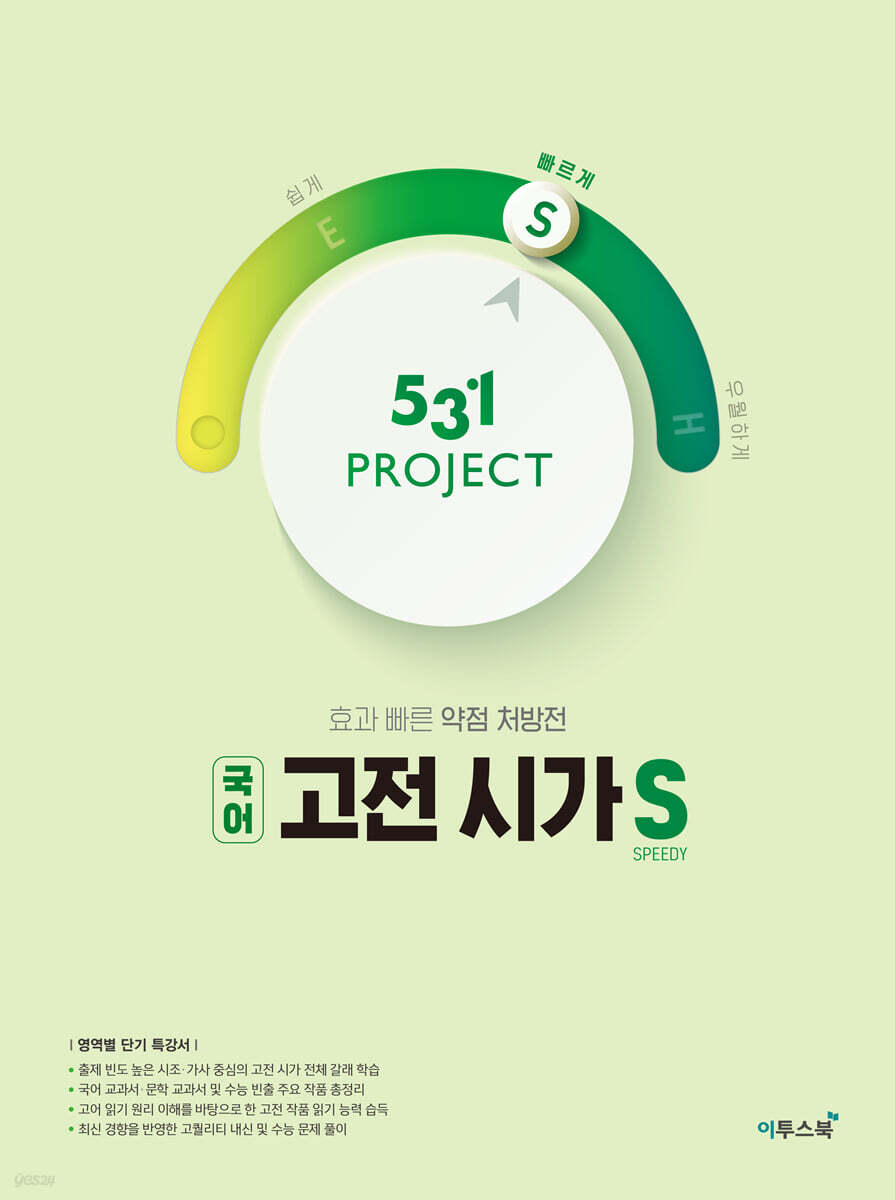
531 Project Korean Classical Poetry S (for 2026)
 |
Description
Book Introduction
Mini-mock exams optimized for developing a sense of reality through short, focused training sessions every day.
With this quick-acting prescription for weaknesses (short-term special lecture), you can complete your study of all branches of classical poetry, focusing on sijo and gasa.
It is possible to compile a comprehensive list of major works frequently appearing in Korean language textbooks, literature textbooks, and college entrance exams, and acquire the ability to read classic works based on an understanding of the principles of reading ancient texts.
High-quality solutions to internal and external exam questions reflecting the latest trends are available.
With this quick-acting prescription for weaknesses (short-term special lecture), you can complete your study of all branches of classical poetry, focusing on sijo and gasa.
It is possible to compile a comprehensive list of major works frequently appearing in Korean language textbooks, literature textbooks, and college entrance exams, and acquire the ability to read classic works based on an understanding of the principles of reading ancient texts.
High-quality solutions to internal and external exam questions reflecting the latest trends are available.
- You can preview some of the book's contents.
Preview
index
● Reading Classical Poetry I~IV
Ⅰ Ancient songs, Hyangga, Goryeo songs, Gyeonggichega, Chinese poetry
Lesson 1: Ancient Songs, Hyangga
Lesson 2: Goryeo songs (Gyeonggi style), Chinese poetry
Ⅱ Sijo
Lesson 3: Sijo 1: Praise of Nature
Lesson 4: Sijo 2: Designation of Yeongun
Lesson 5: Sijo 3: Love, Longing, and Lessons
Lesson 6: Sijo 4: Satire and Humor (Private Sijo)
Ⅲ Lyrics
Lesson 7 Lyrics 1: Praise of Nature
Lesson 8 Lyrics 2: Designation of the Allied Forces
Lesson 9 Lyrics 3: Contentment with One's Own Portion, Rural Life, and Lamenting One's Fate
Lesson 10 Lyrics 4 Lessons, Travels, and Customs
Lesson 11 Lyrics 5: Love, Longing, and Social Satire
Ⅳ Movement, Vernacular, Folk Song
12 movements, translation, folk songs
● [Appendix] Modern language explanations for each work
Ⅰ Ancient songs, Hyangga, Goryeo songs, Gyeonggichega, Chinese poetry
Lesson 1: Ancient Songs, Hyangga
Lesson 2: Goryeo songs (Gyeonggi style), Chinese poetry
Ⅱ Sijo
Lesson 3: Sijo 1: Praise of Nature
Lesson 4: Sijo 2: Designation of Yeongun
Lesson 5: Sijo 3: Love, Longing, and Lessons
Lesson 6: Sijo 4: Satire and Humor (Private Sijo)
Ⅲ Lyrics
Lesson 7 Lyrics 1: Praise of Nature
Lesson 8 Lyrics 2: Designation of the Allied Forces
Lesson 9 Lyrics 3: Contentment with One's Own Portion, Rural Life, and Lamenting One's Fate
Lesson 10 Lyrics 4 Lessons, Travels, and Customs
Lesson 11 Lyrics 5: Love, Longing, and Social Satire
Ⅳ Movement, Vernacular, Folk Song
12 movements, translation, folk songs
● [Appendix] Modern language explanations for each work
Publisher's Review
[Recommended for students like this]
- Students who want to completely master the Korean classical poetry section of the CSAT in a short period of time.
- Students who want to comprehensively examine important classical poetry works, focusing on sijo and gasa.
- Students who want to fully understand classical poetry through reading principles and practice.
- Students who want to prepare for real-life exams by solving internal and external exam questions.
Reading Classical Poetry I-IV
To help you read and understand classical poetry accurately, we have compiled the characteristics of archaic language, archaic reading tips, essential classical vocabulary, and frequently appearing topic vocabulary.
Additionally, the values of our ancestors are presented along with example works to help understand classical poetry.
STEP 1
/ Concepts and characteristics of major branches by era /
By presenting the concepts, characteristics, and representative works of the major branches of each era, we have helped you learn the history of classical poetry and accurately understand the characteristics of each branch.
STEP 2
/ Representative works by genre and theme /
Classical poetry is organized by major genres and eras, and the frequently appearing genres, sijo and gasa, are further divided by subject.
And we selected works that fit each branch and topic and presented CSAT-style questions.
STEP 3
/ Internal exam or college entrance exam practice questions /
By solving past exam questions from representative works that were used in actual school exams, college entrance exams, mock exams, and academic ability assessments, you can understand the exam trends and learn how to approach real-world problems.
Modern language explanations for each work
We present the original text of the work in which Gore was used and provide a modern interpretation of it, so that you can read and compare the original text with the modern interpretation.
We've highlighted key vocabulary for comparison to help you improve your reading skills when reading classical poetry.
[Answer and Explanation]
Detailed and accurate explanations make it easier to understand the work and solve problems.
- Students who want to completely master the Korean classical poetry section of the CSAT in a short period of time.
- Students who want to comprehensively examine important classical poetry works, focusing on sijo and gasa.
- Students who want to fully understand classical poetry through reading principles and practice.
- Students who want to prepare for real-life exams by solving internal and external exam questions.
Reading Classical Poetry I-IV
To help you read and understand classical poetry accurately, we have compiled the characteristics of archaic language, archaic reading tips, essential classical vocabulary, and frequently appearing topic vocabulary.
Additionally, the values of our ancestors are presented along with example works to help understand classical poetry.
STEP 1
/ Concepts and characteristics of major branches by era /
By presenting the concepts, characteristics, and representative works of the major branches of each era, we have helped you learn the history of classical poetry and accurately understand the characteristics of each branch.
STEP 2
/ Representative works by genre and theme /
Classical poetry is organized by major genres and eras, and the frequently appearing genres, sijo and gasa, are further divided by subject.
And we selected works that fit each branch and topic and presented CSAT-style questions.
STEP 3
/ Internal exam or college entrance exam practice questions /
By solving past exam questions from representative works that were used in actual school exams, college entrance exams, mock exams, and academic ability assessments, you can understand the exam trends and learn how to approach real-world problems.
Modern language explanations for each work
We present the original text of the work in which Gore was used and provide a modern interpretation of it, so that you can read and compare the original text with the modern interpretation.
We've highlighted key vocabulary for comparison to help you improve your reading skills when reading classical poetry.
[Answer and Explanation]
Detailed and accurate explanations make it easier to understand the work and solve problems.
GOODS SPECIFICS
- Date of issue: May 31, 2021
- Page count, weight, size: 176 pages | 224*300*20mm
- ISBN13: 9791165987763
- ISBN10: 1165987767
- Reference book for use in grades: High school common
- Reference book usage semester: Common semester
- Reference book difficulty: Medium Reference book difficulty guide
You may also like
카테고리
korean


korean

![GQ KOREA Mark (Monthly): December [2025]](http://librairie.coreenne.fr/cdn/shop/files/8ef265dbbfbf186523ed75ba7319009d.jpg?v=1765340328&width=3840)


