

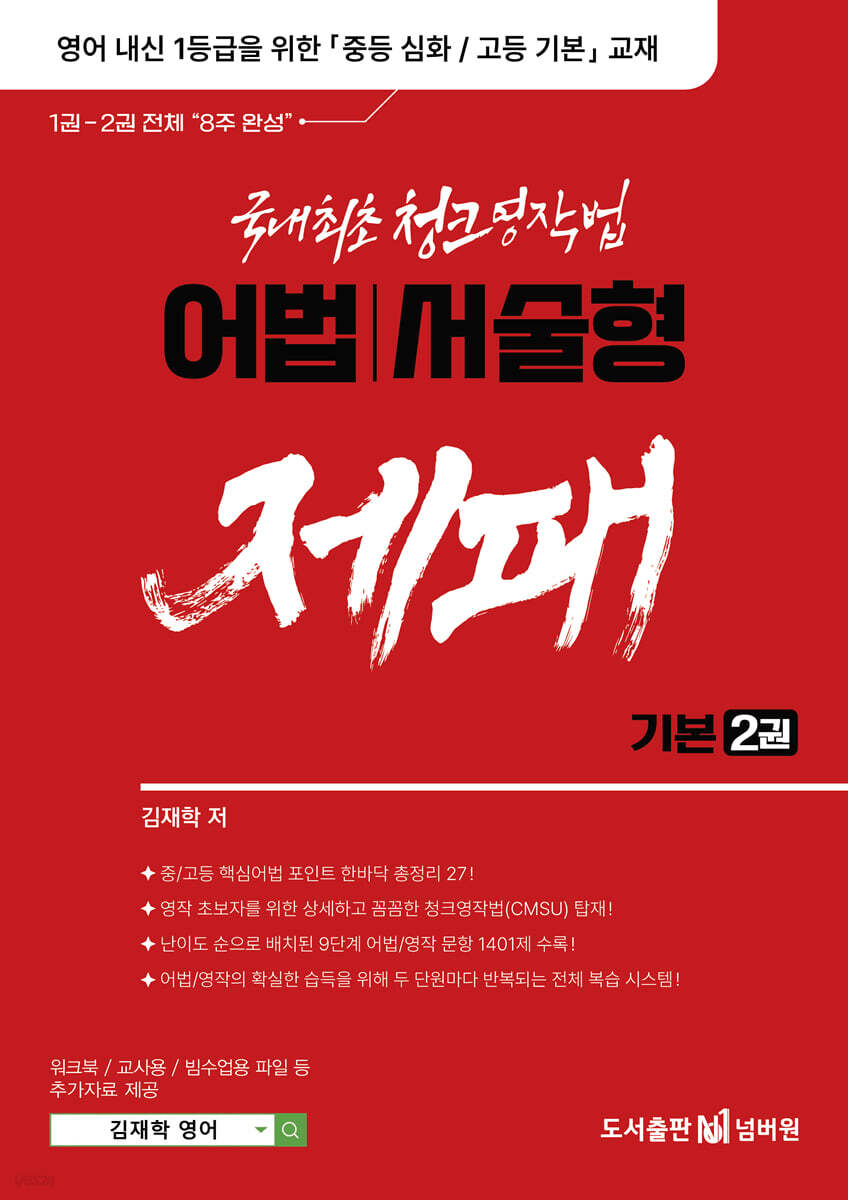
Grammar Descriptive Conquest Volume 2
 |
Description
Book Introduction
We've compiled 27 key grammar points that are essential for middle and high school courses into one easy-to-read format.
In addition, examples were presented in a grammatical choice format so that students could intuitively grasp the key points in grammar, making it easier for students to understand the content and for teachers to teach.
In addition, examples were presented in a grammatical choice format so that students could intuitively grasp the key points in grammar, making it easier for students to understand the content and for teachers to teach.
- You can preview some of the book's contents.
Preview
index
PART 4.
verbal
Chapter 15 to-infinitive
------------------------------------- Grammar/Composition Infinite Accumulation ∞Q22
Chapter 16 Gerunds
Chapter 17 Participles
------------------------------------- Grammar/Composition Infinite Accumulation ∞Q22
Chapter 18 The form of the objective complement
*Unit Summary: "Let's Memorize This! One-Sentence Grammar Memorization Notes"
PART 5.
Important phrases
Chapter 19 Participle Phrases
------------------------------------- Grammar/Composition Infinite Accumulation ∞Q22
Chapter 20: Emphasis on "It is - that"
Chapter 21 Comparative Sentences
------------------------------------- Grammar/Composition Infinite Accumulation ∞Q22
Chapter 22 Parallel Structure
*Unit Summary: "Let's Memorize This! One-Sentence Grammar Memorization Notes"
PART 6.
Grammar to be careful of in Heseok
Chapter 23 Passive Voice
------------------------------------- Grammar/Composition Infinite Accumulation ∞Q22
Chapter 24 Auxiliary Verbs
Chapter 25 Tenses
------------------------------------- Grammar/Composition Infinite Accumulation ∞Q22
Chapter 26 Adjectives/Adverbs
Chapter 27 Pronouns
------------------------------------- Grammar/Composition Infinite Accumulation ∞Q22
*Unit Summary: "Let's Memorize This! One-Sentence Grammar Memorization Notes"
verbal
Chapter 15 to-infinitive
------------------------------------- Grammar/Composition Infinite Accumulation ∞Q22
Chapter 16 Gerunds
Chapter 17 Participles
------------------------------------- Grammar/Composition Infinite Accumulation ∞Q22
Chapter 18 The form of the objective complement
*Unit Summary: "Let's Memorize This! One-Sentence Grammar Memorization Notes"
PART 5.
Important phrases
Chapter 19 Participle Phrases
------------------------------------- Grammar/Composition Infinite Accumulation ∞Q22
Chapter 20: Emphasis on "It is - that"
Chapter 21 Comparative Sentences
------------------------------------- Grammar/Composition Infinite Accumulation ∞Q22
Chapter 22 Parallel Structure
*Unit Summary: "Let's Memorize This! One-Sentence Grammar Memorization Notes"
PART 6.
Grammar to be careful of in Heseok
Chapter 23 Passive Voice
------------------------------------- Grammar/Composition Infinite Accumulation ∞Q22
Chapter 24 Auxiliary Verbs
Chapter 25 Tenses
------------------------------------- Grammar/Composition Infinite Accumulation ∞Q22
Chapter 26 Adjectives/Adverbs
Chapter 27 Pronouns
------------------------------------- Grammar/Composition Infinite Accumulation ∞Q22
*Unit Summary: "Let's Memorize This! One-Sentence Grammar Memorization Notes"
Publisher's Review
Unit 1.
Grammar Point
We've compiled 27 key grammar points that are essential for middle and high school courses into one easy-to-read format.
Additionally, examples are presented in a grammatical choice format to help students intuitively grasp the key grammatical elements, making it easier for students to understand the content and for teachers to teach.
Unit 2.
Grammar Test
It consists of a 4-5 step grammar test process for important grammar points: G - Selection ⇒ G - Correction ⇒ G - Blanks ⇒ Sentence Conversion ⇒ Mixed Full-Sentence.
In particular, the mixed Full-Sentence test presents difficult questions despite being a basic textbook, as it is a mixed grammar test with the previous units.
Unit 3.
English Writing Test
This is a four-step writing test process, consisting of Writing Guide ⇒ Chunks ⇒ Words ⇒ Conditional.
Using the Chunk Writing Method (CMSU), we provide a detailed and thorough writing guide that even beginners can easily follow, and we provide three-level writing questions arranged in order of difficulty.
Unit 4.
Descriptive Practical Test
This is a descriptive practical test course created using mock exam passages from the Office of Education. In addition to the grammar and writing skills learned in this unit, it also includes other types of descriptive questions that are often asked in schools.
Additionally, to avoid testing on material you have not yet learned, the questions are structured solely around material you have learned, and to enable continuous review of previous units, the questions are created by accumulating material from the current and previous units.
Unit 5.
Grammar/Composition Infinite ∞ Cumulative Q22
This is a three-step review process for the “entire previous unit” learned previously, consisting of G - Selection ⇒ G - Correction ⇒ Writing.
By continuously reviewing the entire contents of the previous unit after each unit, students naturally acquire the contents of the previous unit on grammar and writing.
*Unit Summary: "Let's Memorize This! One-Sentence Grammar Memorization Notes"
This is a grammar memorization notebook created in a subjective format so that you can memorize all the grammar points in the unit.
The completion of grammar learning does not end with understanding, but is achieved only when you can accurately memorize what you have understood and use it in real life.
Commentary (separate summary of key grammar included)
As this textbook is a basic textbook on "Grammar/Composition/Descriptive Writing," it contains detailed and friendly explanations, similar to receiving one-on-one private tutoring.
Additionally, the separately included "Key Grammar Summary" allows you to check key grammar at once, eliminating the hassle of having to look up related content while solving problems.
1.
Are you doomed to fail in middle school or high school if your grades are lacking? ⇒ Fix your middle school grades and build a solid foundation for high school!
Students who did not do well in high school in middle school see their scores drop by an average of 20 points or more in high school.
The reason is that the 'test scope' and 'difficulty of the questions' are at least twice as high as in the middle school, and above all, many students make mistakes in the difficult types of questions such as "grammar, writing, and descriptive questions."
So why are middle school English grades so poor? Just like high school, it's because everyone makes a lot of mistakes on difficult grammar, writing, and descriptive questions.
In other words, even if you diligently prepare for the grammar and descriptive writing that falls within the scope of the exam using textbooks for secondary school grades, the exam may be more difficult than what you prepared for, or you may be asked questions that are outside the scope of the exam.
This is why we need a basic book that systematically teaches grammar/writing/descriptive writing.
The purpose of this book is to help students who struggle with "Grammar/Composition/Descriptive Writing" in the secondary school curriculum complete the content of the secondary school curriculum while systematically establishing the foundation for advanced English.
2.
K-High School students lacking fundamentals. Is there no answer? ⇒ 8-week comprehensive course "High School Basic Grammar, Writing, and Narrative Writing"
When you move from middle school to high school, there is absolutely no time to build basic English skills due to the increased difficulty of other subjects and extracurricular activities for the regular admission process.
Therefore, it is necessary to intensively lay the foundation for "grammar/writing/descriptive writing" in a short period of time. However, it is difficult to find a "basic grammar textbook" or "basic writing textbook" for advanced English, and there is no book that links grammar and writing and teaches them intensively at the same time.
Moreover, if you study with a grammar textbook, it may become more difficult to study because you do not know the words in the sentences in the book.
Therefore, this book was designed to provide sentences composed of easy vocabulary, taking into account the vocabulary of middle and lower level students, so that they can learn “grammar/writing/descriptive writing” in an integrated manner in a short period of time (8 weeks).
Nevertheless, considering that the learners are high school students, the mixed Full-Sentence (mixed grammar), Conditional (conditional writing), and descriptive practice tests, although basic, provide high-level, difficult problems.
The reality is that high school students cannot solve only easy problems because they lack basic skills.
3.
Why are there only problems in English writing books, and no writing methods? ⇒ Development and inclusion of the Chunked Writing Method (CMSU)!
Most books on the market that are supposed to be English writing textbooks either don't provide tips on how to write in English or provide abstract, concise explanations.
This is the reality, so students are practicing writing in English and taking midterm and final exams without even knowing how to write in English.
The Chunking Method on Semantic Units included in this textbook applies Korean chunks (chunks) to the English writing process, and was developed for the first time in Korea for learners who have difficulty writing in English.
Along with the general chunk writing method for the 5 formats, each unit provides a detailed and thorough writing guide that even beginners can easily follow, as well as 3-level writing questions arranged in order of difficulty (chunk writing → array writing → conditional writing).
4.
Studying grammar and writing separately? ⇒ Linking grammar and writing! 1,401 questions in 9 difficulty levels!
Grammar and writing are not unrelated fields; rather, grammar is what creates the framework for writing.
However, most of the textbooks currently available in bookstores are grammar textbooks.
English composition textbooks also neglect the connection between grammar and composition.
This textbook offers a "minimum 9-step learning system" to organically connect grammar and writing in 18 of the 27 units where grammar and writing are closely connected.
Additionally, we have created questions based on sentences from recent mock exams conducted by the Office of Education to provide practical help to students taking the exam.
〈9-10 Step Learning System〉
G - Selection ⇒ G - Correction ⇒ G - Blanks ⇒ Sentence-Conversion ⇒ Mixed Full-Sentence ⇒ Writing Guide ⇒ Chunks ⇒ Words ⇒ Conditional ⇒ Descriptive Practice Test
5.
No more messy theoretical explanations! ⇒ Includes a comprehensive summary of key grammar and a grammar memorization notebook!
We've compiled 27 key grammar points that appear on the exam into one easy-to-read page.
A one-page summary of important grammar points helps you focus more on what you're learning and makes it easier to memorize key grammar points (2 pages for the to-infinitive alone).
Additionally, at the end of each part, we've included a "Let's Memorize This! One-Sentence Grammar Memorization Note" to help you memorize every key grammar point in detail.
Just as memorizing words is important, the final step of grammar is also completed through memorization.
6.
Finished the book, but not much left? ⇒ "Full Unit Review System" provided every two units!
When I finish a book, what I remember are the last lesson and the jokes the teacher told in the previous class.
The most important thing in progressing through the textbook is reviewing the content of previous classes, but it is difficult to expect students to review on their own.
Unlike other textbooks that do not review previous units or only provide a partial review, this textbook provides a repetitive review process for the entire unit.
In "Mixed Full-Sentence," the questions are a continuous mixture of grammar from the previous units, and in particular, at the end of each two units, "Grammar/Composition Infinite ∞ Cumulative Q22," which is a review process for the entire unit, allows you to naturally learn what you learned before.
The table of contents of the textbook also places important sections as early as possible to enable more repeated study of the relevant content.
7.
It may seem like nothing special, but what's important to someone who doesn't know English? A great book!
There is a saying, “A rice cake that looks good tastes good.”
For learners who already find English uncomfortable and difficult, the repulsive appearance of the book can make it difficult to continue learning.
This book uses readable fonts and font sizes, and provides ample line spacing between problems to help students breathe.
For students, the margins in a book are not a waste of paper, but a rest area, like a rest stop, that makes long-distance travel possible.
Grammar Point
We've compiled 27 key grammar points that are essential for middle and high school courses into one easy-to-read format.
Additionally, examples are presented in a grammatical choice format to help students intuitively grasp the key grammatical elements, making it easier for students to understand the content and for teachers to teach.
Unit 2.
Grammar Test
It consists of a 4-5 step grammar test process for important grammar points: G - Selection ⇒ G - Correction ⇒ G - Blanks ⇒ Sentence Conversion ⇒ Mixed Full-Sentence.
In particular, the mixed Full-Sentence test presents difficult questions despite being a basic textbook, as it is a mixed grammar test with the previous units.
Unit 3.
English Writing Test
This is a four-step writing test process, consisting of Writing Guide ⇒ Chunks ⇒ Words ⇒ Conditional.
Using the Chunk Writing Method (CMSU), we provide a detailed and thorough writing guide that even beginners can easily follow, and we provide three-level writing questions arranged in order of difficulty.
Unit 4.
Descriptive Practical Test
This is a descriptive practical test course created using mock exam passages from the Office of Education. In addition to the grammar and writing skills learned in this unit, it also includes other types of descriptive questions that are often asked in schools.
Additionally, to avoid testing on material you have not yet learned, the questions are structured solely around material you have learned, and to enable continuous review of previous units, the questions are created by accumulating material from the current and previous units.
Unit 5.
Grammar/Composition Infinite ∞ Cumulative Q22
This is a three-step review process for the “entire previous unit” learned previously, consisting of G - Selection ⇒ G - Correction ⇒ Writing.
By continuously reviewing the entire contents of the previous unit after each unit, students naturally acquire the contents of the previous unit on grammar and writing.
*Unit Summary: "Let's Memorize This! One-Sentence Grammar Memorization Notes"
This is a grammar memorization notebook created in a subjective format so that you can memorize all the grammar points in the unit.
The completion of grammar learning does not end with understanding, but is achieved only when you can accurately memorize what you have understood and use it in real life.
Commentary (separate summary of key grammar included)
As this textbook is a basic textbook on "Grammar/Composition/Descriptive Writing," it contains detailed and friendly explanations, similar to receiving one-on-one private tutoring.
Additionally, the separately included "Key Grammar Summary" allows you to check key grammar at once, eliminating the hassle of having to look up related content while solving problems.
1.
Are you doomed to fail in middle school or high school if your grades are lacking? ⇒ Fix your middle school grades and build a solid foundation for high school!
Students who did not do well in high school in middle school see their scores drop by an average of 20 points or more in high school.
The reason is that the 'test scope' and 'difficulty of the questions' are at least twice as high as in the middle school, and above all, many students make mistakes in the difficult types of questions such as "grammar, writing, and descriptive questions."
So why are middle school English grades so poor? Just like high school, it's because everyone makes a lot of mistakes on difficult grammar, writing, and descriptive questions.
In other words, even if you diligently prepare for the grammar and descriptive writing that falls within the scope of the exam using textbooks for secondary school grades, the exam may be more difficult than what you prepared for, or you may be asked questions that are outside the scope of the exam.
This is why we need a basic book that systematically teaches grammar/writing/descriptive writing.
The purpose of this book is to help students who struggle with "Grammar/Composition/Descriptive Writing" in the secondary school curriculum complete the content of the secondary school curriculum while systematically establishing the foundation for advanced English.
2.
K-High School students lacking fundamentals. Is there no answer? ⇒ 8-week comprehensive course "High School Basic Grammar, Writing, and Narrative Writing"
When you move from middle school to high school, there is absolutely no time to build basic English skills due to the increased difficulty of other subjects and extracurricular activities for the regular admission process.
Therefore, it is necessary to intensively lay the foundation for "grammar/writing/descriptive writing" in a short period of time. However, it is difficult to find a "basic grammar textbook" or "basic writing textbook" for advanced English, and there is no book that links grammar and writing and teaches them intensively at the same time.
Moreover, if you study with a grammar textbook, it may become more difficult to study because you do not know the words in the sentences in the book.
Therefore, this book was designed to provide sentences composed of easy vocabulary, taking into account the vocabulary of middle and lower level students, so that they can learn “grammar/writing/descriptive writing” in an integrated manner in a short period of time (8 weeks).
Nevertheless, considering that the learners are high school students, the mixed Full-Sentence (mixed grammar), Conditional (conditional writing), and descriptive practice tests, although basic, provide high-level, difficult problems.
The reality is that high school students cannot solve only easy problems because they lack basic skills.
3.
Why are there only problems in English writing books, and no writing methods? ⇒ Development and inclusion of the Chunked Writing Method (CMSU)!
Most books on the market that are supposed to be English writing textbooks either don't provide tips on how to write in English or provide abstract, concise explanations.
This is the reality, so students are practicing writing in English and taking midterm and final exams without even knowing how to write in English.
The Chunking Method on Semantic Units included in this textbook applies Korean chunks (chunks) to the English writing process, and was developed for the first time in Korea for learners who have difficulty writing in English.
Along with the general chunk writing method for the 5 formats, each unit provides a detailed and thorough writing guide that even beginners can easily follow, as well as 3-level writing questions arranged in order of difficulty (chunk writing → array writing → conditional writing).
4.
Studying grammar and writing separately? ⇒ Linking grammar and writing! 1,401 questions in 9 difficulty levels!
Grammar and writing are not unrelated fields; rather, grammar is what creates the framework for writing.
However, most of the textbooks currently available in bookstores are grammar textbooks.
English composition textbooks also neglect the connection between grammar and composition.
This textbook offers a "minimum 9-step learning system" to organically connect grammar and writing in 18 of the 27 units where grammar and writing are closely connected.
Additionally, we have created questions based on sentences from recent mock exams conducted by the Office of Education to provide practical help to students taking the exam.
〈9-10 Step Learning System〉
G - Selection ⇒ G - Correction ⇒ G - Blanks ⇒ Sentence-Conversion ⇒ Mixed Full-Sentence ⇒ Writing Guide ⇒ Chunks ⇒ Words ⇒ Conditional ⇒ Descriptive Practice Test
5.
No more messy theoretical explanations! ⇒ Includes a comprehensive summary of key grammar and a grammar memorization notebook!
We've compiled 27 key grammar points that appear on the exam into one easy-to-read page.
A one-page summary of important grammar points helps you focus more on what you're learning and makes it easier to memorize key grammar points (2 pages for the to-infinitive alone).
Additionally, at the end of each part, we've included a "Let's Memorize This! One-Sentence Grammar Memorization Note" to help you memorize every key grammar point in detail.
Just as memorizing words is important, the final step of grammar is also completed through memorization.
6.
Finished the book, but not much left? ⇒ "Full Unit Review System" provided every two units!
When I finish a book, what I remember are the last lesson and the jokes the teacher told in the previous class.
The most important thing in progressing through the textbook is reviewing the content of previous classes, but it is difficult to expect students to review on their own.
Unlike other textbooks that do not review previous units or only provide a partial review, this textbook provides a repetitive review process for the entire unit.
In "Mixed Full-Sentence," the questions are a continuous mixture of grammar from the previous units, and in particular, at the end of each two units, "Grammar/Composition Infinite ∞ Cumulative Q22," which is a review process for the entire unit, allows you to naturally learn what you learned before.
The table of contents of the textbook also places important sections as early as possible to enable more repeated study of the relevant content.
7.
It may seem like nothing special, but what's important to someone who doesn't know English? A great book!
There is a saying, “A rice cake that looks good tastes good.”
For learners who already find English uncomfortable and difficult, the repulsive appearance of the book can make it difficult to continue learning.
This book uses readable fonts and font sizes, and provides ample line spacing between problems to help students breathe.
For students, the margins in a book are not a waste of paper, but a rest area, like a rest stop, that makes long-distance travel possible.
GOODS SPECIFICS
- Date of issue: August 27, 2025
- Page count, weight, size: 392 pages | 210*297*30mm
- ISBN13: 9791196547066
- ISBN10: 1196547068
You may also like
카테고리
korean


korean

![GQ KOREA Mark (Monthly): December [2025]](http://librairie.coreenne.fr/cdn/shop/files/8ef265dbbfbf186523ed75ba7319009d.jpg?v=1765340328&width=3840)


