

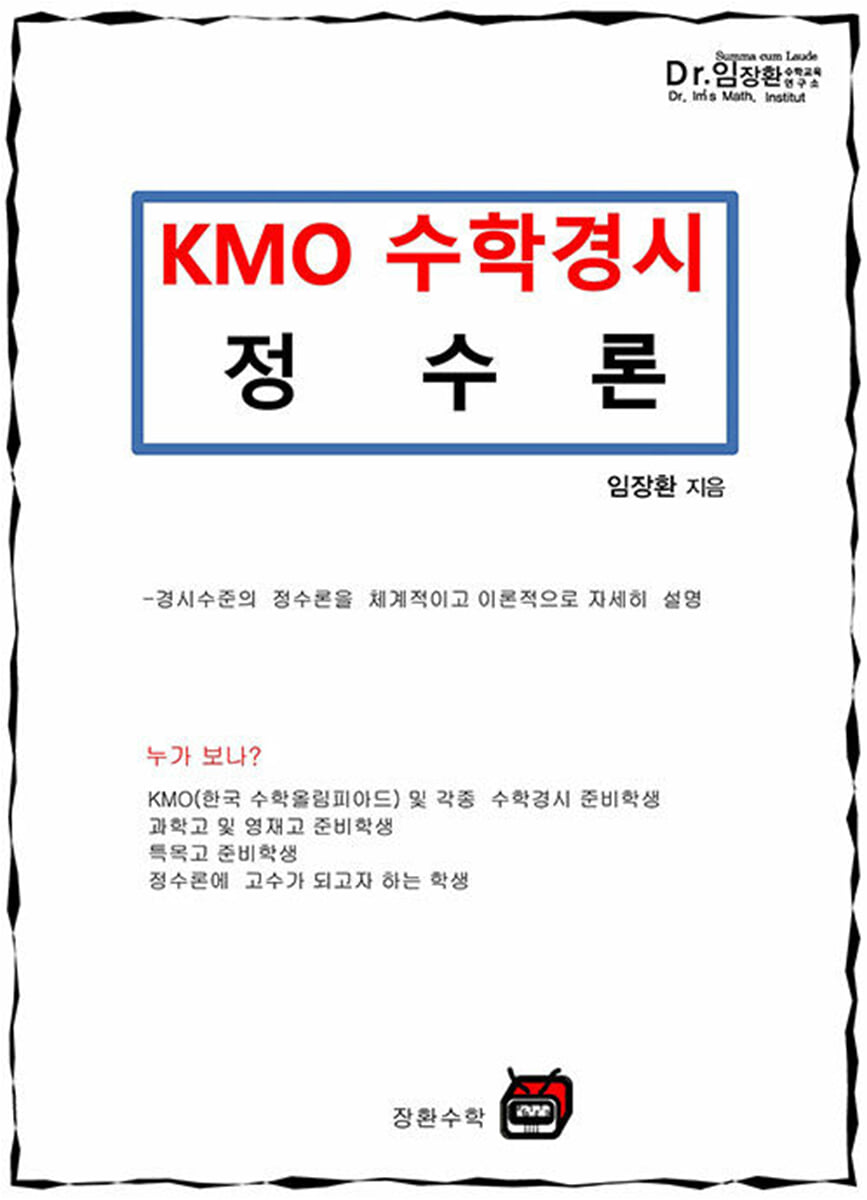
KMO Math Competition Number Theory
 |
Description
index
1.
Mathematical induction and the axiom of the order of natural numbers
2.
Euclidean method for factors and multiples
2.1 Operational rules for divisors
2.2 Euclidean Algorithm
3.
Factor and multiple problem types
3.1 Factors and Multiples Problem Type 1
3.2 Factors and Multiples Problem Type 2
3.3 Factors and Multiples Problem Type 3
3.4 Factors and Multiples Problem Type 4:
The number of divisors of a positive integer and the sum of the divisors
3.5 Factors and Multiples Problem Type 5
4. Prime Numbers and Composite Numbers
5.
[ ] function (Bracket Function)
5.1 [ ] function (Bracket Function)
5.2 Lattice Polygon Problem
6.
Congruence and Residue, Wilson's Theorem
6.1 Definition and Operational Rules of Congruence (Modular Arithmetic)
6.2 Powers of natural numbers and the units digit of powers
6.3 Perfect squares
6.4 Complete remainder system and standard complete remainder system
6.5 Wilson Theorem
7.
Fermat's little theorem and Euler's theorem
7.1 Fermat's Little Theorem
7.2 Euler's Theorem: Euler's Generalization of Fermat's Little Theorem
8.
Solution to the Diophantine Equation
8.1 Linear indeterminate equations
8.2 How to find special solutions to indefinite equations
8.3 Factoring solutions to indefinite equations
8.4 Solving indefinite equations through expression method interpretation
8.5 Various methods for solving indefinite equations
9.
Linear Congruence and Chinese Remainder Theorem
9.1 Linear Congruences
9.2 Chinese Remainder Theorem
Mathematical induction and the axiom of the order of natural numbers
2.
Euclidean method for factors and multiples
2.1 Operational rules for divisors
2.2 Euclidean Algorithm
3.
Factor and multiple problem types
3.1 Factors and Multiples Problem Type 1
3.2 Factors and Multiples Problem Type 2
3.3 Factors and Multiples Problem Type 3
3.4 Factors and Multiples Problem Type 4:
The number of divisors of a positive integer and the sum of the divisors
3.5 Factors and Multiples Problem Type 5
4. Prime Numbers and Composite Numbers
5.
[ ] function (Bracket Function)
5.1 [ ] function (Bracket Function)
5.2 Lattice Polygon Problem
6.
Congruence and Residue, Wilson's Theorem
6.1 Definition and Operational Rules of Congruence (Modular Arithmetic)
6.2 Powers of natural numbers and the units digit of powers
6.3 Perfect squares
6.4 Complete remainder system and standard complete remainder system
6.5 Wilson Theorem
7.
Fermat's little theorem and Euler's theorem
7.1 Fermat's Little Theorem
7.2 Euler's Theorem: Euler's Generalization of Fermat's Little Theorem
8.
Solution to the Diophantine Equation
8.1 Linear indeterminate equations
8.2 How to find special solutions to indefinite equations
8.3 Factoring solutions to indefinite equations
8.4 Solving indefinite equations through expression method interpretation
8.5 Various methods for solving indefinite equations
9.
Linear Congruence and Chinese Remainder Theorem
9.1 Linear Congruences
9.2 Chinese Remainder Theorem
GOODS SPECIFICS
- Date of issue: May 1, 2024
- Page count, weight, size: 232 pages | 441g | 182*257*20mm
- ISBN13: 9788969060327
- ISBN10: 8969060324
You may also like
카테고리
korean


korean

![GQ KOREA Mark (Monthly): December [2025]](http://librairie.coreenne.fr/cdn/shop/files/8ef265dbbfbf186523ed75ba7319009d.jpg?v=1765340328&width=3840)


