

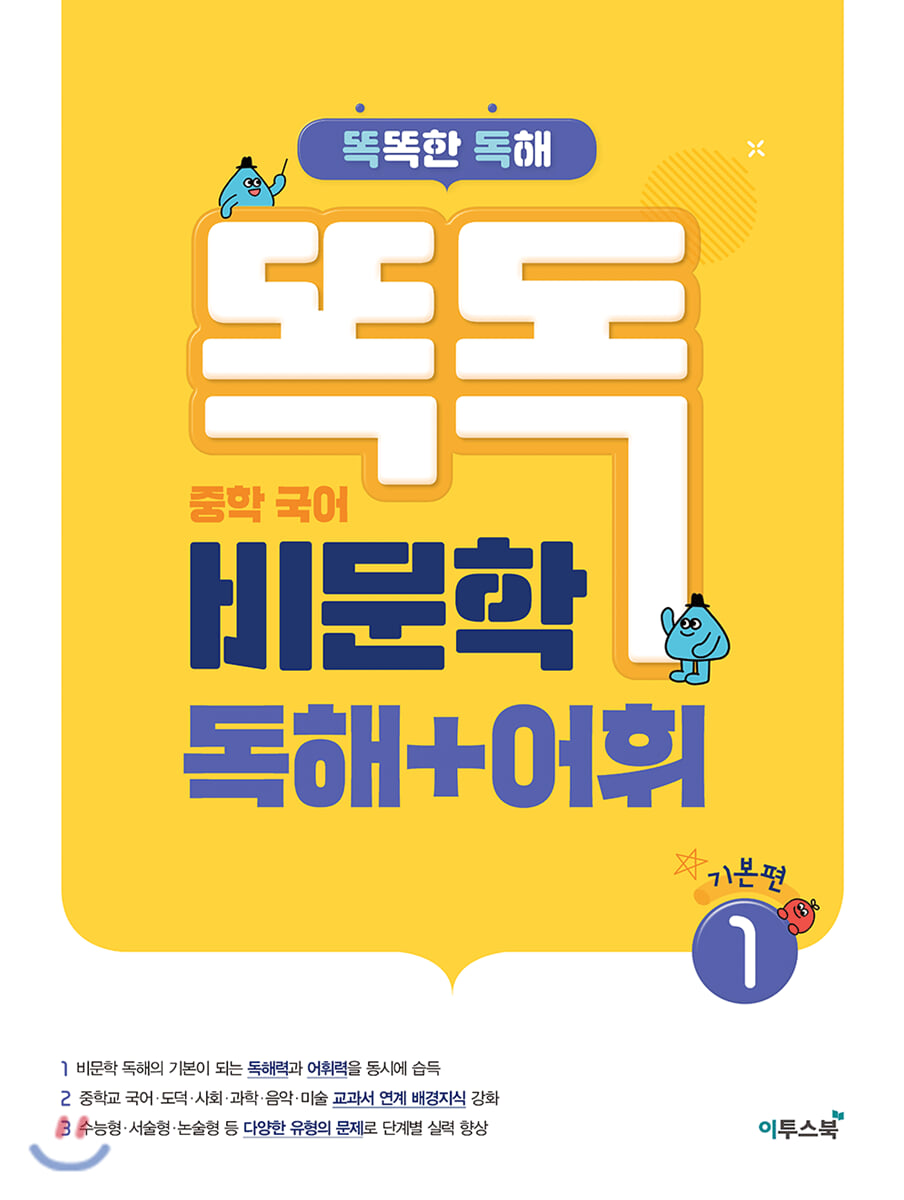
Dokdok Middle School Korean Non-Fiction Reading Comprehension + Vocabulary 1 Basic Edition
 |
Description
Book Introduction
『Ttokdok Middle School Korean Non-Fiction Reading + Vocabulary』 is a reading comprehension training book that helps develop both non-fiction reading comprehension and vocabulary.
You can learn reading skills and practice reading comprehension.
You can also improve your vocabulary and build your argumentative writing skills based on background knowledge for each subject.
You can learn reading skills and practice reading comprehension.
You can also improve your vocabulary and build your argumentative writing skills based on background knowledge for each subject.
- You can preview some of the book's contents.
Preview
index
DAY 1 Paragraph Reading Skills (Central Topic / Central Sentence / Summary of Central Content / Topic / Comprehensive Reading)
DAY 2 (Humanities) The Concept and Characteristics of Metaphor / (Science) Why Plate Movement Occurs
DAY 3 (Technology) Invisible Ship / Art) Differences between Korean and Western Music
DAY 4 (Humanities) Purpose of Studying / Technology) Radiation Technology
DAY 5 (Society) Establishing Cultural Traditions / (Science Why Cicadas' Sounds Are Noise)
DAY 6 (Technology) Artificial Intelligence Computers / (Art) Symbolism of Folk Painting
DAY 7 Paragraph Reading Skills (Definition / Example / Claim and Evidence / Induction and Deduction / Criticism and Refutation)
DAY 8 (Humanities) Thinking Through Analogy / (Society) Good and Bad Assets and Liabilities
DAY 9 (Technology) Radio Frequency Identification Chips / (Art) Modernist Art and the Grid
DAY 10 (Society) Enhancing Local Festivals / (Humanities) A Perspective on Culture
DAY 11 (Science) Conserving Biodiversity / (Society) Corporate Social Responsibility
DAY 12 (Arts) The Charm of Pansori / (Humanities) The Fate of the Korean Language
DAY 13 Reading Skills (Explanation / Parallelism / Cause and Effect / Synchronicity / Comparison)
DAY 14 (Humanities) Zhuangzi's Philosophy and the Problems of Modern Man / (Science) The Value of the Sea
DAY 15 (Society) Application of Law to Dispute Resolution / (Humanities) Types of History
DAY 16 (Science) Living Things That Changed the Environment / (Society) Index Prices and Perceived Prices
DAY 17 (Science) Global Warming and Carbon Dioxide / (Society) Liberalism and Neoliberalism
DAY 18 (Technology) CT and MRI Scans / (Science) The Number of Stars in the Universe
DAY 19 Reading Skills (Contrast / Classification / Analysis / Problem and Solution / Process)
DAY 20 (Art) The Difference Between Eastern and Western Painting / (Society) Two Perspectives on Public Opinion
DAY 21 (Science) Three Animal Behavior Patterns / (Society) Dominant Culture and Subculture
DAY 22 (Technology) The Principle of the Water Mill / (Humanities) The Power of the Ancient Egyptian Pharaohs
DAY 23 (Society) The Benefits of the Consumer Basic Law / (Technology) How to Identify Organic Vegetables
DAY 24 (Science) The Birth, Growth, and Death of Stars / (Technology) The Process of Removing Stains with Soap
DAY 2 (Humanities) The Concept and Characteristics of Metaphor / (Science) Why Plate Movement Occurs
DAY 3 (Technology) Invisible Ship / Art) Differences between Korean and Western Music
DAY 4 (Humanities) Purpose of Studying / Technology) Radiation Technology
DAY 5 (Society) Establishing Cultural Traditions / (Science Why Cicadas' Sounds Are Noise)
DAY 6 (Technology) Artificial Intelligence Computers / (Art) Symbolism of Folk Painting
DAY 7 Paragraph Reading Skills (Definition / Example / Claim and Evidence / Induction and Deduction / Criticism and Refutation)
DAY 8 (Humanities) Thinking Through Analogy / (Society) Good and Bad Assets and Liabilities
DAY 9 (Technology) Radio Frequency Identification Chips / (Art) Modernist Art and the Grid
DAY 10 (Society) Enhancing Local Festivals / (Humanities) A Perspective on Culture
DAY 11 (Science) Conserving Biodiversity / (Society) Corporate Social Responsibility
DAY 12 (Arts) The Charm of Pansori / (Humanities) The Fate of the Korean Language
DAY 13 Reading Skills (Explanation / Parallelism / Cause and Effect / Synchronicity / Comparison)
DAY 14 (Humanities) Zhuangzi's Philosophy and the Problems of Modern Man / (Science) The Value of the Sea
DAY 15 (Society) Application of Law to Dispute Resolution / (Humanities) Types of History
DAY 16 (Science) Living Things That Changed the Environment / (Society) Index Prices and Perceived Prices
DAY 17 (Science) Global Warming and Carbon Dioxide / (Society) Liberalism and Neoliberalism
DAY 18 (Technology) CT and MRI Scans / (Science) The Number of Stars in the Universe
DAY 19 Reading Skills (Contrast / Classification / Analysis / Problem and Solution / Process)
DAY 20 (Art) The Difference Between Eastern and Western Painting / (Society) Two Perspectives on Public Opinion
DAY 21 (Science) Three Animal Behavior Patterns / (Society) Dominant Culture and Subculture
DAY 22 (Technology) The Principle of the Water Mill / (Humanities) The Power of the Ancient Egyptian Pharaohs
DAY 23 (Society) The Benefits of the Consumer Basic Law / (Technology) How to Identify Organic Vegetables
DAY 24 (Science) The Birth, Growth, and Death of Stars / (Technology) The Process of Removing Stains with Soap
Detailed image

Publisher's Review
1 You can learn 'reading skills'.
This book helps students who are new to non-fiction learn how to approach texts through reading comprehension skills exercises that help them read texts easily.
You can improve your reading comprehension skills by practicing summarizing the key points of each paragraph.
2 You can do 'reading practice'.
This book allows you to practice reading comprehension without burden by dividing the texts into the Korean language section of the CSAT and linking them to the textbook content, using texts appropriate for the middle school student level.
You can perfect your reading comprehension with a variety of problem types, including essay-type and descriptive questions.
3 You can develop your 'vocabulary'.
This book allows you to develop your vocabulary through step-by-step learning, starting with 'Vocabulary Preview', which allows you to check your vocabulary before reading the text, 'Complete Vocabulary', which allows you to check the meaning and usage of vocabulary after reading the text, and finally, 'College Scholastic Ability Test-style Vocabulary Test', which provides in-depth vocabulary study.
You can develop your vocabulary and reading comprehension skills together by learning vocabulary related to fingerprints.
4 You can develop your argumentative writing skills based on the 'background knowledge' for each subject.
This book allows you to build background knowledge for each subject through reading materials for subjects other than Korean, such as ethics, society, history, science, technology, home economics, music, and art.
By building basic background knowledge of other subjects, you can easily understand any non-literary text and improve your reading comprehension skills.
And based on this background knowledge, you can prepare for not only essay writing but also performance evaluations through essay writing practice.
Develop reading comprehension skills by analyzing texts and solving problems.
① Reading skills learned step by step
You can systematically learn reading comprehension methods by incorporating step-by-step reading techniques in the order of 'paragraph' to 'text'.
② Solutions to texts and practice problems linked to the curriculum
By reading passages 100% related to all middle school curriculum and solving multiple-choice questions in the style of the CSAT, you can check whether you have properly understood the passages and acquire a feel for the actual CSAT. You can also prepare for performance assessments and descriptive internal exam questions through descriptive questions.
③ Developing thinking skills with background knowledge
By reviewing the background knowledge included in the textbook in relation to what you have previously learned, you can increase your understanding of the text and build knowledge about other subject areas.
Build your vocabulary with step-by-step vocabulary learning
① Vocabulary Preview
Before reading, you can check the important vocabulary in the text in advance and infer the meaning of the vocabulary during the reading process.
② Complete the vocabulary
You can confirm the meaning and usage of vocabulary through definitions and example sentences, check if the meaning you guessed is correct, and learn it with certainty through solving simple problems.
③ Deepen your vocabulary
As the last study of the week, you can practice vocabulary from the passages in the form of CSAT-style problems to deepen your vocabulary and prepare for the CSAT.
[Answer and Explanation]
Detailed and accurate explanations help you understand the text and problems more easily and clearly.
This book helps students who are new to non-fiction learn how to approach texts through reading comprehension skills exercises that help them read texts easily.
You can improve your reading comprehension skills by practicing summarizing the key points of each paragraph.
2 You can do 'reading practice'.
This book allows you to practice reading comprehension without burden by dividing the texts into the Korean language section of the CSAT and linking them to the textbook content, using texts appropriate for the middle school student level.
You can perfect your reading comprehension with a variety of problem types, including essay-type and descriptive questions.
3 You can develop your 'vocabulary'.
This book allows you to develop your vocabulary through step-by-step learning, starting with 'Vocabulary Preview', which allows you to check your vocabulary before reading the text, 'Complete Vocabulary', which allows you to check the meaning and usage of vocabulary after reading the text, and finally, 'College Scholastic Ability Test-style Vocabulary Test', which provides in-depth vocabulary study.
You can develop your vocabulary and reading comprehension skills together by learning vocabulary related to fingerprints.
4 You can develop your argumentative writing skills based on the 'background knowledge' for each subject.
This book allows you to build background knowledge for each subject through reading materials for subjects other than Korean, such as ethics, society, history, science, technology, home economics, music, and art.
By building basic background knowledge of other subjects, you can easily understand any non-literary text and improve your reading comprehension skills.
And based on this background knowledge, you can prepare for not only essay writing but also performance evaluations through essay writing practice.
Develop reading comprehension skills by analyzing texts and solving problems.
① Reading skills learned step by step
You can systematically learn reading comprehension methods by incorporating step-by-step reading techniques in the order of 'paragraph' to 'text'.
② Solutions to texts and practice problems linked to the curriculum
By reading passages 100% related to all middle school curriculum and solving multiple-choice questions in the style of the CSAT, you can check whether you have properly understood the passages and acquire a feel for the actual CSAT. You can also prepare for performance assessments and descriptive internal exam questions through descriptive questions.
③ Developing thinking skills with background knowledge
By reviewing the background knowledge included in the textbook in relation to what you have previously learned, you can increase your understanding of the text and build knowledge about other subject areas.
Build your vocabulary with step-by-step vocabulary learning
① Vocabulary Preview
Before reading, you can check the important vocabulary in the text in advance and infer the meaning of the vocabulary during the reading process.
② Complete the vocabulary
You can confirm the meaning and usage of vocabulary through definitions and example sentences, check if the meaning you guessed is correct, and learn it with certainty through solving simple problems.
③ Deepen your vocabulary
As the last study of the week, you can practice vocabulary from the passages in the form of CSAT-style problems to deepen your vocabulary and prepare for the CSAT.
[Answer and Explanation]
Detailed and accurate explanations help you understand the text and problems more easily and clearly.
GOODS SPECIFICS
- Publication date: October 30, 2020
- Page count, weight, size: 216 pages | 215*285*20mm
- ISBN13: 9791165981235
- ISBN10: 1165981238
- Reference book for grade level: 1st year of middle school
- Reference book usage semester: Common semester
- Reference book difficulty: Medium Reference book difficulty guide
You may also like
카테고리
korean


korean

![GQ KOREA Mark (Monthly): December [2025]](http://librairie.coreenne.fr/cdn/shop/files/8ef265dbbfbf186523ed75ba7319009d.jpg?v=1765340328&width=3840)


