

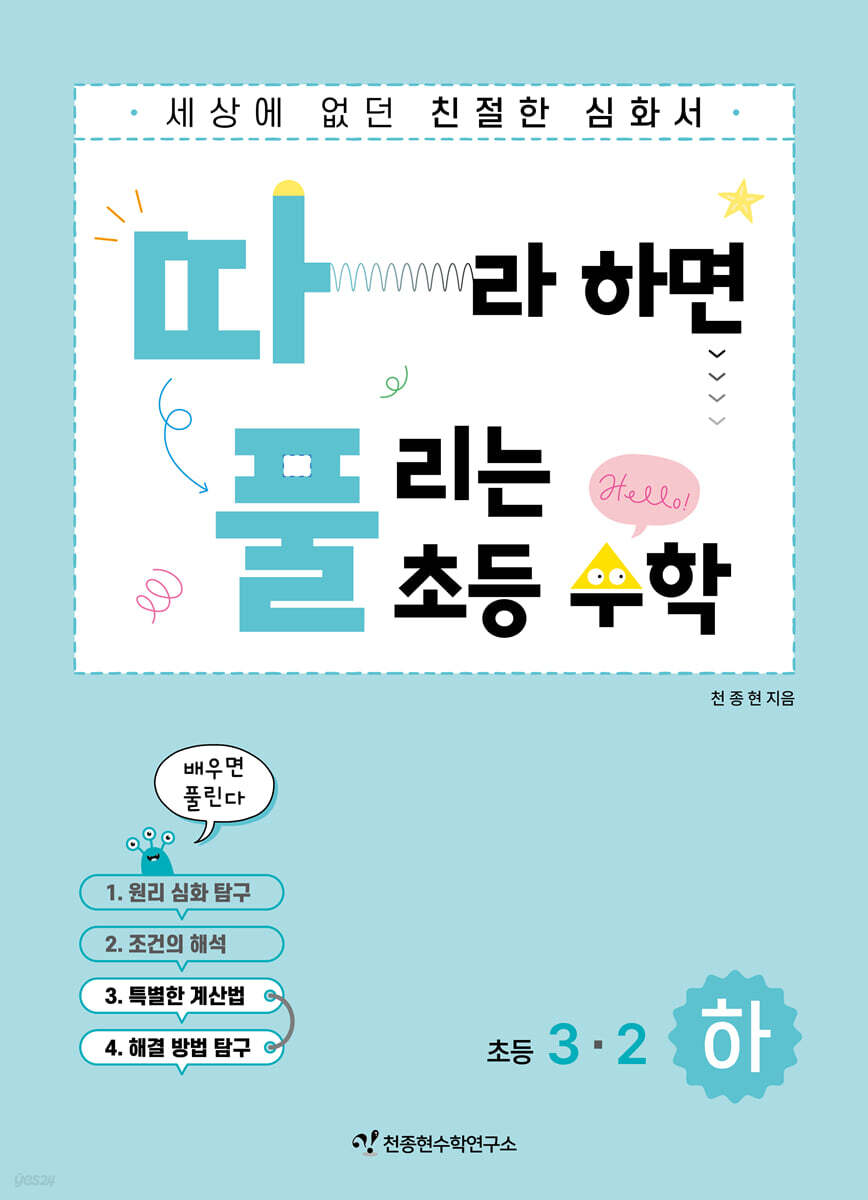
Elementary Math 3-2 (Part 2)
 |
Description
Book Introduction
What kind of textbook is Ttapul?
The method of solving difficult problems is organized into steps so that you can learn according to the solution method and practice similar types of advanced problems.
While existing advanced textbooks simply cover difficult problems and lack explanations of actual solution methods or contain logical leaps, Ttapul is a textbook that teaches students how to solve difficult problems step by step, ultimately enabling them to solve advanced problems on their own.
I recommend Ttapul to these students.
This book is recommended for students who know the basic concepts and principles covered in mathematics but have difficulty with advanced problems, and for students who want to deal with advanced problems while using applied textbooks or textbooks that cover both basic and applied concepts.
The method of solving difficult problems is organized into steps so that you can learn according to the solution method and practice similar types of advanced problems.
While existing advanced textbooks simply cover difficult problems and lack explanations of actual solution methods or contain logical leaps, Ttapul is a textbook that teaches students how to solve difficult problems step by step, ultimately enabling them to solve advanced problems on their own.
I recommend Ttapul to these students.
This book is recommended for students who know the basic concepts and principles covered in mathematics but have difficulty with advanced problems, and for students who want to deal with advanced problems while using applied textbooks or textbooks that cover both basic and applied concepts.
- You can preview some of the book's contents.
Preview
index
Part 3.
Special calculation method
Lesson 1: Largest and Smallest Multiplication 1
Lecture 2: Largest and Smallest Multiplications 2
The smallest division with the largest quotient of three
The sum of the four quarterfinal differences is a fixed number
Lesson 5: Representing as the sum of consecutive numbers
Lesson 6: Estimating Multiplication
Lesson 7: Repeating Rule 1
Rule 2 of the Quarterfinals
Lesson 9: Finding the Day of the Week
10th grade remainder and number of numbers
Part 4.
Exploring solutions
Lesson 11: Hakgusan
12th class balance
Simplify Lesson 13 Problems
Lesson 14: Solving Problems in Reverse 1
Lesson 15: Solving Problems in Reverse 2
Set up a round of 16 to solve the problem
Lesson 17 Two Equations Problem 1
Lesson 18 Two-Equation Problem 2
Numbers that can be made in the 19th lecture
20 Relationship between the two
Special calculation method
Lesson 1: Largest and Smallest Multiplication 1
Lecture 2: Largest and Smallest Multiplications 2
The smallest division with the largest quotient of three
The sum of the four quarterfinal differences is a fixed number
Lesson 5: Representing as the sum of consecutive numbers
Lesson 6: Estimating Multiplication
Lesson 7: Repeating Rule 1
Rule 2 of the Quarterfinals
Lesson 9: Finding the Day of the Week
10th grade remainder and number of numbers
Part 4.
Exploring solutions
Lesson 11: Hakgusan
12th class balance
Simplify Lesson 13 Problems
Lesson 14: Solving Problems in Reverse 1
Lesson 15: Solving Problems in Reverse 2
Set up a round of 16 to solve the problem
Lesson 17 Two Equations Problem 1
Lesson 18 Two-Equation Problem 2
Numbers that can be made in the 19th lecture
20 Relationship between the two
Detailed image

Publisher's Review
If you study elementary mathematics in depth, you will encounter the following difficulties.
First, it is a problem that contains logic that is difficult to solve using only the concepts and principles of the subject.
Second, for advanced problems, it is difficult to practice similar problems.
This book aims to teach students who want to tackle difficult problems and develop skills beyond the concepts of the subject, including the required "principles and concepts," "conditions and rules," "special calculation methods," and "problem-solving techniques," through video lectures.
While typical math textbooks are structured to challenge students with a list of problems, this book selects 40 concepts and problem-solving methods that students must know after learning the basics of the subject each semester, and encourages students to learn them on their own, sometimes through questions, sometimes through video lectures, and practice with confirmation problems.
If you're struggling with word problems, you'll often hear advice to read a lot.
Is the difficulty with math word problems really a problem of reading comprehension? While it may have a slight impact on early elementary school students, the reason they struggle with word problems is because, even if they read the problem carefully, they don't understand the key conditions or don't know where to start and how to solve it.
The way to do well in word problems is to learn various conditions and problem-solving methods logically.
That is, by increasing your mathematical background knowledge, you must acquire the skills to interpret the mathematical meaning hidden in sentences and solve problems easily and logically.
Solving a lot of sentence-based problems doesn't make you better.
The essence of a word problem is not the sentence itself, but the difficult mathematical conditions.
Warm!! I hope that elementary math, which can be solved by following along, will be a blessing to students who have difficulty with advanced learning.
First, it is a problem that contains logic that is difficult to solve using only the concepts and principles of the subject.
Second, for advanced problems, it is difficult to practice similar problems.
This book aims to teach students who want to tackle difficult problems and develop skills beyond the concepts of the subject, including the required "principles and concepts," "conditions and rules," "special calculation methods," and "problem-solving techniques," through video lectures.
While typical math textbooks are structured to challenge students with a list of problems, this book selects 40 concepts and problem-solving methods that students must know after learning the basics of the subject each semester, and encourages students to learn them on their own, sometimes through questions, sometimes through video lectures, and practice with confirmation problems.
If you're struggling with word problems, you'll often hear advice to read a lot.
Is the difficulty with math word problems really a problem of reading comprehension? While it may have a slight impact on early elementary school students, the reason they struggle with word problems is because, even if they read the problem carefully, they don't understand the key conditions or don't know where to start and how to solve it.
The way to do well in word problems is to learn various conditions and problem-solving methods logically.
That is, by increasing your mathematical background knowledge, you must acquire the skills to interpret the mathematical meaning hidden in sentences and solve problems easily and logically.
Solving a lot of sentence-based problems doesn't make you better.
The essence of a word problem is not the sentence itself, but the difficult mathematical conditions.
Warm!! I hope that elementary math, which can be solved by following along, will be a blessing to students who have difficulty with advanced learning.
GOODS SPECIFICS
- Date of issue: June 15, 2024
- Page count, weight, size: 128 pages | 215*297*10mm
- ISBN13: 9791160123906
- ISBN10: 116012390X
- Reference book for grades: 3rd grade elementary school
- Reference book usage period: 2nd semester
- KC Certification: Certification Type: Conformity Confirmation
You may also like
카테고리
korean


korean

![GQ KOREA Mark (Monthly): December [2025]](http://librairie.coreenne.fr/cdn/shop/files/8ef265dbbfbf186523ed75ba7319009d.jpg?v=1765340328&width=3840)


