

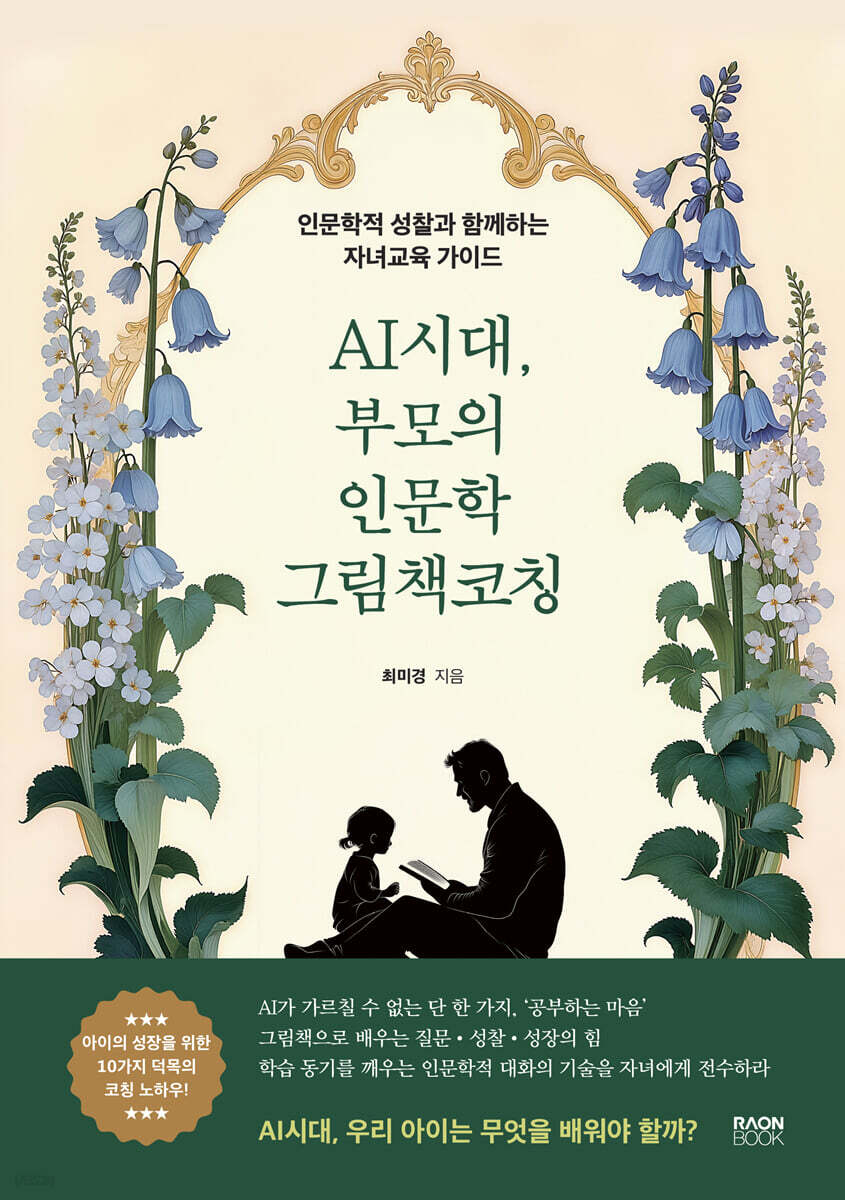
Humanities Picture Book Coaching for Parents in the AI Era
 |
Description
Book Introduction
“Raising questions rather than answers
“Humanities Coaching Based on Picture Books”
In the rapidly changing AI era, children's learning can no longer be evaluated solely on how much knowledge they have.
The most important thing in today's education is the child's desire to learn on his own and the power to explore the meaning of life.
"Parents' Humanities Picture Book Coaching in the AI Era" explores the role of parents in this changing era, helping them deeply understand their children's inner selves through the familiar medium of picture books.
This book explores from a humanistic perspective why children's motivation to learn fades and how to revive it.
It psychologically interprets the symbols, stories, and characters' emotions in picture books and suggests specific ways for parents to read their children's minds and communicate with them.
The core elements that support children's learning, such as the transition from extrinsic to intrinsic motivation, self-understanding that grows through failure, self-efficacy created by small achievements, emotional stability that leads to immersion and growth, and positivity and emotional regulation skills, are naturally connected to the stories in picture books.
In particular, this book emphasizes that the 'heart to study' is more important than the 'brain to study'.
Forcing study cannot last, and the joy of learning always begins in the child's heart.
When parents truly understand their child's feelings and needs, and offer empathy and questions instead of instructions and control, children finally discover the power to learn on their own.
Each chapter of the book contains 'picture book coaching questions' to help parents communicate with their children using picture books, making it highly practical.
It provides a way to change the conversation that opens a child's heart from words that close the child's heart, an attitude to see the world through a child's eyes, and an opportunity for reflection to look back on one's own inner self.
"Parents' Humanities Picture Book Coaching in the AI Age" is a guide for parents who explore life together rather than simply impart knowledge.
This is a warm and profound book that invites both parents and children on a journey to find answers to the fundamental question, “Why should we learn?”
“Humanities Coaching Based on Picture Books”
In the rapidly changing AI era, children's learning can no longer be evaluated solely on how much knowledge they have.
The most important thing in today's education is the child's desire to learn on his own and the power to explore the meaning of life.
"Parents' Humanities Picture Book Coaching in the AI Era" explores the role of parents in this changing era, helping them deeply understand their children's inner selves through the familiar medium of picture books.
This book explores from a humanistic perspective why children's motivation to learn fades and how to revive it.
It psychologically interprets the symbols, stories, and characters' emotions in picture books and suggests specific ways for parents to read their children's minds and communicate with them.
The core elements that support children's learning, such as the transition from extrinsic to intrinsic motivation, self-understanding that grows through failure, self-efficacy created by small achievements, emotional stability that leads to immersion and growth, and positivity and emotional regulation skills, are naturally connected to the stories in picture books.
In particular, this book emphasizes that the 'heart to study' is more important than the 'brain to study'.
Forcing study cannot last, and the joy of learning always begins in the child's heart.
When parents truly understand their child's feelings and needs, and offer empathy and questions instead of instructions and control, children finally discover the power to learn on their own.
Each chapter of the book contains 'picture book coaching questions' to help parents communicate with their children using picture books, making it highly practical.
It provides a way to change the conversation that opens a child's heart from words that close the child's heart, an attitude to see the world through a child's eyes, and an opportunity for reflection to look back on one's own inner self.
"Parents' Humanities Picture Book Coaching in the AI Age" is a guide for parents who explore life together rather than simply impart knowledge.
This is a warm and profound book that invites both parents and children on a journey to find answers to the fundamental question, “Why should we learn?”
- You can preview some of the book's contents.
Preview
index
Prologue: Awakening the Study Mind with Picture Book Humanities
Part 1: The Transformation from 'Because I Have to' to 'Because I Want to'
INTRO: Learning begins with a desire to do something · 18
Chapter 1: From Extrinsic Motivation to Intrinsic Motivation: Restoring Autonomy
● Real learning begins only when autonomy is restored · 23
From Extrinsic Motivation to Intrinsic Motivation: Marcolino's Self-Discovered Tuba · 26
When Parents' Unfulfilled Dreams Turn to Their Children · 30
Like Marcolino's cat, accompaniment rather than surveillance, empathy rather than direction · 33
● 'Read Together, Open Your Hearts' Picture Book Coaching Questions · 36
Chapter 2: Intrinsic Motivation: Growing from Failure
Blurred Self-Portrait: The Heart of Uro Hidden Beneath 'Perfection' · 41
Trust, Not Obsession: The Power of Stepping Back · 45
Self-Immersion and Inner Growth that Bloom from Failure · 48
● A Self-Portrait Covered in Cloth: The Wait to Face the Real Me · 52
● The starting point for facing your true self: self-understanding · 55
● 'Read Together, Open Your Hearts' Picture Book Coaching Questions · 58
PART 2 The Power of the Heart that Grows a “Child Who Can Do It”
INTRO: The "Can Do" Belief Drives Children's Growth · 64
Chapter 3: The Beginning of Self-Efficacy Created by Small Achievements
Self-efficacy: Starting from Small Points · 69
● The attitude of an adult who respects one point · 72
● Self-Efficacy Driven Growth · 75
From My Point to Your Point: The Power of Expanding Growth · 78
● 'Read Together, Open Your Hearts' Picture Book Coaching Questions · 80
Chapter 4 The power to see it through to the end
The Moment When Love Grows into Courage and Responsibility · 85
● Braving the Snowstorm and Moving Forward to Growth · 88
● The Power to Walk Again in Moments of Loss and Despair · 90
Wind of Trials, Wind of Miracles · 93
● The door opened after responsibility and effort, and the recognition bestowed by society · 95
● 'Read Together, Open Your Hearts' Picture Book Coaching Questions · 98
PART 3 Goal Orientation and Immersion
INTRO: When Motivation Changes, So Does the Joy of Learning · 104
Chapter 5 Two perspectives on children
The Price of Being "Good and Right": The Beginning of Emotional Suppression and Isolation · 109
The Trap of the 'Good Kid': Why Couldn't Jezebel Run? · 112
From the Perspective of Others to Yourself: Rethinking the Direction of Motivation · 115
● 'Read Together, Open Your Hearts' Picture Book Coaching Questions · 118
Chapter 6: Mastery Goal Orientation Leading to Immersion and Collaboration
Immersion in the pursuit of valuable learning: Sam and Dave's small first steps · 125
● We Just Haven't Found It Yet: The Birth of Exploratory Thinking · 128
The Power of Learning: Digging Together and Growing Together · 131
You Are Not the Same After You Return · 133
● 'Read Together, Open Your Hearts' Picture Book Coaching Questions · 136
PART 4 The Essence of Learning: Growth Begins Within the Child
INTRO: Why Study? · 142
Chapter 7 The Meaning of Learning and Adult Attitudes
A Cycle of Growth, a Path of Learning · 147
Obstacles Encountered on the Path to Learning · 149
● Proudly Showcase Your Learning · 151
The Shadow of an Adult Who Frozen in the Teaching Place · 153
● Collapsed Authority, Return of Education · 156
● 'Read Together, Open Your Hearts' Picture Book Coaching Questions · 159
Chapter 8 The Value of Learning
● Inner Strength Created by Culture · 165
From the Boundary to the Door: The Power of Learning to Transform Relationships · 168
● 'Read Together, Open Your Hearts' Picture Book Coaching Questions · 171
PART 5 Positivity Makes Children Grow
INTRO: Children who regulate their emotions also continue to study · 176
Chapter 9: The Beginning of Emotional Regulation: Emotional Coaching
From Expectation to Disappointment, and to Maturity · 181
The Power of Emotional Regulation to Affect Learning · 183
● The Adult Attitude That Leads Disappointment to Growth · 187
● 'Read Together, Open Your Hearts' Picture Book Coaching Questions · 190
Chapter 10: The Root of Self-Regulation, the Power of Positivity
Diversity and New Perspectives Encountered on the Bus · 197
● Adult Attitudes that Lead to Positive Thinking · 200
● Viewing the World with a Positive Perspective · 203
● 'Read Together, Open Your Hearts' Picture Book Coaching Questions · 206
Epilogue: Learning Grows When the Heart Moves · 208
References · 211
supplement
What Should Our Children Learn in the AI Era? · 215
● Why Picture Book Humanities Are Needed Now · 219
● The Path to Designing Your Child's Career and Learning Path in the Age of Generative AI · 222
Part 1: The Transformation from 'Because I Have to' to 'Because I Want to'
INTRO: Learning begins with a desire to do something · 18
Chapter 1: From Extrinsic Motivation to Intrinsic Motivation: Restoring Autonomy
● Real learning begins only when autonomy is restored · 23
From Extrinsic Motivation to Intrinsic Motivation: Marcolino's Self-Discovered Tuba · 26
When Parents' Unfulfilled Dreams Turn to Their Children · 30
Like Marcolino's cat, accompaniment rather than surveillance, empathy rather than direction · 33
● 'Read Together, Open Your Hearts' Picture Book Coaching Questions · 36
Chapter 2: Intrinsic Motivation: Growing from Failure
Blurred Self-Portrait: The Heart of Uro Hidden Beneath 'Perfection' · 41
Trust, Not Obsession: The Power of Stepping Back · 45
Self-Immersion and Inner Growth that Bloom from Failure · 48
● A Self-Portrait Covered in Cloth: The Wait to Face the Real Me · 52
● The starting point for facing your true self: self-understanding · 55
● 'Read Together, Open Your Hearts' Picture Book Coaching Questions · 58
PART 2 The Power of the Heart that Grows a “Child Who Can Do It”
INTRO: The "Can Do" Belief Drives Children's Growth · 64
Chapter 3: The Beginning of Self-Efficacy Created by Small Achievements
Self-efficacy: Starting from Small Points · 69
● The attitude of an adult who respects one point · 72
● Self-Efficacy Driven Growth · 75
From My Point to Your Point: The Power of Expanding Growth · 78
● 'Read Together, Open Your Hearts' Picture Book Coaching Questions · 80
Chapter 4 The power to see it through to the end
The Moment When Love Grows into Courage and Responsibility · 85
● Braving the Snowstorm and Moving Forward to Growth · 88
● The Power to Walk Again in Moments of Loss and Despair · 90
Wind of Trials, Wind of Miracles · 93
● The door opened after responsibility and effort, and the recognition bestowed by society · 95
● 'Read Together, Open Your Hearts' Picture Book Coaching Questions · 98
PART 3 Goal Orientation and Immersion
INTRO: When Motivation Changes, So Does the Joy of Learning · 104
Chapter 5 Two perspectives on children
The Price of Being "Good and Right": The Beginning of Emotional Suppression and Isolation · 109
The Trap of the 'Good Kid': Why Couldn't Jezebel Run? · 112
From the Perspective of Others to Yourself: Rethinking the Direction of Motivation · 115
● 'Read Together, Open Your Hearts' Picture Book Coaching Questions · 118
Chapter 6: Mastery Goal Orientation Leading to Immersion and Collaboration
Immersion in the pursuit of valuable learning: Sam and Dave's small first steps · 125
● We Just Haven't Found It Yet: The Birth of Exploratory Thinking · 128
The Power of Learning: Digging Together and Growing Together · 131
You Are Not the Same After You Return · 133
● 'Read Together, Open Your Hearts' Picture Book Coaching Questions · 136
PART 4 The Essence of Learning: Growth Begins Within the Child
INTRO: Why Study? · 142
Chapter 7 The Meaning of Learning and Adult Attitudes
A Cycle of Growth, a Path of Learning · 147
Obstacles Encountered on the Path to Learning · 149
● Proudly Showcase Your Learning · 151
The Shadow of an Adult Who Frozen in the Teaching Place · 153
● Collapsed Authority, Return of Education · 156
● 'Read Together, Open Your Hearts' Picture Book Coaching Questions · 159
Chapter 8 The Value of Learning
● Inner Strength Created by Culture · 165
From the Boundary to the Door: The Power of Learning to Transform Relationships · 168
● 'Read Together, Open Your Hearts' Picture Book Coaching Questions · 171
PART 5 Positivity Makes Children Grow
INTRO: Children who regulate their emotions also continue to study · 176
Chapter 9: The Beginning of Emotional Regulation: Emotional Coaching
From Expectation to Disappointment, and to Maturity · 181
The Power of Emotional Regulation to Affect Learning · 183
● The Adult Attitude That Leads Disappointment to Growth · 187
● 'Read Together, Open Your Hearts' Picture Book Coaching Questions · 190
Chapter 10: The Root of Self-Regulation, the Power of Positivity
Diversity and New Perspectives Encountered on the Bus · 197
● Adult Attitudes that Lead to Positive Thinking · 200
● Viewing the World with a Positive Perspective · 203
● 'Read Together, Open Your Hearts' Picture Book Coaching Questions · 206
Epilogue: Learning Grows When the Heart Moves · 208
References · 211
supplement
What Should Our Children Learn in the AI Era? · 215
● Why Picture Book Humanities Are Needed Now · 219
● The Path to Designing Your Child's Career and Learning Path in the Age of Generative AI · 222
Into the book
The path to learning is never a straight line.
It is a journey of repeated moments of falling, stopping, and turning back.
The important thing is that you can continue to learn by challenging yourself and trying again, even if you fail.
The starting point is self-efficacy.
Self-efficacy is the belief that “I can do it” before starting something.
This is different from actual ability.
However, this belief is a powerful predictor of actual achievement.
Self-efficacy is the inner strength that allows a child to take on a challenge and the driving force that allows them to continue acting even when it is difficult.
--- p.64
The goal of education today is to cultivate people who can live together, grow together, and share.
Betty now sees not only her own growth, but also the potential of others.
This scene shown by Betty reminds us that a child who supports and moves forward with someone else's growth rather than moving forward alone is a truly 'grown child.'
A child who was hesitant to give a presentation in class gains courage after hearing a friend's words of encouragement, or a child who was not good at jumping rope gains confidence by trying again after hearing, "Let's do it together."
These are the moments that make living together possible.
--- p.79
A child's growth through learning is not simply repetition.
Even though it may seem like we walk the same path every day, new experiences and learnings accumulate along the way, gradually strengthening our inner selves.
Parents should celebrate the change together, sometimes holding hands and sometimes stepping back to respect the child's ability to learn and grow on their own.
The end of the story is not the end.
It is depicted as a similar but different scene from the first one.
It is another beginning to move forward into a wider world.
John knows more, feels more deeply, and is ready to walk further than yesterday.
It is a journey of repeated moments of falling, stopping, and turning back.
The important thing is that you can continue to learn by challenging yourself and trying again, even if you fail.
The starting point is self-efficacy.
Self-efficacy is the belief that “I can do it” before starting something.
This is different from actual ability.
However, this belief is a powerful predictor of actual achievement.
Self-efficacy is the inner strength that allows a child to take on a challenge and the driving force that allows them to continue acting even when it is difficult.
--- p.64
The goal of education today is to cultivate people who can live together, grow together, and share.
Betty now sees not only her own growth, but also the potential of others.
This scene shown by Betty reminds us that a child who supports and moves forward with someone else's growth rather than moving forward alone is a truly 'grown child.'
A child who was hesitant to give a presentation in class gains courage after hearing a friend's words of encouragement, or a child who was not good at jumping rope gains confidence by trying again after hearing, "Let's do it together."
These are the moments that make living together possible.
--- p.79
A child's growth through learning is not simply repetition.
Even though it may seem like we walk the same path every day, new experiences and learnings accumulate along the way, gradually strengthening our inner selves.
Parents should celebrate the change together, sometimes holding hands and sometimes stepping back to respect the child's ability to learn and grow on their own.
The end of the story is not the end.
It is depicted as a similar but different scene from the first one.
It is another beginning to move forward into a wider world.
John knows more, feels more deeply, and is ready to walk further than yesterday.
--- p.148
Publisher's Review
“A child’s learning begins in the heart.”
In an age where AI can summarize knowledge and provide answers, what children need to learn is not the ability to know the right answer, but the power to create their own questions and expand their thinking.
"Parents' Humanities Picture Book Coaching in the AI Era" begins at this very point.
This book is a new type of parenting education book that systematically guides parents on how to read their children's minds and foster their children's inner motivation through picture books.
The book views picture books as humanistic texts, meticulously analyzing the emotions, values, and reflections contained within a single short story.
And it connects that message to educational psychology perspectives such as autonomy, intrinsic motivation, reinterpretation of failure experiences, self-efficacy, immersion, emotional regulation, and positivity, which are core to child education.
This allows parents to understand the true voice behind their child's behavior.
The greatest strength of this book is that it changes your 'perspective' rather than your 'method'.
The author says that parents should not be assistants who help their children study, but rather conversationalists who look into their children's inner world.
It shows how parents' expectations can sometimes be a heavy burden for children, and explains, through examples in the picture book, that empathy rather than control and companionship rather than instructions lead to deeper learning.
Additionally, the 'Picture Book Coaching Questions' presented at the end of each chapter are practical tools that help parents have real conversations with their children.
Rather than questions designed to evaluate or guide children, they are comprised of questions that lead children to explain their own feelings, choices, and experiences, thereby making the relationship between parents and children much smoother and deeper.
"Parents' Humanities Picture Book Coaching in the AI Age" is more than just a parenting book; it's a book that gives parents time to reflect on themselves.
It helps parents see their children as 'living children' before they become 'students', and guides parents to walk the journey of growth together.
In an age overflowing with knowledge, where mental strength is crucial, this book will serve as a solid guide that supports both children's learning and parents' growth.
In an age where AI can summarize knowledge and provide answers, what children need to learn is not the ability to know the right answer, but the power to create their own questions and expand their thinking.
"Parents' Humanities Picture Book Coaching in the AI Era" begins at this very point.
This book is a new type of parenting education book that systematically guides parents on how to read their children's minds and foster their children's inner motivation through picture books.
The book views picture books as humanistic texts, meticulously analyzing the emotions, values, and reflections contained within a single short story.
And it connects that message to educational psychology perspectives such as autonomy, intrinsic motivation, reinterpretation of failure experiences, self-efficacy, immersion, emotional regulation, and positivity, which are core to child education.
This allows parents to understand the true voice behind their child's behavior.
The greatest strength of this book is that it changes your 'perspective' rather than your 'method'.
The author says that parents should not be assistants who help their children study, but rather conversationalists who look into their children's inner world.
It shows how parents' expectations can sometimes be a heavy burden for children, and explains, through examples in the picture book, that empathy rather than control and companionship rather than instructions lead to deeper learning.
Additionally, the 'Picture Book Coaching Questions' presented at the end of each chapter are practical tools that help parents have real conversations with their children.
Rather than questions designed to evaluate or guide children, they are comprised of questions that lead children to explain their own feelings, choices, and experiences, thereby making the relationship between parents and children much smoother and deeper.
"Parents' Humanities Picture Book Coaching in the AI Age" is more than just a parenting book; it's a book that gives parents time to reflect on themselves.
It helps parents see their children as 'living children' before they become 'students', and guides parents to walk the journey of growth together.
In an age overflowing with knowledge, where mental strength is crucial, this book will serve as a solid guide that supports both children's learning and parents' growth.
GOODS SPECIFICS
- Date of issue: December 8, 2025
- Page count, weight, size: 232 pages | 374g | 148*210*15mm
- ISBN13: 9791169582391
- ISBN10: 1169582397
You may also like
카테고리
korean


korean

![GQ KOREA Mark (Monthly): December [2025]](http://librairie.coreenne.fr/cdn/shop/files/8ef265dbbfbf186523ed75ba7319009d.jpg?v=1765340328&width=3840)


