

Misfortune Avoidance Techniques
 |
Description
Book Introduction
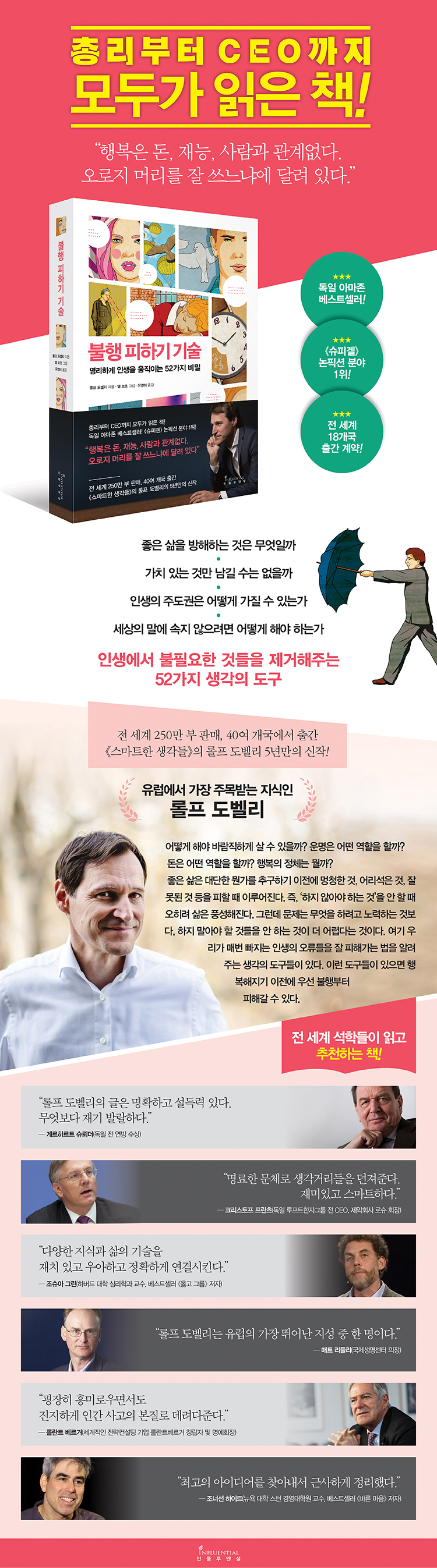
From Prime Ministers to CEOs, Everyone Reads His Book
Amazing ideas from Rolf Dobelli, Europe's most notable knowledge manager!
There were countless answers that promised a better future and a happier life.
But no matter how hard I try to follow those answers, my life doesn't seem to change much.
Why? Because we're only looking for one concept, one law.
But now is the time to quietly bring about a change in thinking.
The world is too complex to be understood by one or a few principles.
Unfortunately, it will get more complicated.
The types of challenges I have to face in this complex world continue to increase.
Rolf Dobelli, a leading European knowledge manager, said, “All CEOs in Germany carry this man’s book in their briefcases” (former CEO of Lufthansa Group) and “His ideas become the gold that creates bestsellers” (German daily Die Welt).
“Do you want to live a good life? It’s simple.
Avoid unhappiness and increase happiness! This simple method is difficult because many people don't actually focus on reducing their unhappiness.
As a cool-headed entrepreneur, capable investor, sought-after lecturer, and globe-trotting intellectual, Rolf Dobelli offers a profoundly rational, sensible, and practical approach to the age-old philosophical question: "How can we live a good life?"
Amazing ideas from Rolf Dobelli, Europe's most notable knowledge manager!
There were countless answers that promised a better future and a happier life.
But no matter how hard I try to follow those answers, my life doesn't seem to change much.
Why? Because we're only looking for one concept, one law.
But now is the time to quietly bring about a change in thinking.
The world is too complex to be understood by one or a few principles.
Unfortunately, it will get more complicated.
The types of challenges I have to face in this complex world continue to increase.
Rolf Dobelli, a leading European knowledge manager, said, “All CEOs in Germany carry this man’s book in their briefcases” (former CEO of Lufthansa Group) and “His ideas become the gold that creates bestsellers” (German daily Die Welt).
“Do you want to live a good life? It’s simple.
Avoid unhappiness and increase happiness! This simple method is difficult because many people don't actually focus on reducing their unhappiness.
As a cool-headed entrepreneur, capable investor, sought-after lecturer, and globe-trotting intellectual, Rolf Dobelli offers a profoundly rational, sensible, and practical approach to the age-old philosophical question: "How can we live a good life?"
- You can preview some of the book's contents.
Preview
index
prolog
PART 1: What Gets in the Way of a Good Life?
1.
The Art of the Mind That Doesn't Waste Time: Psychological Accounting
2.
There's No Perfect Setting: The Art of Modification
3.
Saying No to Dessert: A No-Compromise Strategy
4.
The World Doesn't Care About Your Feelings: Black Box Accident
5.
Is it really beneficial to my life?: Counterproductivity
6.
Avoiding the Wrong Brings the Right: The Art of Denial
7.
Is Success Really About Effort?: The Ovarian Lottery
8.
How to Let Negative Emotions Fly Away: The Illusion of Self-Observation
9.
The lie that honesty is good: Humans are animals with different insides and outs.
10.
Successful People Say 'No': Count to 5 Seconds Every Time
11.
Living in the Caribbean Doesn't Make You Happy: The Focus Fallacy
12.
How Purchased Goods Disintegrate: Negative Happiness
13.
How Much Salary Will Make You Happy: Financial Buffer
PART 2 Keeping Only What's Valuable
14.
Knowing When to Stop Playing: The Scope of Your Abilities
15.
Understanding the Difference Between Speculation and Investing: The Secret to Consistency
16.
Nothing is more dangerous than blind passion: faith in one's calling.
17.
Reputation is less important than you think: Your inner scorecard
18.
The Truth About People: How Smart Entrepreneurs Hire People
19.
Achievable Goals and Unachievable Goals: The Small Meanings of Life
20.
Why Your Life Isn't a Photo Album: Two Selves
21.
Experience is Better Than Memory: The Memory Account
22.
Your Life Is Not Causal: The Self-Serving Bias
23.
Thinking About Death Is a Waste of Time: The James Dean Effect
24.
How to Break Free from Past Hurts: The Self-Pity Spiral
25.
Can Pleasure and Meaning Coexist?: The Fundamentals of Happiness
PART 3: How to Take Control of Your Life
26.
Establishing Non-Compromising Principles: The Scope of Dignity
27.
The world is always attacking your tastes: the defense of dignity
28.
Are there things you won't sell for money?: The Devil's Pact
29.
How to Solve Chronic Fear, Leaving Only the Real Worries Behind
30.
You Don't Have to Be Clear About Everything: Opinion Overload
31.
How to Interpret Failure: A Mental Fortress
32.
There's always someone better off than me: The Toxic Power of Jealousy
33.
It's better to avoid problems in the first place: the wisdom of prevention.
34.
Addressing Earth's Misfortunes: Social Irresponsibility
35.
How to Handle Your Precious Self: The Trap of Attention
36.
How to Read to Leave a Trace in Your Brain: The Principle of Reading Twice
37.
Your Group Isn't the Public: The Trap of Dogma
38.
How to Become Aware of the Happiness You Have: The Art of Subtraction
39.
You can act without thinking: the maximum point of consideration.
PART 4 How not to be fooled by the world's words
40.
You can't understand people with your head: put yourself in someone else's shoes.
41.
World history wasn't written by great men: the illusion that the world can be changed.
42.
Don't Praise Yourself: A Chance Role
43.
Why Our Lives Are Not Mystery Novels: Belief in a Just World
44.
Wearing a hoodie doesn't make you Zuckerberg: Cargo Cult
45.
You Don't Need to Know Culture: The Birth of an Expert Fool
46.
Why You Should Avoid War: The Arms Race
47.
Surround Yourself with Weird People: Why It's Better to Be Van Gogh's Friend Than Van Gogh
48.
The more you date, the better partner you'll find: The mathematical solution
49.
Some Wishes Can't Be Fulfilled: Managing Expectations
50.
If 90 percent of everything is trash: Trash detector
51.
When You Don't Delude Yourself into Being Great: A Praise of Humility
52.
Ultimately, it's about inner success: A different definition of success.
Epilogue
Acknowledgements
References
PART 1: What Gets in the Way of a Good Life?
1.
The Art of the Mind That Doesn't Waste Time: Psychological Accounting
2.
There's No Perfect Setting: The Art of Modification
3.
Saying No to Dessert: A No-Compromise Strategy
4.
The World Doesn't Care About Your Feelings: Black Box Accident
5.
Is it really beneficial to my life?: Counterproductivity
6.
Avoiding the Wrong Brings the Right: The Art of Denial
7.
Is Success Really About Effort?: The Ovarian Lottery
8.
How to Let Negative Emotions Fly Away: The Illusion of Self-Observation
9.
The lie that honesty is good: Humans are animals with different insides and outs.
10.
Successful People Say 'No': Count to 5 Seconds Every Time
11.
Living in the Caribbean Doesn't Make You Happy: The Focus Fallacy
12.
How Purchased Goods Disintegrate: Negative Happiness
13.
How Much Salary Will Make You Happy: Financial Buffer
PART 2 Keeping Only What's Valuable
14.
Knowing When to Stop Playing: The Scope of Your Abilities
15.
Understanding the Difference Between Speculation and Investing: The Secret to Consistency
16.
Nothing is more dangerous than blind passion: faith in one's calling.
17.
Reputation is less important than you think: Your inner scorecard
18.
The Truth About People: How Smart Entrepreneurs Hire People
19.
Achievable Goals and Unachievable Goals: The Small Meanings of Life
20.
Why Your Life Isn't a Photo Album: Two Selves
21.
Experience is Better Than Memory: The Memory Account
22.
Your Life Is Not Causal: The Self-Serving Bias
23.
Thinking About Death Is a Waste of Time: The James Dean Effect
24.
How to Break Free from Past Hurts: The Self-Pity Spiral
25.
Can Pleasure and Meaning Coexist?: The Fundamentals of Happiness
PART 3: How to Take Control of Your Life
26.
Establishing Non-Compromising Principles: The Scope of Dignity
27.
The world is always attacking your tastes: the defense of dignity
28.
Are there things you won't sell for money?: The Devil's Pact
29.
How to Solve Chronic Fear, Leaving Only the Real Worries Behind
30.
You Don't Have to Be Clear About Everything: Opinion Overload
31.
How to Interpret Failure: A Mental Fortress
32.
There's always someone better off than me: The Toxic Power of Jealousy
33.
It's better to avoid problems in the first place: the wisdom of prevention.
34.
Addressing Earth's Misfortunes: Social Irresponsibility
35.
How to Handle Your Precious Self: The Trap of Attention
36.
How to Read to Leave a Trace in Your Brain: The Principle of Reading Twice
37.
Your Group Isn't the Public: The Trap of Dogma
38.
How to Become Aware of the Happiness You Have: The Art of Subtraction
39.
You can act without thinking: the maximum point of consideration.
PART 4 How not to be fooled by the world's words
40.
You can't understand people with your head: put yourself in someone else's shoes.
41.
World history wasn't written by great men: the illusion that the world can be changed.
42.
Don't Praise Yourself: A Chance Role
43.
Why Our Lives Are Not Mystery Novels: Belief in a Just World
44.
Wearing a hoodie doesn't make you Zuckerberg: Cargo Cult
45.
You Don't Need to Know Culture: The Birth of an Expert Fool
46.
Why You Should Avoid War: The Arms Race
47.
Surround Yourself with Weird People: Why It's Better to Be Van Gogh's Friend Than Van Gogh
48.
The more you date, the better partner you'll find: The mathematical solution
49.
Some Wishes Can't Be Fulfilled: Managing Expectations
50.
If 90 percent of everything is trash: Trash detector
51.
When You Don't Delude Yourself into Being Great: A Praise of Humility
52.
Ultimately, it's about inner success: A different definition of success.
Epilogue
Acknowledgements
References
Detailed image
Into the book
How can we live a better life? What role does fate play? What role does money play? Is it better to pursue happiness or avoid unhappiness? Every generation poses these questions anew.
But the answer is basically always disappointing.
Why is that? Because we're looking for just one principle, just one law, just one rule.
But there is no such thing as an absolute, ultimate principle for achieving a good life.
Because the world is too complex to be understood by a single concept or a few principles.
To understand the world, we need a toolbox of diverse ways of thinking, and we need a toolbox that we can use in real life.
Nowadays, in any field, if you are not armed with a solid thinking tool, you are likely to face failure in life.
From 'Prologue'
There is a CEO of a multinational company whom I meet two or three times a year at ceremonial dinner events.
But a few years ago, he started making a rule of not eating dessert, and started refusing dessert no matter what was served.
Until recently, I thought such behavior was illogical and against my desires.
Why would anyone rule out a sweet option on principle? But there's something surprising about this "no-compromise strategy."
-From 'Escaping the Trap of Flexibility'
When I get a request, I think about it for 5 seconds and then decide.
And most of them refuse.
Love from everyone
I think it's better to refuse a request and risk not receiving it than the opposite.
You try that too.
Not many people would dismiss you as unkind for refusing a request.
-From 'Successful People Say 'No''
The thinking habits, mental tricks, and mental tools taught by long-term successful investors are also excellent for our own lives.
The most important thing to do is to avoid the downside.
Before looking at the upside, let's first be mindful of what to avoid, that is, what not to do.
Buffett said this:
“We haven’t learned how to solve difficult problems in business.
What we have learned is to avoid such problems.” Therefore, the good life is not achieved by pursuing great happiness, but by avoiding stupidity, foolishness, and following trends.
It is not doing more of something that enriches life, but 'not doing something, being moderate' that enriches life.
From 'When something wrong comes, something right comes'
A good life is not achieved through self-observation.
Psychologists call this delusion of self-observation the "illusion of self-observation," the idea that one can discover one's tendencies, life goals, meaning in life, and the secret to happiness by looking into one's inner self.
As many poets have likened our emotional world to a deep forest, if we follow our emotions, we will only end up lost in the deep forest and fall into a swamp filled with various feelings, thoughts, and emotional stimuli.
From 'How to Let Negative Emotions Fly Away'
There is a concept called 'scope of ability'.
Anything within your capabilities can be accomplished with excellence.
However, we do not know much about things that are beyond our scope of ability, or we only know part of them.
Know your limits and stay within them.
The size of the range doesn't really matter.
The important thing is to know the boundaries of the scope.
But the push to expand one's capabilities is very tempting.
This temptation is great when you are feeling confident because you are doing pretty well within your current range.
But don't expand the scope.
Competence does not transfer easily from one area to another.
There's no guarantee that a chess player will be a good strategist in business, and there's no guarantee that a skilled heart surgeon will be a good hospital manager.
How could a real estate speculator become a good president?
? From 'Knowing When to Stop Playing'
If only I had bowed down a little before the torturers, I could have avoided the brutal abuse.
I wish I hadn't been tortured like the other prisoners.
Stockdale didn't think about it that way, and he consciously accepted the torture.
Fortunately, we do not have to endure torture, solitary confinement, or eternal ice.
Nevertheless, the accounts of those who have survived such extreme situations are important even to ordinary people like us.
We too face daily attacks on our will, our principles, and our tastes.
The boundaries of dignity are being attacked.
?From 'The world always attacks your taste'
It's liberating to think that you don't have to have an opinion about everything.
A person who has no opinion is not intellectually inferior.
Don't be ashamed of not having an opinion.
Not having an opinion is a freedom and a right we can enjoy.
The real problem today is not information overload, but opinion overload.
Therefore, consciously choose the topics on which you express your opinion.
Why let journalists, bloggers, and Twitterians dictate what you should think about? Avoid situations where you have to judge things.
The world will go on just fine without your comments.
?From 'Not everything needs to be clear'
Wisdom is a practical ability.
It is a measure of how skillfully we navigate life.
Anyone who has realized that it is simpler to avoid difficulties than to solve them will appreciate the simple definition: "Prevention is wisdom."
In fact, life is not easy.
Problems come at you from all over the place.
Chance digs a hole in front of you and barricades your life's path.
This in itself cannot be helped.
But if you anticipate where danger lurks, you can avoid obstacles farther away.
Didn't Einstein say, "Clever people solve problems, wise people avoid them."
?'It is better to avoid the problem in the first place'
Beware, empty formalities are more common than you think.
If you want a good life, expose pretense as pretense and drive it out of your life.
Formalism wastes time and narrows our vision.
Stay away from people or organizations that are involved in cargo cults.
Avoid companies that try to make a dent in the market with empty promises and empty words, rather than substance.
And above all, don't imitate the actions of successful people without knowing what truly makes them successful.
-From 'Wearing a hoodie doesn't make you a Zuckerberg'
But the answer is basically always disappointing.
Why is that? Because we're looking for just one principle, just one law, just one rule.
But there is no such thing as an absolute, ultimate principle for achieving a good life.
Because the world is too complex to be understood by a single concept or a few principles.
To understand the world, we need a toolbox of diverse ways of thinking, and we need a toolbox that we can use in real life.
Nowadays, in any field, if you are not armed with a solid thinking tool, you are likely to face failure in life.
From 'Prologue'
There is a CEO of a multinational company whom I meet two or three times a year at ceremonial dinner events.
But a few years ago, he started making a rule of not eating dessert, and started refusing dessert no matter what was served.
Until recently, I thought such behavior was illogical and against my desires.
Why would anyone rule out a sweet option on principle? But there's something surprising about this "no-compromise strategy."
-From 'Escaping the Trap of Flexibility'
When I get a request, I think about it for 5 seconds and then decide.
And most of them refuse.
Love from everyone
I think it's better to refuse a request and risk not receiving it than the opposite.
You try that too.
Not many people would dismiss you as unkind for refusing a request.
-From 'Successful People Say 'No''
The thinking habits, mental tricks, and mental tools taught by long-term successful investors are also excellent for our own lives.
The most important thing to do is to avoid the downside.
Before looking at the upside, let's first be mindful of what to avoid, that is, what not to do.
Buffett said this:
“We haven’t learned how to solve difficult problems in business.
What we have learned is to avoid such problems.” Therefore, the good life is not achieved by pursuing great happiness, but by avoiding stupidity, foolishness, and following trends.
It is not doing more of something that enriches life, but 'not doing something, being moderate' that enriches life.
From 'When something wrong comes, something right comes'
A good life is not achieved through self-observation.
Psychologists call this delusion of self-observation the "illusion of self-observation," the idea that one can discover one's tendencies, life goals, meaning in life, and the secret to happiness by looking into one's inner self.
As many poets have likened our emotional world to a deep forest, if we follow our emotions, we will only end up lost in the deep forest and fall into a swamp filled with various feelings, thoughts, and emotional stimuli.
From 'How to Let Negative Emotions Fly Away'
There is a concept called 'scope of ability'.
Anything within your capabilities can be accomplished with excellence.
However, we do not know much about things that are beyond our scope of ability, or we only know part of them.
Know your limits and stay within them.
The size of the range doesn't really matter.
The important thing is to know the boundaries of the scope.
But the push to expand one's capabilities is very tempting.
This temptation is great when you are feeling confident because you are doing pretty well within your current range.
But don't expand the scope.
Competence does not transfer easily from one area to another.
There's no guarantee that a chess player will be a good strategist in business, and there's no guarantee that a skilled heart surgeon will be a good hospital manager.
How could a real estate speculator become a good president?
? From 'Knowing When to Stop Playing'
If only I had bowed down a little before the torturers, I could have avoided the brutal abuse.
I wish I hadn't been tortured like the other prisoners.
Stockdale didn't think about it that way, and he consciously accepted the torture.
Fortunately, we do not have to endure torture, solitary confinement, or eternal ice.
Nevertheless, the accounts of those who have survived such extreme situations are important even to ordinary people like us.
We too face daily attacks on our will, our principles, and our tastes.
The boundaries of dignity are being attacked.
?From 'The world always attacks your taste'
It's liberating to think that you don't have to have an opinion about everything.
A person who has no opinion is not intellectually inferior.
Don't be ashamed of not having an opinion.
Not having an opinion is a freedom and a right we can enjoy.
The real problem today is not information overload, but opinion overload.
Therefore, consciously choose the topics on which you express your opinion.
Why let journalists, bloggers, and Twitterians dictate what you should think about? Avoid situations where you have to judge things.
The world will go on just fine without your comments.
?From 'Not everything needs to be clear'
Wisdom is a practical ability.
It is a measure of how skillfully we navigate life.
Anyone who has realized that it is simpler to avoid difficulties than to solve them will appreciate the simple definition: "Prevention is wisdom."
In fact, life is not easy.
Problems come at you from all over the place.
Chance digs a hole in front of you and barricades your life's path.
This in itself cannot be helped.
But if you anticipate where danger lurks, you can avoid obstacles farther away.
Didn't Einstein say, "Clever people solve problems, wise people avoid them."
?'It is better to avoid the problem in the first place'
Beware, empty formalities are more common than you think.
If you want a good life, expose pretense as pretense and drive it out of your life.
Formalism wastes time and narrows our vision.
Stay away from people or organizations that are involved in cargo cults.
Avoid companies that try to make a dent in the market with empty promises and empty words, rather than substance.
And above all, don't imitate the actions of successful people without knowing what truly makes them successful.
-From 'Wearing a hoodie doesn't make you a Zuckerberg'
---From the text
Publisher's Review
■ If you avoid misfortune, a good life will come naturally.
The 'smart happiness technology' needed in this era!
How can we live a better life? What role does fate play? What role does money play? What is the essence of happiness? There have been countless answers to these questions, but many of them ultimately proved disappointing.
Why is that?
In fact, a good life is achieved by avoiding the stupid, the foolish, and the wrong before pursuing something great.
The problem is that it is harder to avoid doing these 'don'ts'.
Rolf Dobelli, who is said to have “this man’s book in the briefcase of every CEO in Germany.”
This time, he, one of Europe's most notable knowledge managers, shares his 'techniques for avoiding misfortune.'
A book full of wit, humor, and sharp insight, befitting a cool-headed entrepreneur, capable investor, popular lecturer, and intellectual active in various fields, "The Art of Avoiding Misfortune."
Through this book, let's discover the secret to avoiding the traps we fall into every day in life.
From Prime Ministers to CEOs, everyone reads "His Book."
Amazing ideas from Rolf Dobelli, Europe's most notable knowledge manager!
There were countless answers that promised a better future and a happier life.
But no matter how hard I try to follow those answers, my life doesn't seem to change much.
Why? Because we're only looking for one concept, one law.
But now is the time to quietly bring about a change in thinking.
The world is too complex to be understood by one or a few principles.
Unfortunately, it will get more complicated.
The types of challenges I have to face in this complex world continue to increase.
Rolf Dobelli, a leading European knowledge manager, said, “All CEOs in Germany carry this man’s book in their briefcases” (former CEO of Lufthansa Group) and “His ideas become the gold that creates bestsellers” (German daily Die Welt).
“Do you want to live a good life? It’s simple.
Avoid unhappiness and increase happiness! This simple method is difficult because many people don't actually focus on reducing their unhappiness.
As a cool-headed entrepreneur, capable investor, sought-after lecturer, and globe-trotting intellectual, Rolf Dobelli offers a profoundly rational, sensible, and practical approach to the age-old philosophical question: "How can we live a good life?"
The 52 methods he introduces are thought tools that rescue us from the traps of unhappiness that we fall into every time we live our lives.
These are the traps of misfortune.
In reality, we wallow in feelings that don't really matter, obsess over things we can't actually do, work hard to earn money only to blow it all in an instant, and analyze the past that has no effect on today's work, let alone tomorrow, etc.
Even the wealthiest and most talented people often fall into this trap.
■ Eliminate only the unnecessary things for a good life.
Smart thinking tools that move freely between ancient and modern times!
“A good life has nothing to do with money, talent, or the people around you.
As we go through life, the only thing we can control is our thoughts.
“So, happiness depends on how well you use your head,” says Rolf Dobelli.
The '52 ways to use your brain' he talks about are 'smart happiness techniques' needed in today's age where we are given too many things and cannot know what we truly need.
A new technology for happiness that draws on cutting-edge psychological theories, ancient Greek philosophy, and even the wisdom of investors like Warren Buffett.
How many of these 52 skills we use determines the difference between light and dark in our lives.
If you use just one of these properly, you will feel your life change immediately.
There is a reason why it became a German Amazon bestseller immediately after its publication, reached number one in the non-fiction category of Der Spiegel, and was read first and strongly recommended by numerous opinion leaders, including former German Chancellor Schröder, as well as leading scholars and CEOs from around the world.
'What prevents us from living a good life?', 'Can't we keep only what is valuable?', 'How can we take control of our lives?', 'How can we avoid being deceived by the world?'
Through this book, let's feel our stagnant lives begin to move forward by changing the old prejudices and repetitive bad habits we have been unaware of.
The 'smart happiness technology' needed in this era!
How can we live a better life? What role does fate play? What role does money play? What is the essence of happiness? There have been countless answers to these questions, but many of them ultimately proved disappointing.
Why is that?
In fact, a good life is achieved by avoiding the stupid, the foolish, and the wrong before pursuing something great.
The problem is that it is harder to avoid doing these 'don'ts'.
Rolf Dobelli, who is said to have “this man’s book in the briefcase of every CEO in Germany.”
This time, he, one of Europe's most notable knowledge managers, shares his 'techniques for avoiding misfortune.'
A book full of wit, humor, and sharp insight, befitting a cool-headed entrepreneur, capable investor, popular lecturer, and intellectual active in various fields, "The Art of Avoiding Misfortune."
Through this book, let's discover the secret to avoiding the traps we fall into every day in life.
From Prime Ministers to CEOs, everyone reads "His Book."
Amazing ideas from Rolf Dobelli, Europe's most notable knowledge manager!
There were countless answers that promised a better future and a happier life.
But no matter how hard I try to follow those answers, my life doesn't seem to change much.
Why? Because we're only looking for one concept, one law.
But now is the time to quietly bring about a change in thinking.
The world is too complex to be understood by one or a few principles.
Unfortunately, it will get more complicated.
The types of challenges I have to face in this complex world continue to increase.
Rolf Dobelli, a leading European knowledge manager, said, “All CEOs in Germany carry this man’s book in their briefcases” (former CEO of Lufthansa Group) and “His ideas become the gold that creates bestsellers” (German daily Die Welt).
“Do you want to live a good life? It’s simple.
Avoid unhappiness and increase happiness! This simple method is difficult because many people don't actually focus on reducing their unhappiness.
As a cool-headed entrepreneur, capable investor, sought-after lecturer, and globe-trotting intellectual, Rolf Dobelli offers a profoundly rational, sensible, and practical approach to the age-old philosophical question: "How can we live a good life?"
The 52 methods he introduces are thought tools that rescue us from the traps of unhappiness that we fall into every time we live our lives.
These are the traps of misfortune.
In reality, we wallow in feelings that don't really matter, obsess over things we can't actually do, work hard to earn money only to blow it all in an instant, and analyze the past that has no effect on today's work, let alone tomorrow, etc.
Even the wealthiest and most talented people often fall into this trap.
■ Eliminate only the unnecessary things for a good life.
Smart thinking tools that move freely between ancient and modern times!
“A good life has nothing to do with money, talent, or the people around you.
As we go through life, the only thing we can control is our thoughts.
“So, happiness depends on how well you use your head,” says Rolf Dobelli.
The '52 ways to use your brain' he talks about are 'smart happiness techniques' needed in today's age where we are given too many things and cannot know what we truly need.
A new technology for happiness that draws on cutting-edge psychological theories, ancient Greek philosophy, and even the wisdom of investors like Warren Buffett.
How many of these 52 skills we use determines the difference between light and dark in our lives.
If you use just one of these properly, you will feel your life change immediately.
There is a reason why it became a German Amazon bestseller immediately after its publication, reached number one in the non-fiction category of Der Spiegel, and was read first and strongly recommended by numerous opinion leaders, including former German Chancellor Schröder, as well as leading scholars and CEOs from around the world.
'What prevents us from living a good life?', 'Can't we keep only what is valuable?', 'How can we take control of our lives?', 'How can we avoid being deceived by the world?'
Through this book, let's feel our stagnant lives begin to move forward by changing the old prejudices and repetitive bad habits we have been unaware of.
GOODS SPECIFICS
- Date of issue: January 20, 2018
- Page count, weight, size: 400 pages | 510g | 142*205*30mm
- ISBN13: 9791186560617
- ISBN10: 1186560614
You may also like
카테고리
korean


korean

![GQ KOREA Mark (Monthly): December [2025]](http://librairie.coreenne.fr/cdn/shop/files/8ef265dbbfbf186523ed75ba7319009d.jpg?v=1765340328&width=3840)


