

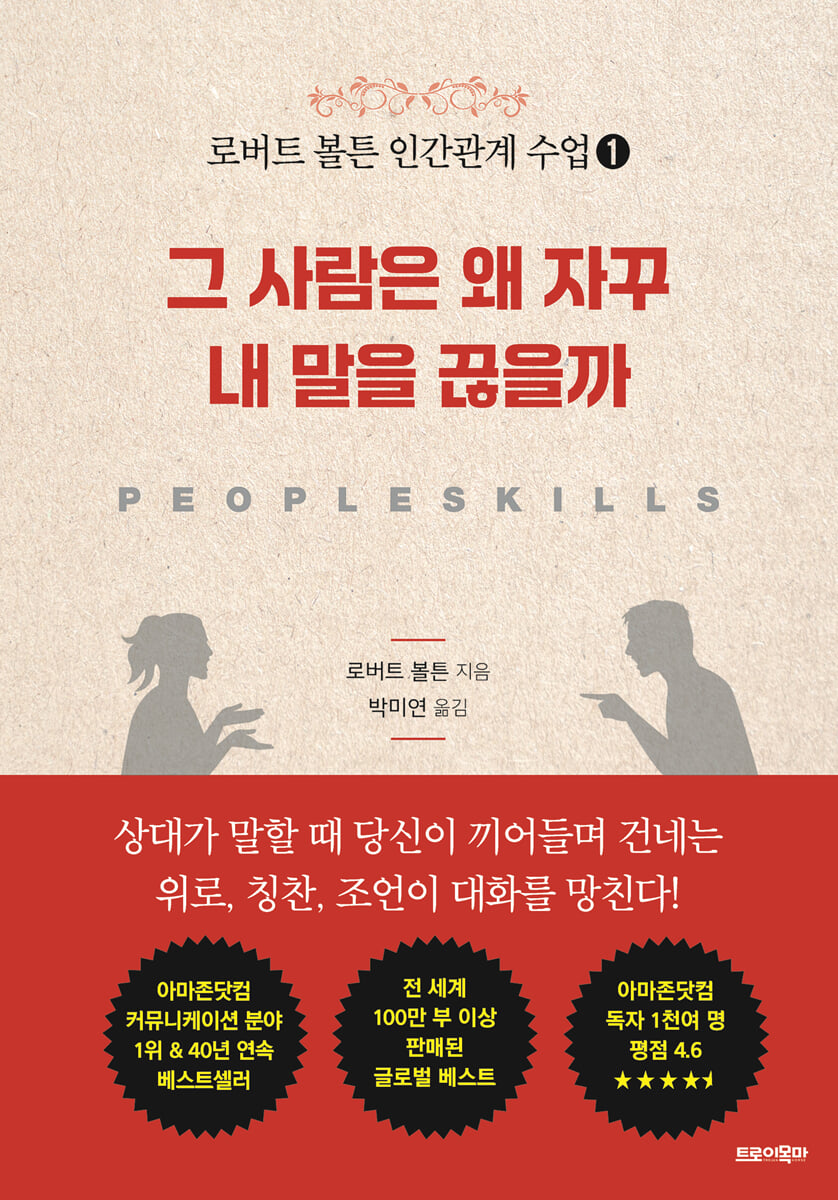
Robert Bolton's Relationship Lesson 1: Why Does That Person Keep Interrupting Me?
 |
Description
Book Introduction
● #1 in the Amazon.com Communications category & 40 consecutive years of bestseller
● A global bestseller with over 1 million copies sold worldwide
● Amazon.com reader rating of 4.6 ★★★★★ from over 1,000 readers
Since the publication of the revised edition in 1986,
A long-term bestseller in the communications field for 40 consecutive years
If you've read Dale Carnegie's How to Win Friends and Influence People, it's time to learn conversation skills for everyday life!
The Korean translation of the classic book on communication skills, "People Skills," which has been a long-term bestseller in the English-speaking world for 40 years, including the #1 position in the Amazon.com Communications category since its first edition in 1979 and a revised edition in 1986, has been published.
The Korean version is published in two volumes: Robert Bolton's Human Relations Lessons ① - 'Why Does That Person Keep Interrupting Me?' and Robert Bolton's Human Relations Lessons ② - 'Why Can't That Person Speak Any Other Way?' (scheduled for publication in October). The first book on 'Human Relations and Listening Skills' has been published first.
Author Dr. Robert Bolton founded Ridge Training, which teaches communication skills to improve relationships to tens of thousands of people working in Fortune 500 companies, healthcare, education, government agencies, and non-profit organizations.
Because interpersonal relationships were the most difficult part of his life, the author studied this topic more deeply than anyone else and worked to improve it. He concluded that learning proper communication skills can lead to better relationships and a happier life.
Since then, he has developed relevant training programs, studied and analyzed tens of thousands of program participants, and written a book called People Skills, which is based on human psychology and behavioral science theories, introducing his communication improvement techniques to millions of readers around the world.
In fact, for decades, readers from all over the world, including the US, UK, France, Germany, Japan, Taiwan, and India, have written reviews saying, “I have come to deeply understand the problems in human relationships that have been damaged by poor communication skills up until now. After reading this book and putting the methods in the book into practice, I have found that they are effective not only in my daily life but also in my work.”
In the section “Why Does That Person Keep Interrupting Me?” of “Robert Bolton’s Human Relations Lessons ①,” the reasons why countless conversations in daily life fail are analyzed into 3 categories and 12 obstacles (“Judging - criticizing, personal attacks, diagnosing, evaluative praise” / “Providing solutions - ordering, threatening, admonishing, asking excessive or inappropriate questions, giving advice” / “Avoiding the other person’s interests - changing the subject, arguing logically, comforting”), and the 13th obstacle, “pointing out,” is also mentioned.
This book explains how poor listening skills can ruin conversations by providing psychological analysis and real-life examples of how compliments, consolation, questions, advice, and logic that listeners often interrupt during conversations can become distractions that harm human relationships.
As a solution to this, the author introduces the 'skill of paying attention' to the speaker's words, the 'skill of accompanying' the speaker's emotions and thoughts, and the 'skill of reflecting' to express that you understand the thoughts and feelings experienced by the other person. He also provides information on how to properly read nonverbal elements that cannot be expressed through words, namely body language.
● A global bestseller with over 1 million copies sold worldwide
● Amazon.com reader rating of 4.6 ★★★★★ from over 1,000 readers
Since the publication of the revised edition in 1986,
A long-term bestseller in the communications field for 40 consecutive years
If you've read Dale Carnegie's How to Win Friends and Influence People, it's time to learn conversation skills for everyday life!
The Korean translation of the classic book on communication skills, "People Skills," which has been a long-term bestseller in the English-speaking world for 40 years, including the #1 position in the Amazon.com Communications category since its first edition in 1979 and a revised edition in 1986, has been published.
The Korean version is published in two volumes: Robert Bolton's Human Relations Lessons ① - 'Why Does That Person Keep Interrupting Me?' and Robert Bolton's Human Relations Lessons ② - 'Why Can't That Person Speak Any Other Way?' (scheduled for publication in October). The first book on 'Human Relations and Listening Skills' has been published first.
Author Dr. Robert Bolton founded Ridge Training, which teaches communication skills to improve relationships to tens of thousands of people working in Fortune 500 companies, healthcare, education, government agencies, and non-profit organizations.
Because interpersonal relationships were the most difficult part of his life, the author studied this topic more deeply than anyone else and worked to improve it. He concluded that learning proper communication skills can lead to better relationships and a happier life.
Since then, he has developed relevant training programs, studied and analyzed tens of thousands of program participants, and written a book called People Skills, which is based on human psychology and behavioral science theories, introducing his communication improvement techniques to millions of readers around the world.
In fact, for decades, readers from all over the world, including the US, UK, France, Germany, Japan, Taiwan, and India, have written reviews saying, “I have come to deeply understand the problems in human relationships that have been damaged by poor communication skills up until now. After reading this book and putting the methods in the book into practice, I have found that they are effective not only in my daily life but also in my work.”
In the section “Why Does That Person Keep Interrupting Me?” of “Robert Bolton’s Human Relations Lessons ①,” the reasons why countless conversations in daily life fail are analyzed into 3 categories and 12 obstacles (“Judging - criticizing, personal attacks, diagnosing, evaluative praise” / “Providing solutions - ordering, threatening, admonishing, asking excessive or inappropriate questions, giving advice” / “Avoiding the other person’s interests - changing the subject, arguing logically, comforting”), and the 13th obstacle, “pointing out,” is also mentioned.
This book explains how poor listening skills can ruin conversations by providing psychological analysis and real-life examples of how compliments, consolation, questions, advice, and logic that listeners often interrupt during conversations can become distractions that harm human relationships.
As a solution to this, the author introduces the 'skill of paying attention' to the speaker's words, the 'skill of accompanying' the speaker's emotions and thoughts, and the 'skill of reflecting' to express that you understand the thoughts and feelings experienced by the other person. He also provides information on how to properly read nonverbal elements that cannot be expressed through words, namely body language.
- You can preview some of the book's contents.
Preview
index
Prologue: How you speak your truth can sometimes be more important than the truth itself.
PART 1: Starting the Human Relations Class
CHAPTER 1.
Technology that builds bridges between people
Dialogue, humanity's greatest achievement
Most conversations fail
The pain of loneliness
Countless lost loves
Secrets to Success at Work
A matter of life and death
You can change
You will change!
When you don't feel like learning new skills
4 Skills for Building Relationships
To summarize…
CHAPTER 2.
communication barriers
People who always fail to communicate
Why Communication Barriers Are Dangerous
Judging, the biggest obstacle
Offer a solution
Avoiding the other person's interests
Pointing out the 13th communication barrier
Guilt, self-reproach, regret
To summarize…
PART 2 LISTENING SKILLS
CHAPTER 3.
Listening is more than just hearing sounds.
The Importance of Listening
What is listening
Types of listening skills
Attention technology
Follow-up technology
To summarize…
CHAPTER 4.
Four Skills of Reflective Listening
Rephrase
Reflecting emotions
Reflecting meaning
Reflect in summary
To summarize…
CHAPTER 5.
Why Reflex Reactions Are Effective
Types and Structures of Listening
Six Characteristics of Communication
Doubt disappears through action.
To summarize…
CHAPTER 6.
Reading body language
The Importance of Body Language
Nonverbal behaviors, the language of emotions
The 'leakage' of hidden emotions
Guidelines for 'reading' body language
Clear yet complex language
To summarize…
CHAPTER 7.
Developing reflective technology
Guidelines for better listening
Beyond reflexive listening
When to practice reflective listening
When to Avoid Reflexive Listening
Pros and Cons of Listening
To summarize…
Endnotes
PART 1: Starting the Human Relations Class
CHAPTER 1.
Technology that builds bridges between people
Dialogue, humanity's greatest achievement
Most conversations fail
The pain of loneliness
Countless lost loves
Secrets to Success at Work
A matter of life and death
You can change
You will change!
When you don't feel like learning new skills
4 Skills for Building Relationships
To summarize…
CHAPTER 2.
communication barriers
People who always fail to communicate
Why Communication Barriers Are Dangerous
Judging, the biggest obstacle
Offer a solution
Avoiding the other person's interests
Pointing out the 13th communication barrier
Guilt, self-reproach, regret
To summarize…
PART 2 LISTENING SKILLS
CHAPTER 3.
Listening is more than just hearing sounds.
The Importance of Listening
What is listening
Types of listening skills
Attention technology
Follow-up technology
To summarize…
CHAPTER 4.
Four Skills of Reflective Listening
Rephrase
Reflecting emotions
Reflecting meaning
Reflect in summary
To summarize…
CHAPTER 5.
Why Reflex Reactions Are Effective
Types and Structures of Listening
Six Characteristics of Communication
Doubt disappears through action.
To summarize…
CHAPTER 6.
Reading body language
The Importance of Body Language
Nonverbal behaviors, the language of emotions
The 'leakage' of hidden emotions
Guidelines for 'reading' body language
Clear yet complex language
To summarize…
CHAPTER 7.
Developing reflective technology
Guidelines for better listening
Beyond reflexive listening
When to practice reflective listening
When to Avoid Reflexive Listening
Pros and Cons of Listening
To summarize…
Endnotes
Detailed image

Into the book
I struggled a lot with learning effective communication skills.
If I had been exceptionally gifted at communicating with people since childhood, I wouldn't have studied so persistently.
Communication was such a difficult problem for me that I studied, learned, practiced, and taught it, and finally wrote a book about it.
I think I was able to teach this skill better than others because I have struggled and encountered many difficulties just like other people.
Having started out with numerous flaws, I can help you avoid pitfalls as you learn and utilize these techniques.
--- p.7, from "Prologue"
In this book, Robert Bolton's Human Relationships Lessons 1 and 2, four very important skills for leading satisfactory interpersonal relationships are introduced, one by one.
The techniques are as follows:
1.
Listening skills: The skill of properly understanding what the other person is saying.
Using the new response method presented here allows the speaker to feel that the other person fully understands the problem and feelings he or she has expressed.
If used properly, this method allows the speaker to solve his own problems without relying on others.
2.
Assertiveness Skills: By mastering these verbal and nonverbal behaviors, you can gain respect, get your needs met, and stand up for your rights without dominating, exploiting, or bullying others.
3.
Conflict Resolution Skills: Learning these skills will help you better manage the tangled emotions that cause conflict with others.
Using these skills will strengthen your relationship with them after the conflict is resolved.
4.
Cooperative Problem Solving Skills: These skills help resolve conflict situations where all parties must be satisfied.
It also helps prevent the same problems from recurring after they have been resolved.
--- p.39~40, 「PART 1.
Beginning the Human Relations class, CHAPTER 1.
From “Technology that builds bridges between people”
At first glance, some of the above distractions may not seem like distractions at all.
Compliments, comfort, logical responses, asking questions, and well-intentioned advice are all commonly considered positive elements in human relationships.
So why did behaviorists identify these 12 types of responses as potentially disruptive to communication?
First, it's important to note that these 12 coping mechanisms are classified as extremely dangerous factors, rather than inevitable obstacles that block all communication.
These are more likely to shut down the conversation than other methods, block the other person's opportunity to effectively resolve their issues, and create emotional distance between the two people, but they can often be overcome without significant negative consequences.
--- p.48, 「PART 1.
Beginning the Human Relations class, CHAPTER 2.
From “Obstacles to Communication”
Questions play an important role in verbal communication.
Like many other responses, questions have strengths and limitations, and very few people know how to ask them effectively.
We tend to rely too much on questions and also use them incorrectly.
People who ask questions usually focus on their own intentions, perspectives, or interests rather than the speaker, and when that happens, questions become a hindrance to the conversation.
(syncopation)
Open-ended questions are usually preferable.
Because it doesn't limit the agenda to the person who wants to start the conversation.
When used skillfully and not too frequently, open-ended questions allow listeners to better understand the speaker without taking control of the conversation.
--- p.102~103, 「PART 2.
Listening Skills CHAPTER 3.
From “Listening is more than just hearing sounds”
There are six problems in human communication.
This is why reflective listening is especially important.
Four of these problems are common in speakers, and two are common in listeners.
The first problem with speakers is that words mean different things to different people, and the second problem is that they 'encode' what they want to say, making it difficult to know what they really mean.
The third problem is 'just the sound of the bell'.
They leave out the most important story and talk about other things.
Finally, the speaker is unable to face his or her emotions and express them effectively.
There is also a problem for the listener.
They don't focus on what the speaker is saying.
And because we listen to what the speaker says through our own filter, we end up distorting the true meaning considerably.
Let's look at these issues one by one in detail.
--- p.142~143, 「PART 2.
Listening Skills CHAPTER 5.
From "Why Reflex Reactions Are Effective"
To develop reflective listening, follow these guidelines:
· Don't pretend to understand.
· Don't say you know how the other person feels.
· React in different ways.
· Focus on your emotions.
· Choose the most accurate emotional expression.
· Express empathy in your voice.
· Encourage them to speak specifically and clearly.
· Be firm in your response without being dogmatic.
· Reflect on the solutions hidden in the other person's words.
· Reflect the emotions hidden in the question.
· Reflect with simple gestures.
If I had been exceptionally gifted at communicating with people since childhood, I wouldn't have studied so persistently.
Communication was such a difficult problem for me that I studied, learned, practiced, and taught it, and finally wrote a book about it.
I think I was able to teach this skill better than others because I have struggled and encountered many difficulties just like other people.
Having started out with numerous flaws, I can help you avoid pitfalls as you learn and utilize these techniques.
--- p.7, from "Prologue"
In this book, Robert Bolton's Human Relationships Lessons 1 and 2, four very important skills for leading satisfactory interpersonal relationships are introduced, one by one.
The techniques are as follows:
1.
Listening skills: The skill of properly understanding what the other person is saying.
Using the new response method presented here allows the speaker to feel that the other person fully understands the problem and feelings he or she has expressed.
If used properly, this method allows the speaker to solve his own problems without relying on others.
2.
Assertiveness Skills: By mastering these verbal and nonverbal behaviors, you can gain respect, get your needs met, and stand up for your rights without dominating, exploiting, or bullying others.
3.
Conflict Resolution Skills: Learning these skills will help you better manage the tangled emotions that cause conflict with others.
Using these skills will strengthen your relationship with them after the conflict is resolved.
4.
Cooperative Problem Solving Skills: These skills help resolve conflict situations where all parties must be satisfied.
It also helps prevent the same problems from recurring after they have been resolved.
--- p.39~40, 「PART 1.
Beginning the Human Relations class, CHAPTER 1.
From “Technology that builds bridges between people”
At first glance, some of the above distractions may not seem like distractions at all.
Compliments, comfort, logical responses, asking questions, and well-intentioned advice are all commonly considered positive elements in human relationships.
So why did behaviorists identify these 12 types of responses as potentially disruptive to communication?
First, it's important to note that these 12 coping mechanisms are classified as extremely dangerous factors, rather than inevitable obstacles that block all communication.
These are more likely to shut down the conversation than other methods, block the other person's opportunity to effectively resolve their issues, and create emotional distance between the two people, but they can often be overcome without significant negative consequences.
--- p.48, 「PART 1.
Beginning the Human Relations class, CHAPTER 2.
From “Obstacles to Communication”
Questions play an important role in verbal communication.
Like many other responses, questions have strengths and limitations, and very few people know how to ask them effectively.
We tend to rely too much on questions and also use them incorrectly.
People who ask questions usually focus on their own intentions, perspectives, or interests rather than the speaker, and when that happens, questions become a hindrance to the conversation.
(syncopation)
Open-ended questions are usually preferable.
Because it doesn't limit the agenda to the person who wants to start the conversation.
When used skillfully and not too frequently, open-ended questions allow listeners to better understand the speaker without taking control of the conversation.
--- p.102~103, 「PART 2.
Listening Skills CHAPTER 3.
From “Listening is more than just hearing sounds”
There are six problems in human communication.
This is why reflective listening is especially important.
Four of these problems are common in speakers, and two are common in listeners.
The first problem with speakers is that words mean different things to different people, and the second problem is that they 'encode' what they want to say, making it difficult to know what they really mean.
The third problem is 'just the sound of the bell'.
They leave out the most important story and talk about other things.
Finally, the speaker is unable to face his or her emotions and express them effectively.
There is also a problem for the listener.
They don't focus on what the speaker is saying.
And because we listen to what the speaker says through our own filter, we end up distorting the true meaning considerably.
Let's look at these issues one by one in detail.
--- p.142~143, 「PART 2.
Listening Skills CHAPTER 5.
From "Why Reflex Reactions Are Effective"
To develop reflective listening, follow these guidelines:
· Don't pretend to understand.
· Don't say you know how the other person feels.
· React in different ways.
· Focus on your emotions.
· Choose the most accurate emotional expression.
· Express empathy in your voice.
· Encourage them to speak specifically and clearly.
· Be firm in your response without being dogmatic.
· Reflect on the solutions hidden in the other person's words.
· Reflect the emotions hidden in the question.
· Reflect with simple gestures.
--- p.228~229, 「PART 2.
Listening Skills CHAPTER 7.
From “Developing Reflective Technology”
Listening Skills CHAPTER 7.
From “Developing Reflective Technology”
Publisher's Review
“When the other person is speaking, you interrupt and say
“Comfort, compliments, and advice ruin conversations!”
▶ A long-term bestseller for 40 consecutive years and a global bestseller with over 1 million copies sold worldwide
《Robert Bolton's Human Relationship Rules ①》- 'Why Does That Person Keep Interrupting Me?' is the first volume in the Korean version of 《People Skills》, a classic on 'communication skills and human relations' that has been a long-term bestseller (in the communication field) in the UK and the US for 40 years since its revised edition was published in 1986, and deals with 'human relations and listening skills.'
(The Korean version of 《People Skills》 will be published in two volumes, and 《Robert Bolton's Human Relationship Rules ②》 - 'Why Can't He Speak Any Other Way?' is scheduled to be published in October.) More than 1 million copies have been sold worldwide, and readers from various countries, including the US, UK, Germany, France, Japan, Taiwan, and India, have said, "I used the methods in the book and it worked."
He left a review saying, “It helped me with my relationships and life.”
“I found some great information on how to listen more effectively and actively!” _ Ke***, USA, October 2018
- “There are many books on the market that cover various areas of communication such as teamwork, negotiation, conflict management, and self-development, but you can find excellent advice on all of these areas in this one book by Robert Bolton.” _ Germany, Pe**************, August 2009
- “This is a book I read for corporate training.
Once you pick it up and start reading, it has been a long-seller for over 40 years since its first publication in 1979.
“It is clear why it became like this.” _ Japan, nan**********, July 2015
- “It makes us reflect on the mistakes we often make: asking too many questions, being too concerned with facts, ignoring other people’s feelings, criticizing, preaching, digressing, evaluative praise, suggestions, etc.” _ Fe******, Taiwan, June 2018
- “I thought the author was going to talk about how to speak well, but he first explained how to listen.
Even now, five years later, I still find myself revisiting it.
“I bought a lot, shared it, and recommended it.” _ France, Am*************, August 2007
▶ How to improve everyday conversation skills based on psychological and behavioral science theories
Dr. Robert Bolton, who experienced significant difficulties with interpersonal relationships and communication, studied effective communication methods based on psychological and behavioral science theories.
He founded Ridge Training, a company that provides communication skills and interpersonal coaching to tens of thousands of individuals working in corporate, medical, educational, non-profit, and government organizations.
Dr. Bolton later published "People Skills," which analyzed and summarized the conversation skills of tens of thousands of participants in the program based on human psychology and behavioral science theories, with the aim of improving the interpersonal relationships of more people.
The author writes, “Our training seminars have brought together people from all walks of life: business executives, salespeople, secretaries, teachers, medical professionals, corporate account managers, construction workers, public officials, psychologists, lawyers, clergy, and many others. As they struggle to improve their communication skills, I have found ways to teach these skills more easily.
“That is, I was able to discover theoretical methods that were presented inappropriately and develop more effective practical methods,” he said, revealing that he had made a lot of efforts to widely publicize the conversational skills that he had discovered to enhance human relationships.
▶ A surprising listening skill that breaks people's common sense about listening.
In his book, Dr. Robert Bolton points out that there are numerous problems with the 'listening and speaking skills' we use in everyday conversations.
Among them, in the section titled “Robert Bolton’s Human Relationship Rules ①” - “Why Does That Person Keep Interrupting Me?”, he mentions “Human Relationships and Listening Skills.”
The author advises that people typically spend 70% of their lives listening, and that the success or failure of human relationships is determined by listening skills, yet too many people unintentionally ruin valuable relationships due to poor listening skills.
The author explains through various examples why we unconsciously use 12 types of interruptions that hinder communication (criticizing, personal attacks, diagnosing, evaluative praise, ordering, threatening, lecturing, excessive or inappropriate questions, giving advice, changing the subject, logical arguments, and comforting) and the 13th, 'pointing out', and why 'praise, advice, logic, and questions' that the listener interrupts while the speaker is speaking are inappropriate.
To avoid these distractions, the listening skills we should adopt are 'attention skills, accompanying skills, and reflective skills'. In particular, we will introduce the specific methods and excellent effects of 'reflective listening skills'.
“Comfort, compliments, and advice ruin conversations!”
▶ A long-term bestseller for 40 consecutive years and a global bestseller with over 1 million copies sold worldwide
《Robert Bolton's Human Relationship Rules ①》- 'Why Does That Person Keep Interrupting Me?' is the first volume in the Korean version of 《People Skills》, a classic on 'communication skills and human relations' that has been a long-term bestseller (in the communication field) in the UK and the US for 40 years since its revised edition was published in 1986, and deals with 'human relations and listening skills.'
(The Korean version of 《People Skills》 will be published in two volumes, and 《Robert Bolton's Human Relationship Rules ②》 - 'Why Can't He Speak Any Other Way?' is scheduled to be published in October.) More than 1 million copies have been sold worldwide, and readers from various countries, including the US, UK, Germany, France, Japan, Taiwan, and India, have said, "I used the methods in the book and it worked."
He left a review saying, “It helped me with my relationships and life.”
“I found some great information on how to listen more effectively and actively!” _ Ke***, USA, October 2018
- “There are many books on the market that cover various areas of communication such as teamwork, negotiation, conflict management, and self-development, but you can find excellent advice on all of these areas in this one book by Robert Bolton.” _ Germany, Pe**************, August 2009
- “This is a book I read for corporate training.
Once you pick it up and start reading, it has been a long-seller for over 40 years since its first publication in 1979.
“It is clear why it became like this.” _ Japan, nan**********, July 2015
- “It makes us reflect on the mistakes we often make: asking too many questions, being too concerned with facts, ignoring other people’s feelings, criticizing, preaching, digressing, evaluative praise, suggestions, etc.” _ Fe******, Taiwan, June 2018
- “I thought the author was going to talk about how to speak well, but he first explained how to listen.
Even now, five years later, I still find myself revisiting it.
“I bought a lot, shared it, and recommended it.” _ France, Am*************, August 2007
▶ How to improve everyday conversation skills based on psychological and behavioral science theories
Dr. Robert Bolton, who experienced significant difficulties with interpersonal relationships and communication, studied effective communication methods based on psychological and behavioral science theories.
He founded Ridge Training, a company that provides communication skills and interpersonal coaching to tens of thousands of individuals working in corporate, medical, educational, non-profit, and government organizations.
Dr. Bolton later published "People Skills," which analyzed and summarized the conversation skills of tens of thousands of participants in the program based on human psychology and behavioral science theories, with the aim of improving the interpersonal relationships of more people.
The author writes, “Our training seminars have brought together people from all walks of life: business executives, salespeople, secretaries, teachers, medical professionals, corporate account managers, construction workers, public officials, psychologists, lawyers, clergy, and many others. As they struggle to improve their communication skills, I have found ways to teach these skills more easily.
“That is, I was able to discover theoretical methods that were presented inappropriately and develop more effective practical methods,” he said, revealing that he had made a lot of efforts to widely publicize the conversational skills that he had discovered to enhance human relationships.
▶ A surprising listening skill that breaks people's common sense about listening.
In his book, Dr. Robert Bolton points out that there are numerous problems with the 'listening and speaking skills' we use in everyday conversations.
Among them, in the section titled “Robert Bolton’s Human Relationship Rules ①” - “Why Does That Person Keep Interrupting Me?”, he mentions “Human Relationships and Listening Skills.”
The author advises that people typically spend 70% of their lives listening, and that the success or failure of human relationships is determined by listening skills, yet too many people unintentionally ruin valuable relationships due to poor listening skills.
The author explains through various examples why we unconsciously use 12 types of interruptions that hinder communication (criticizing, personal attacks, diagnosing, evaluative praise, ordering, threatening, lecturing, excessive or inappropriate questions, giving advice, changing the subject, logical arguments, and comforting) and the 13th, 'pointing out', and why 'praise, advice, logic, and questions' that the listener interrupts while the speaker is speaking are inappropriate.
To avoid these distractions, the listening skills we should adopt are 'attention skills, accompanying skills, and reflective skills'. In particular, we will introduce the specific methods and excellent effects of 'reflective listening skills'.
GOODS SPECIFICS
- Date of issue: October 3, 2025
- Page count, weight, size: 240 pages | 314g | 140*200*16mm
- ISBN13: 9791192959603
- ISBN10: 1192959604
You may also like
카테고리
korean


korean

![GQ KOREA Mark (Monthly): December [2025]](http://librairie.coreenne.fr/cdn/shop/files/8ef265dbbfbf186523ed75ba7319009d.jpg?v=1765340328&width=3840)


