

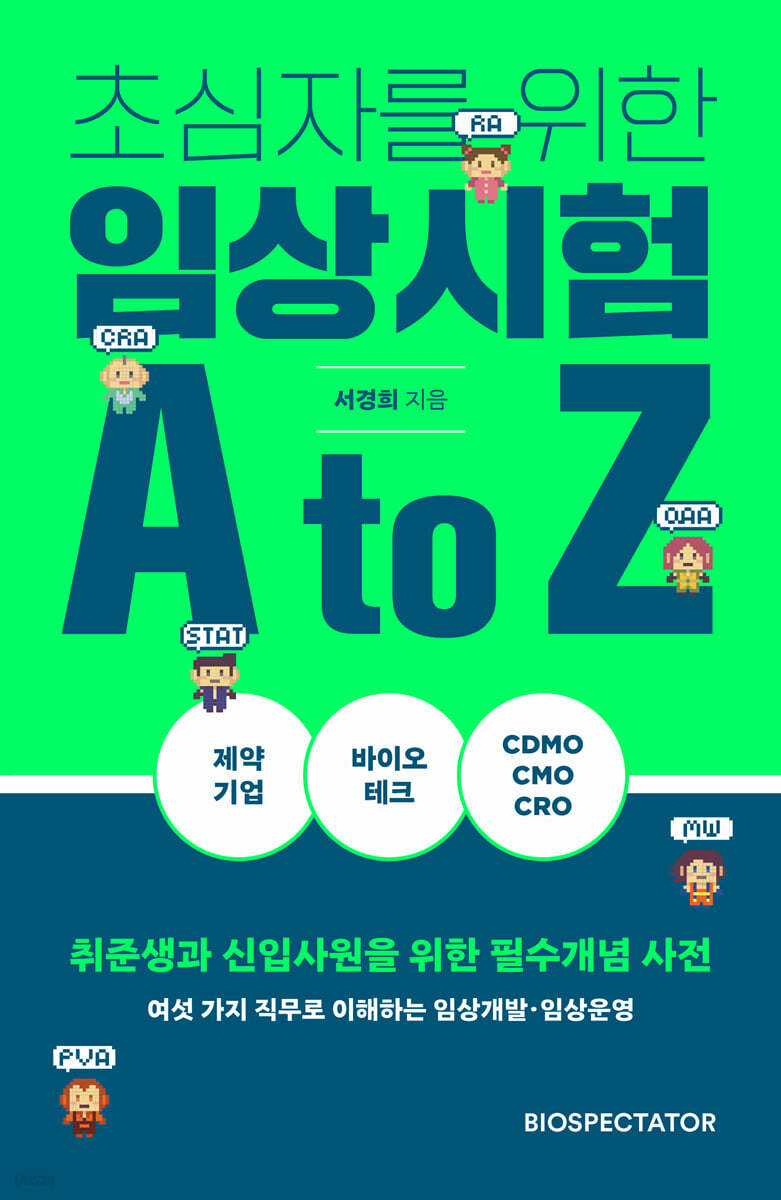
Clinical Trials A to Z for Beginners
 |
Description
Book Introduction
Based on over 20 years of experience in new drug development and clinical trials, I have compiled the terms, concepts, and practical tips that beginners in the clinical trial and clinical development industry must know.
For job seekers who dream of starting their careers, we provide information that will help them find a job, and for new employees who have just started working, we provide information on how to adapt to the actual work environment.
For job seekers who dream of starting their careers, we provide information that will help them find a job, and for new employees who have just started working, we provide information on how to adapt to the actual work environment.
- You can preview some of the book's contents.
Preview
index
Introductory remarks 5
Clinical Trials 15: Understanding Keyword I
New Drug Development 17, Target Setting 21, Mode Of Action (MOA), Mechanism Of Action (MOA) 22, Library 24, Platform Technique 24, Artificial Intelligence (AI) 25, Hit, Lead Compound, New Drug Candidate 26, Pipeline 27, Expiration Date, Shelf Life 27, International Council for Harmonization (ICH) 28, Stability Test 29, Safety, Efficacy 30, Nonclinical Study 30, Target Product Profile (TPP) 31, Clinical Development Plan (CDP) 32, Clinical Trial Protocol, Clinical Trial Amendment 32, Investigator's Brochure (IB) 33, Investigational New Drug Application (IND) 34, Common Technical Document (CTD) 35, Clinical Trial/Study 35, New Drug Application (NDA), Product Approval, Product Approval Renewal 40, Risk Management Plan (RMP) 41, Life Cycle Management 42, Real World Data (RWD), Real World Evidence (RWE) 43, Clinical Study for Conditional Approval 44, Fast Track 45, Accelerated Approval 46, Priority Review 46, Rolling Review 46, Breakthrough Therapy 47, Competence for Clinical Development Jobs 48
II Clinical Trials Step by Step 53
Organizing Project Team 55, Clinical Study Start Up Stage 56, Clinical Study Ongoing Stage 60, Clinical Study Closing Stage 63, Quality Assurance and Quality Control 65
III Clinical Trials by Job Type 69
1.
Clinical Research Associate (CRA) 71
CRA Job Route 71, CRA's Duties 72, Clinical Trial Contract Research Organization (CRO) CRA vs.
CRA at a new drug development company 74, CRA duties according to clinical trial progress stage (on-site CRA) 75, CRA is the most important 78, Studying for survival as a CRA 79, English skills that lead to the next level 81, CRA as a problem solver 82, The rewards and prospects of CRA work 83, One story of success in finding a job as a CRA - a nurse working in a ward 84, Two stories of success in finding a job as a CRA - a graduate student majoring in life sciences 85
2.
Regulatory Associate (RA) 86
Regulatory Affairs (RA) and Regulatory Associate (RA) 86, A Roundabout Path to Permitting Experts 87, Collaboration, Communication, and Results Created by RAs 89, RAs as Strategists 91, Permitting is a Long-Term Project 92, Beyond Permitting Experts to Regulatory Science Experts 94, RAs Are Studying Regulatory Scientists 96, RA English Skills 98, RA Job Success Stories - I Did It, New RA Jobs! 99
3.
Quality Assurance Associate (QAA) 100
Clinical Trial Quality Assurance (QA) vs.
Clinical Trial Quality Control (QC) 100, Quality Assurance Planning, Implementation, and Management 102, The Importance of Independence and Communication in the Quality Assurance Department 103, Inspection and On-Site Survey 106, QAA's Work 106, QAA's Study and Growth 108, QAA's Future Outlook 110, QAA Practitioner Stories - The Ins and Outs of Inspection 111
4.
Biostatistician (STAT) 112
The Role of Clinical Statistics 112, Statisticians in Clinical Development, STAT 112, Knowledge Required for STATs 114, Training for Becoming a STAT 115, The Work of a STAT 116, Communication in STATs 118, Prospects for STAT Careers 119, English Proficiency in STATs 121, Stories from STAT Practitioners - Opportunities That Came to Me 122
5.
Pharmacovigilance Associate (PVA) 124
Detecting and Locating Risks 125, Preparing to Work as a PVA 129, Becoming a Highly Effective Pharmacovigilance Specialist 131, PVA Job Outlook 134, Predictable and Unpredictable 137
6.
Medical Writer (MW) 140
Clinical trial designers and medical writers who sketch and complete the work 140, Required competencies for MWs 141, The pain and joy of writing 144, MW job training 146, MWs in clinical development 147, MW job outlook 149, Stories from MW practitioners - How I became a MW 150
Appendix 1 151
Promising, Growing Professional Careers - Clinical Developer 153, Convergence Talent 156, Essentials for New Employees 157, Too Much Communication is Better Than Too Little 165, Time is Money 167, Documentation 169
Appendix 2 175
Let's learn the terminology 177
Recommendation 191
Search 195
Clinical Trials 15: Understanding Keyword I
New Drug Development 17, Target Setting 21, Mode Of Action (MOA), Mechanism Of Action (MOA) 22, Library 24, Platform Technique 24, Artificial Intelligence (AI) 25, Hit, Lead Compound, New Drug Candidate 26, Pipeline 27, Expiration Date, Shelf Life 27, International Council for Harmonization (ICH) 28, Stability Test 29, Safety, Efficacy 30, Nonclinical Study 30, Target Product Profile (TPP) 31, Clinical Development Plan (CDP) 32, Clinical Trial Protocol, Clinical Trial Amendment 32, Investigator's Brochure (IB) 33, Investigational New Drug Application (IND) 34, Common Technical Document (CTD) 35, Clinical Trial/Study 35, New Drug Application (NDA), Product Approval, Product Approval Renewal 40, Risk Management Plan (RMP) 41, Life Cycle Management 42, Real World Data (RWD), Real World Evidence (RWE) 43, Clinical Study for Conditional Approval 44, Fast Track 45, Accelerated Approval 46, Priority Review 46, Rolling Review 46, Breakthrough Therapy 47, Competence for Clinical Development Jobs 48
II Clinical Trials Step by Step 53
Organizing Project Team 55, Clinical Study Start Up Stage 56, Clinical Study Ongoing Stage 60, Clinical Study Closing Stage 63, Quality Assurance and Quality Control 65
III Clinical Trials by Job Type 69
1.
Clinical Research Associate (CRA) 71
CRA Job Route 71, CRA's Duties 72, Clinical Trial Contract Research Organization (CRO) CRA vs.
CRA at a new drug development company 74, CRA duties according to clinical trial progress stage (on-site CRA) 75, CRA is the most important 78, Studying for survival as a CRA 79, English skills that lead to the next level 81, CRA as a problem solver 82, The rewards and prospects of CRA work 83, One story of success in finding a job as a CRA - a nurse working in a ward 84, Two stories of success in finding a job as a CRA - a graduate student majoring in life sciences 85
2.
Regulatory Associate (RA) 86
Regulatory Affairs (RA) and Regulatory Associate (RA) 86, A Roundabout Path to Permitting Experts 87, Collaboration, Communication, and Results Created by RAs 89, RAs as Strategists 91, Permitting is a Long-Term Project 92, Beyond Permitting Experts to Regulatory Science Experts 94, RAs Are Studying Regulatory Scientists 96, RA English Skills 98, RA Job Success Stories - I Did It, New RA Jobs! 99
3.
Quality Assurance Associate (QAA) 100
Clinical Trial Quality Assurance (QA) vs.
Clinical Trial Quality Control (QC) 100, Quality Assurance Planning, Implementation, and Management 102, The Importance of Independence and Communication in the Quality Assurance Department 103, Inspection and On-Site Survey 106, QAA's Work 106, QAA's Study and Growth 108, QAA's Future Outlook 110, QAA Practitioner Stories - The Ins and Outs of Inspection 111
4.
Biostatistician (STAT) 112
The Role of Clinical Statistics 112, Statisticians in Clinical Development, STAT 112, Knowledge Required for STATs 114, Training for Becoming a STAT 115, The Work of a STAT 116, Communication in STATs 118, Prospects for STAT Careers 119, English Proficiency in STATs 121, Stories from STAT Practitioners - Opportunities That Came to Me 122
5.
Pharmacovigilance Associate (PVA) 124
Detecting and Locating Risks 125, Preparing to Work as a PVA 129, Becoming a Highly Effective Pharmacovigilance Specialist 131, PVA Job Outlook 134, Predictable and Unpredictable 137
6.
Medical Writer (MW) 140
Clinical trial designers and medical writers who sketch and complete the work 140, Required competencies for MWs 141, The pain and joy of writing 144, MW job training 146, MWs in clinical development 147, MW job outlook 149, Stories from MW practitioners - How I became a MW 150
Appendix 1 151
Promising, Growing Professional Careers - Clinical Developer 153, Convergence Talent 156, Essentials for New Employees 157, Too Much Communication is Better Than Too Little 165, Time is Money 167, Documentation 169
Appendix 2 175
Let's learn the terminology 177
Recommendation 191
Search 195
Publisher's Review
The person who sat at the interviewer's table told me
All About Clinical Trials
The author of "Clinical Trials A to Z for Beginners" is an expert in the clinical trial and clinical development industry with over 20 years of experience in new drug development and clinical trial projects, and has direct experience in recruiting people.
The author, having interviewed over 200 people and hired over 70, empathized with the earnestness of job seekers he witnessed and began this book to help them navigate the real-world challenges they face.
The common denominator among the job seekers the author met at interviews was that they 'did not know much about the field they were applying for.'
This is a difficult condition for companies seeking to hire personnel who can be put to work immediately.
Therefore, job seekers must first understand the terminology and concepts.
In Part 1, "Understanding Clinical Trials and Clinical Development through Keywords," of "Clinical Trials A to Z for Beginners," we explain 55 keywords used in the clinical trial and clinical development industries and organize 154 technical terms to help you accurately understand the concepts.
For example, instead of vague concepts like 'mechanism' or 'mechanisms', this book provides a precise term and concept called 'Mode Of Action'.
[See page 22, 'Mode of Action (MOA)']
A friendly roadmap at a glance
Many job seekers confided in the author, "I want to work in clinical trials and clinical development, but I don't know where to start."
This is because we do not know how clinical trials and clinical development work are structured.
To help you resolve these concerns, Part 2 of this book, "Clinical Trials and Clinical Development: A Step-by-Step Guide," covers the entire structure of clinical trials and clinical development.
The contents of Part 2 are summarized in a table that can be seen at a glance, and are included on the back of the cover to help beginners understand.
The table divides clinical trials into preparation, progress, and completion stages, and also shows what each person in charge of clinical trials prepares and carries out.
It is a field map that depicts the work carried out in chronological order from the beginning to the end of a clinical trial.
Knowing how various tasks are arranged within a clinical trial will help you find a position that matches your capabilities and qualifications.
How much do you know about CRA?
When researching careers in the clinical trial and clinical development industries, many people are interested in the position of Clinical Research Associate (CRA). When you think of a CRA, you might think of someone who administers drugs to clinical trial subjects at a clinical trial institution (hospital) and records the results.
However, CRAs have a much wider range of responsibilities.
The author explains the real work of CRA as follows:
In the clinical trial preparation stage, the CRA reviews the documents to be used in the clinical trial and selects the clinical trial conducting institution (hospital) and the clinical trial contract organization (CRO).
Once preparations are complete, the CRA begins monitoring work to manage and supervise the clinical trial.
After the clinical trial is completed and the monitoring work is completed, the CRA carries out the final work.
These tasks include reviewing clinical study reports (CSR), checking the clinical trial drugs used in clinical trials, processing any remaining quantities, and reviewing and checking the storage status of various documents created during the clinical trial process.
Although CRA is one of the most widely known roles in the clinical trial and clinical development fields, it is also true that the exact work that CRAs do in the field is not well known.
Part 3 provides a detailed explanation of what jobs are being done in clinical trials and clinical development.
Readers can learn more about the specific work routines of CRAs and the real-world situations they encounter in the workplace in Chapter 1 of Part 3: Clinical Research Associates (CRAs).
[See page 75, "CRA Work According to Clinical Trial Progress Stage (Onsite CRA)"]
RA, QAA, STAT, PVA, MW
Meanwhile, CRA work is not the only task performed during the clinical trial process.
Broadly speaking, regulatory affairs, quality assurance, biostatistics, pharmacovigilance, and medical writing are all carried out together.
Let's take a look at the clinical trial preparation and progress stages described by the author.
First, a medical writer (MW) writes a clinical trial protocol.
Once the clinical trial plan is completed, a Regulatory Associate (RA) prepares an Investigational New Drug (IND) application. The RA submits the application to regulatory agencies, such as the Ministry of Food and Drug Safety or the U.S. Food and Drug Administration (FDA), and is responsible for communicating with the agency until the clinical trial is approved.
When a regulatory agency approves a clinical trial, the CRA begins to operate the clinical trial. While the CRA monitors the clinical trial, the Quality Assurance Associate (QAA) separately inspects the clinical trial and the clinical trial institution, the Biostatistician (STAT) designs appropriate statistical methods for the clinical trial, and the Pharmacovigilance Associate (PVA) continues to track and monitor the safety of the clinical trial drug.
But this is only part of it.
In 'Clinical Trials and Clinical Development: A 3-Part Guide to Job Functions', the author provides a detailed explanation of five lesser-known clinical trial functions: RA, QAA, STAT, PVA, and MW, in addition to CRA.
Various strategies for entry
Typically, companies want to hire experienced candidates who can be put to work right away.
This is a huge barrier for beginners who want to enter the clinical trial and clinical development fields.
For this reason, the author also provided various entry paths to successful employment for each position.
For example, if you are a nurse, you can gain relevant experience as a clinical research coordinator (CRC) assisting with clinical trials at a clinical trial institution (hospital) and then get a job as a CRA.
For those majoring in basic sciences, such as life sciences, there is a way to gain experience by applying to internship programs run by pharmaceutical companies.
[See page 71 of the text, ‘CRA Employment Detour’] The licensing department, which requires general knowledge of clinical trials due to the nature of its work, especially prefers hiring experienced workers.
If you don't have any relevant experience, you can enter the world of RA by gaining experience in quality control or quality assurance at a pharmaceutical manufacturing plant.
[See page 87, "A Roundabout Path to a Licensed Professional"]
Survival Manual in a New Employee's Bag
A to Z is also necessary for new employees.
If this book is a guide to help job seekers find employment, it serves as a survival manual for new employees just starting out in the real game of practical work.
First, the author begins by showing new employees situations they may encounter in the workplace.
For example, a new CRA is thrown into the field without sufficient training; an RA, due to their role as a permit officer, faces an unexpected barrage of questions about permit regulations from various departments; a QAA, due to the nature of their inspection duties, must endure disapproving glances from other departments; and a STAT faces the challenge of explaining specialized statistical data to colleagues with limited statistical knowledge. The book explores various situations new hires may encounter in their work.
If you show the situation, you must also present a solution.
The author also provided guidance on how to solve various problems that beginners will encounter in clinical trials and clinical development sites.
For example, CRAs can acquire the knowledge necessary for their work by completing the beginner, intermediate, and advanced clinical trial CRA courses and the beginner and intermediate clinical trial project management courses offered by the Korea National Enterprise for Clinical Trials (KoNECT) and the Korea Society for Clinical Development (KSCD). RAs should prepare responses by checking the content of incoming questions with references and relevant regulations, and, if necessary, seeking external advice. QAAs explained that if they adopt a friendly attitude and believe that their inspection work is helpful to other departments and the company, they can resolve misunderstandings that may arise between departments.
STAT also advised that using figures and charts can make it easier to explain complex statistical data to other department members.
In addition, the author interviewed people with practical experience in each department and included their experiences in the book.
In other words, it is the survival story of new employees who were suddenly assigned a task and achieved results one day.
Let's interview a STAT practitioner with a master's degree in biochemistry and statistics.
The interviewee described his own career path to STAT work, detailing books and courses he found helpful in strengthening his skills and developing his expertise.
[See page 122 of the text, "STAT Practitioner's Story - The Opportunity That Came to Me."]
I have to work and get an education
The burden of middle management
Systematic training is necessary for new employees to work more quickly and more stably.
This is onboarding training.
However, realistically, not many companies have an onboarding training system in place.
At this time, mid-level managers have new employees read the clinical trial management standards called GCP (Good Clinical Practice) or the clinical trial guidelines issued by the Ministry of Food and Drug Safety.
The problem is that it is not easy for new employees who have just started working to carefully read and understand professional guidance documents.
If you are a mid-level manager who is responsible for training new employees while also having to do practical work, you can use this book as a training material.
This book helps new employees learn basic concepts and gain a comprehensive understanding of the various tasks of clinical trials, while helping mid-level managers reduce the burden of training new employees.
Need to adapt to work
Survival Tips for Beginners
The author also included tips that job seekers and new employees must know in the 'Appendix'.
He also did not spare advice on social life.
In 'Appendix 1', the author has compiled information that will be helpful to new employees just entering society, along with tips for preparing for employment.
The appendix includes a list of minimum regulations that new employees must study, tips for writing and communicating emails, the importance of efficient time management, and examples of scheduling task execution times.
Explaining the importance of document management in clinical trial work, a list of basic documents required for clinical trials is also included.
In addition, ‘Appendix 2’ contains a list of terms and official definitions related to clinical development and clinical trials.
All About Clinical Trials
The author of "Clinical Trials A to Z for Beginners" is an expert in the clinical trial and clinical development industry with over 20 years of experience in new drug development and clinical trial projects, and has direct experience in recruiting people.
The author, having interviewed over 200 people and hired over 70, empathized with the earnestness of job seekers he witnessed and began this book to help them navigate the real-world challenges they face.
The common denominator among the job seekers the author met at interviews was that they 'did not know much about the field they were applying for.'
This is a difficult condition for companies seeking to hire personnel who can be put to work immediately.
Therefore, job seekers must first understand the terminology and concepts.
In Part 1, "Understanding Clinical Trials and Clinical Development through Keywords," of "Clinical Trials A to Z for Beginners," we explain 55 keywords used in the clinical trial and clinical development industries and organize 154 technical terms to help you accurately understand the concepts.
For example, instead of vague concepts like 'mechanism' or 'mechanisms', this book provides a precise term and concept called 'Mode Of Action'.
[See page 22, 'Mode of Action (MOA)']
A friendly roadmap at a glance
Many job seekers confided in the author, "I want to work in clinical trials and clinical development, but I don't know where to start."
This is because we do not know how clinical trials and clinical development work are structured.
To help you resolve these concerns, Part 2 of this book, "Clinical Trials and Clinical Development: A Step-by-Step Guide," covers the entire structure of clinical trials and clinical development.
The contents of Part 2 are summarized in a table that can be seen at a glance, and are included on the back of the cover to help beginners understand.
The table divides clinical trials into preparation, progress, and completion stages, and also shows what each person in charge of clinical trials prepares and carries out.
It is a field map that depicts the work carried out in chronological order from the beginning to the end of a clinical trial.
Knowing how various tasks are arranged within a clinical trial will help you find a position that matches your capabilities and qualifications.
How much do you know about CRA?
When researching careers in the clinical trial and clinical development industries, many people are interested in the position of Clinical Research Associate (CRA). When you think of a CRA, you might think of someone who administers drugs to clinical trial subjects at a clinical trial institution (hospital) and records the results.
However, CRAs have a much wider range of responsibilities.
The author explains the real work of CRA as follows:
In the clinical trial preparation stage, the CRA reviews the documents to be used in the clinical trial and selects the clinical trial conducting institution (hospital) and the clinical trial contract organization (CRO).
Once preparations are complete, the CRA begins monitoring work to manage and supervise the clinical trial.
After the clinical trial is completed and the monitoring work is completed, the CRA carries out the final work.
These tasks include reviewing clinical study reports (CSR), checking the clinical trial drugs used in clinical trials, processing any remaining quantities, and reviewing and checking the storage status of various documents created during the clinical trial process.
Although CRA is one of the most widely known roles in the clinical trial and clinical development fields, it is also true that the exact work that CRAs do in the field is not well known.
Part 3 provides a detailed explanation of what jobs are being done in clinical trials and clinical development.
Readers can learn more about the specific work routines of CRAs and the real-world situations they encounter in the workplace in Chapter 1 of Part 3: Clinical Research Associates (CRAs).
[See page 75, "CRA Work According to Clinical Trial Progress Stage (Onsite CRA)"]
RA, QAA, STAT, PVA, MW
Meanwhile, CRA work is not the only task performed during the clinical trial process.
Broadly speaking, regulatory affairs, quality assurance, biostatistics, pharmacovigilance, and medical writing are all carried out together.
Let's take a look at the clinical trial preparation and progress stages described by the author.
First, a medical writer (MW) writes a clinical trial protocol.
Once the clinical trial plan is completed, a Regulatory Associate (RA) prepares an Investigational New Drug (IND) application. The RA submits the application to regulatory agencies, such as the Ministry of Food and Drug Safety or the U.S. Food and Drug Administration (FDA), and is responsible for communicating with the agency until the clinical trial is approved.
When a regulatory agency approves a clinical trial, the CRA begins to operate the clinical trial. While the CRA monitors the clinical trial, the Quality Assurance Associate (QAA) separately inspects the clinical trial and the clinical trial institution, the Biostatistician (STAT) designs appropriate statistical methods for the clinical trial, and the Pharmacovigilance Associate (PVA) continues to track and monitor the safety of the clinical trial drug.
But this is only part of it.
In 'Clinical Trials and Clinical Development: A 3-Part Guide to Job Functions', the author provides a detailed explanation of five lesser-known clinical trial functions: RA, QAA, STAT, PVA, and MW, in addition to CRA.
Various strategies for entry
Typically, companies want to hire experienced candidates who can be put to work right away.
This is a huge barrier for beginners who want to enter the clinical trial and clinical development fields.
For this reason, the author also provided various entry paths to successful employment for each position.
For example, if you are a nurse, you can gain relevant experience as a clinical research coordinator (CRC) assisting with clinical trials at a clinical trial institution (hospital) and then get a job as a CRA.
For those majoring in basic sciences, such as life sciences, there is a way to gain experience by applying to internship programs run by pharmaceutical companies.
[See page 71 of the text, ‘CRA Employment Detour’] The licensing department, which requires general knowledge of clinical trials due to the nature of its work, especially prefers hiring experienced workers.
If you don't have any relevant experience, you can enter the world of RA by gaining experience in quality control or quality assurance at a pharmaceutical manufacturing plant.
[See page 87, "A Roundabout Path to a Licensed Professional"]
Survival Manual in a New Employee's Bag
A to Z is also necessary for new employees.
If this book is a guide to help job seekers find employment, it serves as a survival manual for new employees just starting out in the real game of practical work.
First, the author begins by showing new employees situations they may encounter in the workplace.
For example, a new CRA is thrown into the field without sufficient training; an RA, due to their role as a permit officer, faces an unexpected barrage of questions about permit regulations from various departments; a QAA, due to the nature of their inspection duties, must endure disapproving glances from other departments; and a STAT faces the challenge of explaining specialized statistical data to colleagues with limited statistical knowledge. The book explores various situations new hires may encounter in their work.
If you show the situation, you must also present a solution.
The author also provided guidance on how to solve various problems that beginners will encounter in clinical trials and clinical development sites.
For example, CRAs can acquire the knowledge necessary for their work by completing the beginner, intermediate, and advanced clinical trial CRA courses and the beginner and intermediate clinical trial project management courses offered by the Korea National Enterprise for Clinical Trials (KoNECT) and the Korea Society for Clinical Development (KSCD). RAs should prepare responses by checking the content of incoming questions with references and relevant regulations, and, if necessary, seeking external advice. QAAs explained that if they adopt a friendly attitude and believe that their inspection work is helpful to other departments and the company, they can resolve misunderstandings that may arise between departments.
STAT also advised that using figures and charts can make it easier to explain complex statistical data to other department members.
In addition, the author interviewed people with practical experience in each department and included their experiences in the book.
In other words, it is the survival story of new employees who were suddenly assigned a task and achieved results one day.
Let's interview a STAT practitioner with a master's degree in biochemistry and statistics.
The interviewee described his own career path to STAT work, detailing books and courses he found helpful in strengthening his skills and developing his expertise.
[See page 122 of the text, "STAT Practitioner's Story - The Opportunity That Came to Me."]
I have to work and get an education
The burden of middle management
Systematic training is necessary for new employees to work more quickly and more stably.
This is onboarding training.
However, realistically, not many companies have an onboarding training system in place.
At this time, mid-level managers have new employees read the clinical trial management standards called GCP (Good Clinical Practice) or the clinical trial guidelines issued by the Ministry of Food and Drug Safety.
The problem is that it is not easy for new employees who have just started working to carefully read and understand professional guidance documents.
If you are a mid-level manager who is responsible for training new employees while also having to do practical work, you can use this book as a training material.
This book helps new employees learn basic concepts and gain a comprehensive understanding of the various tasks of clinical trials, while helping mid-level managers reduce the burden of training new employees.
Need to adapt to work
Survival Tips for Beginners
The author also included tips that job seekers and new employees must know in the 'Appendix'.
He also did not spare advice on social life.
In 'Appendix 1', the author has compiled information that will be helpful to new employees just entering society, along with tips for preparing for employment.
The appendix includes a list of minimum regulations that new employees must study, tips for writing and communicating emails, the importance of efficient time management, and examples of scheduling task execution times.
Explaining the importance of document management in clinical trial work, a list of basic documents required for clinical trials is also included.
In addition, ‘Appendix 2’ contains a list of terms and official definitions related to clinical development and clinical trials.
GOODS SPECIFICS
- Date of issue: February 2, 2024
- Page count, weight, size: 200 pages | 140*215*20mm
- ISBN13: 9791191768077
- ISBN10: 1191768074
You may also like
카테고리
korean


korean

![GQ KOREA Mark (Monthly): December [2025]](http://librairie.coreenne.fr/cdn/shop/files/8ef265dbbfbf186523ed75ba7319009d.jpg?v=1765340328&width=3840)


