

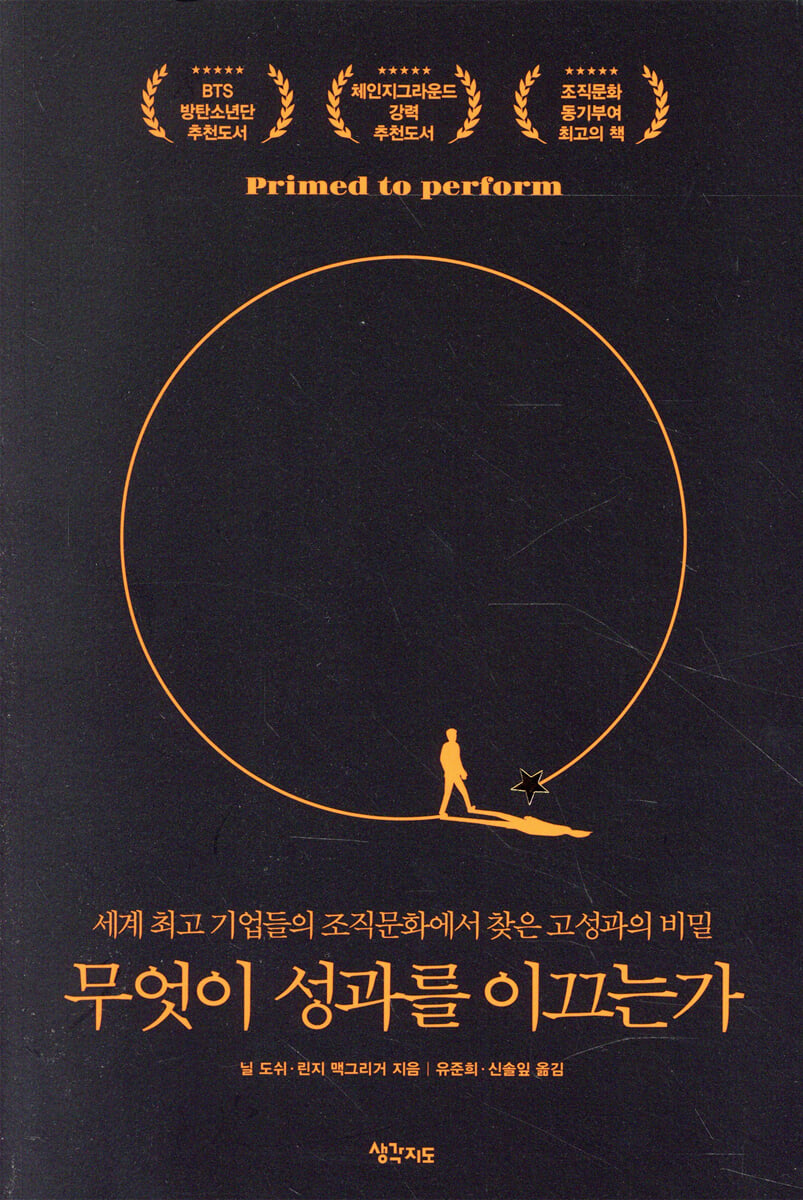
What Drives Performance
 |
Description
Book Introduction
“A definitive book on leadership and organizational management!”
A bestseller already recognized by readers, a revised edition is now available.
There is a book that has been consistently loved through word of mouth for the past five years.
It's a business book with over 400 pages.
However, the review that readers unanimously wrote was “fun.”
The recently revised edition of "What Drives Performance" is the book that most clearly explains where organizations and companies should focus to achieve high performance.
This is a must-read for leaders of organizations or companies who are inseparable from performance.
What sets top-performing organizations like Google, Apple Stores, Starbucks, Southwest, and Whole Foods apart? Two authors with over 20 years of field experience say these high-performing companies possess a "culture where people want to work."
They present a profound and relatable interpretation of the relationship between motivation and performance, asking, "Why do we work?"
This book also provides insights that will be etched in our minds for a long time regarding #leadership #organizational management #performance management #organizational culture, including the role of the leader we want, the 'fire starter', and the role of the person in charge, the 'fire watcher'.
It is also famous as the only business book among the books recommended by BTS.
A bestseller already recognized by readers, a revised edition is now available.
There is a book that has been consistently loved through word of mouth for the past five years.
It's a business book with over 400 pages.
However, the review that readers unanimously wrote was “fun.”
The recently revised edition of "What Drives Performance" is the book that most clearly explains where organizations and companies should focus to achieve high performance.
This is a must-read for leaders of organizations or companies who are inseparable from performance.
What sets top-performing organizations like Google, Apple Stores, Starbucks, Southwest, and Whole Foods apart? Two authors with over 20 years of field experience say these high-performing companies possess a "culture where people want to work."
They present a profound and relatable interpretation of the relationship between motivation and performance, asking, "Why do we work?"
This book also provides insights that will be etched in our minds for a long time regarding #leadership #organizational management #performance management #organizational culture, including the role of the leader we want, the 'fire starter', and the role of the person in charge, the 'fire watcher'.
It is also famous as the only business book among the books recommended by BTS.
- You can preview some of the book's contents.
Preview
index
A letter of recommendation.
A book that stimulates dopamine and ends with a sense of exhilaration.
prolog.
Why were they able to achieve the best performance?
Part 1.
Why do we work?
A high-performance organizational culture starts with something surprisingly simple.
The key is the reason why employees work.
Chapter 1.
Motive Spectrum
Six Reasons We Work
Chapter 2.
Total Motivation Index
A fundamental way to build organizational culture
Part 2.
How are achievements made?
There is a link between ‘organizational culture’ and ‘performance’ called ‘total motivation.’
Chapter 3.
The reality of achievement
To understand how overall motivation impacts performance, we need a new lens through which to view performance.
Chapter 4.
The yin and yang of achievement
A balanced organization with a strong sense of purpose gains a strong competitive advantage.
Part 3.
Why Great Organizational Cultures Are Hard to Find
Our prejudices are blocking the way.
Chapter 5.
negligence bias
Our inherent bias in indirect motivation increases.
Chapter 6.
Rigid organization, flexible organization
At the moment when flexibility is needed, the organization becomes rigid.
Part 4.
How to Create a High-Motivation Organizational Culture
If you understand the science of organizational culture and have the right tools, you can transform your organization into a great one at any time.
Chapter 7.
General Motivation: A Light That Illuminates Achievements
Total Motivation Index: If you can measure magic, you can cast magic.
Chapter 8.
Leadership: Fire Starter
The secret to leadership that produces the best results has been revealed.
Chapter 9.
Identity: The organization's norms of behavior
The 'reason' of a company is directly connected to the 'reason' of its employees.
Chapter 10.
Job Design: Playground
The factor that everyone overlooks is the most powerful factor.
Chapter 11.
Career Paths: A Thousand Career Ladders
Whether employees fight among themselves for survival or fight competitors for victory depends on the organizational culture.
Chapter 12.
compensation system
Compensation systems are a key element of organizational culture that we most often misunderstand.
Chapter 13.
Community: Hunting Group
At first, we create the organization, but then the organization creates us.
Chapter 14.
Person in Charge: Fire Watcher
If you want a fire to stay lit, you need someone to fan it.
Chapter 15.
Performance Evaluation: Performance Evaluation Calibration
Don't change the players, change the board.
Chapter 16.
Social movements: organizational movements
Create total motivation through total motivation.
Epilogue.
Scientist's Toothbrush
References
Into the book
Think of a company known as a high-performing organization among large corporations.
We ask thousands of people this question, and we get the same answer every time.
People always mentioned Southwest, Apple Store, Starbucks, Nordstrom, and Whole Foods.
These companies were ranked 7th, 1st, 5th, 14th, and 18th, respectively, on Fortune's "2015 Most Admired Companies."
But if you ask people what these companies have in common, they can't give a good answer.
These companies all have distinct personalities, values, beliefs, and traditions, and their products and target audiences are very different.
However, when we look at the results of measuring the total motivation of these companies, we can see that they record a total motivation index that is much higher than that of their competitors in the industry.
Looking at the total motivation index, you can see which companies are falling behind their competitors.
You can also see how a company's organizational culture impacts the overall motivation of all its employees, not just those in distant factories and stores.
Most importantly, the Total Motivation Index allows you to directly see how your business is changing over time.
--- p.67
It was an unexpected person who clearly articulated the difference between an organization's strategy and its culture.
“Everyone has a plausible plan.
Until I got hit in the face hard.
“After one hit, I freeze in fear and terror like a rat.” This is not a philosopher’s famous quote.
This is what boxer Mike Tyson said.
Tyson knows what it's like to take a blow to the face.
He holds the record for the fastest knockout (8 seconds) at the Junior Olympics and the youngest heavyweight champion at age 20.
Mike's words illustrate well that even the best strategies can fall apart when faced with the unexpected.
When plans fail, does your organization freeze or adapt? The answer to this question will depend on your organizational culture.
--- p.95
The final choice that has yet to be made by Medallia could have the most devastating consequences.
The driving force that has driven the organization is completely exhausted and a period of stagnation in performance arrives.
At this point, the leader has a choice.
You can either focus on hard-to-get tactical wins, squeezing every last drop out of your organization, or you can continue to trust in adaptive wins to right the ship.
Yet, too many companies choose the first option.
Instead of facing the reality that new growth engines are needed, they reduce investments in areas that increase organizational adaptability (R&D, idle capacity, brand building), erode customer trust (by competing on price or lowering quality), and focus solely on tactical performance, putting excessive pressure on employees.
Management is focused on managing expenses and budgets, and performance goals are adjusted to increase the company's production output.
Managers learn to wield the whip.
Performance management and compensation systems become more coercive.
As a natural consequence, overall motivation decreases and adaptive performance also declines.
If adaptive performance is not achieved, overall performance will ultimately decline.
Companies that don't understand the relationship between overall motivation and performance tend to give their employees more indirect motivation.
In this process, a death spiral begins.
When organizations need to be most flexible, they end up becoming more rigid than intended.
--- p.153
While Google doesn't discuss overall motivation, it does say that the best leaders, in its opinion, inspire a fun motivation (empowering employees), a meaning motivation (establishing a clear vision), and a growth motivation (helping team members achieve their career goals and acting as excellent coaches).
After sharing its analysis across the organization, Google created training courses focused on specific skills, such as how to articulate a clear vision and how to build a vivid vision through storytelling.
High-performing managers held open forums where engineers could share and ask questions about how they managed their teams.
Managers from all over the world joined online.
--- p.205
Another consequence of the existing promotion system is the 'Peter Principle'.
The Peter Principle is the theory that when selecting the right person for an organization, promotion is based on past performance rather than the job performance required for the position.
As a result, employees with poor job performance find it difficult to advance further, while employees with good job performance are promoted to higher positions that do not match their job performance capabilities.
Outstanding engineers become managers because they are the most productive.
Perhaps this engineer will be forced to leave the work he loves and take on a task he neither likes nor is good at.
If we take Peter's logic to its extreme, it could be said that ultimately all managers in an organization are incompetent.
A total motivational organizational culture should not be a tournament where employees have to fight tooth and nail, but rather provide a variety of ways to recognize employees' abilities and help them succeed.
Rather than forcing employees through a single, narrow gate, we need to create thousands of career ladders for them to climb.
--- p.270
The process you use to create or rebuild an organizational culture must itself be highly motivating.
Even in the process of leading change, joy, meaning, and motivation for growth should be demonstrated, not pressure.
As motivation guru Edward Deci wrote, “The right question is not, ‘How do we motivate others?’ but, ‘How do we create an environment in which people can motivate themselves?’”
We ask thousands of people this question, and we get the same answer every time.
People always mentioned Southwest, Apple Store, Starbucks, Nordstrom, and Whole Foods.
These companies were ranked 7th, 1st, 5th, 14th, and 18th, respectively, on Fortune's "2015 Most Admired Companies."
But if you ask people what these companies have in common, they can't give a good answer.
These companies all have distinct personalities, values, beliefs, and traditions, and their products and target audiences are very different.
However, when we look at the results of measuring the total motivation of these companies, we can see that they record a total motivation index that is much higher than that of their competitors in the industry.
Looking at the total motivation index, you can see which companies are falling behind their competitors.
You can also see how a company's organizational culture impacts the overall motivation of all its employees, not just those in distant factories and stores.
Most importantly, the Total Motivation Index allows you to directly see how your business is changing over time.
--- p.67
It was an unexpected person who clearly articulated the difference between an organization's strategy and its culture.
“Everyone has a plausible plan.
Until I got hit in the face hard.
“After one hit, I freeze in fear and terror like a rat.” This is not a philosopher’s famous quote.
This is what boxer Mike Tyson said.
Tyson knows what it's like to take a blow to the face.
He holds the record for the fastest knockout (8 seconds) at the Junior Olympics and the youngest heavyweight champion at age 20.
Mike's words illustrate well that even the best strategies can fall apart when faced with the unexpected.
When plans fail, does your organization freeze or adapt? The answer to this question will depend on your organizational culture.
--- p.95
The final choice that has yet to be made by Medallia could have the most devastating consequences.
The driving force that has driven the organization is completely exhausted and a period of stagnation in performance arrives.
At this point, the leader has a choice.
You can either focus on hard-to-get tactical wins, squeezing every last drop out of your organization, or you can continue to trust in adaptive wins to right the ship.
Yet, too many companies choose the first option.
Instead of facing the reality that new growth engines are needed, they reduce investments in areas that increase organizational adaptability (R&D, idle capacity, brand building), erode customer trust (by competing on price or lowering quality), and focus solely on tactical performance, putting excessive pressure on employees.
Management is focused on managing expenses and budgets, and performance goals are adjusted to increase the company's production output.
Managers learn to wield the whip.
Performance management and compensation systems become more coercive.
As a natural consequence, overall motivation decreases and adaptive performance also declines.
If adaptive performance is not achieved, overall performance will ultimately decline.
Companies that don't understand the relationship between overall motivation and performance tend to give their employees more indirect motivation.
In this process, a death spiral begins.
When organizations need to be most flexible, they end up becoming more rigid than intended.
--- p.153
While Google doesn't discuss overall motivation, it does say that the best leaders, in its opinion, inspire a fun motivation (empowering employees), a meaning motivation (establishing a clear vision), and a growth motivation (helping team members achieve their career goals and acting as excellent coaches).
After sharing its analysis across the organization, Google created training courses focused on specific skills, such as how to articulate a clear vision and how to build a vivid vision through storytelling.
High-performing managers held open forums where engineers could share and ask questions about how they managed their teams.
Managers from all over the world joined online.
--- p.205
Another consequence of the existing promotion system is the 'Peter Principle'.
The Peter Principle is the theory that when selecting the right person for an organization, promotion is based on past performance rather than the job performance required for the position.
As a result, employees with poor job performance find it difficult to advance further, while employees with good job performance are promoted to higher positions that do not match their job performance capabilities.
Outstanding engineers become managers because they are the most productive.
Perhaps this engineer will be forced to leave the work he loves and take on a task he neither likes nor is good at.
If we take Peter's logic to its extreme, it could be said that ultimately all managers in an organization are incompetent.
A total motivational organizational culture should not be a tournament where employees have to fight tooth and nail, but rather provide a variety of ways to recognize employees' abilities and help them succeed.
Rather than forcing employees through a single, narrow gate, we need to create thousands of career ladders for them to climb.
--- p.270
The process you use to create or rebuild an organizational culture must itself be highly motivating.
Even in the process of leading change, joy, meaning, and motivation for growth should be demonstrated, not pressure.
As motivation guru Edward Deci wrote, “The right question is not, ‘How do we motivate others?’ but, ‘How do we create an environment in which people can motivate themselves?’”
--- p.377
Publisher's Review
The world's best companies focus on 'why we work'!
A book that numerically proves the correlation between the nature of work and performance.
The most important thing in organizational change is not finding the 'how'.
We need to pay attention to 'Why'.
The same goes for transforming into a high-performing organization.
Rather than just suggesting 'how to work,' we need to understand 'why employees work.'
This is because the organizational culture of the world's best companies with high performance begins with the motivation to "why we work."
In this book, the authors categorize the reasons for working into six motivations, and say that if you find joy, meaning, and growth in your work, your work performance will naturally improve.
The reasons for working (the motive spectrum) can be divided into 'direct motivations' such as the enjoyment, meaning, and growth of work, and 'indirect motivations' such as economic pressure, emotional pressure, and inertia.
1.
The joy of work: doing something simply because you like it, the work itself is the reward.
2.
Meaning of work: Do your work with the importance of the impact that comes from doing it.
3.
Growth in work: You do work because it produces results you consider important.
4.
Emotional pressure: You do things to avoid the negative emotions you feel.
5.
Economic pressure: Working only to receive a reward or avoid punishment.
6.
Inertia: I did this yesterday, so I'll do it today.
People who feel directly motivated exert their power beyond their own tasks and roles and produce results on their own.
However, for those who work with indirect motivation, providing economic incentives and pressuring them to increase sales only results in a short period of time and making it difficult to sustain the results.
In summary, direct motivation generally increases performance, and indirect motivation generally decreases performance.
The authors calculated the six motivations into a single value called the 'Total Motivation Index (ToMo)', and found that individuals with high total motivation create performance, and organizations where these individuals work create high performance.
This is evidenced by the fact that high-performing companies like Google, Apple Store, Starbucks, Southwest, and Whole Foods have significantly higher total motivation scores than their industry competitors.
This is why, if you want to become a high-performance organization, you must pay attention to why you work.
Volatile, uncertain, complex, and ambiguous (VUCA) era
We must increase resilient and flexible "adaptive performance."
Now is the VUCA era.
Everything is volatile, uncertain, complex and ambiguous.
In a business environment where it is difficult to predict even tomorrow, the authors revisit the concept of "performance," arguing that productivity and efficiency are only a small part of performance.
Have you ever called a call center and felt like the person on duty was reciting a script? Think back to how you felt.
It is no longer enough to rely solely on 'tactical performance', which is simply executing work diligently according to plan and getting more done as quickly as possible in the same amount of time.
Of course, sometimes the scripts that call center agents have are helpful.
But the authors believe that when dealing with angry customers or helping struggling employees, "adaptive performance"—the ability to deviate from the plan and execute flexibly—is necessary.
The secret to great outcomes—innovation, creativity, great customer experiences, and outstanding sales—that has long remained a mystery is adaptive performance.
So how do adaptive performances develop? Here, the authors revisit the motivation behind work: "Why do we work?"
Adaptive performance stems from the enjoyment individuals experience in their work itself, the pride and reward that come from recognizing the purpose and meaning of their work, and the joy of experiencing growth in their work.
Above all, we must be careful not to overemphasize tactical performance alone, as this can lead employees to create "misguided adaptive performance" to relieve the pressure they feel.
Some examples of poor adaptability performance include:
* Distraction effect: When you are blinded by incentives and cannot focus on the task at hand.
* Loss of intention effect: When you lose your intention by focusing only on tactical performance to reduce the pressure you feel.
* Cobra Effect: When you do something completely opposite to your original intention in order to achieve something.
Ultimately, if you want to build a high-performance organization in a rapidly changing, chaotic, and unpredictable world, every department within your company, from executives to the front lines, must work to increase overall motivation and foster adaptive performance.
Who is the ideal leader to achieve results?
High-performing organizations have a "culture where people want to work."
Most leaders have some understanding of the importance of organizational culture.
But few people can define what organizational culture is or explain why it's important.
The authors of this book say they wrote it to bridge that gap.
The reason readers also recommend this book in the field of leadership is because it interprets organizational culture, which can sound like a vague and abstract concept, into a measurable and manageable target through the concept of 'total motivation.'
It is also because it presents the type of leader that is desirable in relation to performance.
The book presents four types of leadership: ① transactional leader, ② indifferent leader, ③ passionate leader, and ④ fire starter. The 'fire starter', who utilizes direct motivation and does not utilize indirect motivation, can be said to be the best leader who increases the total motivation index and thus improves performance.
What's needed to increase overall motivation is an organizational culture that consistently delivers results and allows employees to work happily and enjoyably.
The authors emphasize that what leaders must do to achieve organizational success is to build a flexible organizational culture with high overall motivation.
Why do some organizational cultures foster energy and innovation, generating performance, while others are like tightropes, teetering on the edge of instability and stagnant performance? The authors answer this question by arguing that any organization can transform into a high-performance organization by building a culture of high total motivation based on scientific principles.
The authors expressed this core message in the book:
"If you take just one thing away from this book, it's that organizational cultures that foster joy, meaning, and a drive for growth in work produce the highest levels of performance and sustainability."
From leadership to job design, compensation systems, and performance evaluations
What Drives a High-Motivation Organizational Culture
This book is divided into four parts.
If Parts 1 through 3 were new perspectives on organizational performance, Part 4 contains methodological content that leaders and organizational culture managers concerned about performance should read.
These contents systematically introduce not only organizational emotional activities that form the foundation of organizational culture, but also systematic measures such as leadership, job design, performance evaluation, compensation system, and career path.
If we look at them one by one, they are as follows.
* Chapter 8.
Leadership, Fire Starter: A leader who creates total motivation not only for his or her team but also for the entire organization is called a Fire Starter.
Such leaders can increase a team's overall motivation index by an average of 50 points.
The book introduces Starbucks' leadership culture, which maintains the highest employee retention rate in the industry and enjoys a remarkably high level of customer loyalty.
* Chapter 9.
Identity, the organization's code of conduct: The company's identity, which embodies its mission, code of conduct, heritage, and traditions, is the second most important key to organizational culture.
On average, the difference in total motivation scores between companies with ambiguous identities and those with strong identities was 65 points.
We can see how an organization's identity influences its culture in the cases of Rosetta Stone, which successfully leads its organization's identity, Keller Williams, which advocates a code of conduct called the "BOLD Law," and Spasek, which has a high level of ethical awareness.
* Chapter 10.
Job Design, the Playground: One of the most powerful yet easily overlooked elements of overall motivation is designing a person's job within an organization.
The difference in total motivation between organizations with well-designed jobs and those without was a whopping 87 points.
You can see how organizations change through job design through various examples.
* Chapter 11.
Career Paths, a Thousand Career Ladders: The career paths of most organizations are structured around a "fight to the death" structure where only the strong survive.
This approach destroys overall motivation and makes adaptive performance impossible.
The overall motivation index, reflected in the difference in career ladders, was 63 points. A look at IBM's Fellows program and YES's autonomous public schools will give you a sense of why "a thousand career ladders" are necessary.
* Chapter 12.
Compensation system: Because the purpose of the compensation system is unclear, employees can easily feel ill-will and unfairness.
Companies with compensation systems focused on employee growth had average total motivation scores 48 points higher.
On the other hand, the book reveals the consequences for organizations that only promote compensation systems with unclear objectives.
* Chapter 13.
Community, Hunting Groups: When a strong community is formed, enjoyment and meaning motivation increase, and the total motivation index increases by as much as 60 points.
In the case of DuPont, whose corporate motto is “Make money and have fun,” we can see how agile the company is through its “amoeba organization.”
* Chapter 14.
Fire Watcher: To build a consistent organizational culture, you need a "fire watcher" who manages all elements together, rather than managing them separately.
We look at the six roles of a fire watcher that helps keep a fire burning.
* Chapter 15.
Performance Appraisal, Performance Appraisal Calibration: A well-designed performance measurement system balances the yin and yang through total motivation.
If you operate your performance management system properly, you can increase your overall motivation by up to 41 points.
You can take a look at SAC Capital's 'Predictive Performance Management System' led by Steve Cohen, one of the legendary traders.
A book that numerically proves the correlation between the nature of work and performance.
The most important thing in organizational change is not finding the 'how'.
We need to pay attention to 'Why'.
The same goes for transforming into a high-performing organization.
Rather than just suggesting 'how to work,' we need to understand 'why employees work.'
This is because the organizational culture of the world's best companies with high performance begins with the motivation to "why we work."
In this book, the authors categorize the reasons for working into six motivations, and say that if you find joy, meaning, and growth in your work, your work performance will naturally improve.
The reasons for working (the motive spectrum) can be divided into 'direct motivations' such as the enjoyment, meaning, and growth of work, and 'indirect motivations' such as economic pressure, emotional pressure, and inertia.
1.
The joy of work: doing something simply because you like it, the work itself is the reward.
2.
Meaning of work: Do your work with the importance of the impact that comes from doing it.
3.
Growth in work: You do work because it produces results you consider important.
4.
Emotional pressure: You do things to avoid the negative emotions you feel.
5.
Economic pressure: Working only to receive a reward or avoid punishment.
6.
Inertia: I did this yesterday, so I'll do it today.
People who feel directly motivated exert their power beyond their own tasks and roles and produce results on their own.
However, for those who work with indirect motivation, providing economic incentives and pressuring them to increase sales only results in a short period of time and making it difficult to sustain the results.
In summary, direct motivation generally increases performance, and indirect motivation generally decreases performance.
The authors calculated the six motivations into a single value called the 'Total Motivation Index (ToMo)', and found that individuals with high total motivation create performance, and organizations where these individuals work create high performance.
This is evidenced by the fact that high-performing companies like Google, Apple Store, Starbucks, Southwest, and Whole Foods have significantly higher total motivation scores than their industry competitors.
This is why, if you want to become a high-performance organization, you must pay attention to why you work.
Volatile, uncertain, complex, and ambiguous (VUCA) era
We must increase resilient and flexible "adaptive performance."
Now is the VUCA era.
Everything is volatile, uncertain, complex and ambiguous.
In a business environment where it is difficult to predict even tomorrow, the authors revisit the concept of "performance," arguing that productivity and efficiency are only a small part of performance.
Have you ever called a call center and felt like the person on duty was reciting a script? Think back to how you felt.
It is no longer enough to rely solely on 'tactical performance', which is simply executing work diligently according to plan and getting more done as quickly as possible in the same amount of time.
Of course, sometimes the scripts that call center agents have are helpful.
But the authors believe that when dealing with angry customers or helping struggling employees, "adaptive performance"—the ability to deviate from the plan and execute flexibly—is necessary.
The secret to great outcomes—innovation, creativity, great customer experiences, and outstanding sales—that has long remained a mystery is adaptive performance.
So how do adaptive performances develop? Here, the authors revisit the motivation behind work: "Why do we work?"
Adaptive performance stems from the enjoyment individuals experience in their work itself, the pride and reward that come from recognizing the purpose and meaning of their work, and the joy of experiencing growth in their work.
Above all, we must be careful not to overemphasize tactical performance alone, as this can lead employees to create "misguided adaptive performance" to relieve the pressure they feel.
Some examples of poor adaptability performance include:
* Distraction effect: When you are blinded by incentives and cannot focus on the task at hand.
* Loss of intention effect: When you lose your intention by focusing only on tactical performance to reduce the pressure you feel.
* Cobra Effect: When you do something completely opposite to your original intention in order to achieve something.
Ultimately, if you want to build a high-performance organization in a rapidly changing, chaotic, and unpredictable world, every department within your company, from executives to the front lines, must work to increase overall motivation and foster adaptive performance.
Who is the ideal leader to achieve results?
High-performing organizations have a "culture where people want to work."
Most leaders have some understanding of the importance of organizational culture.
But few people can define what organizational culture is or explain why it's important.
The authors of this book say they wrote it to bridge that gap.
The reason readers also recommend this book in the field of leadership is because it interprets organizational culture, which can sound like a vague and abstract concept, into a measurable and manageable target through the concept of 'total motivation.'
It is also because it presents the type of leader that is desirable in relation to performance.
The book presents four types of leadership: ① transactional leader, ② indifferent leader, ③ passionate leader, and ④ fire starter. The 'fire starter', who utilizes direct motivation and does not utilize indirect motivation, can be said to be the best leader who increases the total motivation index and thus improves performance.
What's needed to increase overall motivation is an organizational culture that consistently delivers results and allows employees to work happily and enjoyably.
The authors emphasize that what leaders must do to achieve organizational success is to build a flexible organizational culture with high overall motivation.
Why do some organizational cultures foster energy and innovation, generating performance, while others are like tightropes, teetering on the edge of instability and stagnant performance? The authors answer this question by arguing that any organization can transform into a high-performance organization by building a culture of high total motivation based on scientific principles.
The authors expressed this core message in the book:
"If you take just one thing away from this book, it's that organizational cultures that foster joy, meaning, and a drive for growth in work produce the highest levels of performance and sustainability."
From leadership to job design, compensation systems, and performance evaluations
What Drives a High-Motivation Organizational Culture
This book is divided into four parts.
If Parts 1 through 3 were new perspectives on organizational performance, Part 4 contains methodological content that leaders and organizational culture managers concerned about performance should read.
These contents systematically introduce not only organizational emotional activities that form the foundation of organizational culture, but also systematic measures such as leadership, job design, performance evaluation, compensation system, and career path.
If we look at them one by one, they are as follows.
* Chapter 8.
Leadership, Fire Starter: A leader who creates total motivation not only for his or her team but also for the entire organization is called a Fire Starter.
Such leaders can increase a team's overall motivation index by an average of 50 points.
The book introduces Starbucks' leadership culture, which maintains the highest employee retention rate in the industry and enjoys a remarkably high level of customer loyalty.
* Chapter 9.
Identity, the organization's code of conduct: The company's identity, which embodies its mission, code of conduct, heritage, and traditions, is the second most important key to organizational culture.
On average, the difference in total motivation scores between companies with ambiguous identities and those with strong identities was 65 points.
We can see how an organization's identity influences its culture in the cases of Rosetta Stone, which successfully leads its organization's identity, Keller Williams, which advocates a code of conduct called the "BOLD Law," and Spasek, which has a high level of ethical awareness.
* Chapter 10.
Job Design, the Playground: One of the most powerful yet easily overlooked elements of overall motivation is designing a person's job within an organization.
The difference in total motivation between organizations with well-designed jobs and those without was a whopping 87 points.
You can see how organizations change through job design through various examples.
* Chapter 11.
Career Paths, a Thousand Career Ladders: The career paths of most organizations are structured around a "fight to the death" structure where only the strong survive.
This approach destroys overall motivation and makes adaptive performance impossible.
The overall motivation index, reflected in the difference in career ladders, was 63 points. A look at IBM's Fellows program and YES's autonomous public schools will give you a sense of why "a thousand career ladders" are necessary.
* Chapter 12.
Compensation system: Because the purpose of the compensation system is unclear, employees can easily feel ill-will and unfairness.
Companies with compensation systems focused on employee growth had average total motivation scores 48 points higher.
On the other hand, the book reveals the consequences for organizations that only promote compensation systems with unclear objectives.
* Chapter 13.
Community, Hunting Groups: When a strong community is formed, enjoyment and meaning motivation increase, and the total motivation index increases by as much as 60 points.
In the case of DuPont, whose corporate motto is “Make money and have fun,” we can see how agile the company is through its “amoeba organization.”
* Chapter 14.
Fire Watcher: To build a consistent organizational culture, you need a "fire watcher" who manages all elements together, rather than managing them separately.
We look at the six roles of a fire watcher that helps keep a fire burning.
* Chapter 15.
Performance Appraisal, Performance Appraisal Calibration: A well-designed performance measurement system balances the yin and yang through total motivation.
If you operate your performance management system properly, you can increase your overall motivation by up to 41 points.
You can take a look at SAC Capital's 'Predictive Performance Management System' led by Steve Cohen, one of the legendary traders.
GOODS SPECIFICS
- Publication date: October 19, 2021
- Page count, weight, size: 424 pages | 658g | 153*224*30mm
- ISBN13: 9791187875161
- ISBN10: 1187875163
You may also like
카테고리
korean


korean

![GQ KOREA Mark (Monthly): December [2025]](http://librairie.coreenne.fr/cdn/shop/files/8ef265dbbfbf186523ed75ba7319009d.jpg?v=1765340328&width=3840)


