

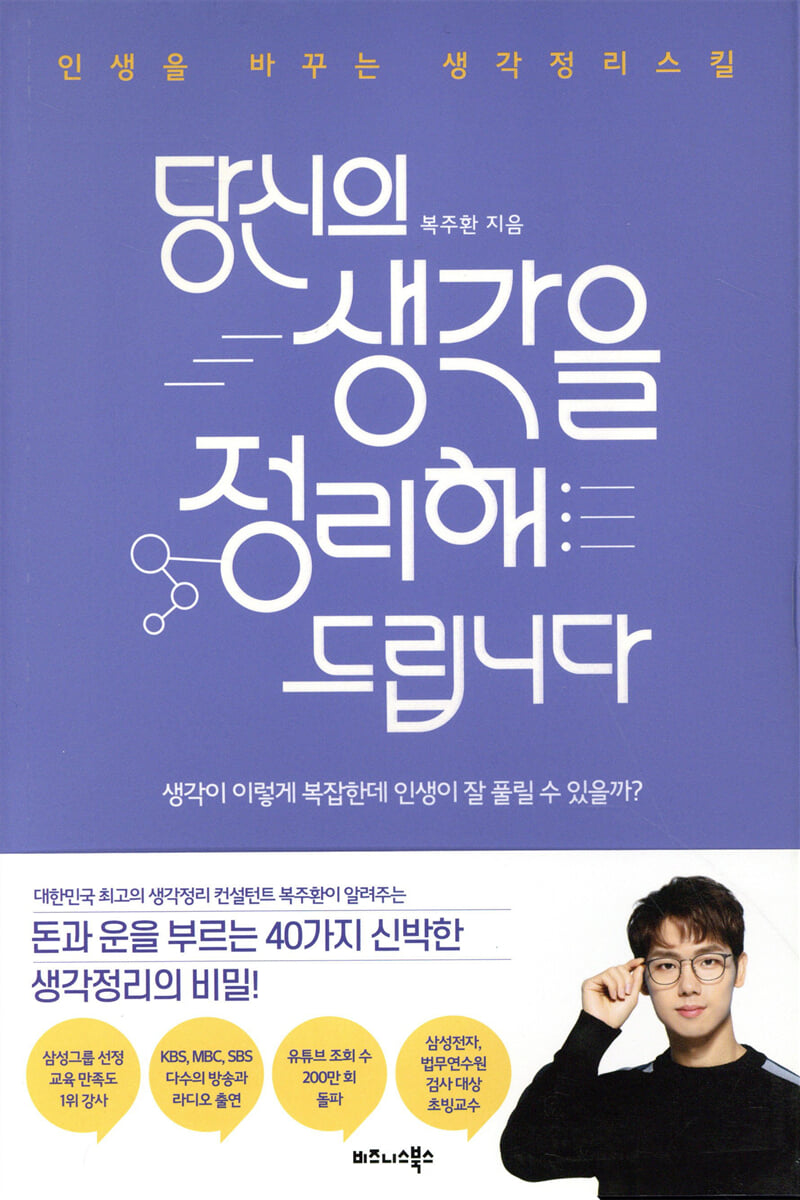
Let me organize your thoughts.
 |
Description
Book Introduction
Korea's best thought management consultant, Bok Joo-hwan, tells you The secret to organizing your thoughts in 40 amazing ways to attract money and luck! People who spend their days in a daze without getting anything done properly, people who get swayed by unnecessary emotions over trivial things, people who always make resolutions but never see them through, people who have a lot of ideas but never produce results, people who have grandiose goals but no plans and end up with nothing, people whose whole lives are complicated because their minds are a mess and they can't be organized. Most of us are one of those people who always struggle with this problem. Information overload, procrastination, tiring relationships, work stress, unnecessary emotions, and a disorganized life. What was the problem? On the other hand, there are people who handle many things easily and neatly. What's the secret behind those who not only succeed in everything they do, but also find money and luck? Author Bok Joo-hwan, Korea's leading thought management consultant, suggests "thought management" as the key to unlocking the secret. |
- You can preview some of the book's contents.
Preview
index
Prologue _ Organizing Your Thoughts
Chapter 1: Life-Changing Thought Management Skills
01 Now you too can organize your thoughts well!
02 The thoughts and actions of the rich
03 Reasons why it was difficult to organize my thoughts and solutions
04 How to Become a Thinking Genius: Using Thought Organization Tools
05 You only need to understand three ways to organize your thoughts.
06 The most essential skill in this era: the ability to organize thoughts
Chapter 2: We Consult Your Thoughts
01 [Consulting] One Page: Work-Life Balance Thought Management Skills
02 [Consulting] Mind Map: Personal Branding & YouTube Planning
03 [Consulting] Logic Tree: A Money-Making Thought Process
04 [Consulting] Mandala: A Survival Strategy for Turning Crisis into Opportunity
05 [Consulting] Mission Statement: How to Find Meaning in Life
06 [Consulting] Mandala: Creating and Presenting a Business Model
Chapter 3: Organizing Your Ideas
01 The top 1 percent use mind maps.
02 How Highly Effective People Use Mind Maps
03 Your Thinking Assistant: Digital Mind Map
04 Why I couldn't organize my thoughts even after using a mind map
05 Planning Business Ideas with Mind Maps
Chapter 4: Organizing Your Time
01 Let me know how much time you have left
02 Time wasted vs. time well spent
03 Are you only using a budget for money? Use a budget for time, too!
04 Scientific Time Management Methods to Create the Best Day
5 Ways to Write a Good To-Do List
06 Not to do list to catch time thieves
07 Creating a Golden Recipe for Time as a Priority
08 Growth Cycle: Creating Your Own Routine
Chapter 5: Organizing Your Goals
01 Time goes backwards for those who achieve their goals.
02 Successful people take a long-term view.
03 How to increase your chances of achieving your goals by more than 10 times
04 Creating a Balanced Lifestyle with Mandala
05 Successfully Lost 20 Kilograms with One Sheet of Paper
06 Gantt chart to see work progress at a glance
07 If you live with your goals in mind, they will eventually come true.
08 Amazing things that happen just by writing on SNS
Chapter 6: We'll sort out your problems.
01 What problem do you want to solve?
02 The problem is the difference between reality and ideals.
03 You need to know the type of problem to solve it.
04 SWOT: If you want to do well, start with a strategy.
05 How to escape the trap of thinking
06 The order and method of solving problems well
07 Five Reasons to Use a Logic Tree
Epilogue _If you want to change your destiny #Become
References
Chapter 1: Life-Changing Thought Management Skills
01 Now you too can organize your thoughts well!
02 The thoughts and actions of the rich
03 Reasons why it was difficult to organize my thoughts and solutions
04 How to Become a Thinking Genius: Using Thought Organization Tools
05 You only need to understand three ways to organize your thoughts.
06 The most essential skill in this era: the ability to organize thoughts
Chapter 2: We Consult Your Thoughts
01 [Consulting] One Page: Work-Life Balance Thought Management Skills
02 [Consulting] Mind Map: Personal Branding & YouTube Planning
03 [Consulting] Logic Tree: A Money-Making Thought Process
04 [Consulting] Mandala: A Survival Strategy for Turning Crisis into Opportunity
05 [Consulting] Mission Statement: How to Find Meaning in Life
06 [Consulting] Mandala: Creating and Presenting a Business Model
Chapter 3: Organizing Your Ideas
01 The top 1 percent use mind maps.
02 How Highly Effective People Use Mind Maps
03 Your Thinking Assistant: Digital Mind Map
04 Why I couldn't organize my thoughts even after using a mind map
05 Planning Business Ideas with Mind Maps
Chapter 4: Organizing Your Time
01 Let me know how much time you have left
02 Time wasted vs. time well spent
03 Are you only using a budget for money? Use a budget for time, too!
04 Scientific Time Management Methods to Create the Best Day
5 Ways to Write a Good To-Do List
06 Not to do list to catch time thieves
07 Creating a Golden Recipe for Time as a Priority
08 Growth Cycle: Creating Your Own Routine
Chapter 5: Organizing Your Goals
01 Time goes backwards for those who achieve their goals.
02 Successful people take a long-term view.
03 How to increase your chances of achieving your goals by more than 10 times
04 Creating a Balanced Lifestyle with Mandala
05 Successfully Lost 20 Kilograms with One Sheet of Paper
06 Gantt chart to see work progress at a glance
07 If you live with your goals in mind, they will eventually come true.
08 Amazing things that happen just by writing on SNS
Chapter 6: We'll sort out your problems.
01 What problem do you want to solve?
02 The problem is the difference between reality and ideals.
03 You need to know the type of problem to solve it.
04 SWOT: If you want to do well, start with a strategy.
05 How to escape the trap of thinking
06 The order and method of solving problems well
07 Five Reasons to Use a Logic Tree
Epilogue _If you want to change your destiny #Become
References
Detailed image

Into the book
Our words, writings, and actions all begin with thoughts.
If you think without any order, your words will also be incoherent, and if you write while thinking without any order, it will be difficult to find logic in your writing.
If your thoughts are complicated, your actions will also be distracted and you will not be able to achieve good results.
First, we need to organize our thoughts well in order to be able to set goals, manage time, solve problems, and plan ideas well.
When you learn how to properly organize your thoughts, you can transform negative thoughts into positive ones and useless ideas into useful ones.
--- From the "Prologue"
People who are not good at organizing their thoughts try to organize things only with their head and do not use their hands well.
Surprisingly, many people do not have the habit of taking notes or writing things down.
Of course, simple decisions like, "What should I eat for lunch today?" can be quickly organized in your head.
But what if the problem becomes more complex? The complex process of understanding the company's current state of affairs, analyzing its causes, and devising solutions is difficult to grasp solely through the mind.
It's like when solving a math problem, simple problems like addition and subtraction can be solved with mental calculation, but as the numbers get bigger and the problem gets more complex, it becomes difficult to find the answer just by calculating in your head.
So when you use your head, you have to use your hands as well.
It is necessary to visualize your thoughts by writing them down by hand.
Just as an X-ray can be used to look inside the body and cure internal ailments, it becomes easier to organize your thoughts when you learn how to look inside your head and organize it.
--- From "Chapter 1: Thought Management Skills That Change Your Life"
Before setting a goal, you must first clarify your 'purpose' so that you can properly establish direction and plan for the goal.
Goals and objectives are similar words and can be easily confused, but there is a clear difference.
A goal is something specific that needs to be done to achieve a goal, and a purpose is the direction or destination that you ultimately want to reach.
You can achieve your goals through detailed objectives.
--- From "Chapter 2 - We Consult Your Thoughts"
There are two types of mind maps: 'hand mind maps', which are used to organize thoughts by hand, and 'digital mind maps', which are used to organize thoughts using a computer or smartphone.
To draw a good mind map, it is best to understand the pros and cons of hand and digital mind maps and use them in a complementary manner.
The advantage of a hand mind map is that you can freely organize your thoughts anytime, anywhere.
And using your hands stimulates your brain, allowing you to think more creatively.
It also stays in your memory longer.
However, hand mind maps have some limitations.
First of all, it is difficult to edit, such as modify, move, or delete.
Our thoughts are constantly changing, and once they are written down, they are not easy to change.
Moreover, thoughts are infinitely expansive, but space is limited.
Digital mind maps were developed as an alternative to overcome these problems.
--- From "Chapter 3: Organizing Your Ideas"
Even at the same time, we feel differently depending on the person and situation.
Let's think back to our school days.
What if you were forced to sit at your desk and study something you didn't want to? Time just wouldn't pass.
But when you play with friends or play fun games, time goes by really quickly.
It's the same at work.
When you work with a boss you hate, time seems to stand still, but when you're with someone you love, time flies.
Because, as Einstein said, time is relative.
--- From "Chapter 4: Organizing Your Time"
The reason we need to organize our thoughts well is so that we can act well.
If you act without thinking, you can easily waste your energy in the wrong direction, making it difficult to achieve the results you want.
And once you have organized your thoughts well, you must achieve your goals through action.
If you only think about it and don't take action, you won't get the results you want.
Remember, thinking and acting are the only ways to achieve your goals.
--- From “Chapter 5: Organizing Your Goals”
There is a basic order to problem solving.
If you want to solve a problem well, remember this 'problem-solving process'.
Problem solving follows these four steps:
① Recognize what the problem is and ask, ② Analyze why the problem occurred and ask, ③ Find out where the real problem is and ask, ④ Think about how to solve the problem and ask, How.
This process is a common language and order that can solve problems regardless of era, country, or industry.
If you think without any order, your words will also be incoherent, and if you write while thinking without any order, it will be difficult to find logic in your writing.
If your thoughts are complicated, your actions will also be distracted and you will not be able to achieve good results.
First, we need to organize our thoughts well in order to be able to set goals, manage time, solve problems, and plan ideas well.
When you learn how to properly organize your thoughts, you can transform negative thoughts into positive ones and useless ideas into useful ones.
--- From the "Prologue"
People who are not good at organizing their thoughts try to organize things only with their head and do not use their hands well.
Surprisingly, many people do not have the habit of taking notes or writing things down.
Of course, simple decisions like, "What should I eat for lunch today?" can be quickly organized in your head.
But what if the problem becomes more complex? The complex process of understanding the company's current state of affairs, analyzing its causes, and devising solutions is difficult to grasp solely through the mind.
It's like when solving a math problem, simple problems like addition and subtraction can be solved with mental calculation, but as the numbers get bigger and the problem gets more complex, it becomes difficult to find the answer just by calculating in your head.
So when you use your head, you have to use your hands as well.
It is necessary to visualize your thoughts by writing them down by hand.
Just as an X-ray can be used to look inside the body and cure internal ailments, it becomes easier to organize your thoughts when you learn how to look inside your head and organize it.
--- From "Chapter 1: Thought Management Skills That Change Your Life"
Before setting a goal, you must first clarify your 'purpose' so that you can properly establish direction and plan for the goal.
Goals and objectives are similar words and can be easily confused, but there is a clear difference.
A goal is something specific that needs to be done to achieve a goal, and a purpose is the direction or destination that you ultimately want to reach.
You can achieve your goals through detailed objectives.
--- From "Chapter 2 - We Consult Your Thoughts"
There are two types of mind maps: 'hand mind maps', which are used to organize thoughts by hand, and 'digital mind maps', which are used to organize thoughts using a computer or smartphone.
To draw a good mind map, it is best to understand the pros and cons of hand and digital mind maps and use them in a complementary manner.
The advantage of a hand mind map is that you can freely organize your thoughts anytime, anywhere.
And using your hands stimulates your brain, allowing you to think more creatively.
It also stays in your memory longer.
However, hand mind maps have some limitations.
First of all, it is difficult to edit, such as modify, move, or delete.
Our thoughts are constantly changing, and once they are written down, they are not easy to change.
Moreover, thoughts are infinitely expansive, but space is limited.
Digital mind maps were developed as an alternative to overcome these problems.
--- From "Chapter 3: Organizing Your Ideas"
Even at the same time, we feel differently depending on the person and situation.
Let's think back to our school days.
What if you were forced to sit at your desk and study something you didn't want to? Time just wouldn't pass.
But when you play with friends or play fun games, time goes by really quickly.
It's the same at work.
When you work with a boss you hate, time seems to stand still, but when you're with someone you love, time flies.
Because, as Einstein said, time is relative.
--- From "Chapter 4: Organizing Your Time"
The reason we need to organize our thoughts well is so that we can act well.
If you act without thinking, you can easily waste your energy in the wrong direction, making it difficult to achieve the results you want.
And once you have organized your thoughts well, you must achieve your goals through action.
If you only think about it and don't take action, you won't get the results you want.
Remember, thinking and acting are the only ways to achieve your goals.
--- From “Chapter 5: Organizing Your Goals”
There is a basic order to problem solving.
If you want to solve a problem well, remember this 'problem-solving process'.
Problem solving follows these four steps:
① Recognize what the problem is and ask, ② Analyze why the problem occurred and ask, ③ Find out where the real problem is and ask, ④ Think about how to solve the problem and ask, How.
This process is a common language and order that can solve problems regardless of era, country, or industry.
--- From Chapter 6, "We'll sort out your problems"
Publisher's Review
“How can life go well when your thoughts are this complicated?”
The secret to a life of money and luck lies in organizing your thoughts!
[#1 Instructor in Education Satisfaction Selected by Samsung Group] [Appearances on numerous broadcasts and radio programs on KBS, MBC, and SBS]
【YouTube Views Surpass 2 Million】【Samsung Electronics Appointed Professor for the Judicial Research and Training Institute Prosecutors】
The author says that the biggest difference between successful people and ordinary people is their 'ability to take action.'
Successful people act quickly because they have the ability to think, that is, they have trained 'thought patterns'.
The ability to organize thoughts is expressed as action.
Successful people (those who act quickly) have positive thinking patterns, and people with positive thinking patterns are generally free from obstacles to action.
Quickly formulate ideas and confidently and quickly complete whatever task you undertake.
On the other hand, people with negative thinking patterns tend to be irrational, narrow-minded, and extreme, and their negative thinking patterns become habitual and hinder their ability to take action.
The key, then, is to let go of negative thoughts and overcome fear.
To do that, you must first set specific goals and plans.
As you do this, various ideas will come to mind and you will gradually be able to overcome your fear.
It's the same principle as when you go to an unfamiliar place for the first time, instead of just going out, you look at a map or navigation system to find your way.
For a while, as minimalism and simple living emerged as hot topics, interest in organizing space and thoughts increased.
It is an immutable truth that by emptying out the unnecessary, the necessary things can find their place and function, and the best weapon to break through the complexities of life is simple thinking.
But it is not a feat to just empty your mind.
The important thing is to quickly achieve what you want through the skill of organizing and designing your messy thoughts.
If you read "Organizing Your Thoughts" carefully and follow the author's guidance, you will soon become a master of organizing your thoughts.
Additionally, by organizing your thoughts, you will be able to change your attitude and direction in life and take a step closer to a life that attracts money and luck.
The dramatic changes in my life after clearing out the clutter from work, emotions, and relationships.
The habit of organizing your thoughts becomes a habit that changes your destiny!
"Organizing Your Thoughts" provides detailed explanations, with examples, of idea planning methods that turn your thoughts into reality, time management methods that allow you to use your 24 hours a day productively, goal setting methods that allow you to systematically achieve what you want, and problem-solving methods that allow you to solve problems in your life on your own.
The author says, “You can change your life just by organizing your thoughts.
“Also, by organizing your thoughts, you can change your attitude and direction in life and get one step closer to a life that attracts money and luck.”
In some ways, the habit of organizing your thoughts may be the habit that changes your destiny.
Above all, the author's words are trustworthy because he himself is the most symbolic evidence of having dramatically changed his life through organizing his thoughts.
The author describes himself as “a doer who always turns his thoughts into action and produces results.”
What makes the content presented in this book so persuasive is that he is actually practicing self-development through organizing his thoughts.
The author read over 3,000 books, lost 20 kilograms by exercising two hours a day, and even took a body profile, which many people find difficult.
I have been keeping a diary and lecture journal for 10 years and have published four books.
I am still consistently pursuing my goals, which are easy to give up after three days, such as reading, exercising, dieting, writing one article a day, and writing a book.
And he was able to accomplish all of this because he learned how to “turn thoughts into actions.”
The author says, “If you know how to properly organize your thoughts, anyone can turn thoughts into action and achieve their dreams.”
And he says he included practical ways to organize his thoughts in this book to help others quickly grasp the solution to success without going through the same trial and error as he did.
Above all, the step-by-step, easy-to-understand explanations, abundant examples, and neatly organized illustrations are eye-catching.
This book is both thorough and practical, with diagrams and edits to help readers grasp the six core topics and content that make up the thinking skills at a glance. After examining examples, it also presents a concrete action plan for readers to follow along.
I give lectures and provide consulting services more than 250 times a year to government agencies, large corporations, and universities.
Witness and experience firsthand the moments of action, change, and achievement through thought-organizing skills!
The reason the thought-organizing skills presented in this book are attracting more attention is because they are not mere theories written in print, but practical solutions that have been put into practice and brought about change in the lives of countless people.
He lectures and provides consulting services over 250 times a year at organizations such as the Ministry of Foreign Affairs, the Ministry of Education, Samsung, LG, Hyundai, POSCO, Seoul National University, Yonsei University, and Korea University.
In the process, I met countless learners and witnessed countless changes and achievements firsthand.
I saw how organizing my thoughts can significantly impact my personal work, and I also experienced how it can contribute to the growth and success of an entire company.
This is also why government agencies and large corporations constantly invite him to give lectures.
Popular YouTube channels also responded to his lectures. Kim Mi-kyung, CEO of [MKTV Kim Mi-kyung TV] and YouTube University [MKYU], said:
“All of our MKYU employees should learn from this opportunity.
“If you organize your thoughts like this, I think you will be able to move forward one step at a time.” In addition, CEO Joo Eon-gyu of the YouTube channel [Shin Saimdang] and CEO Choi Seo-hee of [Company Employee A], [Company Employee B], [Company Employee C], and [Company Employee J] highly praised the skill of organizing thoughts.
This is because the skill of organizing thoughts based on digital mind maps is an absolutely necessary method for content creators who plan, edit, and produce video content.
Recently, we have been actively collaborating with online education platforms such as 'Class 101' and 'MKYU' (Kim Mi-kyung YouTube University).
The video content produced with them has already garnered much acclaim and has become a popular lecture.
Depending on how you plan your 24 hours a day, your entire life—a month, a year, ten years—will change.
This book provides thought-organizing solutions to help you improve your academic and business performance, from everyday issues like dieting to study plans, certification exams, and business plans. It also helps you proactively design and lead your life.
Once your complicated thoughts are organized, your complicated life will become easier.
Furthermore, you will experience a dramatic change in your life as you break free from the negative thoughts that are eating away at your life.
And then we learn another fact.
The reason our lives have been so tangled, complicated, and unstable is not because we lack effort and will, but simply because we don't know how to organize our thoughts.
The secret to a life of money and luck lies in organizing your thoughts!
[#1 Instructor in Education Satisfaction Selected by Samsung Group] [Appearances on numerous broadcasts and radio programs on KBS, MBC, and SBS]
【YouTube Views Surpass 2 Million】【Samsung Electronics Appointed Professor for the Judicial Research and Training Institute Prosecutors】
The author says that the biggest difference between successful people and ordinary people is their 'ability to take action.'
Successful people act quickly because they have the ability to think, that is, they have trained 'thought patterns'.
The ability to organize thoughts is expressed as action.
Successful people (those who act quickly) have positive thinking patterns, and people with positive thinking patterns are generally free from obstacles to action.
Quickly formulate ideas and confidently and quickly complete whatever task you undertake.
On the other hand, people with negative thinking patterns tend to be irrational, narrow-minded, and extreme, and their negative thinking patterns become habitual and hinder their ability to take action.
The key, then, is to let go of negative thoughts and overcome fear.
To do that, you must first set specific goals and plans.
As you do this, various ideas will come to mind and you will gradually be able to overcome your fear.
It's the same principle as when you go to an unfamiliar place for the first time, instead of just going out, you look at a map or navigation system to find your way.
For a while, as minimalism and simple living emerged as hot topics, interest in organizing space and thoughts increased.
It is an immutable truth that by emptying out the unnecessary, the necessary things can find their place and function, and the best weapon to break through the complexities of life is simple thinking.
But it is not a feat to just empty your mind.
The important thing is to quickly achieve what you want through the skill of organizing and designing your messy thoughts.
If you read "Organizing Your Thoughts" carefully and follow the author's guidance, you will soon become a master of organizing your thoughts.
Additionally, by organizing your thoughts, you will be able to change your attitude and direction in life and take a step closer to a life that attracts money and luck.
The dramatic changes in my life after clearing out the clutter from work, emotions, and relationships.
The habit of organizing your thoughts becomes a habit that changes your destiny!
"Organizing Your Thoughts" provides detailed explanations, with examples, of idea planning methods that turn your thoughts into reality, time management methods that allow you to use your 24 hours a day productively, goal setting methods that allow you to systematically achieve what you want, and problem-solving methods that allow you to solve problems in your life on your own.
The author says, “You can change your life just by organizing your thoughts.
“Also, by organizing your thoughts, you can change your attitude and direction in life and get one step closer to a life that attracts money and luck.”
In some ways, the habit of organizing your thoughts may be the habit that changes your destiny.
Above all, the author's words are trustworthy because he himself is the most symbolic evidence of having dramatically changed his life through organizing his thoughts.
The author describes himself as “a doer who always turns his thoughts into action and produces results.”
What makes the content presented in this book so persuasive is that he is actually practicing self-development through organizing his thoughts.
The author read over 3,000 books, lost 20 kilograms by exercising two hours a day, and even took a body profile, which many people find difficult.
I have been keeping a diary and lecture journal for 10 years and have published four books.
I am still consistently pursuing my goals, which are easy to give up after three days, such as reading, exercising, dieting, writing one article a day, and writing a book.
And he was able to accomplish all of this because he learned how to “turn thoughts into actions.”
The author says, “If you know how to properly organize your thoughts, anyone can turn thoughts into action and achieve their dreams.”
And he says he included practical ways to organize his thoughts in this book to help others quickly grasp the solution to success without going through the same trial and error as he did.
Above all, the step-by-step, easy-to-understand explanations, abundant examples, and neatly organized illustrations are eye-catching.
This book is both thorough and practical, with diagrams and edits to help readers grasp the six core topics and content that make up the thinking skills at a glance. After examining examples, it also presents a concrete action plan for readers to follow along.
I give lectures and provide consulting services more than 250 times a year to government agencies, large corporations, and universities.
Witness and experience firsthand the moments of action, change, and achievement through thought-organizing skills!
The reason the thought-organizing skills presented in this book are attracting more attention is because they are not mere theories written in print, but practical solutions that have been put into practice and brought about change in the lives of countless people.
He lectures and provides consulting services over 250 times a year at organizations such as the Ministry of Foreign Affairs, the Ministry of Education, Samsung, LG, Hyundai, POSCO, Seoul National University, Yonsei University, and Korea University.
In the process, I met countless learners and witnessed countless changes and achievements firsthand.
I saw how organizing my thoughts can significantly impact my personal work, and I also experienced how it can contribute to the growth and success of an entire company.
This is also why government agencies and large corporations constantly invite him to give lectures.
Popular YouTube channels also responded to his lectures. Kim Mi-kyung, CEO of [MKTV Kim Mi-kyung TV] and YouTube University [MKYU], said:
“All of our MKYU employees should learn from this opportunity.
“If you organize your thoughts like this, I think you will be able to move forward one step at a time.” In addition, CEO Joo Eon-gyu of the YouTube channel [Shin Saimdang] and CEO Choi Seo-hee of [Company Employee A], [Company Employee B], [Company Employee C], and [Company Employee J] highly praised the skill of organizing thoughts.
This is because the skill of organizing thoughts based on digital mind maps is an absolutely necessary method for content creators who plan, edit, and produce video content.
Recently, we have been actively collaborating with online education platforms such as 'Class 101' and 'MKYU' (Kim Mi-kyung YouTube University).
The video content produced with them has already garnered much acclaim and has become a popular lecture.
Depending on how you plan your 24 hours a day, your entire life—a month, a year, ten years—will change.
This book provides thought-organizing solutions to help you improve your academic and business performance, from everyday issues like dieting to study plans, certification exams, and business plans. It also helps you proactively design and lead your life.
Once your complicated thoughts are organized, your complicated life will become easier.
Furthermore, you will experience a dramatic change in your life as you break free from the negative thoughts that are eating away at your life.
And then we learn another fact.
The reason our lives have been so tangled, complicated, and unstable is not because we lack effort and will, but simply because we don't know how to organize our thoughts.
GOODS SPECIFICS
- Publication date: March 16, 2021
- Page count, weight, size: 308 pages | 554g | 152*225*18mm
- ISBN13: 9791162542040
- ISBN10: 1162542047
You may also like
카테고리
korean


korean

![GQ KOREA Mark (Monthly): December [2025]](http://librairie.coreenne.fr/cdn/shop/files/8ef265dbbfbf186523ed75ba7319009d.jpg?v=1765340328&width=3840)


