

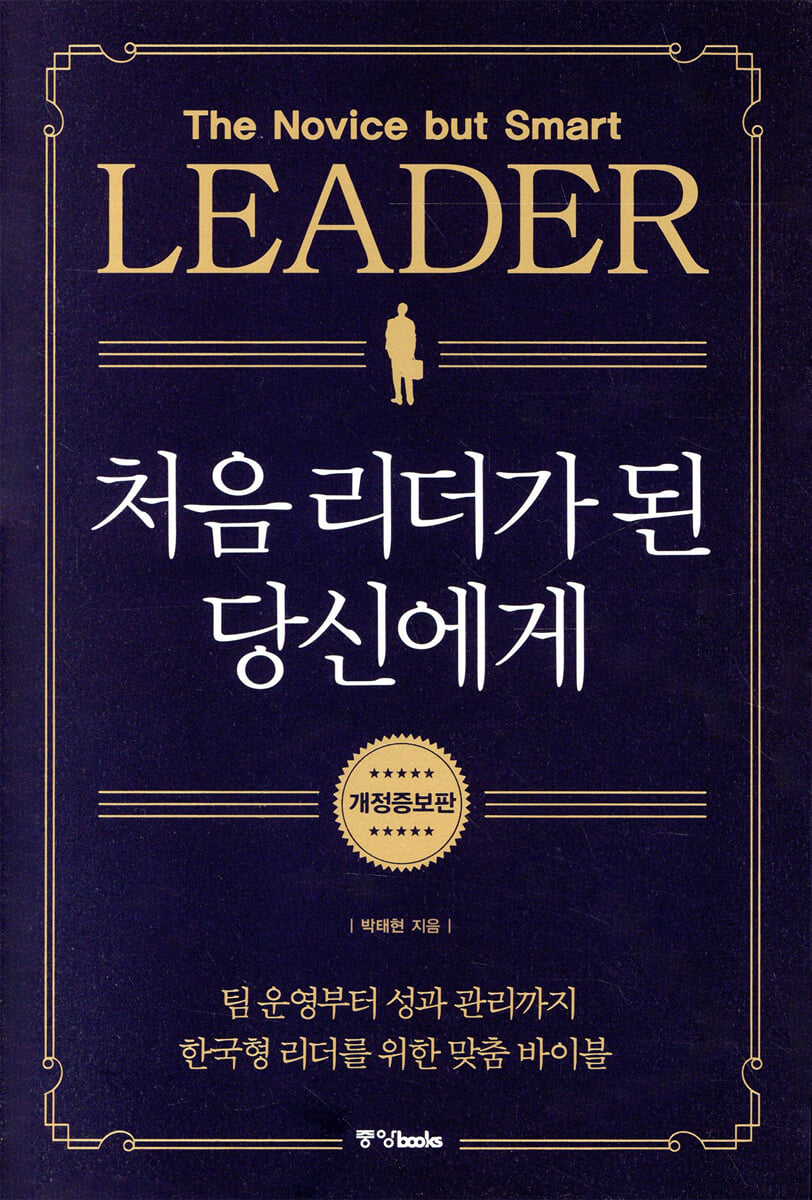
To you who are a leader for the first time
 |
Description
Book Introduction
A personalized bible for team leaders who dream of the best team and the best performance.
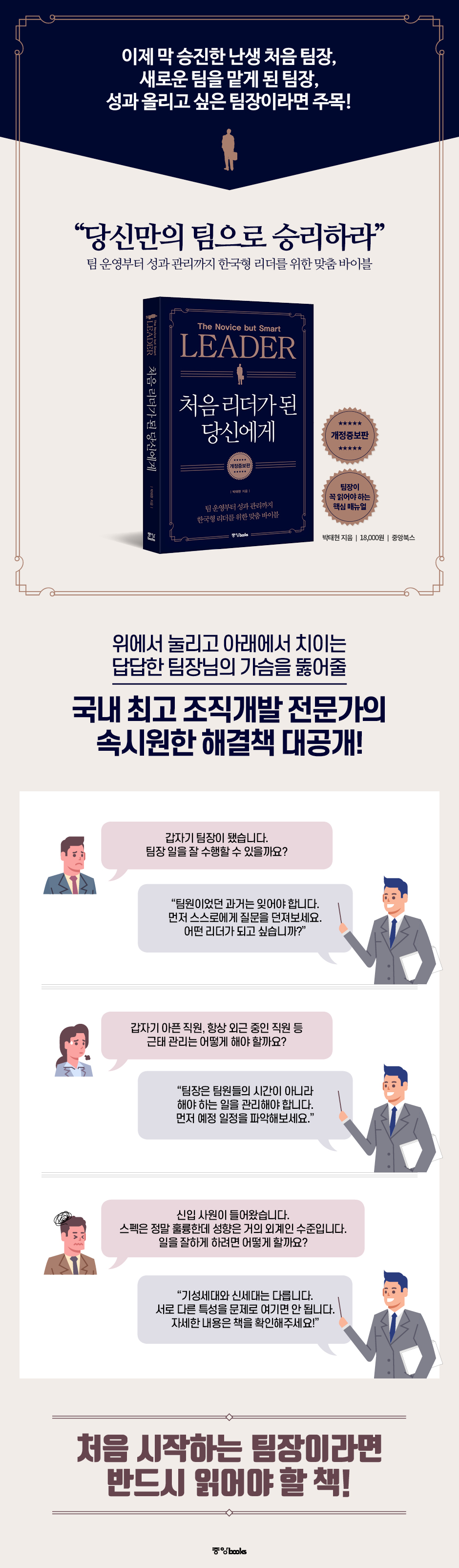
"For You Who Are a First-Time Leader," a book by Taehyun Park, known as Korea's top organizational development expert and filled with over 20 years of experience, has been fully revised and published in 2020, adding key tips for team leaders in this changing era, such as how to work with people born in the 90s and one-on-one meetings.
This book is a personalized bible for Korean leaders, covering everything from team management to performance management. It's filled with practical strategies essential for first-time team leaders, those taking charge of a new team, and those seeking to achieve results.
Unlike existing rigid leadership scriptures or foreign books on organizations and team leaders, this book contains over 90 gem-like solutions that can be immediately applied to the realities of Korean businesses.
A leader's job is a precarious one, like holding a sparrow in one's hand.
If you hold it too tight, the sparrow will die, and if you hold it too loose, it will fly away.
How can we achieve a balance between people, organization, and performance? This is a question that confronts not only those newly appointed as leaders but also anyone leading a team. The revised and expanded edition of "For First-Time Leaders" offers solutions that enable organizations and team members to thrive together.
A must-read for any team leader who wants to build a top-performing team in any organization. Simply completing this book will prove that you already have what it takes to be a great team leader.
"For You Who Are a First-Time Leader," a book by Taehyun Park, known as Korea's top organizational development expert and filled with over 20 years of experience, has been fully revised and published in 2020, adding key tips for team leaders in this changing era, such as how to work with people born in the 90s and one-on-one meetings.
This book is a personalized bible for Korean leaders, covering everything from team management to performance management. It's filled with practical strategies essential for first-time team leaders, those taking charge of a new team, and those seeking to achieve results.
Unlike existing rigid leadership scriptures or foreign books on organizations and team leaders, this book contains over 90 gem-like solutions that can be immediately applied to the realities of Korean businesses.
A leader's job is a precarious one, like holding a sparrow in one's hand.
If you hold it too tight, the sparrow will die, and if you hold it too loose, it will fly away.
How can we achieve a balance between people, organization, and performance? This is a question that confronts not only those newly appointed as leaders but also anyone leading a team. The revised and expanded edition of "For First-Time Leaders" offers solutions that enable organizations and team members to thrive together.
A must-read for any team leader who wants to build a top-performing team in any organization. Simply completing this book will prove that you already have what it takes to be a great team leader.
- You can preview some of the book's contents.
Preview
index
prolog
The quality of your first 90 days determines your success or failure.
Chapter 1: The Leader's Philosophy
What kind of leader do you want to be?
Don't fall for the 'leader game'
Leader, don't show your shabby side.
Chapter 2 Organizational Operations
How to manage attendance
The organization is half the rules
Things that prioritize management over leadership
You can see the team level by looking at the meeting.
The team leader's lunch hour should be different.
Chapter 3 Performance Management
Take the team's compass
There are no team members who work independently.
If you need to show something right now, Quickwin
7 Reasons You're Not Reaching Your Goals
You have to reduce work to get results.
Your team members work 24 hours a day without rest?
Communicate actively with relevant departments.
Chapter 4 Motivation
Don't believe it unless you see it for yourself.
How to Double the Effect of Praise
Favor all team members
The person who resigned did not give a reason.
How to Deal with Troublemaker Team Members
How to Work with People Born in the 90s
Chapter 5: The Art of Feedback
Evaluation, start at the beginning of the year
Killing Two Birds with One-on-One Meetings
The art of giving work instructions that enhances the attractiveness of work
How to Turn Silent Team Members into Chatterboxes
How to sweeten bitter words
Chapter 6: Leveraging Talent
Knowing your teammates is essential for mercenary tactics.
The Secret of a Highly Effective Team Member
Player A and Player C
Help 1 percent change their behavior
Chapter 7: Talent Development
What's on the minds of team members?
benefactor or 'enemy from a past life'
The best way to develop your skills is through work.
Provide frequent presentation opportunities
Epilogue
Leadership is a habit
The quality of your first 90 days determines your success or failure.
Chapter 1: The Leader's Philosophy
What kind of leader do you want to be?
Don't fall for the 'leader game'
Leader, don't show your shabby side.
Chapter 2 Organizational Operations
How to manage attendance
The organization is half the rules
Things that prioritize management over leadership
You can see the team level by looking at the meeting.
The team leader's lunch hour should be different.
Chapter 3 Performance Management
Take the team's compass
There are no team members who work independently.
If you need to show something right now, Quickwin
7 Reasons You're Not Reaching Your Goals
You have to reduce work to get results.
Your team members work 24 hours a day without rest?
Communicate actively with relevant departments.
Chapter 4 Motivation
Don't believe it unless you see it for yourself.
How to Double the Effect of Praise
Favor all team members
The person who resigned did not give a reason.
How to Deal with Troublemaker Team Members
How to Work with People Born in the 90s
Chapter 5: The Art of Feedback
Evaluation, start at the beginning of the year
Killing Two Birds with One-on-One Meetings
The art of giving work instructions that enhances the attractiveness of work
How to Turn Silent Team Members into Chatterboxes
How to sweeten bitter words
Chapter 6: Leveraging Talent
Knowing your teammates is essential for mercenary tactics.
The Secret of a Highly Effective Team Member
Player A and Player C
Help 1 percent change their behavior
Chapter 7: Talent Development
What's on the minds of team members?
benefactor or 'enemy from a past life'
The best way to develop your skills is through work.
Provide frequent presentation opportunities
Epilogue
Leadership is a habit
Detailed image
Into the book
One of the biggest changes you experience when you become a leader is the meeting scene.
Your team members are watching your every word and action.
You may feel pressured to see your team members acting very differently than when you were a team member, and you may become obsessed with showing some kind of leadership style.
As a team leader, here are some dos and don'ts when you're chairing a meeting.
First, let go of the compulsion to add your opinion to every issue.
If it's a story you know, don't try to force an answer even if you don't know the answer.
Expressions like “I don’t know for sure, but that’s what I think” are the worst.
Because your team members will assume that even something you say in passing is a work instruction.
If you don't know something, just listen to understand it.
There's no need to try hard to say it.
There is no need to try hard to show your ignorance.
--- From "You can see the team level by looking at the meeting"
In particular, when small, team-based organizations fall into chaos, it is often because the team is managed with a focus on urgent, pressing issues at hand.
I'm so busy that I can't see the bigger picture.
This is also an unavoidable reality.
The world is changing incredibly rapidly these days, and in the face of global, infinite competition, every organization is locked in a fight to the death.
To put it simply, it is a situation where you are fighting for your life every day on the battlefield.
In this situation, it may be a luxury to question the organization's raison d'être.
Nevertheless, even if others don't know, as the head of an organization, you can't help but ask the team leader about the reason for the organization's existence.
--- From "Take the Team Compass"
How should a first-time leader begin? Regardless of the sport, scoring first or getting off to a good start increases the odds of winning.
From this perspective, what you, as a new leader, need is a good start.
You have to show something 'right now', not 'in the future'.
Therefore, rather than aiming for a long-term 'jackpot', it is better to focus on the immediate fruits that can be harvested.
The focus should be on strong execution and driving force rather than careful deliberation.
If you can aim for something big and achieve it, there is nothing better than that.
But the reality is often not like that.
Because no one is waiting.
Especially at the company level, even if there isn't much that can be done at the lower level team level, it's nearly impossible to get all the resources to do it all at once.
In particular, shouldn't a new leader be tested not only by team members but also by stakeholders? If the stakes are high, you could easily end up wasting time and effort, juggling various issues and persuading stakeholders without achieving anything.
That's why it's better to focus on quick wins that can be achieved within a short period of time.
Your team members are watching your every word and action.
You may feel pressured to see your team members acting very differently than when you were a team member, and you may become obsessed with showing some kind of leadership style.
As a team leader, here are some dos and don'ts when you're chairing a meeting.
First, let go of the compulsion to add your opinion to every issue.
If it's a story you know, don't try to force an answer even if you don't know the answer.
Expressions like “I don’t know for sure, but that’s what I think” are the worst.
Because your team members will assume that even something you say in passing is a work instruction.
If you don't know something, just listen to understand it.
There's no need to try hard to say it.
There is no need to try hard to show your ignorance.
--- From "You can see the team level by looking at the meeting"
In particular, when small, team-based organizations fall into chaos, it is often because the team is managed with a focus on urgent, pressing issues at hand.
I'm so busy that I can't see the bigger picture.
This is also an unavoidable reality.
The world is changing incredibly rapidly these days, and in the face of global, infinite competition, every organization is locked in a fight to the death.
To put it simply, it is a situation where you are fighting for your life every day on the battlefield.
In this situation, it may be a luxury to question the organization's raison d'être.
Nevertheless, even if others don't know, as the head of an organization, you can't help but ask the team leader about the reason for the organization's existence.
--- From "Take the Team Compass"
How should a first-time leader begin? Regardless of the sport, scoring first or getting off to a good start increases the odds of winning.
From this perspective, what you, as a new leader, need is a good start.
You have to show something 'right now', not 'in the future'.
Therefore, rather than aiming for a long-term 'jackpot', it is better to focus on the immediate fruits that can be harvested.
The focus should be on strong execution and driving force rather than careful deliberation.
If you can aim for something big and achieve it, there is nothing better than that.
But the reality is often not like that.
Because no one is waiting.
Especially at the company level, even if there isn't much that can be done at the lower level team level, it's nearly impossible to get all the resources to do it all at once.
In particular, shouldn't a new leader be tested not only by team members but also by stakeholders? If the stakes are high, you could easily end up wasting time and effort, juggling various issues and persuading stakeholders without achieving anything.
That's why it's better to focus on quick wins that can be achieved within a short period of time.
--- From "If I had to show you something right now, Quick Win"
Publisher's Review
When the team leader changes, the team becomes completely different!
A Practical Manual for New Team Leaders
Which team performs better: a team led by a first-time leader or one led by a veteran leader? Author Park Tae-hyun, who has led and studied a wide range of organizations for over 20 years, from those with over 100 team members to those with just one or two, finds that surprisingly, first-time leaders are more likely to drive positive organizational change and demonstrate leadership that earns respect from employees than veteran leaders.
This is because of the ‘beginner’s mind’ that the first leader has.
A leader with a firm resolve will push things forward with positive energy and the ability to execute, even if there are setbacks.
So, if you've just become a team leader, you're in a very good position to demonstrate your capabilities as a first-time leader.
Being a team leader is not an easy position.
While being pushed from above and hit from below, you must also fulfill the role of a bumper that enhances the attractiveness of work, boosts team morale, and increases performance.
From the art of giving directives that boost performance, to the leadership attitudes that lead to productive meetings, to how to deal with trouble-making team members, and other professional methods that can be applied immediately in practice, this book will become a textbook that any team leader who is struggling with how to lead will always have at hand.
A Practical Manual for New Team Leaders
Which team performs better: a team led by a first-time leader or one led by a veteran leader? Author Park Tae-hyun, who has led and studied a wide range of organizations for over 20 years, from those with over 100 team members to those with just one or two, finds that surprisingly, first-time leaders are more likely to drive positive organizational change and demonstrate leadership that earns respect from employees than veteran leaders.
This is because of the ‘beginner’s mind’ that the first leader has.
A leader with a firm resolve will push things forward with positive energy and the ability to execute, even if there are setbacks.
So, if you've just become a team leader, you're in a very good position to demonstrate your capabilities as a first-time leader.
Being a team leader is not an easy position.
While being pushed from above and hit from below, you must also fulfill the role of a bumper that enhances the attractiveness of work, boosts team morale, and increases performance.
From the art of giving directives that boost performance, to the leadership attitudes that lead to productive meetings, to how to deal with trouble-making team members, and other professional methods that can be applied immediately in practice, this book will become a textbook that any team leader who is struggling with how to lead will always have at hand.
GOODS SPECIFICS
- Date of issue: January 27, 2020
- Page count, weight, size: 300 pages | 496g | 145*215*18mm
- ISBN13: 9788927810872
- ISBN10: 8927810872
You may also like
카테고리
korean


korean

![GQ KOREA Mark (Monthly): December [2025]](http://librairie.coreenne.fr/cdn/shop/files/8ef265dbbfbf186523ed75ba7319009d.jpg?v=1765340328&width=3840)


