

How to demonstrate your abilities
 |
Description
Book Introduction
- A word from MD
-
Now shine a light on your abilities!If you work hard, you'll eventually be recognized? No one recognizes your abilities without you expressing them! Discover the art of appealing to your abilities, discovered through 20 years of interviews with top CEOs and scholars, and the latest psychological research.
The power of 'visible ability' to make your own value shine and move others as you wish.
September 14, 2018. Self-Development PD Kim Hyun-joo
If you work hard, you'll be recognized someday?
Wrong, abilities never shine on their own!
Self-expression techniques discovered by the world's top CEOs and scholars.
One morning, in a Washington, D.C. subway station, a man began playing the violin.
It was world-renowned violin genius Joshua Bell.
His concert at Symphony Hall two days ago sold out all 1,000 seats despite the ticket price being over $100.
How many people actually listened to him for 43 minutes, playing Bach on a luxury violin valued at 4 billion won? The results of this experiment, conducted by the Washington Post, were truly astonishing.
Of the 1,097 pedestrians passing through the subway station, only seven listened to his performance for even a minute, and the coin box only collected $32.17!
Joshua Bell's story reminds us of an important misconception we have.
Ability never shines on its own.
There is no one who can recognize your competence without you expressing it.
If you want to be recognized, you have to actively let the world know how talented you are.
So how can you fully demonstrate your abilities? Jack Nasher, a professor at Munich Business School and management consultant who has consulted for global multinationals like IBM and H&M, explains.
He has been delving deep into this issue for 20 years.
"How to Demonstrate Your Abilities" is the result of 20 years of interviews with top CEOs and scholars, as well as a synthesis of the latest psychological research.
This book contains eight techniques for appealing to others' abilities to influence them as desired, such as 'How to make only my strengths come to mind', 'How to make luck and talent work for me', and 'How to use words and gestures to steal their hearts'.
The moment you completely transform the 'visible abilities' of the world's best—exemplary, gentlemanly, and sometimes unstoppable—into your own, your latent abilities will finally shine.
Wrong, abilities never shine on their own!
Self-expression techniques discovered by the world's top CEOs and scholars.
One morning, in a Washington, D.C. subway station, a man began playing the violin.
It was world-renowned violin genius Joshua Bell.
His concert at Symphony Hall two days ago sold out all 1,000 seats despite the ticket price being over $100.
How many people actually listened to him for 43 minutes, playing Bach on a luxury violin valued at 4 billion won? The results of this experiment, conducted by the Washington Post, were truly astonishing.
Of the 1,097 pedestrians passing through the subway station, only seven listened to his performance for even a minute, and the coin box only collected $32.17!
Joshua Bell's story reminds us of an important misconception we have.
Ability never shines on its own.
There is no one who can recognize your competence without you expressing it.
If you want to be recognized, you have to actively let the world know how talented you are.
So how can you fully demonstrate your abilities? Jack Nasher, a professor at Munich Business School and management consultant who has consulted for global multinationals like IBM and H&M, explains.
He has been delving deep into this issue for 20 years.
"How to Demonstrate Your Abilities" is the result of 20 years of interviews with top CEOs and scholars, as well as a synthesis of the latest psychological research.
This book contains eight techniques for appealing to others' abilities to influence them as desired, such as 'How to make only my strengths come to mind', 'How to make luck and talent work for me', and 'How to use words and gestures to steal their hearts'.
The moment you completely transform the 'visible abilities' of the world's best—exemplary, gentlemanly, and sometimes unstoppable—into your own, your latent abilities will finally shine.
- You can preview some of the book's contents.
Preview
index
Prologue: You've worked hard enough, now be recognized.
Chapter 1: How to Get a Competent Evaluation
Einstein's lament: "How did someone like me get all the honor?"
A leader is someone who knows very little about a lot of things.
What on earth is 'ability'?
The world is fair? That's nonsense!
If you seem competent, you actually are: a self-fulfilling prophecy.
[The Psychology of Expression] Don't be swayed by others, move them.
Chapter 2: How to Make Even a Suspicious Boss Trust You
Bill Gates' Courage: "I will make IBM number one."
Why do braggarts and boasters get recognized?
We confirm what we believed from the beginning: confirmation bias
A surefire prescription for those who don't trust themselves: priming.
Humility, if taken to excess, can lead to self-destruction.
With Brussels' best cafes right in front of you, why not head to Starbucks?
Neutralize your opponent's fears.
[The Psychology of Expression] "Loudly Great" Instead of "Secretly Great"
Chapter 3: How to Make Only Your Strengths Come to Mind
Steve Jobs' cry: "Spotlight, please come to me!"
Why Celebrities Who Don't Know Anything About Cars Appear in Car Commercials: The Halo Effect
The Eye with Which You View an Event Determines Success or Failure: Framing
If you have to bring up a bad story,
Whether you are angry, sad, or still
The Power to Instantly Turn No into Yes: The Chodu Effect
Which is more important, first impressions or last impressions?
[The Psychology of Expression] Let the scars of failure be short, and the aftertaste of success be long.
Chapter 4: How to Make Luck and Talent Work for You
Confession of a McKinsey CEO: “I had no money and no luck.”
Does doing difficult tasks in difficult situations make you look smart? : The Competence Formula
Geniuses leave behind masterpieces while lounging around.
If you are just sighing in front of your self-introduction letter
The world doesn't welcome tax accountants who should have been doctors.
[The Psychology of Expression] Create a Framework No One Can Reject
Chapter 5: The Secret to Speaking to Steal Hearts
Hegel's Humiliation: "You say I talk too much and don't think? Me?"
Strip away the five clutter and you have a powerful speech: Power Talking
10 Speaking Habits That Make You Look Competent
Is speaking a dialect a blessing or a curse?
[The Psychology of Expression] Just Being Good at Speaking Makes You Look 10 Times More Competent
Chapter 6: How to Use Gestures That Are More Powerful Than Words
Obama gestures: “Camera number one, can you see me moving?”
Why the President Blinked Over 50 Times in His Resignation Speech: The Nixon Effect
Break free from the compulsion to smile anytime, anywhere.
The Art of Sitting That No One Taught You
What is the appropriate distance between me and my partner, neither too close nor too far?
[The Psychology of Expression] 55% of a good impression is determined by facial expressions.
Chapter 7: The Secret of People Who Are More Attractive the More You See Them
Roosevelt's Leisure: "It's all thanks to a sudden strike."
Discover what's special about the other person
“You have completely convinced me!”
The profound implications of commonalities: The hypothesis that like attracts like
The reason why those who are meant to be can do anything, and those who are not meant to do can't do anything
[The Psychology of Expression] Liking Disarms the Other Person
Chapter 8: How to Create an 'Aura' That No One Can Imitate
Zuckerberg's provocation: "Can't you wear slippers to the Davos Forum?"
Can we be evaluated solely on our skills and not on our looks?
What Your Clothes, Shoes, Pens, and Wallets Say: Status Symbols
6 Ways Outsiders Judge Your Status
Look at the 'behavior' that has been ingrained in you since childhood.
The leader rises to the top with grace like a cat.
A "culture game" for the haves to engage in intellectual conversation.
Elon Musk, Gustave Eiffel, and My Connection: Enjoying Reflected Glory
[The Psychology of Expression] If you want to be easily and abundantly loved, be willing to be the best.
Epilogue: Hidden Abilities Finally Shine
annotation
References
Chapter 1: How to Get a Competent Evaluation
Einstein's lament: "How did someone like me get all the honor?"
A leader is someone who knows very little about a lot of things.
What on earth is 'ability'?
The world is fair? That's nonsense!
If you seem competent, you actually are: a self-fulfilling prophecy.
[The Psychology of Expression] Don't be swayed by others, move them.
Chapter 2: How to Make Even a Suspicious Boss Trust You
Bill Gates' Courage: "I will make IBM number one."
Why do braggarts and boasters get recognized?
We confirm what we believed from the beginning: confirmation bias
A surefire prescription for those who don't trust themselves: priming.
Humility, if taken to excess, can lead to self-destruction.
With Brussels' best cafes right in front of you, why not head to Starbucks?
Neutralize your opponent's fears.
[The Psychology of Expression] "Loudly Great" Instead of "Secretly Great"
Chapter 3: How to Make Only Your Strengths Come to Mind
Steve Jobs' cry: "Spotlight, please come to me!"
Why Celebrities Who Don't Know Anything About Cars Appear in Car Commercials: The Halo Effect
The Eye with Which You View an Event Determines Success or Failure: Framing
If you have to bring up a bad story,
Whether you are angry, sad, or still
The Power to Instantly Turn No into Yes: The Chodu Effect
Which is more important, first impressions or last impressions?
[The Psychology of Expression] Let the scars of failure be short, and the aftertaste of success be long.
Chapter 4: How to Make Luck and Talent Work for You
Confession of a McKinsey CEO: “I had no money and no luck.”
Does doing difficult tasks in difficult situations make you look smart? : The Competence Formula
Geniuses leave behind masterpieces while lounging around.
If you are just sighing in front of your self-introduction letter
The world doesn't welcome tax accountants who should have been doctors.
[The Psychology of Expression] Create a Framework No One Can Reject
Chapter 5: The Secret to Speaking to Steal Hearts
Hegel's Humiliation: "You say I talk too much and don't think? Me?"
Strip away the five clutter and you have a powerful speech: Power Talking
10 Speaking Habits That Make You Look Competent
Is speaking a dialect a blessing or a curse?
[The Psychology of Expression] Just Being Good at Speaking Makes You Look 10 Times More Competent
Chapter 6: How to Use Gestures That Are More Powerful Than Words
Obama gestures: “Camera number one, can you see me moving?”
Why the President Blinked Over 50 Times in His Resignation Speech: The Nixon Effect
Break free from the compulsion to smile anytime, anywhere.
The Art of Sitting That No One Taught You
What is the appropriate distance between me and my partner, neither too close nor too far?
[The Psychology of Expression] 55% of a good impression is determined by facial expressions.
Chapter 7: The Secret of People Who Are More Attractive the More You See Them
Roosevelt's Leisure: "It's all thanks to a sudden strike."
Discover what's special about the other person
“You have completely convinced me!”
The profound implications of commonalities: The hypothesis that like attracts like
The reason why those who are meant to be can do anything, and those who are not meant to do can't do anything
[The Psychology of Expression] Liking Disarms the Other Person
Chapter 8: How to Create an 'Aura' That No One Can Imitate
Zuckerberg's provocation: "Can't you wear slippers to the Davos Forum?"
Can we be evaluated solely on our skills and not on our looks?
What Your Clothes, Shoes, Pens, and Wallets Say: Status Symbols
6 Ways Outsiders Judge Your Status
Look at the 'behavior' that has been ingrained in you since childhood.
The leader rises to the top with grace like a cat.
A "culture game" for the haves to engage in intellectual conversation.
Elon Musk, Gustave Eiffel, and My Connection: Enjoying Reflected Glory
[The Psychology of Expression] If you want to be easily and abundantly loved, be willing to be the best.
Epilogue: Hidden Abilities Finally Shine
annotation
References
Detailed image

Into the book
These are the common lines that lovers say when they are arguing.
“Don’t you know my heart like that?”
“How can you know if you don’t say anything?”
This also applies in the business world.
There are very few people who can tell right away how talented you are without you having to express it.
Be confident in your abilities and show them off without hesitation.
In the end, you will definitely be one step ahead of others.
- From the 'Prologue'
Your story of living in this day and age is sad.
You have devoted most of your time to developing your abilities.
During my school days, I invested heavily in getting into the university of my choice, in getting a job after entering university, and in getting promoted after joining the company.
And all this effort has taken your abilities to the next level.
But you only realize it after a lot of trial and error.
The fact that hard-earned abilities do not guarantee social success.
Your incompetent colleagues have outpaced you! Why on earth did this happen? Because no one prepared you to properly "sell" yourself.
What do we base our judgments on? It's not actual ability, but outward appearance.
- From 'How to get an evaluation of your ability'
The phenomenon in which a concept brought to mind in advance influences the interpretation of information presented later is called 'priming'.
One study that's been puzzling us shows that even thinking briefly about abstract problems can make a difference in performance.
Experimental participants had to solve a difficult task.
Before this, Group A was asked to think about what it means to become a professor.
Group B was asked to imagine themselves as soccer hooligans.
Then, group A solved more tasks than group B.
If you have a big event coming up, like a presentation or a final interview that could potentially lead to a contract, simply visualizing the day's events can be incredibly helpful.
- From 'How to Make Even a Suspicious Boss Trust You'
You broke your leg in an accident and are lying in the hospital in pain.
Then, the doctor in charge greets you warmly and tells you that you are suffering from double misfortune.
So, not only did he break the bone, but out of all the doctors, he came to me.
He says he is not a very skilled doctor, and that he liked to play when he was a student and wanted to be a jazz musician.
But anyway, since I've been entrusted with your treatment, I'll try my best.
Would such humility please you? If you were lying in bed, sick and resigned to your fate, you wouldn't want to hear any words of humility from your doctor.
Rather, you want a confident word of reassurance that you will receive the best treatment.
- From 'How to Make Even a Suspicious Boss Trust You'
The judgment we make about someone we meet for the first time in 30 seconds is not much different from the judgment we make after 5 minutes of deliberation.
Our judgment is not as sharp as we think.
In reality, first judgments are made before we even really know a person.
We usually make judgments about others based on what we hear, on casual conversations, or after skimming a job application.
- From 'How to Make Only My Strengths Come to Mind'
Before you start working in earnest, present these reasons in advance.
Even when you have achieved good results, it is beneficial to mention all the obstacles you have faced.
Responding with “I was just lucky, you know” unnecessarily diminishes your “visible abilities.”
In contrast, if you emphasize the difficulties you had to overcome to achieve your success, your success will be attributed to your exceptional abilities rather than external circumstances.
Worried that listing all sorts of reasons before even starting will make you seem unsure? Instead of saying, "I think this will be difficult," try ending with, "I know there are challenges, but I'll give it a try."
- From 'How to Make Luck and Talent Work for You'
“Don’t you know my heart like that?”
“How can you know if you don’t say anything?”
This also applies in the business world.
There are very few people who can tell right away how talented you are without you having to express it.
Be confident in your abilities and show them off without hesitation.
In the end, you will definitely be one step ahead of others.
- From the 'Prologue'
Your story of living in this day and age is sad.
You have devoted most of your time to developing your abilities.
During my school days, I invested heavily in getting into the university of my choice, in getting a job after entering university, and in getting promoted after joining the company.
And all this effort has taken your abilities to the next level.
But you only realize it after a lot of trial and error.
The fact that hard-earned abilities do not guarantee social success.
Your incompetent colleagues have outpaced you! Why on earth did this happen? Because no one prepared you to properly "sell" yourself.
What do we base our judgments on? It's not actual ability, but outward appearance.
- From 'How to get an evaluation of your ability'
The phenomenon in which a concept brought to mind in advance influences the interpretation of information presented later is called 'priming'.
One study that's been puzzling us shows that even thinking briefly about abstract problems can make a difference in performance.
Experimental participants had to solve a difficult task.
Before this, Group A was asked to think about what it means to become a professor.
Group B was asked to imagine themselves as soccer hooligans.
Then, group A solved more tasks than group B.
If you have a big event coming up, like a presentation or a final interview that could potentially lead to a contract, simply visualizing the day's events can be incredibly helpful.
- From 'How to Make Even a Suspicious Boss Trust You'
You broke your leg in an accident and are lying in the hospital in pain.
Then, the doctor in charge greets you warmly and tells you that you are suffering from double misfortune.
So, not only did he break the bone, but out of all the doctors, he came to me.
He says he is not a very skilled doctor, and that he liked to play when he was a student and wanted to be a jazz musician.
But anyway, since I've been entrusted with your treatment, I'll try my best.
Would such humility please you? If you were lying in bed, sick and resigned to your fate, you wouldn't want to hear any words of humility from your doctor.
Rather, you want a confident word of reassurance that you will receive the best treatment.
- From 'How to Make Even a Suspicious Boss Trust You'
The judgment we make about someone we meet for the first time in 30 seconds is not much different from the judgment we make after 5 minutes of deliberation.
Our judgment is not as sharp as we think.
In reality, first judgments are made before we even really know a person.
We usually make judgments about others based on what we hear, on casual conversations, or after skimming a job application.
- From 'How to Make Only My Strengths Come to Mind'
Before you start working in earnest, present these reasons in advance.
Even when you have achieved good results, it is beneficial to mention all the obstacles you have faced.
Responding with “I was just lucky, you know” unnecessarily diminishes your “visible abilities.”
In contrast, if you emphasize the difficulties you had to overcome to achieve your success, your success will be attributed to your exceptional abilities rather than external circumstances.
Worried that listing all sorts of reasons before even starting will make you seem unsure? Instead of saying, "I think this will be difficult," try ending with, "I know there are challenges, but I'll give it a try."
- From 'How to Make Luck and Talent Work for You'
--- From the text
Publisher's Review
“Don’t hide your talent, show it off!”
The power of 'visible ability' to move the opponent as desired
We must judge the abilities of everyone we encounter in our daily lives, from our bosses and colleagues at work, to our business partners, even our hairdressers and tax accountants.
Our opponents are also evaluating our abilities at every moment.
At this point, what basis do we use to judge someone's competence? Contrary to expectations that exceptional ability will shine through on its own, research shows that accurately assessing ability is nearly impossible.
People guess others' abilities through characteristics such as speech, gestures, facial expressions, and first impressions.
Jack Nasher, author of "How to Show Your Abilities," calls these outwardly visible abilities "visible abilities."
In social success, 'visible ability' plays a more decisive role than actual ability.
Even if you have world-class talent, no one will recognize you if you don't demonstrate your abilities.
If you want to be recognized, you must actively express your abilities.
However, very few people know how to demonstrate their abilities and put them into action.
Moreover, Koreans, who have considered humility and moderation as virtues, find it difficult to show their abilities to others.
This is because of the concern that 'if I express my abilities clumsily, I might be seen as a braggart.'
That's why we need the subtle yet proven art of self-expression.
In this book, the author reveals the skills of appealing to abilities that he discovered through 20 years of interviews and research.
These are perfectly proactive techniques that allow you to make others believe what you want by effectively demonstrating your abilities.
If you consciously apply the techniques in the book, you can achieve overwhelmingly positive results.
When you actively demonstrate your abilities, your opponent gains key information about your abilities.
This is information I might have missed if you hadn't shown it to me.
Also, according to the 'self-fulfilling prophecy' that positive expectations actually have a positive effect, if your 'visible ability' increases, you will actually become more competent.
The skill of 'visible ability' also develops the ability to properly judge the abilities of others.
People who know that just a few characteristics determine an impression do not make the mistake of easily judging someone's abilities based on just a few visible characteristics.
So, if you want to be recognized as much as you deserve, or even more than you deserve, don't hesitate to use the techniques in this book.
The eight techniques in this book will work in synergy with each other to put you one step ahead of others.
Barack Obama, Bill Gates, Steve Jobs, Mark Zuckerberg…
Those known as 'natural geniuses' were actually 'geniuses of expression'!
What sets these world-class individuals apart? It's clear that they possess exceptional abilities.
But ability alone will never get you to the top.
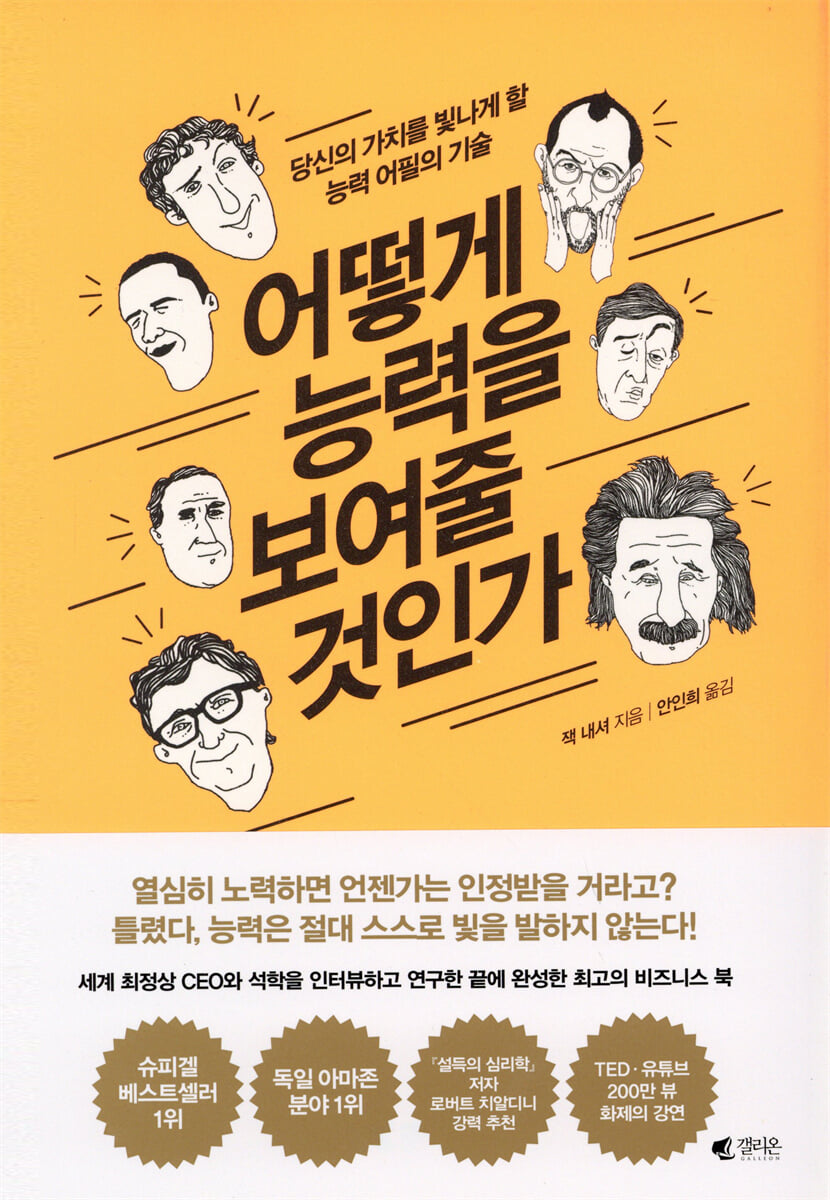
The world's greatest figures, including Barack Obama, Bill Gates, Steve Jobs, and Mark Zuckerberg, all featured in "How to Show Off Your Abilities," possessed techniques that highlighted their abilities.
Those who were known only as 'natural geniuses' were actually 'geniuses of expression'!
Bill Gates, a 24-year-old college dropout, secured a contract with IBM, then a leader in the IT industry, and instantly became the world's richest man.
The secret to his captivating IBM, despite his lack of a fancy office or fame, was his 'confidence.'
He clearly demonstrated his confidence in delivering a great operating system.
Barack Obama and Steve Jobs knew how to grab people's attention.
Barack Obama's secret weapon to command the audience was his 'gestures'.
When he gave a speech in front of people, he placed cameras everywhere.
Then, with his energetic gestures, he gave the impression of speaking to all the attendees.
Meanwhile, Steve Jobs always took the spotlight at Apple's legendary new product launch events.
He appeared with a bright light on his back and looked like a god.
Mark Zuckerberg, the founder of Facebook and the youngest billionaire, is a person who personally practices the saying, "Being innovative is classy."
He rejects typical business fashion like suits and shoes.
Instead, he appeals to the image of an innovative young CEO by wearing a T-shirt and jeans.
In 2007, he surprised the world by appearing at the Davos Forum wearing three-striped slippers.
In addition, the book introduces strategies to highlight your strengths, such as how to instill confidence in others, how to convey good and bad news, and how to create your own 'aura' that no one can imitate, through anecdotes of leaders in each field, such as Einstein, Hegel, and Roosevelt.
Make these strategies a habit through repetition.
Soon you will hear voices praising your abilities.
“You’ve worked hard enough, now get some recognition!”
The art of 'competence appeal' based on empirical evidence from psychology
"How to Demonstrate Your Abilities" presents empirical techniques for demonstrating your abilities, based on the latest psychological research.
We assume that we will be evaluated objectively based on our performance.
However, the results of the experiment were completely different from what was expected! Self-imposed expectations had a greater impact on evaluations than actual performance.
This is because 'confirmation bias' works by selectively accepting information that fits the prediction of evaluators.
Research has shown that people who predicted their own performance positively received positive evaluations even when their performance was lower than expected.
Conversely, people who had negative predictions about their own performance did not receive good evaluations even when they performed well.
Moreover, the "competence formula" that says that doing difficult things in difficult situations makes you look smart directly contradicts the value that values effort above all else.
To those who habitually say that they studied much harder than others, the author advises, “Stop saying that right now.”
Because someone who gets it done easily gets more respect than someone who grits their teeth and works hard.
In addition, research results based on psychological concepts such as priming theory, halo effect, and primacy effect overturn common sense.
The techniques in this book, acquired through numerous experiments, are concrete enough to be put into practice immediately.
Some of the guidelines in the book are as follows:
When trying to persuade someone, start with your strongest argument and end with your second strongest argument.
In important meetings, sit with your body leaning forward, with your back at about a 10-degree angle to the back of your chair.
When you speak, look into the other person's eyes, but when you listen, avoid eye contact.
If you want to maximize your 'visible ability', keep an appropriate distance of 1.2 to 1.5 meters from your opponent.
When holding a meeting at an angled table, sit at the head of the table.
Will you be treated as a professional or branded an incompetent loser?
It all depends on you!
This book focuses on how to effectively demonstrate your abilities rather than how to develop actual abilities.
The message to fully demonstrate your abilities is not a recommendation to focus solely on image management.
This means that you should actively promote your abilities so that more people can recognize them.
According to the author, we do not reap what we sow, but we reap what we see.
Once you establish the impression of competence, people will remember the characteristics and events that support your competence.
The book deals with the factors that influence 'visible abilities' such as confidence, first impressions, luck, talent, speech, gestures, charm, and behavior.
People tend to choose what scares them the least, not what makes them happy.
The author quotes marketing strategist Harry Beckwith, who says, “Don’t try to be the good option; try to eliminate everything that makes you a bad option.” He advises that, in order to get the evaluation you want, you must first eliminate the other person’s fears.
The "framing theory," which states that it is not the event itself but the way you view it that determines success or failure, suggests that presenting a positive perspective to the other person can help overcome even negative situations.
Along with this, we introduce practical know-how that will prove effective in the business field, such as five unnecessary things to remove for powerful speaking and six indicators of how people outside the company judge your status.
It also reminds us of the 'inconvenient truth' that the influence of appearance cannot be ignored in ability evaluations.
But even if you don't have the looks of a movie star, it teaches you the secrets to creating your own unique atmosphere through your clothes, belongings, and behavior.
At the end of each chapter, a table summarizes the book's contents for an at-a-glance overview.
Readers who wish to practice the techniques presented in the book will be able to check themselves in their busy daily lives through the table.
Society is changing at an increasingly rapid pace.
In this situation, the value of 'competent talent' who can actively respond to changes in each field is increasing day by day.
Will you be treated as a competent professional, or will you be stigmatized as an incompetent loser? If you want to thrive in a meritocratic society, this book will provide the answer.
The power of 'visible ability' to move the opponent as desired
We must judge the abilities of everyone we encounter in our daily lives, from our bosses and colleagues at work, to our business partners, even our hairdressers and tax accountants.
Our opponents are also evaluating our abilities at every moment.
At this point, what basis do we use to judge someone's competence? Contrary to expectations that exceptional ability will shine through on its own, research shows that accurately assessing ability is nearly impossible.
People guess others' abilities through characteristics such as speech, gestures, facial expressions, and first impressions.
Jack Nasher, author of "How to Show Your Abilities," calls these outwardly visible abilities "visible abilities."
In social success, 'visible ability' plays a more decisive role than actual ability.
Even if you have world-class talent, no one will recognize you if you don't demonstrate your abilities.
If you want to be recognized, you must actively express your abilities.
However, very few people know how to demonstrate their abilities and put them into action.
Moreover, Koreans, who have considered humility and moderation as virtues, find it difficult to show their abilities to others.
This is because of the concern that 'if I express my abilities clumsily, I might be seen as a braggart.'
That's why we need the subtle yet proven art of self-expression.
In this book, the author reveals the skills of appealing to abilities that he discovered through 20 years of interviews and research.
These are perfectly proactive techniques that allow you to make others believe what you want by effectively demonstrating your abilities.
If you consciously apply the techniques in the book, you can achieve overwhelmingly positive results.
When you actively demonstrate your abilities, your opponent gains key information about your abilities.
This is information I might have missed if you hadn't shown it to me.
Also, according to the 'self-fulfilling prophecy' that positive expectations actually have a positive effect, if your 'visible ability' increases, you will actually become more competent.
The skill of 'visible ability' also develops the ability to properly judge the abilities of others.
People who know that just a few characteristics determine an impression do not make the mistake of easily judging someone's abilities based on just a few visible characteristics.
So, if you want to be recognized as much as you deserve, or even more than you deserve, don't hesitate to use the techniques in this book.
The eight techniques in this book will work in synergy with each other to put you one step ahead of others.
Barack Obama, Bill Gates, Steve Jobs, Mark Zuckerberg…
Those known as 'natural geniuses' were actually 'geniuses of expression'!
What sets these world-class individuals apart? It's clear that they possess exceptional abilities.
But ability alone will never get you to the top.
The world's greatest figures, including Barack Obama, Bill Gates, Steve Jobs, and Mark Zuckerberg, all featured in "How to Show Off Your Abilities," possessed techniques that highlighted their abilities.
Those who were known only as 'natural geniuses' were actually 'geniuses of expression'!
Bill Gates, a 24-year-old college dropout, secured a contract with IBM, then a leader in the IT industry, and instantly became the world's richest man.
The secret to his captivating IBM, despite his lack of a fancy office or fame, was his 'confidence.'
He clearly demonstrated his confidence in delivering a great operating system.
Barack Obama and Steve Jobs knew how to grab people's attention.
Barack Obama's secret weapon to command the audience was his 'gestures'.
When he gave a speech in front of people, he placed cameras everywhere.
Then, with his energetic gestures, he gave the impression of speaking to all the attendees.
Meanwhile, Steve Jobs always took the spotlight at Apple's legendary new product launch events.
He appeared with a bright light on his back and looked like a god.
Mark Zuckerberg, the founder of Facebook and the youngest billionaire, is a person who personally practices the saying, "Being innovative is classy."
He rejects typical business fashion like suits and shoes.
Instead, he appeals to the image of an innovative young CEO by wearing a T-shirt and jeans.
In 2007, he surprised the world by appearing at the Davos Forum wearing three-striped slippers.
In addition, the book introduces strategies to highlight your strengths, such as how to instill confidence in others, how to convey good and bad news, and how to create your own 'aura' that no one can imitate, through anecdotes of leaders in each field, such as Einstein, Hegel, and Roosevelt.
Make these strategies a habit through repetition.
Soon you will hear voices praising your abilities.
“You’ve worked hard enough, now get some recognition!”
The art of 'competence appeal' based on empirical evidence from psychology
"How to Demonstrate Your Abilities" presents empirical techniques for demonstrating your abilities, based on the latest psychological research.
We assume that we will be evaluated objectively based on our performance.
However, the results of the experiment were completely different from what was expected! Self-imposed expectations had a greater impact on evaluations than actual performance.
This is because 'confirmation bias' works by selectively accepting information that fits the prediction of evaluators.
Research has shown that people who predicted their own performance positively received positive evaluations even when their performance was lower than expected.
Conversely, people who had negative predictions about their own performance did not receive good evaluations even when they performed well.
Moreover, the "competence formula" that says that doing difficult things in difficult situations makes you look smart directly contradicts the value that values effort above all else.
To those who habitually say that they studied much harder than others, the author advises, “Stop saying that right now.”
Because someone who gets it done easily gets more respect than someone who grits their teeth and works hard.
In addition, research results based on psychological concepts such as priming theory, halo effect, and primacy effect overturn common sense.
The techniques in this book, acquired through numerous experiments, are concrete enough to be put into practice immediately.
Some of the guidelines in the book are as follows:
When trying to persuade someone, start with your strongest argument and end with your second strongest argument.
In important meetings, sit with your body leaning forward, with your back at about a 10-degree angle to the back of your chair.
When you speak, look into the other person's eyes, but when you listen, avoid eye contact.
If you want to maximize your 'visible ability', keep an appropriate distance of 1.2 to 1.5 meters from your opponent.
When holding a meeting at an angled table, sit at the head of the table.
Will you be treated as a professional or branded an incompetent loser?
It all depends on you!
This book focuses on how to effectively demonstrate your abilities rather than how to develop actual abilities.
The message to fully demonstrate your abilities is not a recommendation to focus solely on image management.
This means that you should actively promote your abilities so that more people can recognize them.
According to the author, we do not reap what we sow, but we reap what we see.
Once you establish the impression of competence, people will remember the characteristics and events that support your competence.
The book deals with the factors that influence 'visible abilities' such as confidence, first impressions, luck, talent, speech, gestures, charm, and behavior.
People tend to choose what scares them the least, not what makes them happy.
The author quotes marketing strategist Harry Beckwith, who says, “Don’t try to be the good option; try to eliminate everything that makes you a bad option.” He advises that, in order to get the evaluation you want, you must first eliminate the other person’s fears.
The "framing theory," which states that it is not the event itself but the way you view it that determines success or failure, suggests that presenting a positive perspective to the other person can help overcome even negative situations.
Along with this, we introduce practical know-how that will prove effective in the business field, such as five unnecessary things to remove for powerful speaking and six indicators of how people outside the company judge your status.
It also reminds us of the 'inconvenient truth' that the influence of appearance cannot be ignored in ability evaluations.
But even if you don't have the looks of a movie star, it teaches you the secrets to creating your own unique atmosphere through your clothes, belongings, and behavior.
At the end of each chapter, a table summarizes the book's contents for an at-a-glance overview.
Readers who wish to practice the techniques presented in the book will be able to check themselves in their busy daily lives through the table.
Society is changing at an increasingly rapid pace.
In this situation, the value of 'competent talent' who can actively respond to changes in each field is increasing day by day.
Will you be treated as a competent professional, or will you be stigmatized as an incompetent loser? If you want to thrive in a meritocratic society, this book will provide the answer.
GOODS SPECIFICS
- Date of publication: September 7, 2018
- Page count, weight, size: 270 pages | 506g | 154*224*16mm
- ISBN13: 9788901226606
- ISBN10: 890122660X
You may also like
카테고리
korean


korean

![GQ KOREA Mark (Monthly): December [2025]](http://librairie.coreenne.fr/cdn/shop/files/8ef265dbbfbf186523ed75ba7319009d.jpg?v=1765340328&width=3840)


