

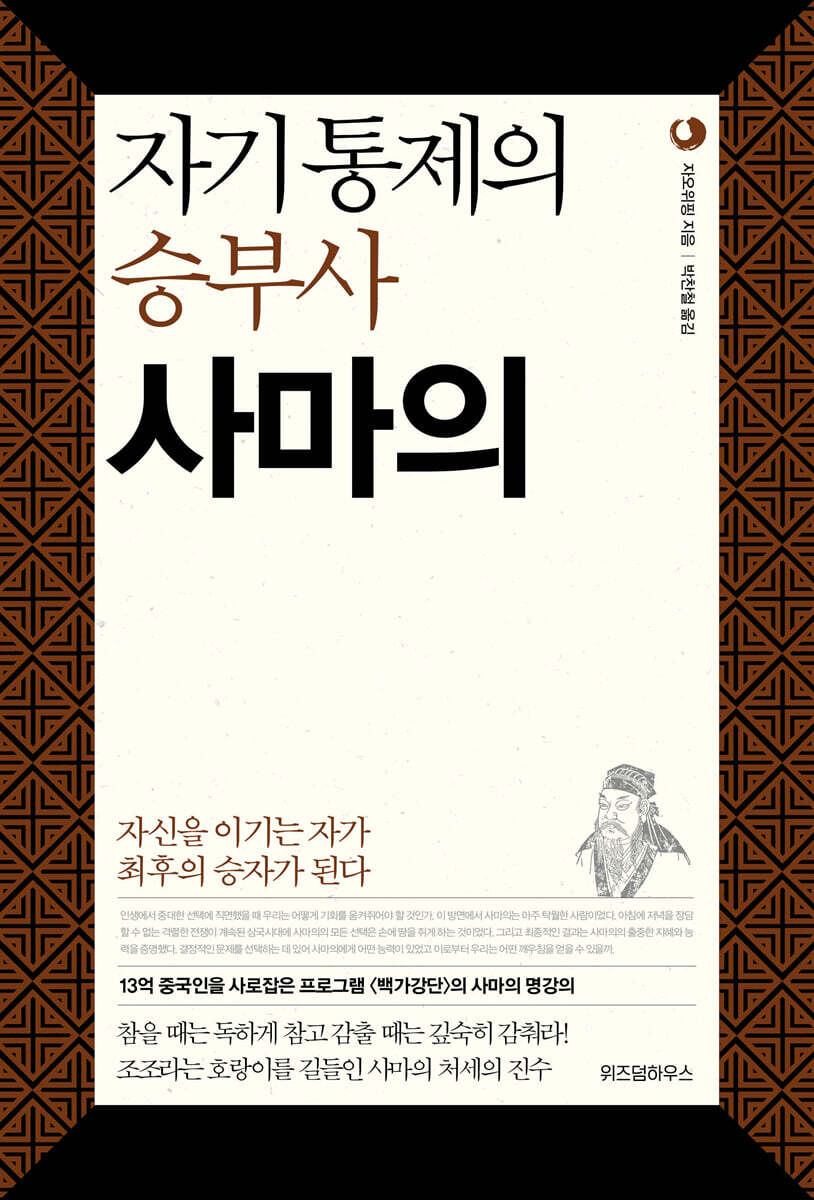
Sima Yi, the master of self-control
 |
Description
Book Introduction
Learn the secrets of success through patience and moderation from Sima Yi's famous lectures.
We know all too well about Zhuge Liang, but we know little about Sima Yi, who appeared at the end of the Romance of the Three Kingdoms and became the subject of the humiliating story of "Dead Kongming Chasing the Living Zhongda."
Sima Yi repelled all five of Zhuge Liang's Northern Expeditions, and his family assisted Cao Cao's family for four generations, never once being excluded from key positions. Finally, he succeeded in a coup and unified the Three Kingdoms, becoming the ultimate victor.
We, in modern times, need to take a close look at the working environment of Sima Yi, who was employed by the cold and cold Cao Cao and worked under constant supervision.
"Sima Yi, the Master of Self-Control" is a compilation of 10 lectures given by Dr. Zhao Yuping, a leading lecturer in Chinese management studies, at the "Hundred Schools of Thought" lecture hall, the pinnacle of Chinese humanities courses.
Here, the author presents the worldly philosophy of Sima Yi, who, despite the humiliation of receiving a woman's clothes as a gift, did not move his troops without any practical benefit, and who, even after winning a battle, was careful with his words and actions to the point of writing a poem expressing his wish for the king's punishment, in an easy and clear manner.
The aesthetics of self-restraint may be the best survival strategy in a harsh environment surrounded by controlling superiors, subordinates who act like scapegoats, and snitches.
Dr. Zhao Yuping's lecture on Sima Yi, selected by Chinese media as one of the top ten lecturers on the mainland, provides an excellent opportunity to learn about Sima Yi, a figure previously not properly accessible.
The book follows Sima Yi's 40-year career as a supporter of the four generations of the Cao family, from his appointment by Cao Cao at the age of 30. It introduces, in a modern sense, the secrets of management that allowed him to control both sharp bosses and dull subordinates, the restrained tactics of winning without showing defeat on the battlefield, and the secret strategies of successfully plotting a rebellion while gaining the trust of his superiors.
We know all too well about Zhuge Liang, but we know little about Sima Yi, who appeared at the end of the Romance of the Three Kingdoms and became the subject of the humiliating story of "Dead Kongming Chasing the Living Zhongda."
Sima Yi repelled all five of Zhuge Liang's Northern Expeditions, and his family assisted Cao Cao's family for four generations, never once being excluded from key positions. Finally, he succeeded in a coup and unified the Three Kingdoms, becoming the ultimate victor.
We, in modern times, need to take a close look at the working environment of Sima Yi, who was employed by the cold and cold Cao Cao and worked under constant supervision.
"Sima Yi, the Master of Self-Control" is a compilation of 10 lectures given by Dr. Zhao Yuping, a leading lecturer in Chinese management studies, at the "Hundred Schools of Thought" lecture hall, the pinnacle of Chinese humanities courses.
Here, the author presents the worldly philosophy of Sima Yi, who, despite the humiliation of receiving a woman's clothes as a gift, did not move his troops without any practical benefit, and who, even after winning a battle, was careful with his words and actions to the point of writing a poem expressing his wish for the king's punishment, in an easy and clear manner.
The aesthetics of self-restraint may be the best survival strategy in a harsh environment surrounded by controlling superiors, subordinates who act like scapegoats, and snitches.
Dr. Zhao Yuping's lecture on Sima Yi, selected by Chinese media as one of the top ten lecturers on the mainland, provides an excellent opportunity to learn about Sima Yi, a figure previously not properly accessible.
The book follows Sima Yi's 40-year career as a supporter of the four generations of the Cao family, from his appointment by Cao Cao at the age of 30. It introduces, in a modern sense, the secrets of management that allowed him to control both sharp bosses and dull subordinates, the restrained tactics of winning without showing defeat on the battlefield, and the secret strategies of successfully plotting a rebellion while gaining the trust of his superiors.
- You can preview some of the book's contents.
Preview
index
introduction
Chapter 1.
Don't jump into the enemy's options recklessly.
Change the situation with a single choice
Strategy 1: Choose satisfaction over excellence.
Strategy 2: Good choices leave no regrets.
Strategy 3: Never choose the options prepared by the enemy.
Chapter 2.
When serving the king, act as if you had a tiger by your side.
Hide the face of the wolf and serve the tiger
Strategy 1: Be diligent, respectful, and patient.
Strategy 2: Be humble, gentle, and silent.
Chapter 3.
In moments of crisis and sudden change, there should be no delay or hesitation.
Uproot the cunning opponent
Strategy 1: Observe for a long time and criticize consistently.
Strategy 2: Finding a problem-solving method that fits your authority.
Strategy 3: Use rats to monitor rats.
Lecture 4.
When the wind blows against you, keep your composure.
Boosting the morale of a weakened organization
Strategy 1: Maintain authority through consistent choices.
Strategy 2: Boost your subordinates' morale with positive suggestions.
Strategy 3: Control your emotions and interpret them rationally.
Chapter 5.
Quietly overpower your competitors with restraint and performance.
Gain an edge over competition within your organization
Strategy 1: Do things loudly and build relationships quietly.
Strategy 2: Let go of selfishness and help your competitors succeed.
Strategy 3: Advance by retreating and defending without attacking.
Chapter 6.
Be humble above and firm below to gain trust.
Overcoming adversity with delegated authority
Strategy 1: Communicate first, then act.
Strategy 2: Fight with wisdom, complement with strength.
Strategy 3: Loyalty from afar, respect from up close
Chapter 7.
Go to where opportunity comes and wait for it.
Designing the board to seize the opportunity
Strategy 1: Gain internal support through political alliances.
Strategy 2: Understand the Boss's Tendency and Adapt Your Style
Strategy 3: Persuade the person according to their type and get their consent before taking action.
Chapter 8.
Once you have the upper hand, act without mercy.
Turning a crisis into a springboard to the throne
Strategy 1: Leave no room for a reversal.
Strategy 2: Tighten the inside, leave room on the outside
Strategy 3: Create public opinion and gain the organization's consent.
Chapter 9.
When going to war, the rich must go together.
Pay attention to your children's education
Strategy 1: Teach good habits by setting an example.
Strategy 2: A Mother's Education Develops a Good Character
Strategy 3: Let them learn through experience.
Chapter 10.
Lure criminals with profit and persuade talent with value.
Stabilize the new political situation
Strategy 1│Reversal of Force
Strategy 2│Mental War
Strategy 3│Wisdom War
Appendix: Biography of Sima Yi_《Book of Jin》〈Records of Emperor Xian〉
Sima Yi's Proverbs on Life
* There cannot be two bosses in one organization.
* People are more prone to being caught in their weaknesses when they are doing what they do best.
* The more capable the key personnel are, the more easily they are hurt in the organization.
* Outstanding people are managed by values, and average people are managed by systems.
* Even if you cater to others, you must not abandon the basic principles of conduct.
* Risks are greatest when success is near, and mistakes are most likely to be made when the going is good.
* To be successful, you must have someone's support.
* All major failures are ultimately failures of tolerance.
* If dignity is higher than virtue, trouble will surely follow.
* Only when you accept what others do not accept can you become a leader.
Chapter 1.
Don't jump into the enemy's options recklessly.
Change the situation with a single choice
Strategy 1: Choose satisfaction over excellence.
Strategy 2: Good choices leave no regrets.
Strategy 3: Never choose the options prepared by the enemy.
Chapter 2.
When serving the king, act as if you had a tiger by your side.
Hide the face of the wolf and serve the tiger
Strategy 1: Be diligent, respectful, and patient.
Strategy 2: Be humble, gentle, and silent.
Chapter 3.
In moments of crisis and sudden change, there should be no delay or hesitation.
Uproot the cunning opponent
Strategy 1: Observe for a long time and criticize consistently.
Strategy 2: Finding a problem-solving method that fits your authority.
Strategy 3: Use rats to monitor rats.
Lecture 4.
When the wind blows against you, keep your composure.
Boosting the morale of a weakened organization
Strategy 1: Maintain authority through consistent choices.
Strategy 2: Boost your subordinates' morale with positive suggestions.
Strategy 3: Control your emotions and interpret them rationally.
Chapter 5.
Quietly overpower your competitors with restraint and performance.
Gain an edge over competition within your organization
Strategy 1: Do things loudly and build relationships quietly.
Strategy 2: Let go of selfishness and help your competitors succeed.
Strategy 3: Advance by retreating and defending without attacking.
Chapter 6.
Be humble above and firm below to gain trust.
Overcoming adversity with delegated authority
Strategy 1: Communicate first, then act.
Strategy 2: Fight with wisdom, complement with strength.
Strategy 3: Loyalty from afar, respect from up close
Chapter 7.
Go to where opportunity comes and wait for it.
Designing the board to seize the opportunity
Strategy 1: Gain internal support through political alliances.
Strategy 2: Understand the Boss's Tendency and Adapt Your Style
Strategy 3: Persuade the person according to their type and get their consent before taking action.
Chapter 8.
Once you have the upper hand, act without mercy.
Turning a crisis into a springboard to the throne
Strategy 1: Leave no room for a reversal.
Strategy 2: Tighten the inside, leave room on the outside
Strategy 3: Create public opinion and gain the organization's consent.
Chapter 9.
When going to war, the rich must go together.
Pay attention to your children's education
Strategy 1: Teach good habits by setting an example.
Strategy 2: A Mother's Education Develops a Good Character
Strategy 3: Let them learn through experience.
Chapter 10.
Lure criminals with profit and persuade talent with value.
Stabilize the new political situation
Strategy 1│Reversal of Force
Strategy 2│Mental War
Strategy 3│Wisdom War
Appendix: Biography of Sima Yi_《Book of Jin》〈Records of Emperor Xian〉
Sima Yi's Proverbs on Life
* There cannot be two bosses in one organization.
* People are more prone to being caught in their weaknesses when they are doing what they do best.
* The more capable the key personnel are, the more easily they are hurt in the organization.
* Outstanding people are managed by values, and average people are managed by systems.
* Even if you cater to others, you must not abandon the basic principles of conduct.
* Risks are greatest when success is near, and mistakes are most likely to be made when the going is good.
* To be successful, you must have someone's support.
* All major failures are ultimately failures of tolerance.
* If dignity is higher than virtue, trouble will surely follow.
* Only when you accept what others do not accept can you become a leader.
Into the book
There is a saying that choice is more important than effort.
One of the most important factors in achieving success in our lives and businesses is making the right choices at crucial times.
However, many people feel anxious and uneasy because they do not know what choice to make.
So, are there any rules we can observe and follow when making choices? How should we seize opportunities when faced with crucial choices in life? In this regard, Sima Yi was exceptional.
In the Three Kingdoms period, a time of fierce warfare where one could not guarantee a night's rest, every decision Sima Yi made was a nail-biter.
And the final result proved Sima Yi's outstanding wisdom and ability.
---p.16
There is a saying in management:
“The part of a sword that cracks most easily is the blade, and the part of a spear that wears most easily is the tip.
“The more capable and key personnel are, the more easily they are hurt in the organization.” Organizational leaders must know how to protect excellent talent, just as they would protect the blade of a sword or the tip of a spear.
Many leaders mistakenly believe that talented people are strong and that strong people do not need protection.
The truth is, talented people are the underdogs, and they face enormous pressure.
First, there is the pressure of interpersonal relationships, followed by the pressure of learning, the pressure of performance goals, the pressure of family life, and the pressure of emotions.
If the hero dies first, no one will want to be a hero; if the example is ruined, no one will want to be an example. ---p.51
How should one work under a boss like Cao Pi? The remaining three of the six-character proverbs can be described as "modesty, warmth, and secrecy."
Humility means to lower one's posture humbly and not to act arrogantly.
No matter how many achievements you make, keep your tail between your legs and never ignore your boss.
'On' is to speak gently.
No matter how reasonable it may be, speak quietly without blushing or using provocative words.
'Mil' means keeping a secret and keeping something to say private.
Whatever your boss says, you must not spread it without telling others.
Sima Yi acted very appropriately, relying on the three characters "humility," "kindness," and "military." ---p.78
We talk about freedom of the press, but the press is needed to publish, not to radiate.
It is not even for excretion.
This is an important distinction.
Sima Yi was very careful with every word he spoke.
He had been around the supreme ruler for a long time and had been subject to suspicion and jealousy at one time or another.
In this situation, he naturally realized the importance of speaking carefully.
A look at the numerous sources in the Records of the Three Kingdoms, the Book of Jin, and the Comprehensive Mirror for Government Administration reveals that Sima Yi never spoke about his personal feelings or how he was treated during his official career.
Even when discussing work, he maintained a relatively humble demeanor, briefly stating the main points and avoiding expressing personal feelings. ---p.153
“A person cannot be consistently good for a thousand days, and no flower, however beautiful, can remain red for a hundred days.
It is said, “No people, 100 days, no flowers, no more than 100 days.”
In other words, even beautiful flowers wither after a hundred days, and even successful people and passionate relationships cool down over time.
Adapting well not only in smooth situations but also in adversity is the way of life.
We must be able to get through winter as well as we did summer.
But many people don't do this well.
For example, there are people like this around us.
Young people, in particular, are full of pride when they achieve their goals and are filled with joy, but once they encounter setbacks and difficulties, they become discouraged, lose their spirit, and cannot get up.
This is all wrong.
To achieve great things, you must pass the test of adversity.
Steel is forged in hot fire.
Even dazzling and beautiful flowers bloom in the manure.
For human growth to occur, the test of adversity is inevitable. ---p.232
All inflation is accompanied by devaluation.
What monetary expansion, or inflation, brings about is the devaluation of currency, and what human minds expand about is the devaluation of happiness.
So how do people with power, resources, or high profile in real life control their expansion?
The most effective thing is to moderate your desires.
Even if you are unsatisfied with the results, you can look back and savor the initial happiness by recalling the past when there was nothing.
“When you have it, always think of when you don’t have it, and don’t underestimate the pleasure right in front of you.
“If you treat everything in life as if you are seeing it for the first time, beautiful days filled with happiness will begin.” ---p.238
“You get the support of ordinary people through profit, and you get the support of outstanding people through value.
If you do something that brings tangible benefits, ordinary people will follow you, and if you do something with vision, outstanding people will follow you.” “Practice the Way on behalf of Heaven” is said of the heroes of Liangshanbo in Water Margin.
If there had been no grand goal of “changing the way of heaven” and if the idea had been to simply share gold and silver treasures, then perhaps we would have gathered countless gangsters and rascals.
How could gold and silver treasures alone have won the heroes over? It simply couldn't have been done. ---p.298
Sima Yi was different from Zhuge Liang.
Sima Yi was a man who led with his head.
His head was cool and his judgment was accurate.
He won each war based on his extraordinary courage, insight, and excellent strategy.
Sima Yi's life can be summarized in the following four characters: 'Eun' (secret), 'Jun' (standard), 'Han' (tolerance), and 'In' (forbearance).
He was a man of common selfishness and preoccupation, with desires and ambitions for power.
Reading about Sima Yi's life will probably reveal many things that will enlighten and serve as examples for ordinary people like us.
Because the world of our hearts is filled with selfish thoughts, distracting thoughts, desires, and ambitions, just like Sima Yi.
In today's temptation-filled age, how to manage one's inner world is a major challenge facing everyone.
One of the most important factors in achieving success in our lives and businesses is making the right choices at crucial times.
However, many people feel anxious and uneasy because they do not know what choice to make.
So, are there any rules we can observe and follow when making choices? How should we seize opportunities when faced with crucial choices in life? In this regard, Sima Yi was exceptional.
In the Three Kingdoms period, a time of fierce warfare where one could not guarantee a night's rest, every decision Sima Yi made was a nail-biter.
And the final result proved Sima Yi's outstanding wisdom and ability.
---p.16
There is a saying in management:
“The part of a sword that cracks most easily is the blade, and the part of a spear that wears most easily is the tip.
“The more capable and key personnel are, the more easily they are hurt in the organization.” Organizational leaders must know how to protect excellent talent, just as they would protect the blade of a sword or the tip of a spear.
Many leaders mistakenly believe that talented people are strong and that strong people do not need protection.
The truth is, talented people are the underdogs, and they face enormous pressure.
First, there is the pressure of interpersonal relationships, followed by the pressure of learning, the pressure of performance goals, the pressure of family life, and the pressure of emotions.
If the hero dies first, no one will want to be a hero; if the example is ruined, no one will want to be an example. ---p.51
How should one work under a boss like Cao Pi? The remaining three of the six-character proverbs can be described as "modesty, warmth, and secrecy."
Humility means to lower one's posture humbly and not to act arrogantly.
No matter how many achievements you make, keep your tail between your legs and never ignore your boss.
'On' is to speak gently.
No matter how reasonable it may be, speak quietly without blushing or using provocative words.
'Mil' means keeping a secret and keeping something to say private.
Whatever your boss says, you must not spread it without telling others.
Sima Yi acted very appropriately, relying on the three characters "humility," "kindness," and "military." ---p.78
We talk about freedom of the press, but the press is needed to publish, not to radiate.
It is not even for excretion.
This is an important distinction.
Sima Yi was very careful with every word he spoke.
He had been around the supreme ruler for a long time and had been subject to suspicion and jealousy at one time or another.
In this situation, he naturally realized the importance of speaking carefully.
A look at the numerous sources in the Records of the Three Kingdoms, the Book of Jin, and the Comprehensive Mirror for Government Administration reveals that Sima Yi never spoke about his personal feelings or how he was treated during his official career.
Even when discussing work, he maintained a relatively humble demeanor, briefly stating the main points and avoiding expressing personal feelings. ---p.153
“A person cannot be consistently good for a thousand days, and no flower, however beautiful, can remain red for a hundred days.
It is said, “No people, 100 days, no flowers, no more than 100 days.”
In other words, even beautiful flowers wither after a hundred days, and even successful people and passionate relationships cool down over time.
Adapting well not only in smooth situations but also in adversity is the way of life.
We must be able to get through winter as well as we did summer.
But many people don't do this well.
For example, there are people like this around us.
Young people, in particular, are full of pride when they achieve their goals and are filled with joy, but once they encounter setbacks and difficulties, they become discouraged, lose their spirit, and cannot get up.
This is all wrong.
To achieve great things, you must pass the test of adversity.
Steel is forged in hot fire.
Even dazzling and beautiful flowers bloom in the manure.
For human growth to occur, the test of adversity is inevitable. ---p.232
All inflation is accompanied by devaluation.
What monetary expansion, or inflation, brings about is the devaluation of currency, and what human minds expand about is the devaluation of happiness.
So how do people with power, resources, or high profile in real life control their expansion?
The most effective thing is to moderate your desires.
Even if you are unsatisfied with the results, you can look back and savor the initial happiness by recalling the past when there was nothing.
“When you have it, always think of when you don’t have it, and don’t underestimate the pleasure right in front of you.
“If you treat everything in life as if you are seeing it for the first time, beautiful days filled with happiness will begin.” ---p.238
“You get the support of ordinary people through profit, and you get the support of outstanding people through value.
If you do something that brings tangible benefits, ordinary people will follow you, and if you do something with vision, outstanding people will follow you.” “Practice the Way on behalf of Heaven” is said of the heroes of Liangshanbo in Water Margin.
If there had been no grand goal of “changing the way of heaven” and if the idea had been to simply share gold and silver treasures, then perhaps we would have gathered countless gangsters and rascals.
How could gold and silver treasures alone have won the heroes over? It simply couldn't have been done. ---p.298
Sima Yi was different from Zhuge Liang.
Sima Yi was a man who led with his head.
His head was cool and his judgment was accurate.
He won each war based on his extraordinary courage, insight, and excellent strategy.
Sima Yi's life can be summarized in the following four characters: 'Eun' (secret), 'Jun' (standard), 'Han' (tolerance), and 'In' (forbearance).
He was a man of common selfishness and preoccupation, with desires and ambitions for power.
Reading about Sima Yi's life will probably reveal many things that will enlighten and serve as examples for ordinary people like us.
Because the world of our hearts is filled with selfish thoughts, distracting thoughts, desires, and ambitions, just like Sima Yi.
In today's temptation-filled age, how to manage one's inner world is a major challenge facing everyone.
--- From the text
Publisher's Review
The only way to become a winner is to master yourself!
The success story of patience and moderation that turns crises into opportunities and turns opportunities into profits.
Among the many heroes of the Romance of the Three Kingdoms, the one most beloved by Koreans is undoubtedly Zhuge Liang.
The story of the Three Gochoryo became a typical example of talent scouting, and the Southeast Wind anecdote from the Battle of Red Cliffs mythologized Zhuge Liang.
On the other hand, few Koreans are truly familiar with Sima Yi, who appeared at the end of the Romance of the Three Kingdoms and became the subject of the humiliating story of "Dead Kongming chasing the living Zhongda."
However, Sima Yi blocked all five of Zhuge Liang's northern expeditions, and his family assisted Cao Cao's family for four generations, never once being excluded from key figures, and in the end, he succeeded in a coup and became the final victor who unified the Three Kingdoms.
We need to take a closer look at the working environment of Sima Yi, who, unlike Zhuge Liang, worked under a boss who trusted him and enjoyed the respect of his subordinates and the support of his colleagues, was employed by the cold and cold Cao Cao and worked under constant surveillance.
This is because it is very similar to the harsh survival conditions of modern people, who must think about work and duties on the one hand, and interpersonal relationships and public opinion on the other.
《Sima Yi, the Master of Self-Control》(published by Wisdom House) is a book that compiles 10 lectures given by Dr. Zhao Yuping, a leading lecturer in Chinese management studies, at the Hundred Schools of Thought lecture hall, the pinnacle of Chinese humanities lectures.
In this book, the author presents the worldly philosophy of Sima Yi, who, despite the humiliation of receiving a woman's clothes as a gift, did not move his troops without any practical benefit, and who, even after winning a battle, was careful with his words and actions to the point of writing a poem expressing his wish for the king's punishment, in an easy and clear manner.
The author emphasizes through Sima Yi that the aesthetics of self-restraint and self-denial are the survival skills of middle managers in a harsh work environment surrounded by bosses who keep them in check, subordinates who act like traitors, and colleagues who snitches.
Sima Yi's famous lectures from the "Hundred Schools of Thought" lecture series, the pinnacle of Chinese humanities courses.
Classic self-improvement lessons from Zhao Yuping, one of the top 10 instructors on the continent.
The "Hundred Schools of Thought" lecture, which sparked a craze for humanities throughout China, led by Lee Jung-ten's lecture on the Romance of the Three Kingdoms, is a popular liberal arts program planned with the motto of "popularizing advanced knowledge."
"Baekgajiangdan," famous for the fact that actor Andy Lau watched it for 40 hours straight, has become a program that is enjoyed by both ordinary college students and CEOs of leading companies alike, thanks to its selection of topics that appeal to the general public and its feast of expert knowledge that retains its depth.
Just like the Hundred Schools of Thought during the Warring States Period, the high-quality lectures given by accredited scholars in mainland China, the mecca of Eastern classics, are a classic guide that you can choose without much hesitation and still be highly satisfied with.
Our bookstores are full of commentaries that offer a superficial understanding of the context of classics and list their primary lessons, each focusing on a specific field.
In that sense, the lecture on Sima Yi by Dr. Zhao Yuping, one of the top 10 lecturers on the mainland selected by Chinese media, provides a good opportunity to learn about Sima Yi from a multi-layered perspective, a figure that was previously not properly accessible.
The book follows Sima Yi's 40-year career as a supporter of the fourth generation of the Cao family, from his appointment by Cao Cao at the age of 30 to his death. It introduces, in a modern sense, his management secrets for controlling sharp bosses and dull subordinates, his restrained tactics for winning without showing defeat on the battlefield, and his secret strategies for successfully plotting a rebellion while gaining the trust of his superiors.
The Biography of Sima Yi in its Original Version
Sima Yi's management and worldly skills vividly encountered through the "Records of Emperor Xian" of the "Book of Jin"
The book's translator, Park Chan-cheol, is an expert on Chinese classics who introduced unfamiliar Chinese classics in Korea, such as "The Story of a Man Who Was a Wise Man," "The Story of a Man Who Was a Wise Man," and "The Humiliation of a General," and provided guidance on the sure-win strategies of heroes who commanded the continent, the wisdom of personnel management, and how to overcome hardships.
The book includes the “Records of Emperor Xian” from the “Book of Jin” that was not included in the original text, providing the fun of reading the original text and an opportunity to analyze Sima Yi, who was relatively underestimated, in a three-dimensional way.
Through the vivid descriptions in the original text, you will be able to learn about the secrets of Sima Yi's child education, famous for his "Sima Paldal" (Sima Paldal), and the detailed management elements that are difficult to grasp in commentary books, such as Sima Yi's relationship skills of being humble while being firm toward his subordinates.
The success story of patience and moderation that turns crises into opportunities and turns opportunities into profits.
Among the many heroes of the Romance of the Three Kingdoms, the one most beloved by Koreans is undoubtedly Zhuge Liang.
The story of the Three Gochoryo became a typical example of talent scouting, and the Southeast Wind anecdote from the Battle of Red Cliffs mythologized Zhuge Liang.
On the other hand, few Koreans are truly familiar with Sima Yi, who appeared at the end of the Romance of the Three Kingdoms and became the subject of the humiliating story of "Dead Kongming chasing the living Zhongda."
However, Sima Yi blocked all five of Zhuge Liang's northern expeditions, and his family assisted Cao Cao's family for four generations, never once being excluded from key figures, and in the end, he succeeded in a coup and became the final victor who unified the Three Kingdoms.
We need to take a closer look at the working environment of Sima Yi, who, unlike Zhuge Liang, worked under a boss who trusted him and enjoyed the respect of his subordinates and the support of his colleagues, was employed by the cold and cold Cao Cao and worked under constant surveillance.
This is because it is very similar to the harsh survival conditions of modern people, who must think about work and duties on the one hand, and interpersonal relationships and public opinion on the other.
《Sima Yi, the Master of Self-Control》(published by Wisdom House) is a book that compiles 10 lectures given by Dr. Zhao Yuping, a leading lecturer in Chinese management studies, at the Hundred Schools of Thought lecture hall, the pinnacle of Chinese humanities lectures.
In this book, the author presents the worldly philosophy of Sima Yi, who, despite the humiliation of receiving a woman's clothes as a gift, did not move his troops without any practical benefit, and who, even after winning a battle, was careful with his words and actions to the point of writing a poem expressing his wish for the king's punishment, in an easy and clear manner.
The author emphasizes through Sima Yi that the aesthetics of self-restraint and self-denial are the survival skills of middle managers in a harsh work environment surrounded by bosses who keep them in check, subordinates who act like traitors, and colleagues who snitches.
Sima Yi's famous lectures from the "Hundred Schools of Thought" lecture series, the pinnacle of Chinese humanities courses.
Classic self-improvement lessons from Zhao Yuping, one of the top 10 instructors on the continent.
The "Hundred Schools of Thought" lecture, which sparked a craze for humanities throughout China, led by Lee Jung-ten's lecture on the Romance of the Three Kingdoms, is a popular liberal arts program planned with the motto of "popularizing advanced knowledge."
"Baekgajiangdan," famous for the fact that actor Andy Lau watched it for 40 hours straight, has become a program that is enjoyed by both ordinary college students and CEOs of leading companies alike, thanks to its selection of topics that appeal to the general public and its feast of expert knowledge that retains its depth.
Just like the Hundred Schools of Thought during the Warring States Period, the high-quality lectures given by accredited scholars in mainland China, the mecca of Eastern classics, are a classic guide that you can choose without much hesitation and still be highly satisfied with.
Our bookstores are full of commentaries that offer a superficial understanding of the context of classics and list their primary lessons, each focusing on a specific field.
In that sense, the lecture on Sima Yi by Dr. Zhao Yuping, one of the top 10 lecturers on the mainland selected by Chinese media, provides a good opportunity to learn about Sima Yi from a multi-layered perspective, a figure that was previously not properly accessible.
The book follows Sima Yi's 40-year career as a supporter of the fourth generation of the Cao family, from his appointment by Cao Cao at the age of 30 to his death. It introduces, in a modern sense, his management secrets for controlling sharp bosses and dull subordinates, his restrained tactics for winning without showing defeat on the battlefield, and his secret strategies for successfully plotting a rebellion while gaining the trust of his superiors.
The Biography of Sima Yi in its Original Version
Sima Yi's management and worldly skills vividly encountered through the "Records of Emperor Xian" of the "Book of Jin"
The book's translator, Park Chan-cheol, is an expert on Chinese classics who introduced unfamiliar Chinese classics in Korea, such as "The Story of a Man Who Was a Wise Man," "The Story of a Man Who Was a Wise Man," and "The Humiliation of a General," and provided guidance on the sure-win strategies of heroes who commanded the continent, the wisdom of personnel management, and how to overcome hardships.
The book includes the “Records of Emperor Xian” from the “Book of Jin” that was not included in the original text, providing the fun of reading the original text and an opportunity to analyze Sima Yi, who was relatively underestimated, in a three-dimensional way.
Through the vivid descriptions in the original text, you will be able to learn about the secrets of Sima Yi's child education, famous for his "Sima Paldal" (Sima Paldal), and the detailed management elements that are difficult to grasp in commentary books, such as Sima Yi's relationship skills of being humble while being firm toward his subordinates.
GOODS SPECIFICS
- Date of issue: September 30, 2013
- Page count, weight, size: 370 pages | 646g | 153*224*30mm
- ISBN13: 9788960866232
- ISBN10: 8960866237
You may also like
카테고리
korean


korean

![GQ KOREA Mark (Monthly): December [2025]](http://librairie.coreenne.fr/cdn/shop/files/8ef265dbbfbf186523ed75ba7319009d.jpg?v=1765340328&width=3840)


