

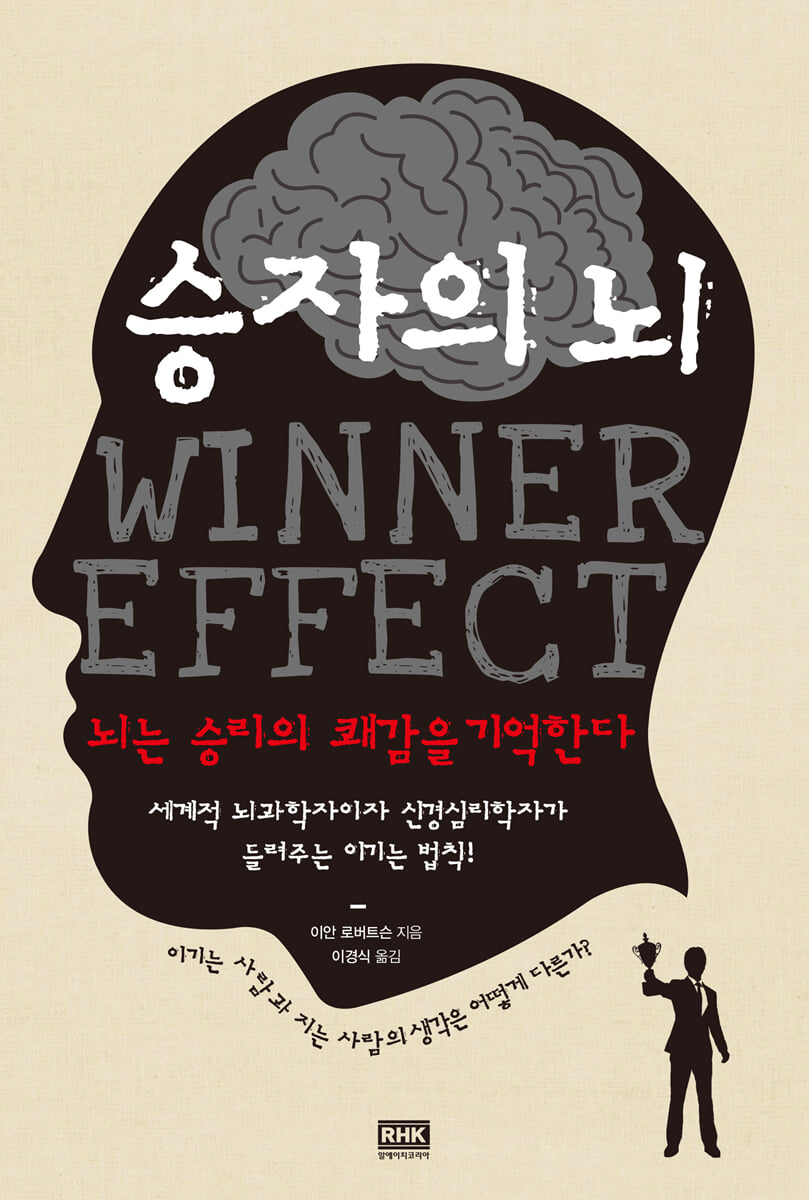
The Winner's Brain WINNER EFFECT
 |
Description
Book Introduction
The Rules of Winning: A Look at Cutting-Edge Neuroscience
Five fascinating mysteries about 'victory' are skillfully unfolded through various cases from the latest neuroscience, cognitive developmental psychology, political science, and economics.
When a person experiences victory or gains power, his brain actually changes.
This is why we often say that someone who suddenly gains status or popularity has “changed.”
So what determines winners and losers, and how does power, a metric of success, influence human behavior and thinking? Ian Robertson, a world-renowned neuropsychologist, sought to explain the dynamics of victory through the "winner effect," a term often used in biology.
The results we achieve in competition depend not only on our mental state and hormonal activity immediately before performing the task, but also on our past experiences of victory.
WBC world champion Don King's strategy of deliberately pairing Tyson with weaker opponents so he could demonstrate greater strength and courage when fighting stronger opponents certainly worked.
The more people experience small successes, the more likely they are to achieve greater success.
Those who have won many times win well, and those who have achieved success also achieve success.
But this success is not determined by innate destiny.
A person's intelligence quotient also changes depending on the environment and will.
The winner is determined by the environment.
This book explains such content through examples such as Tyson, Sarkozy, Obama, and Clinton.
These days, the gap between the rich and the poor is a hot social issue.
Teachers, who influence students' progress to higher education by teaching them and grading them, can also become powerful figures who control their students, and doctors, who are inevitably in a relatively weak position when dealing with patients, can similarly abuse their patients due to their obsession with power.
A police officer with the authority to arrest someone or a prison guard with the authority to lock an inmate in a cell are also powerful figures who can wield their power with ruthless force.
This book provides answers to the question of how we should properly use the drug called power, which is used in various places in society.
Five fascinating mysteries about 'victory' are skillfully unfolded through various cases from the latest neuroscience, cognitive developmental psychology, political science, and economics.
When a person experiences victory or gains power, his brain actually changes.
This is why we often say that someone who suddenly gains status or popularity has “changed.”
So what determines winners and losers, and how does power, a metric of success, influence human behavior and thinking? Ian Robertson, a world-renowned neuropsychologist, sought to explain the dynamics of victory through the "winner effect," a term often used in biology.
The results we achieve in competition depend not only on our mental state and hormonal activity immediately before performing the task, but also on our past experiences of victory.
WBC world champion Don King's strategy of deliberately pairing Tyson with weaker opponents so he could demonstrate greater strength and courage when fighting stronger opponents certainly worked.
The more people experience small successes, the more likely they are to achieve greater success.
Those who have won many times win well, and those who have achieved success also achieve success.
But this success is not determined by innate destiny.
A person's intelligence quotient also changes depending on the environment and will.
The winner is determined by the environment.
This book explains such content through examples such as Tyson, Sarkozy, Obama, and Clinton.
These days, the gap between the rich and the poor is a hot social issue.
Teachers, who influence students' progress to higher education by teaching them and grading them, can also become powerful figures who control their students, and doctors, who are inevitably in a relatively weak position when dealing with patients, can similarly abuse their patients due to their obsession with power.
A police officer with the authority to arrest someone or a prison guard with the authority to lock an inmate in a cell are also powerful figures who can wield their power with ruthless force.
This book provides answers to the question of how we should properly use the drug called power, which is used in various places in society.
- You can preview some of the book's contents.
Preview
index
Chapter 1: The Mystery of Picasso's Son
: Are winners or losers determined by genes from birth?
Chapter 2: The Mystery of the Transforming Fish
: How much influence do chance or circumstances have on winning?
Chapter 3: The Mystery of Tony Blair
: How would things change if people had power?
Chapter 4: The Mystery of the Academy Awards
: Why do we want to win so much?
Chapter 5 The Mystery of CEOs Riding Private Jets
: Does victory always have negative consequences?
Chapter 6: The Spirit of a True Winner
: What makes a winner?
: Are winners or losers determined by genes from birth?
Chapter 2: The Mystery of the Transforming Fish
: How much influence do chance or circumstances have on winning?
Chapter 3: The Mystery of Tony Blair
: How would things change if people had power?
Chapter 4: The Mystery of the Academy Awards
: Why do we want to win so much?
Chapter 5 The Mystery of CEOs Riding Private Jets
: Does victory always have negative consequences?
Chapter 6: The Spirit of a True Winner
: What makes a winner?
Into the book
The best managers know how to turn on the secret switch of inner motivation in their subordinates' brains.
When this switch is turned on and intrinsic motivation is activated, employees work passionately, with little thought given to how much they will receive in compensation.
At this time, managers should not hold back internal motivation by telling employees how they will be rewarded externally.
---pp.
36~37
Among the conclusions that Wort reached, the trend in stress hormone levels of those with a low desire for power when they won was particularly interesting.
Despite the victory, cortisol levels rose.
For those with a weak lust for power, even victory is a stressor.
If you've ever exercised, you've probably already noticed this phenomenon.
Some people have what is called a 'killer instinct' and want to win the game at all costs.
However, some people feel uncomfortable when victory is imminent, and they give up victory to the other person and become losers themselves.
---p.
168
This is not to say that a good leader should not be someone who seeks people's consent.
It's the exact opposite.
In fact, the most ideal leader is one who exerts leadership so that the team he leads comes together with one opinion.
But even so, an effective leader needs at least a minimum desire for power.
A leader without a lust for power will perceive the responsibility that comes with the power given to him as stress.
If a person with a low desire for power is promoted to CEO, his cortisol levels will rise due to stress, and this cortisol will eventually interfere with his ability to make sound decisions.
---p.
177
True winners pursue the socially oriented S desire for power as much as the ego-oriented P desire for power.
Winners feel in control of their lives.
And this sense of control protects winners from stress, allowing them to be more successful, live longer, and be happier.
But the true winner fully recognizes that his ego, however great, is a ferocious and dangerous dog.
He who carries the heavy burden of power and uses it well always keeps the dog at a distance, and also keeps the dog firmly tied to the leash of loyalty to social principles beyond himself.
When this switch is turned on and intrinsic motivation is activated, employees work passionately, with little thought given to how much they will receive in compensation.
At this time, managers should not hold back internal motivation by telling employees how they will be rewarded externally.
---pp.
36~37
Among the conclusions that Wort reached, the trend in stress hormone levels of those with a low desire for power when they won was particularly interesting.
Despite the victory, cortisol levels rose.
For those with a weak lust for power, even victory is a stressor.
If you've ever exercised, you've probably already noticed this phenomenon.
Some people have what is called a 'killer instinct' and want to win the game at all costs.
However, some people feel uncomfortable when victory is imminent, and they give up victory to the other person and become losers themselves.
---p.
168
This is not to say that a good leader should not be someone who seeks people's consent.
It's the exact opposite.
In fact, the most ideal leader is one who exerts leadership so that the team he leads comes together with one opinion.
But even so, an effective leader needs at least a minimum desire for power.
A leader without a lust for power will perceive the responsibility that comes with the power given to him as stress.
If a person with a low desire for power is promoted to CEO, his cortisol levels will rise due to stress, and this cortisol will eventually interfere with his ability to make sound decisions.
---p.
177
True winners pursue the socially oriented S desire for power as much as the ego-oriented P desire for power.
Winners feel in control of their lives.
And this sense of control protects winners from stress, allowing them to be more successful, live longer, and be happier.
But the true winner fully recognizes that his ego, however great, is a ferocious and dangerous dog.
He who carries the heavy burden of power and uses it well always keeps the dog at a distance, and also keeps the dog firmly tied to the leash of loyalty to social principles beyond himself.
---p.
363
363
Publisher's Review
“What makes a winner and a loser?”
Why do only the winners always win?
People who suddenly gain status or popularity often say, “You must have changed since you became famous.”
It may be unfair to the person hearing this, but it is actually true.
Because when a person experiences victory or gains power, his brain actually changes.
In a competitive society, becoming a winner in a match is the destiny of all of us.
So what determines winners and losers, and how does power, a metric of success, influence human behavior and thinking? In "The Winner Effect," Ian Robertson, a world-renowned authority on neuropsychology, expertly unravels five fascinating mysteries of "winning," drawing on cutting-edge neuroscience, cognitive developmental psychology, political science, and economics.
Why do some people remain dignified even when they gain power, while others become as corrupt as dogs? Is this simply a matter of self-cultivation? Is there no concept or scientific principle that can clearly explain all the erratic, malicious, and vile behavior that manifests in marriage and political life?
The original title of this book, 'The Winner Effect', is often used in biology.
This is the theory that if an animal is made to fight a weak opponent, it will not only win easily, but also have a high probability of winning in the next fight against a strong opponent.
For example, a fish that has lived with a smaller fish for five days will show more aggressive behavior than a fish that has lived with a larger fish.
But this theory applies equally to humans.
American boxing promoter Don King seems to have instinctively known this fact.
He applies the 'winner effect' to Mike Tyson, who served three years in prison.
In boxing, there is a slang term for a weak opponent who is easy to beat in preparation for an important fight: a "can of tomatoes," and Tyson's first can of tomatoes was Peter McNeely.
The fight ended blandly with Tyson winning just 89 seconds after it started, and his second comeback was no different.
And soon after, he stood on the third stage, but this time his opponent was not a 'can of tomatoes', but the WBC world champion.
However, Tyson knocked out his opponent in the third round and became world champion once again.
The results we achieve in competition depend not only on our mental state and hormonal activity immediately before performing the task, but also on our past experiences of victory.
Don King's strategy of deliberately pairing Tyson with weaker opponents so he could demonstrate greater strength and courage when fighting stronger opponents certainly worked.
But unfortunately, we don't have a strategic promoter like Don King around us.
So what increases your odds of winning? Is it your innate genes, or perhaps a combination of circumstances or luck?
Is it true that from birth, we are determined by our bloodlines to win and those to lose?
The children of celebrities who have lived exceptionally successful lives around the world generally fall into two categories.
There are cases where one inherits the glory of one's parents and lives a relatively comfortable life, or where one lives an unhappy life in the shadow of one's parents.
Einstein's eldest son was a renowned hydraulic engineer, and Warren Buffett's children are farmers, musicians, and social workers, although they are not involved in investing.
This is the former case.
But most of them are the latter.
The son of American oil tycoon Paul Getty was forced to witness the kidnapping of his own children and the helplessness of those who were kidnapped without even receiving his father's inheritance, and the son of world-renowned painter Pablo Picasso was forced to live his entire life as an alcoholic.
In particular, Picasso's son worked as his father's part-time driver, but after the family broke up, he lived in his father's house and worked as his father's secretary and driver. Picasso is said to have resented and despised this son throughout his life.
Although there is a 'dragon rising from a poor family' situation, it seems very difficult for outstanding parents to surpass their parents.
But one question can be raised here.
If you inherited such exceptional parents' bloodline, shouldn't your children evolve to match their level? However, according to the book, those with genius parents experience a particularly devastating level of stress when they fail to meet their expectations, which can actually hinder the development of their potential.
But even though they inherited the same excellent genes, why do some children live happy lives while others fall into the abyss?
According to research by Professor David McLelland, a renowned psychologist at Harvard University, the people who achieve the most in what they pursue, that is, the winners, are generally those who like their porridge to be neither too hot nor too cold, like Goldilocks (the girl in the English fairy tale who always chooses just the right amount).
People who achieve most of what they want usually consistently set challenging goals that are appropriate for their abilities—goals that are not easy, but achievable.
Don't set your eye level too low or too high.
However, it is said that children of highly successful parents often have a very difficult time setting their ambition goals within the Goldilocks zone, that is, setting an appropriate level of ambition.
Especially if both parents are geniuses, the children of such parents cannot escape the shadow of their parents' level of achievement.
You need to set goals that won't seem trivial compared to the enormous achievements your parents have made, because it's not easy for your children to achieve those things.
According to the book, one of the most common mistakes parents make when praising their children is saying, “You’re smart.”
To develop a child's potential, it is more effective to tell them how persistently they worked and how creatively they achieved certain results.
Otherwise, if you just say “he’s smart,” the curse of genetic fatalism (such as “I’m smart, so I don’t have to work harder than others,” or “I’m smart, so I always have to be number one”) can unconsciously be passed on to the child.
How much does luck or chance play into winning?
In financial markets where hundreds of dollars are traded every day, an investor's IQ score has little impact.
In an organization, 'standing in line' is ultimately a judgment about which side to stand on to increase the chances of luck or chance for my success.
Sports events, in particular, are a testament to this kind of luck and chance.
Perhaps because of the nature of gaining money and fame through short-term wins and losses, there are constant instances of judgement disputes and match-fixing in important matches.
Let's look at the Tyson case introduced above from a more scientific perspective.
The reason Tyson was able to win against a world champion despite his long break was because his previous win triggered a surge of testosterone, the male hormone.
Testosterone is responsible for aggressive tendencies, and it is said that when testosterone increases, the androgen receptors responsible for motivation and dopamine, which causes pleasure and enjoyment, also increase.
Researchers at Durham University in the UK analyzed the results of matches between two athletes with similar objective abilities (as determined by world rankings) wearing red and blue shirts at the Athens Olympics to study the effect of shirt color on wins and losses.
The analysis showed that players wearing red had a 62 percent win rate, while players wearing blue had a 38 percent win rate.
Just wearing a red shirt has the effect of increasing testosterone levels, while the other person is intimidated by the red and their testosterone levels drop.
Our bodies instinctively send signals to us to win.
In any game, the winner's cheer is usually marked by a clenched fist.
The fist is a universal symbol of victory and power.
On the other hand, male peacocks, who spread their colorful tails, are also expanding their bodies to show off their superiority.
What if there was a factor more important than winning or losing in determining the quality of life?
As long as we are exposed to a competitive structure, we strive, consciously or unconsciously, to win.
So, returning to a more fundamental question: why do people desire victory so much? We can find some clues in Academy Award winners.
Winning an Academy Award is like a lifelong insurance policy that protects me from the terrible stress of negative evaluations from others.
In other words, it may be a permanent safety signal that tells us that our inner self is safely protected.
This is why Academy Award winners live longer than nominees.
The surprising protective effect of status on longevity and self-awareness.
Let's look at another example using baboons.
Upper-class baboons are quick and carefree in choosing a mate.
Just pick the most attractive female.
On the other hand, the lower-class monkeys experience extreme stress because they can compete for females from among the remaining females after the upper-class monkeys have chosen them.
If we dig a little deeper, it has to do with 'control', and the important reason why we experience more or less stress is not whether we win or lose or whether we have a certain status, but whether we 'believe that we are in control of our own lives'.
There are two people in the same position.
One person complains about having too much work to do, while the other person doesn't suffer from work and enjoys another life after work.
Why would both feel the same pressure from the same job? It has to do with a sense of control.
People who are not overwhelmed by work exercise control over the schedule and flow of their work.
Some tasks he agrees to do, but others he does not agree to, and he manages his own daily workload.
Additionally, through various interpersonal strategies, one can manage the workload imposed on oneself, thereby overcoming the state of "loss of control," one of the toxic factors that comes with low status.
In contrast, a complainer who is overwhelmed with work all day is likely to have no control over his or her work.
Everything you need to know to become a true winner!
The more people experience small successes, the more likely they are to achieve greater success.
Those who have won many times win well, and those who have achieved success also achieve success.
But this success is not determined by innate destiny.
A person's intelligence quotient also changes depending on the environment and will.
The winner is determined by the environment.
The environment can either strengthen the human brain to favor success or weaken it to disadvantage it.
However, power, which is an indicator of success, changes the chemical state of the brain of the person who has power, and changes the way he or she treats others, and even his or her outlook on life and the world.
This book explains such content through examples such as Tyson, Sarkozy, Obama, and Clinton.
Winners enjoy the perks of power (e.g., testosterone-fueled drive, intelligence, creativity, and focus).
I also enjoy influencing others by sharing the various resources they need and want.
However, true winners pursue a 'socially oriented S desire for power' as much as a 'self-oriented P desire for power' that is centered on pursuing one's own interests.
Also, no matter how great your ego is, you are fully aware that it is a ferocious dog that is extremely dangerous.
So, he always keeps the dog at a distance, and also keeps the dog on a tight leash of loyalty to social principles that go beyond himself.
Power is a safe haven for my vulnerable self.
These days, the gap between the rich and the poor is a hot social issue.
Teachers, who influence students' progress to higher education by teaching them and grading them, can also become powerful figures who control their students, and doctors, who are inevitably in a relatively weak position when dealing with patients, can similarly abuse their patients due to their obsession with power.
A police officer with the authority to arrest someone or a prison guard with the authority to lock an inmate in a cell are also powerful figures who can wield their power with ruthless force.
This book provides answers to the question of how we should properly use the drug called power, which is used in various places in society.
Recommendation
It's fantastic.
Robertson will help you understand what makes winners and losers, and the behavior of your friends, family, and colleagues.
The Sunday Times
It's incredibly fascinating.
Publisher's Weekly
Why do only the winners always win?
People who suddenly gain status or popularity often say, “You must have changed since you became famous.”
It may be unfair to the person hearing this, but it is actually true.
Because when a person experiences victory or gains power, his brain actually changes.
In a competitive society, becoming a winner in a match is the destiny of all of us.
So what determines winners and losers, and how does power, a metric of success, influence human behavior and thinking? In "The Winner Effect," Ian Robertson, a world-renowned authority on neuropsychology, expertly unravels five fascinating mysteries of "winning," drawing on cutting-edge neuroscience, cognitive developmental psychology, political science, and economics.
Why do some people remain dignified even when they gain power, while others become as corrupt as dogs? Is this simply a matter of self-cultivation? Is there no concept or scientific principle that can clearly explain all the erratic, malicious, and vile behavior that manifests in marriage and political life?
The original title of this book, 'The Winner Effect', is often used in biology.
This is the theory that if an animal is made to fight a weak opponent, it will not only win easily, but also have a high probability of winning in the next fight against a strong opponent.
For example, a fish that has lived with a smaller fish for five days will show more aggressive behavior than a fish that has lived with a larger fish.
But this theory applies equally to humans.
American boxing promoter Don King seems to have instinctively known this fact.
He applies the 'winner effect' to Mike Tyson, who served three years in prison.
In boxing, there is a slang term for a weak opponent who is easy to beat in preparation for an important fight: a "can of tomatoes," and Tyson's first can of tomatoes was Peter McNeely.
The fight ended blandly with Tyson winning just 89 seconds after it started, and his second comeback was no different.
And soon after, he stood on the third stage, but this time his opponent was not a 'can of tomatoes', but the WBC world champion.
However, Tyson knocked out his opponent in the third round and became world champion once again.
The results we achieve in competition depend not only on our mental state and hormonal activity immediately before performing the task, but also on our past experiences of victory.
Don King's strategy of deliberately pairing Tyson with weaker opponents so he could demonstrate greater strength and courage when fighting stronger opponents certainly worked.
But unfortunately, we don't have a strategic promoter like Don King around us.
So what increases your odds of winning? Is it your innate genes, or perhaps a combination of circumstances or luck?
Is it true that from birth, we are determined by our bloodlines to win and those to lose?
The children of celebrities who have lived exceptionally successful lives around the world generally fall into two categories.
There are cases where one inherits the glory of one's parents and lives a relatively comfortable life, or where one lives an unhappy life in the shadow of one's parents.
Einstein's eldest son was a renowned hydraulic engineer, and Warren Buffett's children are farmers, musicians, and social workers, although they are not involved in investing.
This is the former case.
But most of them are the latter.
The son of American oil tycoon Paul Getty was forced to witness the kidnapping of his own children and the helplessness of those who were kidnapped without even receiving his father's inheritance, and the son of world-renowned painter Pablo Picasso was forced to live his entire life as an alcoholic.
In particular, Picasso's son worked as his father's part-time driver, but after the family broke up, he lived in his father's house and worked as his father's secretary and driver. Picasso is said to have resented and despised this son throughout his life.
Although there is a 'dragon rising from a poor family' situation, it seems very difficult for outstanding parents to surpass their parents.
But one question can be raised here.
If you inherited such exceptional parents' bloodline, shouldn't your children evolve to match their level? However, according to the book, those with genius parents experience a particularly devastating level of stress when they fail to meet their expectations, which can actually hinder the development of their potential.
But even though they inherited the same excellent genes, why do some children live happy lives while others fall into the abyss?
According to research by Professor David McLelland, a renowned psychologist at Harvard University, the people who achieve the most in what they pursue, that is, the winners, are generally those who like their porridge to be neither too hot nor too cold, like Goldilocks (the girl in the English fairy tale who always chooses just the right amount).
People who achieve most of what they want usually consistently set challenging goals that are appropriate for their abilities—goals that are not easy, but achievable.
Don't set your eye level too low or too high.
However, it is said that children of highly successful parents often have a very difficult time setting their ambition goals within the Goldilocks zone, that is, setting an appropriate level of ambition.
Especially if both parents are geniuses, the children of such parents cannot escape the shadow of their parents' level of achievement.
You need to set goals that won't seem trivial compared to the enormous achievements your parents have made, because it's not easy for your children to achieve those things.
According to the book, one of the most common mistakes parents make when praising their children is saying, “You’re smart.”
To develop a child's potential, it is more effective to tell them how persistently they worked and how creatively they achieved certain results.
Otherwise, if you just say “he’s smart,” the curse of genetic fatalism (such as “I’m smart, so I don’t have to work harder than others,” or “I’m smart, so I always have to be number one”) can unconsciously be passed on to the child.
How much does luck or chance play into winning?
In financial markets where hundreds of dollars are traded every day, an investor's IQ score has little impact.
In an organization, 'standing in line' is ultimately a judgment about which side to stand on to increase the chances of luck or chance for my success.
Sports events, in particular, are a testament to this kind of luck and chance.
Perhaps because of the nature of gaining money and fame through short-term wins and losses, there are constant instances of judgement disputes and match-fixing in important matches.
Let's look at the Tyson case introduced above from a more scientific perspective.
The reason Tyson was able to win against a world champion despite his long break was because his previous win triggered a surge of testosterone, the male hormone.
Testosterone is responsible for aggressive tendencies, and it is said that when testosterone increases, the androgen receptors responsible for motivation and dopamine, which causes pleasure and enjoyment, also increase.
Researchers at Durham University in the UK analyzed the results of matches between two athletes with similar objective abilities (as determined by world rankings) wearing red and blue shirts at the Athens Olympics to study the effect of shirt color on wins and losses.
The analysis showed that players wearing red had a 62 percent win rate, while players wearing blue had a 38 percent win rate.
Just wearing a red shirt has the effect of increasing testosterone levels, while the other person is intimidated by the red and their testosterone levels drop.
Our bodies instinctively send signals to us to win.
In any game, the winner's cheer is usually marked by a clenched fist.
The fist is a universal symbol of victory and power.
On the other hand, male peacocks, who spread their colorful tails, are also expanding their bodies to show off their superiority.
What if there was a factor more important than winning or losing in determining the quality of life?
As long as we are exposed to a competitive structure, we strive, consciously or unconsciously, to win.
So, returning to a more fundamental question: why do people desire victory so much? We can find some clues in Academy Award winners.
Winning an Academy Award is like a lifelong insurance policy that protects me from the terrible stress of negative evaluations from others.
In other words, it may be a permanent safety signal that tells us that our inner self is safely protected.
This is why Academy Award winners live longer than nominees.
The surprising protective effect of status on longevity and self-awareness.
Let's look at another example using baboons.
Upper-class baboons are quick and carefree in choosing a mate.
Just pick the most attractive female.
On the other hand, the lower-class monkeys experience extreme stress because they can compete for females from among the remaining females after the upper-class monkeys have chosen them.
If we dig a little deeper, it has to do with 'control', and the important reason why we experience more or less stress is not whether we win or lose or whether we have a certain status, but whether we 'believe that we are in control of our own lives'.
There are two people in the same position.
One person complains about having too much work to do, while the other person doesn't suffer from work and enjoys another life after work.
Why would both feel the same pressure from the same job? It has to do with a sense of control.
People who are not overwhelmed by work exercise control over the schedule and flow of their work.
Some tasks he agrees to do, but others he does not agree to, and he manages his own daily workload.
Additionally, through various interpersonal strategies, one can manage the workload imposed on oneself, thereby overcoming the state of "loss of control," one of the toxic factors that comes with low status.
In contrast, a complainer who is overwhelmed with work all day is likely to have no control over his or her work.
Everything you need to know to become a true winner!
The more people experience small successes, the more likely they are to achieve greater success.
Those who have won many times win well, and those who have achieved success also achieve success.
But this success is not determined by innate destiny.
A person's intelligence quotient also changes depending on the environment and will.
The winner is determined by the environment.
The environment can either strengthen the human brain to favor success or weaken it to disadvantage it.
However, power, which is an indicator of success, changes the chemical state of the brain of the person who has power, and changes the way he or she treats others, and even his or her outlook on life and the world.
This book explains such content through examples such as Tyson, Sarkozy, Obama, and Clinton.
Winners enjoy the perks of power (e.g., testosterone-fueled drive, intelligence, creativity, and focus).
I also enjoy influencing others by sharing the various resources they need and want.
However, true winners pursue a 'socially oriented S desire for power' as much as a 'self-oriented P desire for power' that is centered on pursuing one's own interests.
Also, no matter how great your ego is, you are fully aware that it is a ferocious dog that is extremely dangerous.
So, he always keeps the dog at a distance, and also keeps the dog on a tight leash of loyalty to social principles that go beyond himself.
Power is a safe haven for my vulnerable self.
These days, the gap between the rich and the poor is a hot social issue.
Teachers, who influence students' progress to higher education by teaching them and grading them, can also become powerful figures who control their students, and doctors, who are inevitably in a relatively weak position when dealing with patients, can similarly abuse their patients due to their obsession with power.
A police officer with the authority to arrest someone or a prison guard with the authority to lock an inmate in a cell are also powerful figures who can wield their power with ruthless force.
This book provides answers to the question of how we should properly use the drug called power, which is used in various places in society.
Recommendation
It's fantastic.
Robertson will help you understand what makes winners and losers, and the behavior of your friends, family, and colleagues.
The Sunday Times
It's incredibly fascinating.
Publisher's Weekly
GOODS SPECIFICS
- Date of issue: August 2, 2013
- Page count, weight, size: 392 pages | 738g | 153*224*30mm
- ISBN13: 9788925551012
- ISBN10: 8925551012
You may also like
카테고리
korean


korean

![GQ KOREA Mark (Monthly): December [2025]](http://librairie.coreenne.fr/cdn/shop/files/8ef265dbbfbf186523ed75ba7319009d.jpg?v=1765340328&width=3840)


