

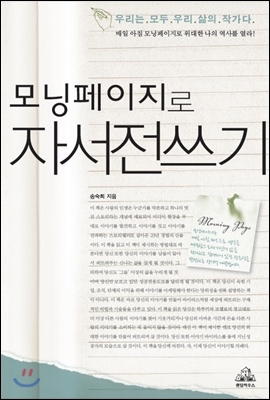
Writing an Autobiography with Morning Pages
 |
Description
Book Introduction
In the era of story marketing, where effectively expressing yourself becomes a competitive advantage, Song Sook-hee, a storytelling coach who has given various lectures on writing, says anyone can inspire the world by consistently recording their lives and thoughts.
The author offers a simple way to complete an autobiography for those who find it difficult to tell their stories or find writing difficult.
The method presented in this book is called 'morning pages', which is a creative development method that organizes one's life and unleashes one's latent creativity by writing down the thoughts that come to mind every morning.
The author claims that you can write an autobiography simply by consistently writing morning pages. To overcome the vagueness of writing down thoughts that come to mind, he included 354 questions in 10 groups to make it easy for even beginners to approach.
『Writing an Autobiography with Morning Pages』, which helps you easily bring out the honest stories within you, is a good guide for those preparing for essays, job seekers, contest applicants, and others who want to achieve their goals through writing. It also delivers a useful message to those who want to look back on their lives and organize themselves more specifically.
The author offers a simple way to complete an autobiography for those who find it difficult to tell their stories or find writing difficult.
The method presented in this book is called 'morning pages', which is a creative development method that organizes one's life and unleashes one's latent creativity by writing down the thoughts that come to mind every morning.
The author claims that you can write an autobiography simply by consistently writing morning pages. To overcome the vagueness of writing down thoughts that come to mind, he included 354 questions in 10 groups to make it easy for even beginners to approach.
『Writing an Autobiography with Morning Pages』, which helps you easily bring out the honest stories within you, is a good guide for those preparing for essays, job seekers, contest applicants, and others who want to achieve their goals through writing. It also delivers a useful message to those who want to look back on their lives and organize themselves more specifically.
- You can preview some of the book's contents.
Preview
index
prolog
1.
Story Age: All success in this world begins with a story.
Success genes have a story virus.
The story virus that dominates the world of success
We live to tell stories
A story virus that secretly moves the world
The power of story viruses
The world covets your story
The world covets your story. Greatness disguised as ordinary life. We are all great ordinary people. Draw your self-portrait with your own hands.
Why You Should Write a Story
Life's religious pilgrimage∥Finding the North Star in the latter half of life∥What happens when stories transcend the boundaries of the individual?∥Mature death, an expression of love for the family left behind∥The reason for existence that helps others∥The unexpected effect of cleansing the mind
Even ordinary people like you are excellent storytellers
Stories: Stop consuming and create.
2.
Story Mining: How to Find Story Material in Life's Barn
Getting my story out there with morning pages
Explore Your Inner Self with Morning Pages | The Power of Morning Pages to Create Habits | The Rules for Writing Stories with Morning Pages
A list of questions for inner exploration completed with morning pages
Question Leadership∥Characteristics of Questions∥Tips for Answering Questions
Take a close look at yourself
Look inside yourself first∥Your feeling is right∥Be trapped in solitude
3.
Storytelling: Creating Stories That Spread Virally
Making a pearl necklace with story beads
Sourcing∥Mining∥Concepting∥Messaging: Storymaking∥Storytelling: Spreading the Word
Interpret the metaphors of your life
Find the metaphors in your life
To make your story more exciting
Divide, arrange and name life
My story, where and how does it begin?
Imitate a well-written story∥The first line that completes the story∥In a word, life∥The first sentence is the lifeline of every story∥To write a captivating first sentence
Interesting devices that make you read the story to the end
Talk about 'people'∥Talk about symbols∥Explain the background of the story∥Highlight the meaning with words of thanks and dedication
101 Ways to Complete Your Story
How to Weave a Life Story∥101 Ways to Create Your Own Story
Creating a story that spreads like a virus
What is your story in one word?
Reframe the story into topics
Solve the problem at hand. Transform it into a compelling story. Build empathy. Focus on people. The internet loves these topics. Include a story in the title.
7 Rules of Storytelling That Countless People Are Observing
1. Write proactively∥2. Write with sincerity at the tip of your pen∥3. Express yourself, not prove yourself∥4. Write with fun∥5. Write with the reader in mind∥6. Write without embellishment∥7. Start right now
How to Share Your Story with the World
The world is wide and there are many media.
Epilogue
supplement
1.
Story Age: All success in this world begins with a story.
Success genes have a story virus.
The story virus that dominates the world of success
We live to tell stories
A story virus that secretly moves the world
The power of story viruses
The world covets your story
The world covets your story. Greatness disguised as ordinary life. We are all great ordinary people. Draw your self-portrait with your own hands.
Why You Should Write a Story
Life's religious pilgrimage∥Finding the North Star in the latter half of life∥What happens when stories transcend the boundaries of the individual?∥Mature death, an expression of love for the family left behind∥The reason for existence that helps others∥The unexpected effect of cleansing the mind
Even ordinary people like you are excellent storytellers
Stories: Stop consuming and create.
2.
Story Mining: How to Find Story Material in Life's Barn
Getting my story out there with morning pages
Explore Your Inner Self with Morning Pages | The Power of Morning Pages to Create Habits | The Rules for Writing Stories with Morning Pages
A list of questions for inner exploration completed with morning pages
Question Leadership∥Characteristics of Questions∥Tips for Answering Questions
Take a close look at yourself
Look inside yourself first∥Your feeling is right∥Be trapped in solitude
3.
Storytelling: Creating Stories That Spread Virally
Making a pearl necklace with story beads
Sourcing∥Mining∥Concepting∥Messaging: Storymaking∥Storytelling: Spreading the Word
Interpret the metaphors of your life
Find the metaphors in your life
To make your story more exciting
Divide, arrange and name life
My story, where and how does it begin?
Imitate a well-written story∥The first line that completes the story∥In a word, life∥The first sentence is the lifeline of every story∥To write a captivating first sentence
Interesting devices that make you read the story to the end
Talk about 'people'∥Talk about symbols∥Explain the background of the story∥Highlight the meaning with words of thanks and dedication
101 Ways to Complete Your Story
How to Weave a Life Story∥101 Ways to Create Your Own Story
Creating a story that spreads like a virus
What is your story in one word?
Reframe the story into topics
Solve the problem at hand. Transform it into a compelling story. Build empathy. Focus on people. The internet loves these topics. Include a story in the title.
7 Rules of Storytelling That Countless People Are Observing
1. Write proactively∥2. Write with sincerity at the tip of your pen∥3. Express yourself, not prove yourself∥4. Write with fun∥5. Write with the reader in mind∥6. Write without embellishment∥7. Start right now
How to Share Your Story with the World
The world is wide and there are many media.
Epilogue
supplement
Into the book
World-renowned authors Haruki Murakami and Paolo Coelho sent the same message through their recent blockbuster novels, 1Q84 and The Only Winner Alone.
The two authors warned, "Don't get caught up in other people's stories."
After reading this book, you will no longer seek out other people's stories, nor will you waste your precious time and money consuming them, as Haruki and Coelho warned.
Instead, you will live by creating and spreading your great story as this book suggests.
You too will live as a successful person with the story virus in your body.
--- pp.7-8
Companies that want to somehow plant their brands in the minds and hearts of consumers know how powerful the tool of "storytelling" can be.
As a result, your wallet is always empty, your eyes are always looking away from others, your mouth is talking to others, and your ears are open to others.
Just think about how many times throughout the day you hear stories about prominent figures in the media.
--- p.15
In fact, ‘creating and spreading stories’ does not require any special or great know-how.
Whether it's a diary, blog, travelogue, book review, photo album, experience report, life story, chronicle, report, or even a work log, if you can tie your experiences into a story, or if the stories contained within can convey meaning to yourself and others, then that is a 'story.'
Also, the work of reinterpreting the memories at the crossroads of that experience from the present point of view is 'storytelling.'
Even if it doesn't necessarily take the form of a 'story', simply telling someone your life story is enough to make the story viral.
No, even if you don't try to convey any meaning, just talking about yourself, that's a story virus.
--- p.18
We have an instinct for stories and understand society through stories.
Marketers who recognized this early on injected a story virus into something to sell it.
As a result, the story virus was transplanted into anything that was sold, such as PDPs, apples, cars, jumpers, and sneakers.
We also installed story viruses in intangible products such as movies, games, tourism, and education.
Even things visible or invisible, like countries, mountains, the universe, and planets, were sold using stories.
In this way, there are 4,000 stories hidden in the 4,000 or so messages we encounter every day, and we breathe, live, consume, and live while infected with the viruses within those stories.*103 For this reason, companies that need to sell something are obsessed with promoting the activity of the story viruses that have infiltrated the insides of consumers.
This is because the story virus transmits the optimal frequency to open people's hearts.
--- p.21
It's not just the so-called 'successful' people who create and sell stories.
Anyone can sell their story online at any time if they want to.
Mr. Kim Ga-seong is a self-proclaimed civil servant from Gochang-gun, Jeollanam-do, worth 18 billion won.
He transformed his achievements in the field into stories and delivered the message that 'civil servants can be creative too', and even published a book.
Mr. Oh Myeong-sa, a former bank executive, wrote a book titled “30 days 40 years” in which he tells the story of his life as a retired person who was envied by others, after taking on the world with nothing.
Ms. Jiyeon Yoo, a former housewife, published a book titled “Childcare English,” which tells the story of how she taught English to her four-year-old son and how he learned both Korean and English, and received applause from numerous mothers.
p.24
The first time I came across the word “morning pages” was about 10 years ago.
At that time, when I was suddenly unemployed due to the foreign exchange crisis, I sat in front of the computer every morning and wrote morning pages as this book instructed.
I wrote morning pages every single day without fail and imagined the day I would launch the magazine I wanted to create.
I started writing morning pages to clear my mind, make new plans, and devote myself to it without distractions for less than four months, and in November of that year, I launched a new magazine.
Although it was founded in a poor environment, it became the industry leader in less than a year.
I have no doubt that the success I experienced at that time was thanks to morning pages.
pp.80-81
To make morning pages a habit, you need to do them consistently for at least 21 days without fail.
It is said that 21 days is the time it takes for cells in our body to be resurrected.
For this reason, when treating addictions such as alcohol or cigarettes, the program is usually conducted for 21 days.
21 days is the absolute time it takes to establish a new habit, a globally recognized standard. That's why the American Cancer Society's smoking cessation program and the "Cure the Disease of Pleasing" workshop by Harriet Breaker, a psychologist and management consultant, are both 21-day programs.
--- p.83
I must not forget why I write morning pages, why I am answering this question now.
To emphasize once again, the questions posed here and the answers to them are the task of finding meaningful material to write about among the countless things buried in your past and memories.
As you answer, you will recall old memories, and whether you take notes, write sentences, or draw pictures, you can collect the memories that come to mind and the facts, testimonies, and materials related to the memories that come to mind.
Also, make a note of what you think about them.
At this point, your story is almost complete.
--- p.84
What metaphors lie hidden within your life? What are the events, big and small, meant to speak to you? If you examine each source you uncovered through your inner exploration with a loving gaze, you will discover messages that sparkle like gold dust mixed in sand.
The very metaphor that your life has symbolized over and over again will become the theme of your life, your calling, and the subject of your story.
p.145~146
When we divide life, we usually use a specific event or period that was a turning point, or a person who represents that time as a standard.
By dividing life in this way, you will be able to read your thoughts about life that you didn't even know about.
The task of dividing the chapters of life has significance here.
After dividing the chapters, let's give each chapter a name.
Naming is the function of clearly defining the meanings you have grasped in language and has the effect of engraving those meanings in your consciousness.
Naming should be expressed in words or phrases related to the chapter, but should include the identity you want to convey through the story or the direction you are pursuing.
The two authors warned, "Don't get caught up in other people's stories."
After reading this book, you will no longer seek out other people's stories, nor will you waste your precious time and money consuming them, as Haruki and Coelho warned.
Instead, you will live by creating and spreading your great story as this book suggests.
You too will live as a successful person with the story virus in your body.
--- pp.7-8
Companies that want to somehow plant their brands in the minds and hearts of consumers know how powerful the tool of "storytelling" can be.
As a result, your wallet is always empty, your eyes are always looking away from others, your mouth is talking to others, and your ears are open to others.
Just think about how many times throughout the day you hear stories about prominent figures in the media.
--- p.15
In fact, ‘creating and spreading stories’ does not require any special or great know-how.
Whether it's a diary, blog, travelogue, book review, photo album, experience report, life story, chronicle, report, or even a work log, if you can tie your experiences into a story, or if the stories contained within can convey meaning to yourself and others, then that is a 'story.'
Also, the work of reinterpreting the memories at the crossroads of that experience from the present point of view is 'storytelling.'
Even if it doesn't necessarily take the form of a 'story', simply telling someone your life story is enough to make the story viral.
No, even if you don't try to convey any meaning, just talking about yourself, that's a story virus.
--- p.18
We have an instinct for stories and understand society through stories.
Marketers who recognized this early on injected a story virus into something to sell it.
As a result, the story virus was transplanted into anything that was sold, such as PDPs, apples, cars, jumpers, and sneakers.
We also installed story viruses in intangible products such as movies, games, tourism, and education.
Even things visible or invisible, like countries, mountains, the universe, and planets, were sold using stories.
In this way, there are 4,000 stories hidden in the 4,000 or so messages we encounter every day, and we breathe, live, consume, and live while infected with the viruses within those stories.*103 For this reason, companies that need to sell something are obsessed with promoting the activity of the story viruses that have infiltrated the insides of consumers.
This is because the story virus transmits the optimal frequency to open people's hearts.
--- p.21
It's not just the so-called 'successful' people who create and sell stories.
Anyone can sell their story online at any time if they want to.
Mr. Kim Ga-seong is a self-proclaimed civil servant from Gochang-gun, Jeollanam-do, worth 18 billion won.
He transformed his achievements in the field into stories and delivered the message that 'civil servants can be creative too', and even published a book.
Mr. Oh Myeong-sa, a former bank executive, wrote a book titled “30 days 40 years” in which he tells the story of his life as a retired person who was envied by others, after taking on the world with nothing.
Ms. Jiyeon Yoo, a former housewife, published a book titled “Childcare English,” which tells the story of how she taught English to her four-year-old son and how he learned both Korean and English, and received applause from numerous mothers.
p.24
The first time I came across the word “morning pages” was about 10 years ago.
At that time, when I was suddenly unemployed due to the foreign exchange crisis, I sat in front of the computer every morning and wrote morning pages as this book instructed.
I wrote morning pages every single day without fail and imagined the day I would launch the magazine I wanted to create.
I started writing morning pages to clear my mind, make new plans, and devote myself to it without distractions for less than four months, and in November of that year, I launched a new magazine.
Although it was founded in a poor environment, it became the industry leader in less than a year.
I have no doubt that the success I experienced at that time was thanks to morning pages.
pp.80-81
To make morning pages a habit, you need to do them consistently for at least 21 days without fail.
It is said that 21 days is the time it takes for cells in our body to be resurrected.
For this reason, when treating addictions such as alcohol or cigarettes, the program is usually conducted for 21 days.
21 days is the absolute time it takes to establish a new habit, a globally recognized standard. That's why the American Cancer Society's smoking cessation program and the "Cure the Disease of Pleasing" workshop by Harriet Breaker, a psychologist and management consultant, are both 21-day programs.
--- p.83
I must not forget why I write morning pages, why I am answering this question now.
To emphasize once again, the questions posed here and the answers to them are the task of finding meaningful material to write about among the countless things buried in your past and memories.
As you answer, you will recall old memories, and whether you take notes, write sentences, or draw pictures, you can collect the memories that come to mind and the facts, testimonies, and materials related to the memories that come to mind.
Also, make a note of what you think about them.
At this point, your story is almost complete.
--- p.84
What metaphors lie hidden within your life? What are the events, big and small, meant to speak to you? If you examine each source you uncovered through your inner exploration with a loving gaze, you will discover messages that sparkle like gold dust mixed in sand.
The very metaphor that your life has symbolized over and over again will become the theme of your life, your calling, and the subject of your story.
p.145~146
When we divide life, we usually use a specific event or period that was a turning point, or a person who represents that time as a standard.
By dividing life in this way, you will be able to read your thoughts about life that you didn't even know about.
The task of dividing the chapters of life has significance here.
After dividing the chapters, let's give each chapter a name.
Naming is the function of clearly defining the meanings you have grasped in language and has the effect of engraving those meanings in your consciousness.
Naming should be expressed in words or phrases related to the chapter, but should include the identity you want to convey through the story or the direction you are pursuing.
--- p.150
Publisher's Review
Inspire the world with your own story.
Writing an Autobiography with Morning Pages, as Suggested by a Storytelling Expert Coach
An article about how to impress admissions officers in college entrance essay tests is “your own story” (「Impress admissions officers with ‘your own story’」_『Chosun Ilbo』2009).
10.7.) was reported.
Amidst the flood of various one-person media outlets, including blogs, cafes, and homepages, interest and desire for one's own writing are rising more than ever, and on the other hand, various media outlets, including the Chosun Ilbo and Shin Dong-a, are competing to hold non-fiction contests with prize money in the hundreds of millions.
However, the reality is that many people question how their stories can become a book, or they are confident that if they wrote a book about their lives, they would publish a dozen volumes, but when they actually sit down at their desk, they are unable to write a single line.
For these people, storytelling expert coach Song Sook-hee published “Writing an Autobiography with Morning Pages.”
The author, who has worked as a corporate storytelling coach and has written several bestselling writing books, including “Own Your Book” and “Marketing Writing that Attracts Customers,” uses his accumulated storytelling know-how and seasoned experience to argue that anyone can create their own great story and succeed as an individual with a story that the media seeks out and pays attention to, and he proves this with rich and specific examples.
The methodology the author suggests is 'morning pages'.
Morning Pages is a creative development method that organizes one's life and unleashes latent creativity by writing down thoughts that come to mind every morning. The author has successfully applied this method to writing an autobiography.
In fact, the author, who runs the Naver Cafe 'Bread Baking Typewriter' and 'Toz Book Writing Class', not only coaches students to write autobiographies using morning pages, but also practices this method himself to organize and record his own life.
Additionally, at the end of this book, a questionnaire-style appendix is included to help readers explore and record their inner thoughts every morning. This will help readers easily put autobiography writing into practice, thereby bringing them one step closer to the great task of writing an autobiography.
Your survival weapon that's gaining attention in the "Story Age," the era of story marketing.
Having worked as a business writer and columnist, head of a content production company, editor-in-chief of a women's magazine, content director for the women's portal site Potji.com, online shopping mall marketer, and publishing planner, the author realized the power and influence of captivating writing and began delving into the topic of "thinking and expressing creatively."
The author, who has been actively giving lectures and workshops at leading domestic companies such as Lotte Home Shopping, Hyundai Heavy Industries, and KAIST, as well as universities and local governments, has also written columns for Korea Internet & Security Agency and corporate magazines, and contributed to various magazines including Monthly JoongAng, has studied various writing methodologies and asserts that today's era of comprehensively demanded storytelling marketing is the 'Story Age.'
For example, in an era where people pay almost twice as much as regular eggs at the supermarket, such as 'eggs laid by chickens fed fermented soybean paste', 'eggs laid by chickens raised on free-range pastures', and 'eggs containing chitosan', as long as there is a good reason, they do not feel sorry about it. In an era where there are many stories to tell even over a single egg, I suggest packaging your own story.
He argues that everyone has a story within them that goes beyond what they know, that they can extract special meaning from seemingly ordinary stories, and that they can spread these stories like a virus.
Above all, advertisements, movies, books, and all media want stories of ordinary people, and ordinary stories sell.
President Barack Obama, who impressed people with his speech immediately after his inauguration, Apple CEO Steve Jobs, who became even more famous with his famous speech at Stanford University's commencement ceremony, and even former President Bill Clinton, who caused controversy with a sex scandal, have all reimagined their own image by writing their own stories.
These celebrities have been able to make themselves look more believable and live more successful lives by honestly confessing to the public about their lesser-known childhoods, their wounds, and even their shame.
However, this does not mean that autobiographies are exclusive to celebrities.
"Writing an Autobiography with Morning Pages" will guide ordinary people to discover the stories recorded within them like nightingales, and to utilize those stories to spread them among the public. By presenting detailed secrets and techniques, it will guide you on how to spread your own story like a virus, just like prominent figures.
A practical manual for completing the precious records of your life into an autobiography.
Morning pages, a method of writing an autobiography presented in this book, is a method that anyone can easily practice.
Morning Pages is a creative development method suggested by Julia Cameron in her book, The Artist's Way. It refers to a three-page piece of writing in which you freely jot down the thoughts that come to you as soon as you open your eyes every morning. Through this, you can trace your mental state that remains in your subconscious, and if the ideas or problems that come to mind at this time move in your subconscious during your daily life, your inherent creativity will be revealed.
The author suggests actively using morning pages in writing an autobiography.
To overcome the vagueness of writing down thoughts that come to mind, the author presents 354 questions in 10 groups that can help you reflect on yourself and, going forward, complete your autobiography.
By reflecting on and recording your past experiences one by one through questions such as ‘Looking back on my life like a panorama’, ‘When I was young, the growing pains that made me grow an inch at a time overnight’, ‘Stories of love, marriage, and family’, ‘Other family friends, colleagues, seniors, juniors, and neighbors’, ‘About talent and ability or knowledge and career’, ‘About the things that dominated my life’, ‘My dream sleeping in a corner of my memory’, ‘This is how I should live from now on’, ‘What I ask myself’, ‘The evening I forgot’, you will soon be able to collect enough stories to write an autobiography.
"Writing an Autobiography with Morning Pages" includes a supplementary notebook that you can write in every morning, helping you turn the decision to write an autobiography into action and practice right away.
Essay preparation students, job seekers, contest applicants, etc.
A must-read for anyone hoping to succeed in writing.
The author shares core know-how, which he has personally experienced and continues to practice, not only with students preparing for the college entrance exam essay, the 500,000 job seekers across the country who must compete with their resumes and self-introductions, and applicants preparing for contests held by various literary and daily newspapers, but also with all those who dream of success through writing.
From the data collection stage to the writing stage, publishing paper and e-books, and even the process of sharing one's story, the author's firsthand experience provides detailed explanations and practical guidance, ensuring that many readers will receive practical help. In particular, the abundant examples of those who published their own ordinary stories and attracted attention will give readers hope and courage.
"Writing an Autobiography with Morning Pages" is the product of the author's twenty-plus years of experience as a storyteller, discovering, creating, and disseminating stories in the media, fascinated by the concept that everyone's life, regardless of who they are, is a wonderful story.
The author guarantees that anyone who reads this book and follows the methods it presents will live an exciting life where others will share their stories.
I am confident that everyone will be able to take a big step closer to success.
Writing an Autobiography with Morning Pages, as Suggested by a Storytelling Expert Coach
An article about how to impress admissions officers in college entrance essay tests is “your own story” (「Impress admissions officers with ‘your own story’」_『Chosun Ilbo』2009).
10.7.) was reported.
Amidst the flood of various one-person media outlets, including blogs, cafes, and homepages, interest and desire for one's own writing are rising more than ever, and on the other hand, various media outlets, including the Chosun Ilbo and Shin Dong-a, are competing to hold non-fiction contests with prize money in the hundreds of millions.
However, the reality is that many people question how their stories can become a book, or they are confident that if they wrote a book about their lives, they would publish a dozen volumes, but when they actually sit down at their desk, they are unable to write a single line.
For these people, storytelling expert coach Song Sook-hee published “Writing an Autobiography with Morning Pages.”
The author, who has worked as a corporate storytelling coach and has written several bestselling writing books, including “Own Your Book” and “Marketing Writing that Attracts Customers,” uses his accumulated storytelling know-how and seasoned experience to argue that anyone can create their own great story and succeed as an individual with a story that the media seeks out and pays attention to, and he proves this with rich and specific examples.
The methodology the author suggests is 'morning pages'.
Morning Pages is a creative development method that organizes one's life and unleashes latent creativity by writing down thoughts that come to mind every morning. The author has successfully applied this method to writing an autobiography.
In fact, the author, who runs the Naver Cafe 'Bread Baking Typewriter' and 'Toz Book Writing Class', not only coaches students to write autobiographies using morning pages, but also practices this method himself to organize and record his own life.
Additionally, at the end of this book, a questionnaire-style appendix is included to help readers explore and record their inner thoughts every morning. This will help readers easily put autobiography writing into practice, thereby bringing them one step closer to the great task of writing an autobiography.
Your survival weapon that's gaining attention in the "Story Age," the era of story marketing.
Having worked as a business writer and columnist, head of a content production company, editor-in-chief of a women's magazine, content director for the women's portal site Potji.com, online shopping mall marketer, and publishing planner, the author realized the power and influence of captivating writing and began delving into the topic of "thinking and expressing creatively."
The author, who has been actively giving lectures and workshops at leading domestic companies such as Lotte Home Shopping, Hyundai Heavy Industries, and KAIST, as well as universities and local governments, has also written columns for Korea Internet & Security Agency and corporate magazines, and contributed to various magazines including Monthly JoongAng, has studied various writing methodologies and asserts that today's era of comprehensively demanded storytelling marketing is the 'Story Age.'
For example, in an era where people pay almost twice as much as regular eggs at the supermarket, such as 'eggs laid by chickens fed fermented soybean paste', 'eggs laid by chickens raised on free-range pastures', and 'eggs containing chitosan', as long as there is a good reason, they do not feel sorry about it. In an era where there are many stories to tell even over a single egg, I suggest packaging your own story.
He argues that everyone has a story within them that goes beyond what they know, that they can extract special meaning from seemingly ordinary stories, and that they can spread these stories like a virus.
Above all, advertisements, movies, books, and all media want stories of ordinary people, and ordinary stories sell.
President Barack Obama, who impressed people with his speech immediately after his inauguration, Apple CEO Steve Jobs, who became even more famous with his famous speech at Stanford University's commencement ceremony, and even former President Bill Clinton, who caused controversy with a sex scandal, have all reimagined their own image by writing their own stories.
These celebrities have been able to make themselves look more believable and live more successful lives by honestly confessing to the public about their lesser-known childhoods, their wounds, and even their shame.
However, this does not mean that autobiographies are exclusive to celebrities.
"Writing an Autobiography with Morning Pages" will guide ordinary people to discover the stories recorded within them like nightingales, and to utilize those stories to spread them among the public. By presenting detailed secrets and techniques, it will guide you on how to spread your own story like a virus, just like prominent figures.
A practical manual for completing the precious records of your life into an autobiography.
Morning pages, a method of writing an autobiography presented in this book, is a method that anyone can easily practice.
Morning Pages is a creative development method suggested by Julia Cameron in her book, The Artist's Way. It refers to a three-page piece of writing in which you freely jot down the thoughts that come to you as soon as you open your eyes every morning. Through this, you can trace your mental state that remains in your subconscious, and if the ideas or problems that come to mind at this time move in your subconscious during your daily life, your inherent creativity will be revealed.
The author suggests actively using morning pages in writing an autobiography.
To overcome the vagueness of writing down thoughts that come to mind, the author presents 354 questions in 10 groups that can help you reflect on yourself and, going forward, complete your autobiography.
By reflecting on and recording your past experiences one by one through questions such as ‘Looking back on my life like a panorama’, ‘When I was young, the growing pains that made me grow an inch at a time overnight’, ‘Stories of love, marriage, and family’, ‘Other family friends, colleagues, seniors, juniors, and neighbors’, ‘About talent and ability or knowledge and career’, ‘About the things that dominated my life’, ‘My dream sleeping in a corner of my memory’, ‘This is how I should live from now on’, ‘What I ask myself’, ‘The evening I forgot’, you will soon be able to collect enough stories to write an autobiography.
"Writing an Autobiography with Morning Pages" includes a supplementary notebook that you can write in every morning, helping you turn the decision to write an autobiography into action and practice right away.
Essay preparation students, job seekers, contest applicants, etc.
A must-read for anyone hoping to succeed in writing.
The author shares core know-how, which he has personally experienced and continues to practice, not only with students preparing for the college entrance exam essay, the 500,000 job seekers across the country who must compete with their resumes and self-introductions, and applicants preparing for contests held by various literary and daily newspapers, but also with all those who dream of success through writing.
From the data collection stage to the writing stage, publishing paper and e-books, and even the process of sharing one's story, the author's firsthand experience provides detailed explanations and practical guidance, ensuring that many readers will receive practical help. In particular, the abundant examples of those who published their own ordinary stories and attracted attention will give readers hope and courage.
"Writing an Autobiography with Morning Pages" is the product of the author's twenty-plus years of experience as a storyteller, discovering, creating, and disseminating stories in the media, fascinated by the concept that everyone's life, regardless of who they are, is a wonderful story.
The author guarantees that anyone who reads this book and follows the methods it presents will live an exciting life where others will share their stories.
I am confident that everyone will be able to take a big step closer to success.
GOODS SPECIFICS
- Date of issue: October 30, 2009
- Page count, weight, size: 323 pages | 544g | 153*224*30mm
- ISBN13: 9788925534091
- ISBN10: 8925534096
You may also like
카테고리
korean


korean

![GQ KOREA Mark (Monthly): December [2025]](http://librairie.coreenne.fr/cdn/shop/files/8ef265dbbfbf186523ed75ba7319009d.jpg?v=1765340328&width=3840)


