

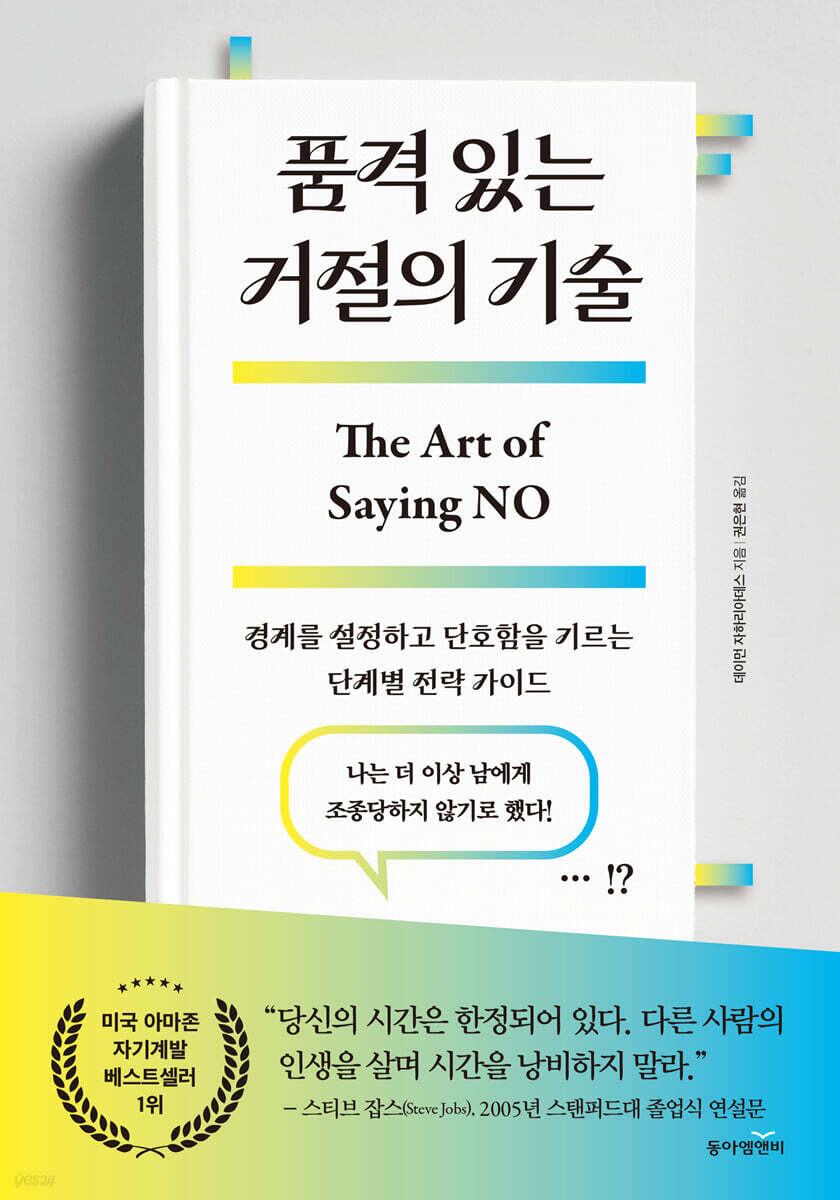
The Art of Graceful Refusal
 |
Description
Book Introduction
Have you ever had a difficult experience where the more you were kind, the more you were treated like a fool?
Have you ever turned someone down bluntly and then regretted it?
Want to change your innate “yes man” tendencies?
Reset your life with the art of graceful rejection!
“The difference between successful people and highly successful people is that highly successful people say no to almost everything.” - Warren Buffett
This book contains solutions for those who, unable to refuse in situations where they should, end up neglecting their own responsibilities and thus exhausting themselves and making life difficult for those around them.
We cover step-by-step rejection strategies and specific application techniques that work for everyone, regardless of innate tendencies.
This is a high-quality rejection technique necessary for anyone who wants to reset their indecisive life and live proactively.
The book first analyzes the tendency to have difficulty refusing requests from others.
It describes a variety of psychological phenomena, including not wanting to hurt others' feelings, not wanting to be seen as selfish, not wanting to be in conflict, being manipulated by emotional abuse, and being addicted to the happiness that comes from helping others.
Next, we will explain strategies for rejection that work right away.
The key is to reduce the shock of rejection for the person being rejected, to eliminate guilt for the person rejecting, and to make them feel respected.
Describes the technique of maintaining both a respectful and firm attitude toward others.
But there are always opponents who don't know how to give up until the end.
Part 4 covers how to reject such rude people, how to build a strong mentality to reject with confidence, etc.
Part 5 covers rejection strategies for different situations, including relatives, spouses and lovers, children, friends, neighbors, coworkers, customers, strangers, and yourself.
The author is Damon Zahariades, a productivity expert.
The author, who confesses to being a former yes-man, began researching ways to change his unhappy life, which had been characterized by prioritizing pleasing others over his own needs, and this book is the result.
It immediately rose to number one on Amazon's bestseller list upon its publication in 2017 and remains in the top ranks to this day.
Have you ever turned someone down bluntly and then regretted it?
Want to change your innate “yes man” tendencies?
Reset your life with the art of graceful rejection!
“The difference between successful people and highly successful people is that highly successful people say no to almost everything.” - Warren Buffett
This book contains solutions for those who, unable to refuse in situations where they should, end up neglecting their own responsibilities and thus exhausting themselves and making life difficult for those around them.
We cover step-by-step rejection strategies and specific application techniques that work for everyone, regardless of innate tendencies.
This is a high-quality rejection technique necessary for anyone who wants to reset their indecisive life and live proactively.
The book first analyzes the tendency to have difficulty refusing requests from others.
It describes a variety of psychological phenomena, including not wanting to hurt others' feelings, not wanting to be seen as selfish, not wanting to be in conflict, being manipulated by emotional abuse, and being addicted to the happiness that comes from helping others.
Next, we will explain strategies for rejection that work right away.
The key is to reduce the shock of rejection for the person being rejected, to eliminate guilt for the person rejecting, and to make them feel respected.
Describes the technique of maintaining both a respectful and firm attitude toward others.
But there are always opponents who don't know how to give up until the end.
Part 4 covers how to reject such rude people, how to build a strong mentality to reject with confidence, etc.
Part 5 covers rejection strategies for different situations, including relatives, spouses and lovers, children, friends, neighbors, coworkers, customers, strangers, and yourself.
The author is Damon Zahariades, a productivity expert.
The author, who confesses to being a former yes-man, began researching ways to change his unhappy life, which had been characterized by prioritizing pleasing others over his own needs, and this book is the result.
It immediately rose to number one on Amazon's bestseller list upon its publication in 2017 and remains in the top ranks to this day.
- You can preview some of the book's contents.
Preview
index
Prologue: There is a technique for rejecting relationships without breaking them or being dragged around.
Part 1: Betrayal of Kindness: The Tragedy of the "Yes Man," the Master of Pandering
01 The person who always comes to mind when you need help
02 I was a depressed happy maker
03 Why You Should Take Care of Yourself First
04 Are you an assertive person?
05 Strong Self-Assertion vs.
Aggression
06 Rejecting Gracefully and Without Guilt
Part 2: Rejection is Hard: The Psychology of Just Giving in
07 The power of the short word “No”
08 I don't want to hurt the other person's feelings
09 I don't want to disappoint people around me.
10 I don't want to be seen as a selfish person.
11 The happiness of helping others is so thrilling.
12. Being controlled by low self-esteem
13 I want others to like me
14 It feels good to be recognized for my true worth.
15 I'm worried that I might miss a good opportunity.
16. Surrender to emotional abuse
17 I hate conflict and clashes.
18 The Yes-Man Habit I Cultivated Without Realizing It
Pop quiz: What's your yes-man score?
Part 3: Why Doesn't My Reject Work?: Strategies for Instant Rejection Without the Risk of Ruining the Relationship
19. Reject directly without beating around the bush.
20 If you're not going to listen anyway, don't waste time.
21. Use various expressions of refusal.
22 Overcoming the Temptation to Make Excuses
23 Check if your habit of refusing is to avoid responsibility
24 If there is room for listening, I look forward to the next time
25 It's dangerous to refuse with lies.
26 If you want to show goodwill, suggest an alternative.
27 Recommend someone more suitable in terms of expertise
28 Explain your limitations without getting into an argument.
Part 4: Facing Rude Opponents: Building a Strong Mentality to Confidently Reject
29 How to Deal with People Who Never Give Up
30 How to Avoid Being Rude
31. Bring out the fear called 'FOMO' that is lurking inside you.
32 How to Deal with Common Request Types
33 You are not responsible for the other person's feelings.
34 My time and attention are more valuable
35 Rejecting someone doesn't make you a bad person.
36 Practice Saying No to Create a Habit of Saying No
Part 5 Bonus: How to Say No in Different Situations
37 How can I refuse to get the best benefit?
38 How to refuse a request from an unreasonable relative
39 It's especially awkward when your spouse refuses a request.
40 Ways Parents Can Reject Their Children
41. Rejecting a difficult friend's request out of loyalty
42 I really want to avoid having an uncomfortable relationship with my neighbors.
43 How to Decline a Coworker's Request at Work
44 How do I refuse a difficult request from my boss?
45. How to refuse a customer request you don't want to miss
46 Surprisingly Tricky! Declining a Favor from a Stranger
47 The Art of Saying “No” to Yourself
Epilogue: The ripple effects of easily saying "yes" to someone's request
Part 1: Betrayal of Kindness: The Tragedy of the "Yes Man," the Master of Pandering
01 The person who always comes to mind when you need help
02 I was a depressed happy maker
03 Why You Should Take Care of Yourself First
04 Are you an assertive person?
05 Strong Self-Assertion vs.
Aggression
06 Rejecting Gracefully and Without Guilt
Part 2: Rejection is Hard: The Psychology of Just Giving in
07 The power of the short word “No”
08 I don't want to hurt the other person's feelings
09 I don't want to disappoint people around me.
10 I don't want to be seen as a selfish person.
11 The happiness of helping others is so thrilling.
12. Being controlled by low self-esteem
13 I want others to like me
14 It feels good to be recognized for my true worth.
15 I'm worried that I might miss a good opportunity.
16. Surrender to emotional abuse
17 I hate conflict and clashes.
18 The Yes-Man Habit I Cultivated Without Realizing It
Pop quiz: What's your yes-man score?
Part 3: Why Doesn't My Reject Work?: Strategies for Instant Rejection Without the Risk of Ruining the Relationship
19. Reject directly without beating around the bush.
20 If you're not going to listen anyway, don't waste time.
21. Use various expressions of refusal.
22 Overcoming the Temptation to Make Excuses
23 Check if your habit of refusing is to avoid responsibility
24 If there is room for listening, I look forward to the next time
25 It's dangerous to refuse with lies.
26 If you want to show goodwill, suggest an alternative.
27 Recommend someone more suitable in terms of expertise
28 Explain your limitations without getting into an argument.
Part 4: Facing Rude Opponents: Building a Strong Mentality to Confidently Reject
29 How to Deal with People Who Never Give Up
30 How to Avoid Being Rude
31. Bring out the fear called 'FOMO' that is lurking inside you.
32 How to Deal with Common Request Types
33 You are not responsible for the other person's feelings.
34 My time and attention are more valuable
35 Rejecting someone doesn't make you a bad person.
36 Practice Saying No to Create a Habit of Saying No
Part 5 Bonus: How to Say No in Different Situations
37 How can I refuse to get the best benefit?
38 How to refuse a request from an unreasonable relative
39 It's especially awkward when your spouse refuses a request.
40 Ways Parents Can Reject Their Children
41. Rejecting a difficult friend's request out of loyalty
42 I really want to avoid having an uncomfortable relationship with my neighbors.
43 How to Decline a Coworker's Request at Work
44 How do I refuse a difficult request from my boss?
45. How to refuse a customer request you don't want to miss
46 Surprisingly Tricky! Declining a Favor from a Stranger
47 The Art of Saying “No” to Yourself
Epilogue: The ripple effects of easily saying "yes" to someone's request
Into the book
This book will help you transition from a life of pleasing others to one that puts your own wants and needs first.
Looking back now, I regret it, but I would like to introduce some strategies for a dignified rejection, rather than the blunt rejection I used to use.
--- p.24
It is necessary to distinguish between the words 'assertive' and 'aggressive'.
People often confuse these two expressions with similar meanings.
However, the two expressions refer to entirely different actions.
Strong but healthy assertiveness is based on respect for others.
As mentioned before, being assertive means being able to express your opinions confidently.
--- p.32
Have you ever said "yes" to a boss's request out of fear that saying "no" would hurt your chances of a raise or promotion? Have you ever said "yes" to a friend's request out of fear that saying no would mean missing out on a rewarding life experience? This fear is often abbreviated as "FOMO," the fear of missing out on a good opportunity.
FOMO is the feeling of anxiety about missing out on a good opportunity.
And this is a common reason why we can't say no and accept even when we know that saying no would be a better decision.
--- p.66
These 'learned experiences' have a powerful influence on us.
The learned experience that granting requests can lead to short-term benefits, such as praise, self-efficacy, and social inclusion, trains us to accept requests from others.
The more experiences we learn, the greater our desire to repeat those results.
We then become addicts who seek out the next 'mission'.
--- p.78
Resist the temptation to give any excuse; be honest about why you are refusing a request.
Otherwise, you may feel guilty about lying, and the person asking may doubt your sincerity.
As a result, the person who asked may become even more upset with you.
The best way to refuse is to be direct, honest, and respectful of the other person.
--- p.92
You may want to refuse someone's request, but you may feel like lying.
You've been asked to do something you don't want to do, and you want to be honest and say you don't want to do it.
The problem is, to be honest, I'm worried that the other person might feel offended, upset, or angry.
So you lie.
--- p.112
There will undoubtedly be people who cannot accept the answer “no.”
I'm talking about people who don't know how to back down even when they're rejected and who persistently ask for favors.
These types of people will not stop trying to persuade others until their requests are met.
They manipulate the other person's emotions and even use outright threats to get a "yes" answer.
--- p.130
Do you often receive similar requests? Is your first thought "I can't do it"? If so, this strategy will save you a lot of time.
This strategy also helps prevent anger in the person being rejected by showing that your rejection is not a personal rejection.
--- p.142
The solution to this is to reset expectations.
It clearly draws a line that the relative must keep.
One concrete way to do this is to establish principles for what you are willing to help with and what you are not willing to help with.
--- p.163~164
In conclusion, saying “no” to your child is a serious matter of setting expectations and maintaining your position as a parent.
When your child learns that “no” truly means “no,” he or she will be less likely to manipulate you.
--- p.174
We are always exposed to the temptation to waste time, money, labor, and other resources.
These temptations usually lead us away from our goals.
The ability to resist these temptations—essentially, to say “no” to yourself—is key to living a healthy and fulfilling life.
Looking back now, I regret it, but I would like to introduce some strategies for a dignified rejection, rather than the blunt rejection I used to use.
--- p.24
It is necessary to distinguish between the words 'assertive' and 'aggressive'.
People often confuse these two expressions with similar meanings.
However, the two expressions refer to entirely different actions.
Strong but healthy assertiveness is based on respect for others.
As mentioned before, being assertive means being able to express your opinions confidently.
--- p.32
Have you ever said "yes" to a boss's request out of fear that saying "no" would hurt your chances of a raise or promotion? Have you ever said "yes" to a friend's request out of fear that saying no would mean missing out on a rewarding life experience? This fear is often abbreviated as "FOMO," the fear of missing out on a good opportunity.
FOMO is the feeling of anxiety about missing out on a good opportunity.
And this is a common reason why we can't say no and accept even when we know that saying no would be a better decision.
--- p.66
These 'learned experiences' have a powerful influence on us.
The learned experience that granting requests can lead to short-term benefits, such as praise, self-efficacy, and social inclusion, trains us to accept requests from others.
The more experiences we learn, the greater our desire to repeat those results.
We then become addicts who seek out the next 'mission'.
--- p.78
Resist the temptation to give any excuse; be honest about why you are refusing a request.
Otherwise, you may feel guilty about lying, and the person asking may doubt your sincerity.
As a result, the person who asked may become even more upset with you.
The best way to refuse is to be direct, honest, and respectful of the other person.
--- p.92
You may want to refuse someone's request, but you may feel like lying.
You've been asked to do something you don't want to do, and you want to be honest and say you don't want to do it.
The problem is, to be honest, I'm worried that the other person might feel offended, upset, or angry.
So you lie.
--- p.112
There will undoubtedly be people who cannot accept the answer “no.”
I'm talking about people who don't know how to back down even when they're rejected and who persistently ask for favors.
These types of people will not stop trying to persuade others until their requests are met.
They manipulate the other person's emotions and even use outright threats to get a "yes" answer.
--- p.130
Do you often receive similar requests? Is your first thought "I can't do it"? If so, this strategy will save you a lot of time.
This strategy also helps prevent anger in the person being rejected by showing that your rejection is not a personal rejection.
--- p.142
The solution to this is to reset expectations.
It clearly draws a line that the relative must keep.
One concrete way to do this is to establish principles for what you are willing to help with and what you are not willing to help with.
--- p.163~164
In conclusion, saying “no” to your child is a serious matter of setting expectations and maintaining your position as a parent.
When your child learns that “no” truly means “no,” he or she will be less likely to manipulate you.
--- p.174
We are always exposed to the temptation to waste time, money, labor, and other resources.
These temptations usually lead us away from our goals.
The ability to resist these temptations—essentially, to say “no” to yourself—is key to living a healthy and fulfilling life.
--- p.199
Publisher's Review
Get away from a life of pleasing others
A life that puts my wants and needs first
The author confesses that he was a former yes-man who believed that granting other people's requests was the right thing to do and that he should naturally do things that would make the other person happy.
An inner voice told me that if I spent time, money, and energy on others, I would have no time, money, or energy left for myself, but I didn't know what to do.
Eventually, he became unhappy, suffering from the constant requests of those around him, and he repeatedly turned down requests with a curt response, only to immediately regret it.
The author, who was angry at himself for this and hated himself for not being able to say no, tried and practiced various methods and eventually mastered the skill of saying no gently while being considerate.
The author wrote the book in the hope that it would help people like himself.
Part 1 explains why you should take care of your own wants and needs first.
It makes a compelling argument that taking care of yourself first will make you more useful to others in the long run.
Describes the skill of proper assertiveness as an important trait to acquire in order to say no.
The important thing here is to distinguish between assertiveness and aggression, two concepts that many people confuse. Let's explain this easily using common, everyday examples.
Only those who know how to assert themselves properly can refuse with dignity, and thus maintain a good relationship without guilt or hurt for both themselves and the other person.
In Part 2, we delve into the psychological reasons why it's so difficult to say no.
It's important to understand that it's not my fault that the other person gets upset when I reject them.
The author explains that disappointment is due to one's own expectations, not the fault of the person who rejected them.
Moreover, taking care of yourself is not selfish, it is absolutely necessary.
In addition to this, there are other reasons why people cannot confidently refuse, such as the happiness of being recognized, the white knight complex, low self-esteem, the desire to be loved, and FOMO syndrome.
I am sure that there is no one to whom none of these apply.
At the end of Part 2, the “Yes Man Index” scale and its solutions are presented.
With a systematic and effective rejection strategy
Stop living a life of being swayed and controlled by others!
How to Move Toward Better Relationships and a More Prosperous Life
Parts 3 through 5 present specific rejection strategies.
What's interesting is that before I blame the person asking, I first check my attitude toward the person who was asked.
Reading this part is very helpful in that it allows you to objectively see how the ambiguous attitudes of those who are asked to do favors cause problems for both yourself and the other person.
People who make unreasonable requests without proper consideration are a problem, but it also makes you realize that it is more important to focus on your own behavior, which you can solve, rather than focusing on the other person's behavior, which you cannot control.
Here are some things that everyone has experienced at least once due to poor rejection methods, such as the illusion that an ambiguous attitude is considerate, the attitude of wasting time by thinking that the person won't listen anyway, backing me into a corner by lying to reject me, and the way of rejecting me by wasting time and energy with endless arguments.
It is very helpful in that it lists all the types of people and objects that need to be rejected, including family, relatives, children and spouses, lovers, neighbors, coworkers and bosses, and even strangers and yourself, and provides specific solutions.
Although it is a small difference, it is full of techniques for refusing with dignity and respect, and for respecting both the other person and yourself.
The author fills the book with quotes that are good to remember on a daily basis.
To summarize just a few things:
“No one in the world can represent my time and my needs as diligently as I can.”
“We live in a limited time.
“Accepting one request is like refusing another.”
“Taking care of yourself is not selfish, it is necessary.”
“The most responsible thing you can do is to take care of yourself before you take care of others.”
“You can’t always get along.
People's opinions, needs, and desires collide with each other.
Friction is inevitable.”
“It’s not your fault if the other person is having a hard time when you politely and respectfully decline.”
As the author says, it is a thin book that can be read in just two hours, but the content is not shallow at all.
I dare say it's "the bible for building better relationships through wise rejection," and it's something you should always refer to whenever you face difficult situations at home, at work, in your friendships, or in any other social community.
“Your time is limited.
“Don’t waste your time living someone else’s life.”
- Steve Jobs, Stanford University Commencement Speech, 2005
A life that puts my wants and needs first
The author confesses that he was a former yes-man who believed that granting other people's requests was the right thing to do and that he should naturally do things that would make the other person happy.
An inner voice told me that if I spent time, money, and energy on others, I would have no time, money, or energy left for myself, but I didn't know what to do.
Eventually, he became unhappy, suffering from the constant requests of those around him, and he repeatedly turned down requests with a curt response, only to immediately regret it.
The author, who was angry at himself for this and hated himself for not being able to say no, tried and practiced various methods and eventually mastered the skill of saying no gently while being considerate.
The author wrote the book in the hope that it would help people like himself.
Part 1 explains why you should take care of your own wants and needs first.
It makes a compelling argument that taking care of yourself first will make you more useful to others in the long run.
Describes the skill of proper assertiveness as an important trait to acquire in order to say no.
The important thing here is to distinguish between assertiveness and aggression, two concepts that many people confuse. Let's explain this easily using common, everyday examples.
Only those who know how to assert themselves properly can refuse with dignity, and thus maintain a good relationship without guilt or hurt for both themselves and the other person.
In Part 2, we delve into the psychological reasons why it's so difficult to say no.
It's important to understand that it's not my fault that the other person gets upset when I reject them.
The author explains that disappointment is due to one's own expectations, not the fault of the person who rejected them.
Moreover, taking care of yourself is not selfish, it is absolutely necessary.
In addition to this, there are other reasons why people cannot confidently refuse, such as the happiness of being recognized, the white knight complex, low self-esteem, the desire to be loved, and FOMO syndrome.
I am sure that there is no one to whom none of these apply.
At the end of Part 2, the “Yes Man Index” scale and its solutions are presented.
With a systematic and effective rejection strategy
Stop living a life of being swayed and controlled by others!
How to Move Toward Better Relationships and a More Prosperous Life
Parts 3 through 5 present specific rejection strategies.
What's interesting is that before I blame the person asking, I first check my attitude toward the person who was asked.
Reading this part is very helpful in that it allows you to objectively see how the ambiguous attitudes of those who are asked to do favors cause problems for both yourself and the other person.
People who make unreasonable requests without proper consideration are a problem, but it also makes you realize that it is more important to focus on your own behavior, which you can solve, rather than focusing on the other person's behavior, which you cannot control.
Here are some things that everyone has experienced at least once due to poor rejection methods, such as the illusion that an ambiguous attitude is considerate, the attitude of wasting time by thinking that the person won't listen anyway, backing me into a corner by lying to reject me, and the way of rejecting me by wasting time and energy with endless arguments.
It is very helpful in that it lists all the types of people and objects that need to be rejected, including family, relatives, children and spouses, lovers, neighbors, coworkers and bosses, and even strangers and yourself, and provides specific solutions.
Although it is a small difference, it is full of techniques for refusing with dignity and respect, and for respecting both the other person and yourself.
The author fills the book with quotes that are good to remember on a daily basis.
To summarize just a few things:
“No one in the world can represent my time and my needs as diligently as I can.”
“We live in a limited time.
“Accepting one request is like refusing another.”
“Taking care of yourself is not selfish, it is necessary.”
“The most responsible thing you can do is to take care of yourself before you take care of others.”
“You can’t always get along.
People's opinions, needs, and desires collide with each other.
Friction is inevitable.”
“It’s not your fault if the other person is having a hard time when you politely and respectfully decline.”
As the author says, it is a thin book that can be read in just two hours, but the content is not shallow at all.
I dare say it's "the bible for building better relationships through wise rejection," and it's something you should always refer to whenever you face difficult situations at home, at work, in your friendships, or in any other social community.
“Your time is limited.
“Don’t waste your time living someone else’s life.”
- Steve Jobs, Stanford University Commencement Speech, 2005
GOODS SPECIFICS
- Date of issue: August 25, 2025
- Page count, weight, size: 208 pages | 284g | 140*200*14mm
- ISBN13: 9791163639732
- ISBN10: 1163639737
You may also like
카테고리
korean


korean

![GQ KOREA Mark (Monthly): December [2025]](http://librairie.coreenne.fr/cdn/shop/files/8ef265dbbfbf186523ed75ba7319009d.jpg?v=1765340328&width=3840)


