

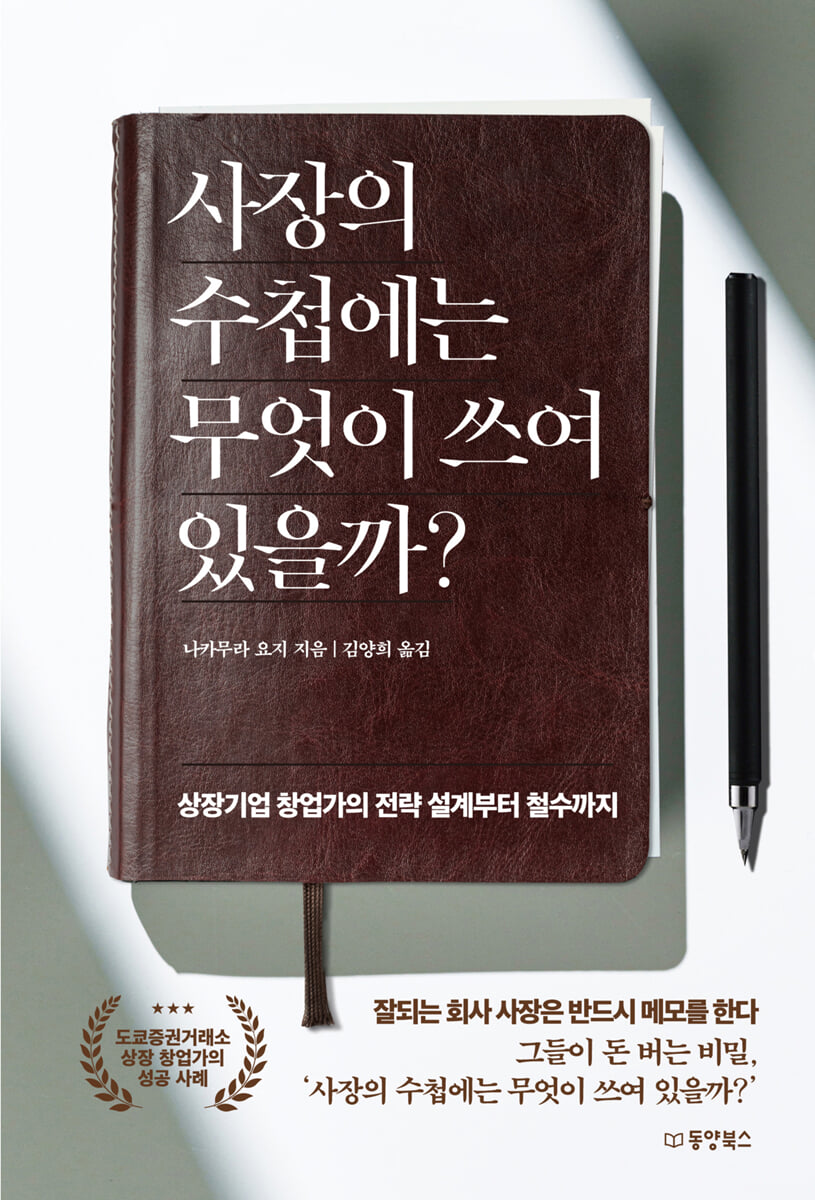
What's written in the boss's notebook?
 |
Description
Book Introduction
What the CEO of a successful company does every day, notes
'What's written in the boss's notebook?'
The CEO's Notebook: The Secrets to Making Money in Every Business You Touch
Discovering new businesses for large corporations, expanding the scope of small and medium-sized enterprises,
Until the very beginning of a startup!
“I believe that notes make a company.” Kim Seung-ho, founder of Snowfox Group, takes notes whenever a good idea comes to mind.
Not only ideas, but also advertising slogans, sentences from magazines, and even names of foreign restaurants are recorded without exception.
The same goes for Kang Yun-seon, CEO of Juno Hair, known as the Samsung of the beauty industry.
“If you don’t catch your thoughts, they disappear.
But when I take notes, it feels like I'm planting it in my head," he says, and takes notes whenever he has time.
What these respected and successful CEOs have in common is that they write a 'CEO's Notebook.'
Their notebooks contain an eye for opportunity and precise criteria for judgment.
The new book, "What's in the CEO's Notebook?", focuses on how successful CEOs start their businesses and what they focus on.
The author of this book is a successful entrepreneur and new business designer.
He successfully acquired a company in crisis, normalized its management, and sold it.
In 2017, he launched an AI business and sold it to an investment fund. In 2021, he successfully listed a company in which he had received angel investment, proving his capabilities as a new business designer.
When an item that seemed good is being ignored by customers, when competitors are gaining momentum while we are stuck, when initial reactions are good but we stop at the threshold of a leap forward.
What is needed in times like these is the 'criteria for judgment' written in the notebooks of successful CEOs.
Therefore, this book examines the real-world strategies of several entrepreneurs who started their businesses from scratch and successfully listed them on the Tokyo Stock Exchange. It vividly depicts their perspectives on analyzing the market and how they seized opportunities.
We take a close look at the entire process of developing a new business, from selecting a business area, uncovering insights, developing a strategy, and determining when to withdraw.
In particular, it is noteworthy that it covers everything from new business design to ‘withdrawal’.
Anyone can start a business, but many hesitate because they don't know how to exit.
The author says that in such situations, withdrawal should also be prepared as a strategy to minimize losses.
This book will be a useful secret weapon for those who are taking on a new business challenge.
'What's written in the boss's notebook?'
The CEO's Notebook: The Secrets to Making Money in Every Business You Touch
Discovering new businesses for large corporations, expanding the scope of small and medium-sized enterprises,
Until the very beginning of a startup!
“I believe that notes make a company.” Kim Seung-ho, founder of Snowfox Group, takes notes whenever a good idea comes to mind.
Not only ideas, but also advertising slogans, sentences from magazines, and even names of foreign restaurants are recorded without exception.
The same goes for Kang Yun-seon, CEO of Juno Hair, known as the Samsung of the beauty industry.
“If you don’t catch your thoughts, they disappear.
But when I take notes, it feels like I'm planting it in my head," he says, and takes notes whenever he has time.
What these respected and successful CEOs have in common is that they write a 'CEO's Notebook.'
Their notebooks contain an eye for opportunity and precise criteria for judgment.
The new book, "What's in the CEO's Notebook?", focuses on how successful CEOs start their businesses and what they focus on.
The author of this book is a successful entrepreneur and new business designer.
He successfully acquired a company in crisis, normalized its management, and sold it.
In 2017, he launched an AI business and sold it to an investment fund. In 2021, he successfully listed a company in which he had received angel investment, proving his capabilities as a new business designer.
When an item that seemed good is being ignored by customers, when competitors are gaining momentum while we are stuck, when initial reactions are good but we stop at the threshold of a leap forward.
What is needed in times like these is the 'criteria for judgment' written in the notebooks of successful CEOs.
Therefore, this book examines the real-world strategies of several entrepreneurs who started their businesses from scratch and successfully listed them on the Tokyo Stock Exchange. It vividly depicts their perspectives on analyzing the market and how they seized opportunities.
We take a close look at the entire process of developing a new business, from selecting a business area, uncovering insights, developing a strategy, and determining when to withdraw.
In particular, it is noteworthy that it covers everything from new business design to ‘withdrawal’.
Anyone can start a business, but many hesitate because they don't know how to exit.
The author says that in such situations, withdrawal should also be prepared as a strategy to minimize losses.
This book will be a useful secret weapon for those who are taking on a new business challenge.
- You can preview some of the book's contents.
Preview
index
What is written in the notebook of the president of a successful company?
CEOs who started with nothing and achieved success
Part 1: How do successful company presidents find new business opportunities?
Selecting a business area
Chapter 1: Even moments easily overlooked become special in the CEO's notebook.
What kind of opportunities do successful CEOs see?
Will following a company that makes a lot of money really lead to success?
Start with passion, but survive to the end.
Successful CEOs don't miss opportunities.
A line written while working will later become a business item
Chapter 2: What Weapons Are in the Notebooks of Successful CEOs?
How much can I raise with the weapons I have now?
Focus on capabilities your competitors lack.
Why starting out by relying on just one strength will lead to failure
Great businessmen are not easily satisfied.
From an ordinary student to a successful CEO
Even if there's just one person like this, the business will run.
A new business that is not properly prepared will only end up being a costly failure.
Business is different when viewed from the outside than when viewed from the inside.
Chapter 3: Is it really okay to jump into this market?
If you don't read the market properly, you'll eventually disappear from the market.
Those who run without information quickly become prey.
Part 2: Find Insights from the Notebook of a Successful CEO
Discovering Insights
Chapter 1: Successful CEOs Focus on "How" More Than "What"
Insights from Successful Entrepreneurs
Two Insights Focused on by Successful Salespeople
Customers are partners with countless ideas.
Use precedent companies as model answers and error notes.
Chapter 2: How to Use Insights to Transform Your Performance
Find out why the starting runner failed.
Why are competent CEOs wary of "too new an idea"?
Customers or competitors, who do successful CEOs look at first?
There is no right answer to insight.
A new business is a process of creating the right answer.
Things to Check Before Submitting a New Business Plan
The notebook of a successful CEO contains results.
Promoting new businesses
Chapter 1: How to Launch a New Business to Increase Your Chances of Success
Hesitation only destroys your chances of success.
A strategy used by all successful businessmen
Large corporations' new business challenges and overcoming organizational issues
Why is it more difficult for large corporations to start new businesses?
Chapter 2: Should I continue or stop the business?
When should I decide to withdraw?
When and how much do successful CEOs invest?
Do I have what it takes to be a businessman?
New business programs written in the notebook of a successful CEO
Author's career
The CEO's notebook is filled with opportunities for success.
References
CEOs who started with nothing and achieved success
Part 1: How do successful company presidents find new business opportunities?
Selecting a business area
Chapter 1: Even moments easily overlooked become special in the CEO's notebook.
What kind of opportunities do successful CEOs see?
Will following a company that makes a lot of money really lead to success?
Start with passion, but survive to the end.
Successful CEOs don't miss opportunities.
A line written while working will later become a business item
Chapter 2: What Weapons Are in the Notebooks of Successful CEOs?
How much can I raise with the weapons I have now?
Focus on capabilities your competitors lack.
Why starting out by relying on just one strength will lead to failure
Great businessmen are not easily satisfied.
From an ordinary student to a successful CEO
Even if there's just one person like this, the business will run.
A new business that is not properly prepared will only end up being a costly failure.
Business is different when viewed from the outside than when viewed from the inside.
Chapter 3: Is it really okay to jump into this market?
If you don't read the market properly, you'll eventually disappear from the market.
Those who run without information quickly become prey.
Part 2: Find Insights from the Notebook of a Successful CEO
Discovering Insights
Chapter 1: Successful CEOs Focus on "How" More Than "What"
Insights from Successful Entrepreneurs
Two Insights Focused on by Successful Salespeople
Customers are partners with countless ideas.
Use precedent companies as model answers and error notes.
Chapter 2: How to Use Insights to Transform Your Performance
Find out why the starting runner failed.
Why are competent CEOs wary of "too new an idea"?
Customers or competitors, who do successful CEOs look at first?
There is no right answer to insight.
A new business is a process of creating the right answer.
Things to Check Before Submitting a New Business Plan
The notebook of a successful CEO contains results.
Promoting new businesses
Chapter 1: How to Launch a New Business to Increase Your Chances of Success
Hesitation only destroys your chances of success.
A strategy used by all successful businessmen
Large corporations' new business challenges and overcoming organizational issues
Why is it more difficult for large corporations to start new businesses?
Chapter 2: Should I continue or stop the business?
When should I decide to withdraw?
When and how much do successful CEOs invest?
Do I have what it takes to be a businessman?
New business programs written in the notebook of a successful CEO
Author's career
The CEO's notebook is filled with opportunities for success.
References
Detailed image

Into the book
People preparing for a new business are always curious about what other people are thinking.
From "What do customers like? What messages will they respond to?" to "What kind of business is the CEO envisioning?" to "Does the current strategy align with the company's direction?"
People who constantly ask questions like this eventually find direction and find a way.
---From "Preface - What's written in the notebook of a successful company president?"
Companies must always move to acquire new capabilities.
The business environment is constantly changing, and the capabilities required change accordingly.
If you stay in one place, you will inevitably fall behind in the competition.
Eventually, the power to generate profits also gradually weakens.
That's why great businessmen are not easily satisfied.
Because companies that do not develop will soon be eliminated.
---From "Part 1 - How do CEOs of successful companies find new business areas?"
McDonald's is a representative global brand that can be found anywhere in the world.
However, McDonald's share in the restaurant market does not exceed 50%.
Why is that?
---From "Part 1 - How do CEOs of successful companies find new business areas?"
Explain from an insightful perspective what makes a best-selling product successful and how it stands out from other products.
That is, it is about interpreting the reasons why the product sells well from the perspective of customer insight or predecessor insight.
If you can't explain why something is selling well, you haven't yet penetrated the market.
---From "Part 2 - Find Insights from the Notebook of a Successful CEO"
There are generally two most important points to consider when starting a business.
The questions are 'Will it sell?' and 'Can it be made?'
For example, there is no room for debate as to whether a means of transportation that can safely travel from Seoul to Busan in 30 minutes for 50,000 won would sell.
At this point, the key question for business is, "Is it feasible? In other words, can it be created?"
---From "Part 3 - The Notebook of a Successful CEO Contains Results"
The trial and error you experience in the beginning becomes an asset that helps you rapidly grow your capabilities.
We must embrace this journey not as a simple struggle, but as a valuable opportunity for growth.
Starting a new business is certainly a challenging endeavor, but it is well worth the effort.
From "What do customers like? What messages will they respond to?" to "What kind of business is the CEO envisioning?" to "Does the current strategy align with the company's direction?"
People who constantly ask questions like this eventually find direction and find a way.
---From "Preface - What's written in the notebook of a successful company president?"
Companies must always move to acquire new capabilities.
The business environment is constantly changing, and the capabilities required change accordingly.
If you stay in one place, you will inevitably fall behind in the competition.
Eventually, the power to generate profits also gradually weakens.
That's why great businessmen are not easily satisfied.
Because companies that do not develop will soon be eliminated.
---From "Part 1 - How do CEOs of successful companies find new business areas?"
McDonald's is a representative global brand that can be found anywhere in the world.
However, McDonald's share in the restaurant market does not exceed 50%.
Why is that?
---From "Part 1 - How do CEOs of successful companies find new business areas?"
Explain from an insightful perspective what makes a best-selling product successful and how it stands out from other products.
That is, it is about interpreting the reasons why the product sells well from the perspective of customer insight or predecessor insight.
If you can't explain why something is selling well, you haven't yet penetrated the market.
---From "Part 2 - Find Insights from the Notebook of a Successful CEO"
There are generally two most important points to consider when starting a business.
The questions are 'Will it sell?' and 'Can it be made?'
For example, there is no room for debate as to whether a means of transportation that can safely travel from Seoul to Busan in 30 minutes for 50,000 won would sell.
At this point, the key question for business is, "Is it feasible? In other words, can it be created?"
---From "Part 3 - The Notebook of a Successful CEO Contains Results"
The trial and error you experience in the beginning becomes an asset that helps you rapidly grow your capabilities.
We must embrace this journey not as a simple struggle, but as a valuable opportunity for growth.
Starting a new business is certainly a challenging endeavor, but it is well worth the effort.
---From "New Business Programs Written in the Notebook of a Successful CEO"
Publisher's Review
I didn't know when I was a new business planner
Why wasn't my plan adopted!
If you are a new business practitioner, you have probably written countless business plans.
But how many of these plans have been buried? Why were they never implemented? It's because they lacked the essential elements that are always included in the notebooks of successful CEOs.
The idea is sound, but the market analysis is lacking, the strategy is poorly developed, and there is no risk management scenario or feedback from customers or leading companies.
Such plans eventually disappear without turning the new business manager into an entrepreneur.
For a CEO responsible for sales, real-world feasibility is more important than a completely new market, and risk management is more important than a 1% profitability.
This book explains this 'perspective of a successful company president' with real-life examples.
By following the secrets contained in their notebooks, you will discover opportunities to proactively implement new businesses.
There's no need to shrink because you're small
How a company with no capital or brand can turn the market upside down
For latecomers and small and medium-sized enterprises, new businesses are a bigger challenge.
How can a company with a weak brand, limited human resources, and limited capital enter a market dominated by large corporations? Unfortunately, surprisingly few books provide a clear answer to this question.
There are so many books out there that list obvious principles like textbooks or only show success stories that rely on the capital power of large corporations.
This is what makes this book special.
It specifically shows how not only large companies with abundant resources, but also small businesses and latecomers have analyzed and entered the market.
In particular, the case of gradual expansion, taking into account internal capabilities and risks, will serve as a practical guide for many organizations.
This book answers the question, "Can we do it too?" with real-life success stories.
“How could the president of that company not have failed?”
The "9-Step Formula" of Successful CEOs: Read it at Every Crucial Moment
Most new businesses start out as a "good idea," but quickly collapse in the harsh marketplace.
So this book asks the opposite question:
"Why didn't the CEO of that company fail?" This book contains the author's "9-step formula for success in new businesses," which he has written, erased, and refined countless times.
This is a practical strategy that involves objectively assessing your company's capabilities, researching and validating your market and customers, verifying your insights, and managing risks while ensuring that you're generating real sales.
1.
Understanding your company's capabilities
2.
Selecting the target area
3.
Target area survey
4.
Discover solid insights
5.
Confirm customer purchase intent and present sales performance
6.
Creating a fast-paced system
7.
Starting a business
8.
Risk Management
9.
Concentrated investment
However, many companies make the mistake of making a gut decision in steps 1 and 2 and then skipping step 5.
Ideas should not be implemented blindly.
You have to jump in and increase your survival rate at each stage.
This book helps businesses avoid the trap of "premature confidence" that they often fall into.
If you want to feel confident that you can start now, these nine-step strategies from successful business leaders will help.
Why wasn't my plan adopted!
If you are a new business practitioner, you have probably written countless business plans.
But how many of these plans have been buried? Why were they never implemented? It's because they lacked the essential elements that are always included in the notebooks of successful CEOs.
The idea is sound, but the market analysis is lacking, the strategy is poorly developed, and there is no risk management scenario or feedback from customers or leading companies.
Such plans eventually disappear without turning the new business manager into an entrepreneur.
For a CEO responsible for sales, real-world feasibility is more important than a completely new market, and risk management is more important than a 1% profitability.
This book explains this 'perspective of a successful company president' with real-life examples.
By following the secrets contained in their notebooks, you will discover opportunities to proactively implement new businesses.
There's no need to shrink because you're small
How a company with no capital or brand can turn the market upside down
For latecomers and small and medium-sized enterprises, new businesses are a bigger challenge.
How can a company with a weak brand, limited human resources, and limited capital enter a market dominated by large corporations? Unfortunately, surprisingly few books provide a clear answer to this question.
There are so many books out there that list obvious principles like textbooks or only show success stories that rely on the capital power of large corporations.
This is what makes this book special.
It specifically shows how not only large companies with abundant resources, but also small businesses and latecomers have analyzed and entered the market.
In particular, the case of gradual expansion, taking into account internal capabilities and risks, will serve as a practical guide for many organizations.
This book answers the question, "Can we do it too?" with real-life success stories.
“How could the president of that company not have failed?”
The "9-Step Formula" of Successful CEOs: Read it at Every Crucial Moment
Most new businesses start out as a "good idea," but quickly collapse in the harsh marketplace.
So this book asks the opposite question:
"Why didn't the CEO of that company fail?" This book contains the author's "9-step formula for success in new businesses," which he has written, erased, and refined countless times.
This is a practical strategy that involves objectively assessing your company's capabilities, researching and validating your market and customers, verifying your insights, and managing risks while ensuring that you're generating real sales.
1.
Understanding your company's capabilities
2.
Selecting the target area
3.
Target area survey
4.
Discover solid insights
5.
Confirm customer purchase intent and present sales performance
6.
Creating a fast-paced system
7.
Starting a business
8.
Risk Management
9.
Concentrated investment
However, many companies make the mistake of making a gut decision in steps 1 and 2 and then skipping step 5.
Ideas should not be implemented blindly.
You have to jump in and increase your survival rate at each stage.
This book helps businesses avoid the trap of "premature confidence" that they often fall into.
If you want to feel confident that you can start now, these nine-step strategies from successful business leaders will help.
GOODS SPECIFICS
- Date of issue: August 13, 2025
- Page count, weight, size: 336 pages | 656g | 152*224*21mm
- ISBN13: 9791172109332
- ISBN10: 1172109338
You may also like
카테고리
korean


korean

![GQ KOREA Mark (Monthly): December [2025]](http://librairie.coreenne.fr/cdn/shop/files/8ef265dbbfbf186523ed75ba7319009d.jpg?v=1765340328&width=3840)


