

The art of summarizing key points
 |
Description
Book Introduction
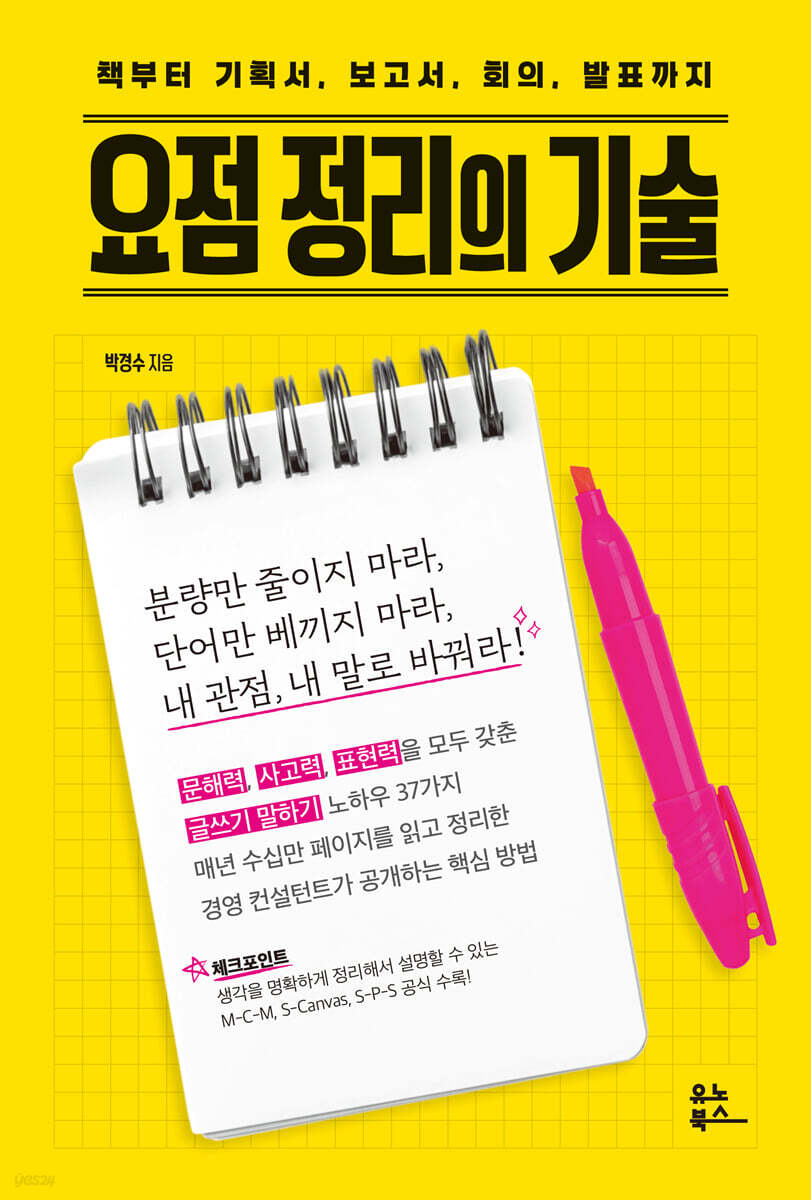
Don't just reduce the portion size,
Don't just copy the words,
Change my perspective, my words!
37 Writing and Speaking Tips for Literacy, Thinking, and Expressive Skills
Key methods revealed by a management consultant who reads and organizes hundreds of thousands of pages every year.
If you want to write reports that colleagues and business partners can understand at a glance, persuade others with presentations that capture the essence of the topic, and clearly convey your message in writing and video, you need the art of summarizing key points.
The point means 'the most important and central fact or viewpoint.'
Author Kyung-soo Park, a management consultant who reads hundreds of thousands of pages of reports every year and summarizes them to convey only the main points, says that summarizing is not simply about reducing the length of the text, but about expressing it in your own perspective and language.
《The Art of Summarizing》 contains 37 key point summarizing techniques developed by the author himself and proven effective, as well as the MCM, S-Canvas, and SPS formulas.
This allows you to write and speak with literacy, thinking, and expressive skills.
The point is that it can be easily summarized in just four steps.
The order is 'understanding the purpose, understanding the structure, extracting the core, and organizing the composition.'
Step 1: Understanding the purpose requires focusing on the purpose of the text rather than its content and understanding the hidden context of the text.
Step 2 is to understand the structure of the text.
The structure of the essay includes a problem-solving structure, an opportunity-utilizing structure, a diagnostic proposal structure, and a value comparison structure.
Step 3 is core extraction.
It depends on the type of writing, but the core message usually appears in the first or last sentence of the writing.
Finally, let's organize the configuration.
To effectively explain the core message, it is important to connect sentences that fit each paragraph.
Rather than simply reducing the length of the text, a process of restructuring the text to include only the main points is necessary.
Based on these four steps, there are MCM, S-Canvas, and SPS formulas to help you organize your points more easily.
By using this, you can internalize the four-step summary technique and communicate your thoughts clearly.
This book is for office workers who want to increase their salary through documents and reports, businesspeople who need to win contracts through presentations, and creators who want to increase their subscriber base through writing and videos.
If you're struggling with how to summarize and convey key points in this age of information overload, focus on "The Art of Summarizing."
You can learn everything from summarizing key points to delivering them in this one book.
Don't just copy the words,
Change my perspective, my words!
37 Writing and Speaking Tips for Literacy, Thinking, and Expressive Skills
Key methods revealed by a management consultant who reads and organizes hundreds of thousands of pages every year.
If you want to write reports that colleagues and business partners can understand at a glance, persuade others with presentations that capture the essence of the topic, and clearly convey your message in writing and video, you need the art of summarizing key points.
The point means 'the most important and central fact or viewpoint.'
Author Kyung-soo Park, a management consultant who reads hundreds of thousands of pages of reports every year and summarizes them to convey only the main points, says that summarizing is not simply about reducing the length of the text, but about expressing it in your own perspective and language.
《The Art of Summarizing》 contains 37 key point summarizing techniques developed by the author himself and proven effective, as well as the MCM, S-Canvas, and SPS formulas.
This allows you to write and speak with literacy, thinking, and expressive skills.
The point is that it can be easily summarized in just four steps.
The order is 'understanding the purpose, understanding the structure, extracting the core, and organizing the composition.'
Step 1: Understanding the purpose requires focusing on the purpose of the text rather than its content and understanding the hidden context of the text.
Step 2 is to understand the structure of the text.
The structure of the essay includes a problem-solving structure, an opportunity-utilizing structure, a diagnostic proposal structure, and a value comparison structure.
Step 3 is core extraction.
It depends on the type of writing, but the core message usually appears in the first or last sentence of the writing.
Finally, let's organize the configuration.
To effectively explain the core message, it is important to connect sentences that fit each paragraph.
Rather than simply reducing the length of the text, a process of restructuring the text to include only the main points is necessary.
Based on these four steps, there are MCM, S-Canvas, and SPS formulas to help you organize your points more easily.
By using this, you can internalize the four-step summary technique and communicate your thoughts clearly.
This book is for office workers who want to increase their salary through documents and reports, businesspeople who need to win contracts through presentations, and creators who want to increase their subscriber base through writing and videos.
If you're struggling with how to summarize and convey key points in this age of information overload, focus on "The Art of Summarizing."
You can learn everything from summarizing key points to delivering them in this one book.
- You can preview some of the book's contents.
Preview
index
Prologue For those who have difficulty grasping the main points in work, school, and conversations
If you just summarize the main points of Chapter 1 well…
_From the meaning of the point to the essence of the point
01 Identifying key points that everyone from elementary school students to working professionals finds difficult
02 Key Points Becoming More Important in the Information Flood
03 You must know the essence to get the essence.
Chapter 2: How to grasp the main points of long text at a glance
_From setting the perspective to deriving keywords
04 Leave only the essentials and discard the unnecessary.
05 Design your own ideas
06 If I have my point of view, the point is not shaken.
07 If you organize things haphazardly, you can easily miss the point.
08 Read consistently, understanding the context.
09 If you know the outline, it becomes easier to summarize the main points.
10 Write down a question mark or an exclamation mark.
You need to know 11 keywords to get the point across.
Chapter 3: How to summarize key points without explaining everything in detail
_4-step summary from technology to practical application
12 How can I summarize only the key points?
Step 1 of Summary: Have a Sense of Purpose
Step 2 of the Summary: Identify the Structure
15 Problem-Solving Structures Used in Plans and Reports
16 Opportunity-leveraging Structures for New Ideas
17 Diagnostic Proposal Structures Used in Editorials and Columns
18 Value comparison structure used in promotional articles
Step 3 of the Summary: Extracting Key Points
Step 4 of the 20 Summary: Organizing the Structure
21 Reorganize and organize by item
22 Organize the structure of the text by grouping the table of contents.
23 Training method to create a basic framework for summarizing key points
24. The art of summarizing key points in a clear argument
25. Techniques for summarizing key points in books with diverse presentation styles
26 Techniques for Summarizing Key Points in a Report
27 If you know the pattern of the text, it becomes easier to find the main point.
Chapter 4: How to communicate clearly and to the point without rambling
_From speaking habits to writing habits
28 Why don't you understand what I'm saying?
29 Emphasize the message and explain the details.
30 Speak on three grounds
31. Deliver your message in a pyramid structure.
32 Express the situation, problem, and solution in three words.
33 Use a twist story to increase persuasiveness.
34 The best way to develop expressive skills is reading.
35 Reading method that extracts only the main points, excerpt reading
36 If you want to know whether someone knows or not, write.
37 You have to open your mouth to organize your thoughts.
If you just summarize the main points of Chapter 1 well…
_From the meaning of the point to the essence of the point
01 Identifying key points that everyone from elementary school students to working professionals finds difficult
02 Key Points Becoming More Important in the Information Flood
03 You must know the essence to get the essence.
Chapter 2: How to grasp the main points of long text at a glance
_From setting the perspective to deriving keywords
04 Leave only the essentials and discard the unnecessary.
05 Design your own ideas
06 If I have my point of view, the point is not shaken.
07 If you organize things haphazardly, you can easily miss the point.
08 Read consistently, understanding the context.
09 If you know the outline, it becomes easier to summarize the main points.
10 Write down a question mark or an exclamation mark.
You need to know 11 keywords to get the point across.
Chapter 3: How to summarize key points without explaining everything in detail
_4-step summary from technology to practical application
12 How can I summarize only the key points?
Step 1 of Summary: Have a Sense of Purpose
Step 2 of the Summary: Identify the Structure
15 Problem-Solving Structures Used in Plans and Reports
16 Opportunity-leveraging Structures for New Ideas
17 Diagnostic Proposal Structures Used in Editorials and Columns
18 Value comparison structure used in promotional articles
Step 3 of the Summary: Extracting Key Points
Step 4 of the 20 Summary: Organizing the Structure
21 Reorganize and organize by item
22 Organize the structure of the text by grouping the table of contents.
23 Training method to create a basic framework for summarizing key points
24. The art of summarizing key points in a clear argument
25. Techniques for summarizing key points in books with diverse presentation styles
26 Techniques for Summarizing Key Points in a Report
27 If you know the pattern of the text, it becomes easier to find the main point.
Chapter 4: How to communicate clearly and to the point without rambling
_From speaking habits to writing habits
28 Why don't you understand what I'm saying?
29 Emphasize the message and explain the details.
30 Speak on three grounds
31. Deliver your message in a pyramid structure.
32 Express the situation, problem, and solution in three words.
33 Use a twist story to increase persuasiveness.
34 The best way to develop expressive skills is reading.
35 Reading method that extracts only the main points, excerpt reading
36 If you want to know whether someone knows or not, write.
37 You have to open your mouth to organize your thoughts.
Detailed image

Into the book
So what is a point? A point is "the most important and central fact or perspective."
People use the word "summarize" when studying for an exam or making an important report.
Summarizing, the act of systematically classifying and synthesizing the most important and central facts or viewpoints, is actually a part of our daily lives.
---From "For those who have difficulty grasping the main points in work, school, and conversation"
Literacy is an issue from elementary school students to adults.
Among the so-called Korean, English, and Math subjects, Korean has emerged as a dark horse.
Literacy is the ability to digest what you read and express it in your own words.
People with high literacy organize their thoughts and explain them systematically.
Naturally, that person's mind is structured like a well-organized bookshelf.
The key here is to ‘summarize the main points.’
---From "Understanding Key Points That Elementary School Students and Office Workers Find Difficult"
Whether it's work or study, the basics are understanding the essence.
If you don't know the essence, the outside will be flashy and the content will be weak.
Poor content is still poor no matter how it is expressed.
The same goes for reading books.
If you read without knowing the essence of the act of reading, knowledge will not accumulate in your head.
Maybe when the wind blows, it will all fly away.
Actions taken without knowing the essence are meaningless.
If the start is uncertain, the process and the result will be bad.
The start is always important.
---From "You must know the essence to obtain the essence"
What if you were to read reports that ranged from a few pages to hundreds of pages? Wouldn't it be exhausting if these reports were attached to the approval documents that come in several times a day? Some managers, finding it tiresome to read a report from the beginning, summon their team members and ask them what the key points are.
That's how much people like reports that are just about the point.
---From "Leave only the essentials and throw away the unnecessary"
Summarizing is not simply the process of condensing text.
Because I need to understand someone's thoughts and also have my own opinion.
The moment you think of the process of summarizing by grasping the main points as abbreviation, it can only function as a summary bot.
Summary bots have no perspective.
If you don't have a point of view, it's easy to be swayed by someone's words.
---From "If I have my point of view, the point is not shaken"
For standardized writing, you can use the structure you learned at school or work.
If not, you can create the structure as you see fit.
The structure is not determined by anyone.
There is no need to think that the structure you created is not the answer.
But every time we encounter a new type of writing, we try to find the right answer as to how to write it.
There is no right answer in writing.
---From "If you know the skeleton, it becomes easier to summarize the main points"
“I can read a little, but my memory is very weak.”
French philosopher Michel Ayquem de Montaigne left a comment in his Essays on the problem of reading without memory.
It is said that Joseon Dynasty intellectual Dasan Jeong Yak-yong also wrote and studied books by writing down random thoughts that came to his mind in the margins of books and copying important passages to collect the contents of books to solve this problem.
Write down whatever comes to your mind, whether it's an exclamation point or a question mark.
It doesn't matter if it's text, a graph, or a picture.
---From "Write it down, whether it's a question mark or an exclamation mark"
Summarizing the main points is a study for myself, but it is also a basic activity to teach to others.
What if your opponent only has one minute and asks you to get to the point? If you just mumble and stammer, no matter how many times you try, you'll never be able to convey the essential message within a minute.
---From "Why don't you understand what I'm saying?"
Next is the absence of perspective.
I mentioned earlier that point of view is an important factor in understanding the structure of a piece of writing.
Without a point of view, the message you are trying to convey is not organized, leading to an endless repetition.
In particular, words like 'and' and 'um' are overused.
I have to keep saying different things, because if there is no connecting link in the middle, I try to replace it with 'and'.
---From "Why don't you understand what I'm saying?"
“The problem can be viewed from three main aspects.
First… , second… , third… .
To solve these three problems, we have derived three tasks for each problem.”
When making a claim, you are asked to provide at least three reasons for your argument.
This is called the 'Rule of 3'.
Because three is the number that people can understand most quickly and clearly.
Consultants who advise others usually use the 'Rule of 3' to suggest problems and solutions.
---From "Speak with 3 Reasons"
What kind of reading should I do to grasp the main points? There are two main reading methods: sparse reading (濫讀) and intensive reading (精讀).
Reading a variety of books is a hobby.
Du Fu, a poet of the Tang Dynasty, said, “A man should read five cartloads of books,” meaning that “a man should read many books.”
On the other hand, Dasan Jeong Yak-yong emphasized reading diligently.
Quality was valued over quantity.
He said that reading a lot of books indiscriminately is no different from not reading at all.
---From "The Best Way to Develop Expressive Power: Reading"
Ultimately, what we write is read by someone.
But if someone doesn't like reading, isn't that a problem? While personal taste may vary, good writing is about writing that flows naturally to the reader.
Just like singer and producer Park Jin-young always tells contestants on music audition programs to “sing as if you’re speaking.”
People use the word "summarize" when studying for an exam or making an important report.
Summarizing, the act of systematically classifying and synthesizing the most important and central facts or viewpoints, is actually a part of our daily lives.
---From "For those who have difficulty grasping the main points in work, school, and conversation"
Literacy is an issue from elementary school students to adults.
Among the so-called Korean, English, and Math subjects, Korean has emerged as a dark horse.
Literacy is the ability to digest what you read and express it in your own words.
People with high literacy organize their thoughts and explain them systematically.
Naturally, that person's mind is structured like a well-organized bookshelf.
The key here is to ‘summarize the main points.’
---From "Understanding Key Points That Elementary School Students and Office Workers Find Difficult"
Whether it's work or study, the basics are understanding the essence.
If you don't know the essence, the outside will be flashy and the content will be weak.
Poor content is still poor no matter how it is expressed.
The same goes for reading books.
If you read without knowing the essence of the act of reading, knowledge will not accumulate in your head.
Maybe when the wind blows, it will all fly away.
Actions taken without knowing the essence are meaningless.
If the start is uncertain, the process and the result will be bad.
The start is always important.
---From "You must know the essence to obtain the essence"
What if you were to read reports that ranged from a few pages to hundreds of pages? Wouldn't it be exhausting if these reports were attached to the approval documents that come in several times a day? Some managers, finding it tiresome to read a report from the beginning, summon their team members and ask them what the key points are.
That's how much people like reports that are just about the point.
---From "Leave only the essentials and throw away the unnecessary"
Summarizing is not simply the process of condensing text.
Because I need to understand someone's thoughts and also have my own opinion.
The moment you think of the process of summarizing by grasping the main points as abbreviation, it can only function as a summary bot.
Summary bots have no perspective.
If you don't have a point of view, it's easy to be swayed by someone's words.
---From "If I have my point of view, the point is not shaken"
For standardized writing, you can use the structure you learned at school or work.
If not, you can create the structure as you see fit.
The structure is not determined by anyone.
There is no need to think that the structure you created is not the answer.
But every time we encounter a new type of writing, we try to find the right answer as to how to write it.
There is no right answer in writing.
---From "If you know the skeleton, it becomes easier to summarize the main points"
“I can read a little, but my memory is very weak.”
French philosopher Michel Ayquem de Montaigne left a comment in his Essays on the problem of reading without memory.
It is said that Joseon Dynasty intellectual Dasan Jeong Yak-yong also wrote and studied books by writing down random thoughts that came to his mind in the margins of books and copying important passages to collect the contents of books to solve this problem.
Write down whatever comes to your mind, whether it's an exclamation point or a question mark.
It doesn't matter if it's text, a graph, or a picture.
---From "Write it down, whether it's a question mark or an exclamation mark"
Summarizing the main points is a study for myself, but it is also a basic activity to teach to others.
What if your opponent only has one minute and asks you to get to the point? If you just mumble and stammer, no matter how many times you try, you'll never be able to convey the essential message within a minute.
---From "Why don't you understand what I'm saying?"
Next is the absence of perspective.
I mentioned earlier that point of view is an important factor in understanding the structure of a piece of writing.
Without a point of view, the message you are trying to convey is not organized, leading to an endless repetition.
In particular, words like 'and' and 'um' are overused.
I have to keep saying different things, because if there is no connecting link in the middle, I try to replace it with 'and'.
---From "Why don't you understand what I'm saying?"
“The problem can be viewed from three main aspects.
First… , second… , third… .
To solve these three problems, we have derived three tasks for each problem.”
When making a claim, you are asked to provide at least three reasons for your argument.
This is called the 'Rule of 3'.
Because three is the number that people can understand most quickly and clearly.
Consultants who advise others usually use the 'Rule of 3' to suggest problems and solutions.
---From "Speak with 3 Reasons"
What kind of reading should I do to grasp the main points? There are two main reading methods: sparse reading (濫讀) and intensive reading (精讀).
Reading a variety of books is a hobby.
Du Fu, a poet of the Tang Dynasty, said, “A man should read five cartloads of books,” meaning that “a man should read many books.”
On the other hand, Dasan Jeong Yak-yong emphasized reading diligently.
Quality was valued over quantity.
He said that reading a lot of books indiscriminately is no different from not reading at all.
---From "The Best Way to Develop Expressive Power: Reading"
Ultimately, what we write is read by someone.
But if someone doesn't like reading, isn't that a problem? While personal taste may vary, good writing is about writing that flows naturally to the reader.
Just like singer and producer Park Jin-young always tells contestants on music audition programs to “sing as if you’re speaking.”
---From "You have to open your mouth to organize your thoughts"
Publisher's Review
Hundreds of thousands of pages read and organized every year
Management Consultant Reveals Key Points and Summary Secrets
Kyung-soo Park, author of "The Art of Summarizing," has included in this book a technique for summarizing points that has never been revealed before.
The author developed his own key point-summarizing technique by reading hundreds of thousands of pages of reports each year, identifying and conveying only the key points that companies want, and through this, he established himself as a sought-after management consultant for companies.
In addition to management consulting, I also give lectures on planning and report writing for individuals.
Through consulting and lectures, the author has learned that people he meets struggle with getting the point across in their studies, work, and conversations.
Also, after seeing people interpreting texts beyond their core meaning and experiencing a lack of literacy, I began to recognize the importance of summarizing key points.
This book helps you easily learn the key point summary method that was previously difficult by organizing it into four steps based on the author's own experience and research.
We've added practicality by including MCM, S-Canvas, and SPS formulas that anyone can immediately apply in practice.
It also provides examples of actual business reports, columns, and book reviews.
If you want to write reports your boss can understand in one sitting, persuade others with a presentation that captures the essence, and clearly convey your message in short texts and videos, "The Art of Summarizing" will teach you how.
Equipped with literacy, thinking, and expressive skills
37 Writing and Speaking Tips
Many people mistakenly believe that when they are asked to summarize only the main points, they are simply reducing the amount of text.
The point means 'the most important and central fact or viewpoint.'
A point can only be made if it contains the most important fact or point of view.
The point is that it can be easily summarized in just four steps.
Step 1 is purpose.
You should focus on the purpose of the text rather than its content and understand the hidden context of the text.
Step 2 is to understand the structure of the text.
Step 3 is core extraction.
It depends on the type of writing, but usually the core message appears in the first or last sentence of the writing.
Finally, let's organize the configuration.
To effectively explain the core message, it is important to connect sentences that fit each paragraph.
★ S-Canvas method for summarizing key points
When summarizing the main points in 4 steps, it is good to use S-Canvas (Summarization Canvas).
S-Canvas consists of items such as the writer's perspective, the background of the text, the structure of the text, the core message, the key sentences (words), and my perspective.
I'm going to try to summarize the main points of the book, "Reading the World with Ted."
Then, we can organize it using the S-Canvas structure as follows.
S-Canvas from "Reading the World with Ted"
· Author's perspective: You can learn various perspectives from TED.
· Background: TED has a lot of inspiring content.
· Structure of the essay: The author's experiences or cases related to the lecture topic - Introduction to the lecture content - Summary of the lecture's implications.
· Key message: Create your own knowledge-sharing platform with TED Talks.
· Key phrases (words): Pursue essence, immersion, and a meaningful life; Autonomy and intelligence: Motivate members and utilize collective intelligence; Change and innovation: Respond nimbly to external changes and pursue technological innovation.
· Organize your thoughts: TED talks can help you learn how to live every moment of your daily life.
★ SPS structure makes it easy to grasp the main points
Understanding the SPS structure, which is commonly used in proposals and reports, makes it easier to grasp the main points of the writing.
SPS stands for Situation, Problem, Solution.
For example, there is an article that presents the problems of false advertising on social media and provides solutions.
Then, it can be organized into an SPS structure as follows.
· Situation: Consumer damage is increasing due to false and exaggerated advertisements on social media.
· Problem: There is no review of false and exaggerated advertisements on major social media channels such as Facebook, Instagram, and Twitter.
· Solution: Domestic law needs to be applied to foreign social media platforms operating in Korea.
★ MCM technique that only speaks the main points
The point is that it is important not only in writing but also in speaking.
If you speak in the order of message, contents, and message, you can clearly convey only what you want to say to the other person.
For example, you are trying to convey to someone something like, 'The purpose of life is essence.'
Unlike texts that are organized in the order of the content flow, speech is effective when it first explains the big picture and then explains the details.
I summarized “What is life?”
I have summarized it into two major aspects: life purpose and implementation strategy.
There are three purposes in life: essence, relationships, and story.
The essence is…, the relationship is…, the story is….
To recap, essence, relationships, and stories are important when it comes to life’s purpose.”
From books to proposals, reports, meetings, and presentations
This one book is all you need!
It is no exaggeration to say that our daily lives begin with grasping the main point and end with conveying the main point.
From the moment we wake up in the morning until we go to bed at night, we are constantly communicating with others, both verbally and in writing, to get the point across.
However, more people than you might think fail to grasp the point and have difficulty conveying the main point.
You may have thought that summarizing the main points was simply about reducing the amount and copying only the words.
But summarizing is a process of re-creation, expressed in one's own perspective and language.
"The Art of Summarizing" easily explains the technique of summarizing key points so that you don't stray from the main point in any situation, from books to proposals, reports, meetings, and presentations.
It goes beyond just organizing and teaches you how to convey your point.
I explain the meaning and essence of summarizing points that no one has ever taught me, and I talk about how to set my perspective and derive keywords so that I can properly summarize points.
It also includes practical application methods, speaking and writing habits, and ways to convey only the main points.
If you're a working professional looking to boost your salary through documents and reports, a businessperson needing to secure contracts through presentations, or a creator looking to increase your subscriber base through writing and video, open this book.
From summarizing key points to delivering the message, you can finish it all in one book.
Management Consultant Reveals Key Points and Summary Secrets
Kyung-soo Park, author of "The Art of Summarizing," has included in this book a technique for summarizing points that has never been revealed before.
The author developed his own key point-summarizing technique by reading hundreds of thousands of pages of reports each year, identifying and conveying only the key points that companies want, and through this, he established himself as a sought-after management consultant for companies.
In addition to management consulting, I also give lectures on planning and report writing for individuals.
Through consulting and lectures, the author has learned that people he meets struggle with getting the point across in their studies, work, and conversations.
Also, after seeing people interpreting texts beyond their core meaning and experiencing a lack of literacy, I began to recognize the importance of summarizing key points.
This book helps you easily learn the key point summary method that was previously difficult by organizing it into four steps based on the author's own experience and research.
We've added practicality by including MCM, S-Canvas, and SPS formulas that anyone can immediately apply in practice.
It also provides examples of actual business reports, columns, and book reviews.
If you want to write reports your boss can understand in one sitting, persuade others with a presentation that captures the essence, and clearly convey your message in short texts and videos, "The Art of Summarizing" will teach you how.
Equipped with literacy, thinking, and expressive skills
37 Writing and Speaking Tips
Many people mistakenly believe that when they are asked to summarize only the main points, they are simply reducing the amount of text.
The point means 'the most important and central fact or viewpoint.'
A point can only be made if it contains the most important fact or point of view.
The point is that it can be easily summarized in just four steps.
Step 1 is purpose.
You should focus on the purpose of the text rather than its content and understand the hidden context of the text.
Step 2 is to understand the structure of the text.
Step 3 is core extraction.
It depends on the type of writing, but usually the core message appears in the first or last sentence of the writing.
Finally, let's organize the configuration.
To effectively explain the core message, it is important to connect sentences that fit each paragraph.
★ S-Canvas method for summarizing key points
When summarizing the main points in 4 steps, it is good to use S-Canvas (Summarization Canvas).
S-Canvas consists of items such as the writer's perspective, the background of the text, the structure of the text, the core message, the key sentences (words), and my perspective.
I'm going to try to summarize the main points of the book, "Reading the World with Ted."
Then, we can organize it using the S-Canvas structure as follows.
S-Canvas from "Reading the World with Ted"
· Author's perspective: You can learn various perspectives from TED.
· Background: TED has a lot of inspiring content.
· Structure of the essay: The author's experiences or cases related to the lecture topic - Introduction to the lecture content - Summary of the lecture's implications.
· Key message: Create your own knowledge-sharing platform with TED Talks.
· Key phrases (words): Pursue essence, immersion, and a meaningful life; Autonomy and intelligence: Motivate members and utilize collective intelligence; Change and innovation: Respond nimbly to external changes and pursue technological innovation.
· Organize your thoughts: TED talks can help you learn how to live every moment of your daily life.
★ SPS structure makes it easy to grasp the main points
Understanding the SPS structure, which is commonly used in proposals and reports, makes it easier to grasp the main points of the writing.
SPS stands for Situation, Problem, Solution.
For example, there is an article that presents the problems of false advertising on social media and provides solutions.
Then, it can be organized into an SPS structure as follows.
· Situation: Consumer damage is increasing due to false and exaggerated advertisements on social media.
· Problem: There is no review of false and exaggerated advertisements on major social media channels such as Facebook, Instagram, and Twitter.
· Solution: Domestic law needs to be applied to foreign social media platforms operating in Korea.
★ MCM technique that only speaks the main points
The point is that it is important not only in writing but also in speaking.
If you speak in the order of message, contents, and message, you can clearly convey only what you want to say to the other person.
For example, you are trying to convey to someone something like, 'The purpose of life is essence.'
Unlike texts that are organized in the order of the content flow, speech is effective when it first explains the big picture and then explains the details.
I summarized “What is life?”
I have summarized it into two major aspects: life purpose and implementation strategy.
There are three purposes in life: essence, relationships, and story.
The essence is…, the relationship is…, the story is….
To recap, essence, relationships, and stories are important when it comes to life’s purpose.”
From books to proposals, reports, meetings, and presentations
This one book is all you need!
It is no exaggeration to say that our daily lives begin with grasping the main point and end with conveying the main point.
From the moment we wake up in the morning until we go to bed at night, we are constantly communicating with others, both verbally and in writing, to get the point across.
However, more people than you might think fail to grasp the point and have difficulty conveying the main point.
You may have thought that summarizing the main points was simply about reducing the amount and copying only the words.
But summarizing is a process of re-creation, expressed in one's own perspective and language.
"The Art of Summarizing" easily explains the technique of summarizing key points so that you don't stray from the main point in any situation, from books to proposals, reports, meetings, and presentations.
It goes beyond just organizing and teaches you how to convey your point.
I explain the meaning and essence of summarizing points that no one has ever taught me, and I talk about how to set my perspective and derive keywords so that I can properly summarize points.
It also includes practical application methods, speaking and writing habits, and ways to convey only the main points.
If you're a working professional looking to boost your salary through documents and reports, a businessperson needing to secure contracts through presentations, or a creator looking to increase your subscriber base through writing and video, open this book.
From summarizing key points to delivering the message, you can finish it all in one book.
GOODS SPECIFICS
- Date of issue: July 15, 2025
- Page count, weight, size: 240 pages | 336g | 142*210*16mm
- ISBN13: 9791171831210
- ISBN10: 1171831218
You may also like
카테고리
korean


korean

![GQ KOREA Mark (Monthly): December [2025]](http://librairie.coreenne.fr/cdn/shop/files/8ef265dbbfbf186523ed75ba7319009d.jpg?v=1765340328&width=3840)


