

What the pros say
 |
Description
Book Introduction
How to Become a Better Speaker Than a Good Speaker
- 150 lectures annually, totaling 2,000 lectures to Samsung, SK, Hyundai, and the Ministry of Personnel Management
- The living know-how of the youngest sales king in the shortest period of time
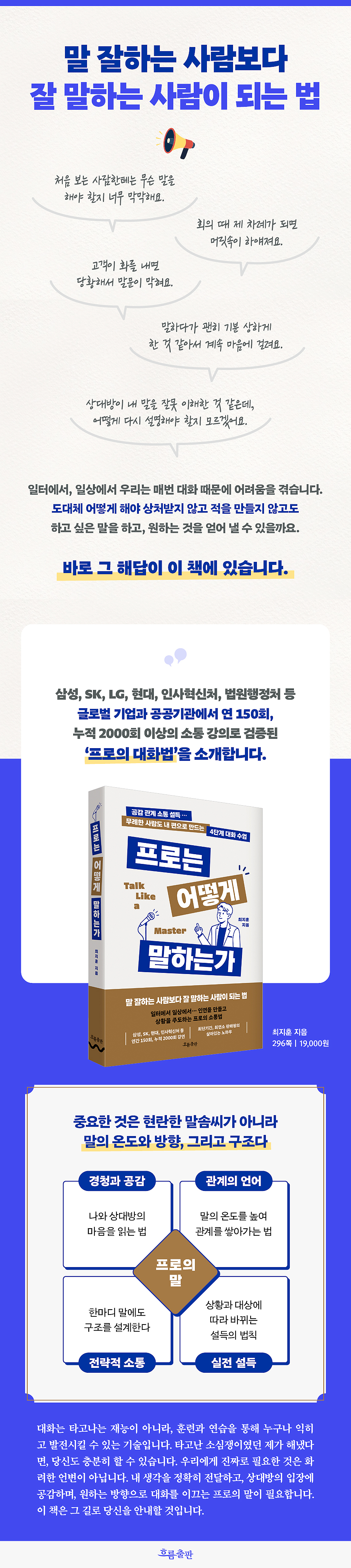
"How Professionals Speak" is a practical communication guide that addresses the conversational concerns everyone faces.
There are moments when your relationship is strained due to your awkward speech, and you can't open your mouth before a presentation or meeting.
Author Ji-Hoon Choi is a communication expert who understands such concerns better than anyone else. He introduces conversation methods that have proven effective in the field through over 2,000 lectures and training sessions held over the past 20 years at major companies and organizations such as Samsung, SK, LG, Hyundai, the Ministry of Personnel Management, and the National Court Administration.
This book guides you through the four stages of conversation: 'empathy - relationship - communication - persuasion', providing a solid theoretical background and vivid examples of conversation techniques that will help you win over even rude people.
Rather than using flowery language, it's about conveying your thoughts accurately at the other person's level.
How to refine the structure of your speech and express your emotions in a healthy way.
It is full of practical conversation techniques that anyone can immediately follow, including how to get back on track when the conversation gets stuck.
I highly recommend this book to anyone who has a lot of thoughts but is slow to speak, anyone who is good at speaking but is always misunderstood, or anyone who wants to improve their relationships.
- 150 lectures annually, totaling 2,000 lectures to Samsung, SK, Hyundai, and the Ministry of Personnel Management
- The living know-how of the youngest sales king in the shortest period of time
"How Professionals Speak" is a practical communication guide that addresses the conversational concerns everyone faces.
There are moments when your relationship is strained due to your awkward speech, and you can't open your mouth before a presentation or meeting.
Author Ji-Hoon Choi is a communication expert who understands such concerns better than anyone else. He introduces conversation methods that have proven effective in the field through over 2,000 lectures and training sessions held over the past 20 years at major companies and organizations such as Samsung, SK, LG, Hyundai, the Ministry of Personnel Management, and the National Court Administration.
This book guides you through the four stages of conversation: 'empathy - relationship - communication - persuasion', providing a solid theoretical background and vivid examples of conversation techniques that will help you win over even rude people.
Rather than using flowery language, it's about conveying your thoughts accurately at the other person's level.
How to refine the structure of your speech and express your emotions in a healthy way.
It is full of practical conversation techniques that anyone can immediately follow, including how to get back on track when the conversation gets stuck.
I highly recommend this book to anyone who has a lot of thoughts but is slow to speak, anyone who is good at speaking but is always misunderstood, or anyone who wants to improve their relationships.
- You can preview some of the book's contents.
Preview
index
Preface Conversation is a skill, not a talent.
Chapter 1.
Empathy: Wanting to be recognized even by your enemies is what makes people human.
- Empathy begins with expressing my feelings.
Listening is also a strategy.
- People who are good at talking vs.
A person who speaks well
- How to ask questions to keep the conversation going
- Empathy strategies that raise the temperature of the relationship
- A single point of difference determines authenticity.
- An apology is not about words, but about attitude.
- The Secret of an Irresistible Request
- Difference and discrimination are different.
Chapter 2.
How to build relationships by increasing the temperature of your words
- Habits of making a good first impression
- Gratitude is concrete and immediate.
- Even the most inconsiderate people need skills.
- How to say no without hurting someone
Understanding the differences between men and women makes communication easier.
- Communication method of 'a person who understands me'
- 3-Step Relationship Management to Increase Influence
- Business manners that determine first impressions
- Speaking habits of people who are recognized at work
- The art of listening that 'old farts' don't know
Chapter 3.
Communication, even short conversations, require structure.
- How do professionals design horses?
- The ultimate skill of great orators: the charisma pattern
- 'A Great Word', 1-Minute Speech
- 4MAT system that builds the logic of speech
Praise and criticism also require strategy.
- If you want to speak confidently without making enemies
- Magical phrases to use when you're speechless
- Sandwich feedback known only to the discussion leader
- A tip for creating a pleasant tone of speech
- MTP strategy to mediate and resolve conflicts
Chapter 4.
Persuasion: A Professional's Persuasion Method That Always Gets Results
- How do professionals persuade?
- Attack psychology rather than facts.
- 3 Conversational Methods to Increase Sales
- Persuasion is done with the whole body.
3 Presentation Strategies for Introverts
- The key to negotiation, Batna
- 3 Negotiation Techniques That Drive Results
- Business Communication for Salespeople
- Document communication also requires strategy.
Conclusion Are you a pro?
Chapter 1.
Empathy: Wanting to be recognized even by your enemies is what makes people human.
- Empathy begins with expressing my feelings.
Listening is also a strategy.
- People who are good at talking vs.
A person who speaks well
- How to ask questions to keep the conversation going
- Empathy strategies that raise the temperature of the relationship
- A single point of difference determines authenticity.
- An apology is not about words, but about attitude.
- The Secret of an Irresistible Request
- Difference and discrimination are different.
Chapter 2.
How to build relationships by increasing the temperature of your words
- Habits of making a good first impression
- Gratitude is concrete and immediate.
- Even the most inconsiderate people need skills.
- How to say no without hurting someone
Understanding the differences between men and women makes communication easier.
- Communication method of 'a person who understands me'
- 3-Step Relationship Management to Increase Influence
- Business manners that determine first impressions
- Speaking habits of people who are recognized at work
- The art of listening that 'old farts' don't know
Chapter 3.
Communication, even short conversations, require structure.
- How do professionals design horses?
- The ultimate skill of great orators: the charisma pattern
- 'A Great Word', 1-Minute Speech
- 4MAT system that builds the logic of speech
Praise and criticism also require strategy.
- If you want to speak confidently without making enemies
- Magical phrases to use when you're speechless
- Sandwich feedback known only to the discussion leader
- A tip for creating a pleasant tone of speech
- MTP strategy to mediate and resolve conflicts
Chapter 4.
Persuasion: A Professional's Persuasion Method That Always Gets Results
- How do professionals persuade?
- Attack psychology rather than facts.
- 3 Conversational Methods to Increase Sales
- Persuasion is done with the whole body.
3 Presentation Strategies for Introverts
- The key to negotiation, Batna
- 3 Negotiation Techniques That Drive Results
- Business Communication for Salespeople
- Document communication also requires strategy.
Conclusion Are you a pro?
Detailed image
Into the book
A conversationalist is not someone who is good at talking, but someone who is good at speaking.
While being eloquent is about using witty and colorful language, speaking well is about the ability to connect with your conversation partner and convey your message clearly and concisely, in their language, so that they can understand.
A good speaker is someone who accurately grasps the essence of the content and is able to express it persuasively, appropriately to the other person's position and level of understanding.
---From the "Preface"
How can I effectively communicate my intentions and achieve my goals? The most fundamental skills needed to achieve this are empathy and listening.
Before conveying my message, I need to have an attitude of listening carefully to what the other person has to say.
It's about thinking from that person's perspective first.
Through empathy and listening, we can understand the other person's intentions and inner feelings and develop communication strategies accordingly.
---From Chapter 1
People are surprised when I tell them that I am extremely introverted and shy.
Actually, I'm not very sociable.
When I hear stories like this, people ask me why I chose sales and how I teach in front of the public.
Sometimes, there are people who look at me with a sad expression and ask if I'm okay.
But I've never had a hard time relating to people.
Rather, I have more memories of receiving help.
The secret is simple.
There is one principle of mine that I have kept since I started my social life.
“If I like it, others will like it, and if I don’t like it, others will hate it.” It’s a common saying, but it’s an important standard for me.
When I was young, there was a man who introduced himself as a teacher and came to my house without permission, using agitated language and aggressive gestures to force me to buy books.
I was so scared of that person and I hated him.
Even now, I can clearly remember that expression and voice.
Perhaps because of that memory, I paid a lot of attention to my facial expressions and tone of voice when doing sales.
I tried to smile as often as possible and be polite in every word I said.
Then, performance and results followed naturally.
Financial compensation is a given.
---From Chapter 2
There is a saying that professionals make difficult content easy to understand, while amateurs make easy content difficult to understand.
The truth is, not everyone can speak like a professional.
Why is that? There are many misconceptions about speech, conversation, language, and speaking.
To communicate like a pro, you need to remember three things:
First, speaking skills are by no means an innate talent.
Second, to be a great speaker, you must take the power out of your words.
Third, anyone can improve their speaking skills through practice.
It's been nearly 20 years since I started teaching.
When I give lectures, the most common comment I hear is, “You explained it so easily that it went right into my head.”
This is what I intended, and it is also the secret to my long-standing trust in the industry.
The secret is simple.
When I lecture, I try to avoid using technical terms, advanced vocabulary, foreign words that seem showy, formality, or face-saving, and I focus on reducing the force in my speech.
Even if the content is the same, it needs to be presented in a more easy and comfortable way to help you focus and understand better.
---From Chapter 3
People often think that good looks and flowery speech are important when it comes to persuasion, but that is absolutely not the case.
In the previous anecdote, I didn't try to persuade the blocker or argue logically to close the deal.
From the first meeting to the end, we focused on the customer's emotions and intuition.
I also built trust and goodwill in advance to win customers over to my side.
Thanks to this, customers raised their hands for me rather than their acquaintances.
When it comes to decision-making, emotions and intuition are more important than reason and logic.
No matter how rational and logical a person may seem, most of our decision-making starts with emotions.
It just seems rational and reasonable.
While being eloquent is about using witty and colorful language, speaking well is about the ability to connect with your conversation partner and convey your message clearly and concisely, in their language, so that they can understand.
A good speaker is someone who accurately grasps the essence of the content and is able to express it persuasively, appropriately to the other person's position and level of understanding.
---From the "Preface"
How can I effectively communicate my intentions and achieve my goals? The most fundamental skills needed to achieve this are empathy and listening.
Before conveying my message, I need to have an attitude of listening carefully to what the other person has to say.
It's about thinking from that person's perspective first.
Through empathy and listening, we can understand the other person's intentions and inner feelings and develop communication strategies accordingly.
---From Chapter 1
People are surprised when I tell them that I am extremely introverted and shy.
Actually, I'm not very sociable.
When I hear stories like this, people ask me why I chose sales and how I teach in front of the public.
Sometimes, there are people who look at me with a sad expression and ask if I'm okay.
But I've never had a hard time relating to people.
Rather, I have more memories of receiving help.
The secret is simple.
There is one principle of mine that I have kept since I started my social life.
“If I like it, others will like it, and if I don’t like it, others will hate it.” It’s a common saying, but it’s an important standard for me.
When I was young, there was a man who introduced himself as a teacher and came to my house without permission, using agitated language and aggressive gestures to force me to buy books.
I was so scared of that person and I hated him.
Even now, I can clearly remember that expression and voice.
Perhaps because of that memory, I paid a lot of attention to my facial expressions and tone of voice when doing sales.
I tried to smile as often as possible and be polite in every word I said.
Then, performance and results followed naturally.
Financial compensation is a given.
---From Chapter 2
There is a saying that professionals make difficult content easy to understand, while amateurs make easy content difficult to understand.
The truth is, not everyone can speak like a professional.
Why is that? There are many misconceptions about speech, conversation, language, and speaking.
To communicate like a pro, you need to remember three things:
First, speaking skills are by no means an innate talent.
Second, to be a great speaker, you must take the power out of your words.
Third, anyone can improve their speaking skills through practice.
It's been nearly 20 years since I started teaching.
When I give lectures, the most common comment I hear is, “You explained it so easily that it went right into my head.”
This is what I intended, and it is also the secret to my long-standing trust in the industry.
The secret is simple.
When I lecture, I try to avoid using technical terms, advanced vocabulary, foreign words that seem showy, formality, or face-saving, and I focus on reducing the force in my speech.
Even if the content is the same, it needs to be presented in a more easy and comfortable way to help you focus and understand better.
---From Chapter 3
People often think that good looks and flowery speech are important when it comes to persuasion, but that is absolutely not the case.
In the previous anecdote, I didn't try to persuade the blocker or argue logically to close the deal.
From the first meeting to the end, we focused on the customer's emotions and intuition.
I also built trust and goodwill in advance to win customers over to my side.
Thanks to this, customers raised their hands for me rather than their acquaintances.
When it comes to decision-making, emotions and intuition are more important than reason and logic.
No matter how rational and logical a person may seem, most of our decision-making starts with emotions.
It just seems rational and reasonable.
---From Chapter 4
Publisher's Review
What matters is not the flashy words,
The temperature, direction, and structure of the words
Empathy, Relationships, Communication, Persuasion… A 4-Step Conversation Lesson to Turn Rude People on Your Side
"How Professionals Speak" is not a book about simple speaking skills or conversational techniques, but rather a book about practical conversation skills that allow you to clearly convey and persuade others from their perspective.
The author started out as a pharmaceutical salesperson and has accumulated business experience from the ground up, achieving the record of the shortest and youngest sales leader.
Based on this experience, he is a communication expert who has delivered over 150 lectures annually and over 2,000 cumulative lectures for various companies and public institutions, including Samsung, SK, LG, and Hyundai, as well as the Ministry of Personnel Management and the National Court Administration, over the past 20 years.
This book goes beyond simply teaching you tips on how to speak well.
It guides you through the four stages of 'empathy-relationship-communication-persuasion', that is, 'how to speak well', which is how to design the structure of speech and adjust the direction and temperature so that the other person can understand and accept it.
While most existing conversation books are centered around the author's anecdotes, this book is different.
The author combines various management, psychological, and communication theories with his field experience and a wealth of real-world examples to develop practical conversation techniques that anyone can follow.
The theory is solid and the examples are realistic, so it is both practical and persuasive.
The core message of this book is simple but powerful.
“A good conversationalist is not someone who speaks well, but someone who speaks well.” If being good at speaking means being able to use fancy language, speaking well is the ability to convey a message clearly and concisely from the other person’s perspective.
What matters is not fluency, but clarity of delivery.
“Conversation is not an innate talent, but a skill that anyone can learn and develop through training and practice.
If I, a naturally timid person, could do it, you can too.
What we really need is not flowery words.
We need professional words that accurately convey our thoughts, empathize with the other person's position, and steer the conversation in the direction we want.
This book will guide you along the way.” - Excerpt from the text
In fact, the author says that even now, he has such an introverted personality that he has to take a deep breath during the first meeting.
However, through long-term training and practical experience, I have honed my communication skills.
As such, he understands the emotions and situations of people who have difficulty communicating more deeply than anyone else.
If the ability to speak well is an innate talent, speaking well is a skill that anyone can acquire through training and practice.
By practicing the communication techniques contained in this book one by one, anyone can become a "good speaker" and a true conversationalist.
Step 1.
Empathy - It's human to want to be recognized even by your enemies.
The first step to conversation is empathy.
But it's not just about nodding or saying "I see."
We need a variety of empathy strategies, from how to express emotions in a healthy way to specific listening skills and how to ask questions that build relationships.
We introduce the secrets of empathy that will help you unravel broken relationships by raising the temperature of your words, such as how to ask questions that keep conversations going and how to convey sincerity with just a little difference.
Step 2.
Relationships - How to Build Relationships by Raising the Temperature of Your Words
Relationships begin with the habits of speech.
This chapter covers the art of speaking to smooth human relationships, including how to make a good first impression, why even interfering requires skill, and how to listen without becoming a "old fart."
Learning how to reject someone without blaming them, the nature of misunderstandings that arise in communication between men and women, and the skill of speaking as if you understand yourself are all effective tools in both the workplace and everyday life.
Step 3.
Communication - Even Short Conversations Need Structure
Communication is determined not by how well you speak, but by how well you speak.
This chapter presents specific key principles for 'speaking well'.
The use and differences between the basic structures of speech, including parentheses, parentheses, and double parentheses, are explained with various examples, and the importance of designing a structure that suits the listener's position is emphasized.
It also provides various strategies for solving communication problems frequently encountered in human relationships, such as methods of praise and criticism, MTP strategies for mediating conflicts, and sandwich feedback for collaboration.
Step 4.
Persuasion - Professional Persuasion Methods That Always Get Results
If you do something, you have to get results.
Step 4 deals with 'speaking that creates results' by completing communication.
Various business cases demonstrate that persuasion is not achieved through logic alone, but rather through psychological design and emotional appeal.
It's packed with practical tips you can apply immediately, including three conversation techniques that boost sales, presentation strategies for introverts, how to use BATNA (Best Alternative to NA) in negotiations, and things to keep in mind when communicating in writing.
The author emphasizes that persuasion is not about flowery words, but rather about achieving real results when it is based on trust and empathy.
"How Professionals Speak" is not just a book for those who want to improve their speaking skills.
This book will serve as a practical guide for anyone involved in any conversation, whether it's those who are awkward with their words and are prone to misunderstandings, those who are nervous before presentations or interviews, those who must take responsibility for every word as a team leader, or those who want to resolve relationship conflicts through dialogue.
The temperature, direction, and structure of the words
Empathy, Relationships, Communication, Persuasion… A 4-Step Conversation Lesson to Turn Rude People on Your Side
"How Professionals Speak" is not a book about simple speaking skills or conversational techniques, but rather a book about practical conversation skills that allow you to clearly convey and persuade others from their perspective.
The author started out as a pharmaceutical salesperson and has accumulated business experience from the ground up, achieving the record of the shortest and youngest sales leader.
Based on this experience, he is a communication expert who has delivered over 150 lectures annually and over 2,000 cumulative lectures for various companies and public institutions, including Samsung, SK, LG, and Hyundai, as well as the Ministry of Personnel Management and the National Court Administration, over the past 20 years.
This book goes beyond simply teaching you tips on how to speak well.
It guides you through the four stages of 'empathy-relationship-communication-persuasion', that is, 'how to speak well', which is how to design the structure of speech and adjust the direction and temperature so that the other person can understand and accept it.
While most existing conversation books are centered around the author's anecdotes, this book is different.
The author combines various management, psychological, and communication theories with his field experience and a wealth of real-world examples to develop practical conversation techniques that anyone can follow.
The theory is solid and the examples are realistic, so it is both practical and persuasive.
The core message of this book is simple but powerful.
“A good conversationalist is not someone who speaks well, but someone who speaks well.” If being good at speaking means being able to use fancy language, speaking well is the ability to convey a message clearly and concisely from the other person’s perspective.
What matters is not fluency, but clarity of delivery.
“Conversation is not an innate talent, but a skill that anyone can learn and develop through training and practice.
If I, a naturally timid person, could do it, you can too.
What we really need is not flowery words.
We need professional words that accurately convey our thoughts, empathize with the other person's position, and steer the conversation in the direction we want.
This book will guide you along the way.” - Excerpt from the text
In fact, the author says that even now, he has such an introverted personality that he has to take a deep breath during the first meeting.
However, through long-term training and practical experience, I have honed my communication skills.
As such, he understands the emotions and situations of people who have difficulty communicating more deeply than anyone else.
If the ability to speak well is an innate talent, speaking well is a skill that anyone can acquire through training and practice.
By practicing the communication techniques contained in this book one by one, anyone can become a "good speaker" and a true conversationalist.
Step 1.
Empathy - It's human to want to be recognized even by your enemies.
The first step to conversation is empathy.
But it's not just about nodding or saying "I see."
We need a variety of empathy strategies, from how to express emotions in a healthy way to specific listening skills and how to ask questions that build relationships.
We introduce the secrets of empathy that will help you unravel broken relationships by raising the temperature of your words, such as how to ask questions that keep conversations going and how to convey sincerity with just a little difference.
Step 2.
Relationships - How to Build Relationships by Raising the Temperature of Your Words
Relationships begin with the habits of speech.
This chapter covers the art of speaking to smooth human relationships, including how to make a good first impression, why even interfering requires skill, and how to listen without becoming a "old fart."
Learning how to reject someone without blaming them, the nature of misunderstandings that arise in communication between men and women, and the skill of speaking as if you understand yourself are all effective tools in both the workplace and everyday life.
Step 3.
Communication - Even Short Conversations Need Structure
Communication is determined not by how well you speak, but by how well you speak.
This chapter presents specific key principles for 'speaking well'.
The use and differences between the basic structures of speech, including parentheses, parentheses, and double parentheses, are explained with various examples, and the importance of designing a structure that suits the listener's position is emphasized.
It also provides various strategies for solving communication problems frequently encountered in human relationships, such as methods of praise and criticism, MTP strategies for mediating conflicts, and sandwich feedback for collaboration.
Step 4.
Persuasion - Professional Persuasion Methods That Always Get Results
If you do something, you have to get results.
Step 4 deals with 'speaking that creates results' by completing communication.
Various business cases demonstrate that persuasion is not achieved through logic alone, but rather through psychological design and emotional appeal.
It's packed with practical tips you can apply immediately, including three conversation techniques that boost sales, presentation strategies for introverts, how to use BATNA (Best Alternative to NA) in negotiations, and things to keep in mind when communicating in writing.
The author emphasizes that persuasion is not about flowery words, but rather about achieving real results when it is based on trust and empathy.
"How Professionals Speak" is not just a book for those who want to improve their speaking skills.
This book will serve as a practical guide for anyone involved in any conversation, whether it's those who are awkward with their words and are prone to misunderstandings, those who are nervous before presentations or interviews, those who must take responsibility for every word as a team leader, or those who want to resolve relationship conflicts through dialogue.
GOODS SPECIFICS
- Date of issue: June 27, 2025
- Page count, weight, size: 296 pages | 406g | 142*210*20mm
- ISBN13: 9788965967255
- ISBN10: 8965967252
You may also like
카테고리
korean


korean

![GQ KOREA Mark (Monthly): December [2025]](http://librairie.coreenne.fr/cdn/shop/files/8ef265dbbfbf186523ed75ba7319009d.jpg?v=1765340328&width=3840)


