

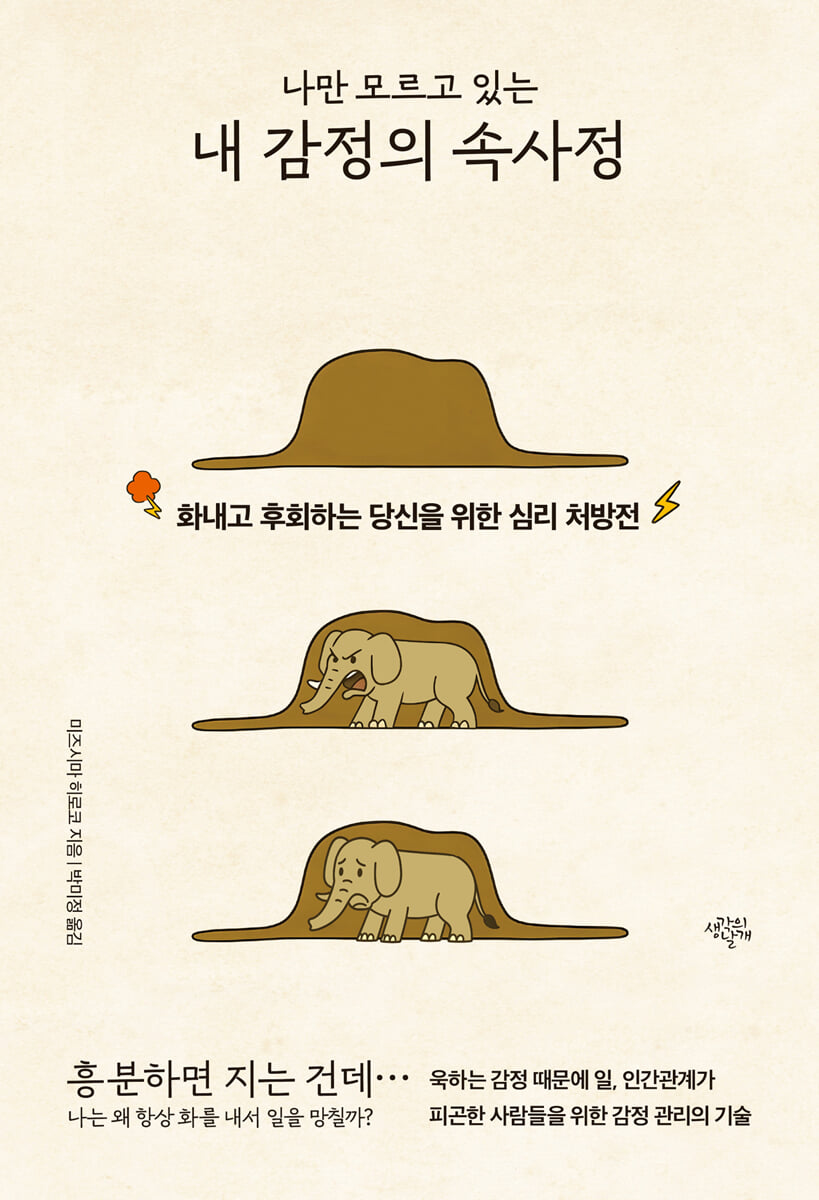
The inside story of my feelings
 |
Description
Book Introduction
Why do I get emotionally agitated and always regret it?
A psychological prescription for those who feel angry and regretful
There are people who easily become 'emotional', unable to control their emotions in the moment over trivial matters and suddenly get angry, or suffer from vague worries and anxiety about anything.
This kind of 'emotional' psychological state not only affects interpersonal relationships and work, but also makes you feel bad and hurts yourself.
This book analyzes the inner workings and mechanisms of emotions of people who easily become emotional about anything, or conversely, suppress their true feelings and pretend not to be emotional. It also suggests ways to maintain peace of mind without being easily swayed by emotions.
A psychological prescription for those who feel angry and regretful
There are people who easily become 'emotional', unable to control their emotions in the moment over trivial matters and suddenly get angry, or suffer from vague worries and anxiety about anything.
This kind of 'emotional' psychological state not only affects interpersonal relationships and work, but also makes you feel bad and hurts yourself.
This book analyzes the inner workings and mechanisms of emotions of people who easily become emotional about anything, or conversely, suppress their true feelings and pretend not to be emotional. It also suggests ways to maintain peace of mind without being easily swayed by emotions.
- You can preview some of the book's contents.
Preview
index
Prologue_ To you who becomes emotional without realizing it
Part 1.
Why do people become emotional?
Why do 'emotions' exist?
The reason I'm angry is because the 'plan' has gone wrong.
If I could express my true feelings
When you're suddenly overcome with anger, think about whether there was a "shock."
Why is judging others violent?
How to avoid developing emotional reactions when you're "hot"
What makes a person 'emotional' is a certain thought
The feeling of 'not wanting to be ignored' hidden behind the word 'emotional'
People become 'emotional' and try to protect their hearts.
If you want to protect yourself, explain rather than get angry.
Why do we tend to repeat the same mistakes once we make them?
Part 2.
An 'emotional' person has low 'self-esteem'
Being 'emotional' is similar to post-traumatic stress disorder.
What is self-esteem?
Do you feel like 'this is enough'?
The root of the problem lies in a misalignment of role expectations.
The thought, "You don't try to understand me!" creates distance between others.
Harnessing emotions is not the same as positive thinking.
Why I Can't Say What I Want to Say
Even 'anxiety' becomes easier when expressed in words.
Things people with low self-esteem often say
Part 3.
If you know each other's territory, you won't get hurt.
Respect each other's territory
Taking responsibility for one's own 'territory'
How to avoid having your 'territory' invaded by others?
When you get angry at someone who has no malicious intent
Why does advice become violence?
But what if you still want to give some advice?
'My rightness' and 'other people's rightness' are different.
Part 4.
Letting go of the 'tug-of-war of righteousness'
Why does insisting that 'I am right' make people feel powerless?
The reason we become 'emotional' is because we are obsessed with 'being right'.
Why we want others to acknowledge our 'rightness'
Focus on your "real" feelings rather than your "right" thoughts.
How to Deal with Differing Perceptions of "Right"
If you have low self-esteem, it's difficult to accept other people's opinions.
What if you feel like you're going to verbally abuse your subordinates at work?
Don't blame yourself for being 'unforgivable'
Part 5.
7 Habits to Avoid Getting Emotional Easily
Habit 1: Understand your physical condition
Habit 2: Thinking it's the other person's problem
Habit 3: Write a 'Friend Note'
〈Habit 4〉 Think of the subject as 'I'
Habit 5: Focus on what you want to do, not what you have to do.
Habit 6: Get out of the way
〈Study 7〉 Closes the 'Shutter of the Heart'
Part 6.
How to Get Along with Emotional People
Are you afraid of a 'verbally abusive boss'?
How to Deal with Sudden Verbal Abuse
What if someone you don't know suddenly makes you angry?
How to solve problems on social media
How to Deal with Emotional Disorders
When encountering anger from a person with atypical developmental disorder
Epilogue: Realizing You Are Strong
Part 1.
Why do people become emotional?
Why do 'emotions' exist?
The reason I'm angry is because the 'plan' has gone wrong.
If I could express my true feelings
When you're suddenly overcome with anger, think about whether there was a "shock."
Why is judging others violent?
How to avoid developing emotional reactions when you're "hot"
What makes a person 'emotional' is a certain thought
The feeling of 'not wanting to be ignored' hidden behind the word 'emotional'
People become 'emotional' and try to protect their hearts.
If you want to protect yourself, explain rather than get angry.
Why do we tend to repeat the same mistakes once we make them?
Part 2.
An 'emotional' person has low 'self-esteem'
Being 'emotional' is similar to post-traumatic stress disorder.
What is self-esteem?
Do you feel like 'this is enough'?
The root of the problem lies in a misalignment of role expectations.
The thought, "You don't try to understand me!" creates distance between others.
Harnessing emotions is not the same as positive thinking.
Why I Can't Say What I Want to Say
Even 'anxiety' becomes easier when expressed in words.
Things people with low self-esteem often say
Part 3.
If you know each other's territory, you won't get hurt.
Respect each other's territory
Taking responsibility for one's own 'territory'
How to avoid having your 'territory' invaded by others?
When you get angry at someone who has no malicious intent
Why does advice become violence?
But what if you still want to give some advice?
'My rightness' and 'other people's rightness' are different.
Part 4.
Letting go of the 'tug-of-war of righteousness'
Why does insisting that 'I am right' make people feel powerless?
The reason we become 'emotional' is because we are obsessed with 'being right'.
Why we want others to acknowledge our 'rightness'
Focus on your "real" feelings rather than your "right" thoughts.
How to Deal with Differing Perceptions of "Right"
If you have low self-esteem, it's difficult to accept other people's opinions.
What if you feel like you're going to verbally abuse your subordinates at work?
Don't blame yourself for being 'unforgivable'
Part 5.
7 Habits to Avoid Getting Emotional Easily
Habit 1: Understand your physical condition
Habit 2: Thinking it's the other person's problem
Habit 3: Write a 'Friend Note'
〈Habit 4〉 Think of the subject as 'I'
Habit 5: Focus on what you want to do, not what you have to do.
Habit 6: Get out of the way
〈Study 7〉 Closes the 'Shutter of the Heart'
Part 6.
How to Get Along with Emotional People
Are you afraid of a 'verbally abusive boss'?
How to Deal with Sudden Verbal Abuse
What if someone you don't know suddenly makes you angry?
How to solve problems on social media
How to Deal with Emotional Disorders
When encountering anger from a person with atypical developmental disorder
Epilogue: Realizing You Are Strong
Detailed image

Into the book
Part 1 | Why do people become emotional?
Why do people become emotional? The word "emotional" means being swayed by emotions and unable to see things objectively.
When people become emotional, they think it's an emotional problem.
But as I said in the prologue, there is nothing wrong with emotions themselves.
In this book, I distinguish between the word "emotional" and the original, innocent emotions, that is, emotions as they are.
So, why do we have "real emotions"? It's a self-defense mechanism inherent in humans.
For example, the feeling of 'anxiety' arises when safety is not secured, and because we feel anxious, we can look at the situation carefully and be cautious in our actions.
--- pp.18-19 From “Why do ‘emotions’ exist?”
Being 'emotional' is a way of 'defending one's heart', although it is a twisted way of doing it.
However, defending yourself 'emotionally' is not only ineffective, it can actually put you at greater risk.
At first, it may be a simple reaction to the 'mismatch of schedule' and 'shock', but by becoming 'emotional' to protect yourself, you can actually torment yourself, and in some cases, you may be ignored or counterattacked by the other person.
This inappropriate self-defense is called 'misaligned defense'.
--- pp.52-53 From “People become ‘emotional’ to protect their hearts”
Part 2 | 'Emotional' people have low 'self-esteem'
Denying natural emotions is also very detrimental to your health.
Because it's no different from saying "it feels cool and good" even though you feel pain when touching something hot.
The first step to not becoming 'emotional' is 'acknowledging and accepting your negative emotions'.
--- p.89 From “Using emotions is different from ‘positive thinking’”
It was said that by expressing emotions verbally, we can share 'emotional thoughts' and correct misalignments in 'role expectations', but people with low self-esteem have difficulty expressing their thoughts verbally.
When I asked, “Where should we eat lunch?” he said, “Anywhere is fine.”
But, I ended up going to a tonkatsu restaurant that I hate, so I said, “I’m not hungry.
“I just want to go home!” he said angrily.
If you look at it literally, some people might think, 'Why are you getting angry when everything is fine?'
The point of this discrepancy is that 'the husband knows very well that his wife hates tonkatsu.'
The husband, upon hearing his wife say that anywhere was fine, probably headed to the tonkatsu restaurant with the thought, "I guess it'll be okay to go anywhere today!"
But the trap is that my wife thinks, 'If we're living together, shouldn't we at least know that I don't like oily food?'
This type of 'I don't need to say anything, you know?' type of communication is especially common in people with low self-esteem.
--- pp.106-107 From “What People with Low Self-Esteem Often Say”
Part 3 | Knowing Each Other's Territories Prevents Hurt
Although the evaluations made by others may at first seem to encroach on one's own territory, they are in fact evaluations made within the other person's territory.
So, from the beginning, the idea is that 'territorial invasion itself cannot occur.'
This is completely different from enduring.
To endure is to ignore the damage and just stand by and watch, which only builds up negative energy in your mind.
On the other hand, the position that it is merely an 'evaluation made within the other person's domain' is that the other person cannot cause harm to me in the first place.
Instead of thinking, "I can tolerate this level of talk," if you think, "The other person is thinking as they please in their own domain, so let's just ignore it," you might be able to change your mood and plan something else.
--- pp.133-134 From “Why Does Advice Become Violence?”
Part 4 | Letting Go of the "Tug-of-War on Moving"
When you think, 'I want to prove that I'm right, but no one is listening to me seriously!', your defense mechanism kicks in and you become even more 'emotional.'
Ultimately, being 'emotional' can be seen as a 'misplaced defense' surrounding one's 'rightness'.
However, because a 'misaligned defense' is literally 'misaligned', it is difficult to get what you believe to be right acknowledged as the result.
If you keep repeating the 'misguided defense' that you are right, the situation will only get worse.
Not only will your relationship with the other person deteriorate, but you will also feel powerless.
Why do people become emotional? The word "emotional" means being swayed by emotions and unable to see things objectively.
When people become emotional, they think it's an emotional problem.
But as I said in the prologue, there is nothing wrong with emotions themselves.
In this book, I distinguish between the word "emotional" and the original, innocent emotions, that is, emotions as they are.
So, why do we have "real emotions"? It's a self-defense mechanism inherent in humans.
For example, the feeling of 'anxiety' arises when safety is not secured, and because we feel anxious, we can look at the situation carefully and be cautious in our actions.
--- pp.18-19 From “Why do ‘emotions’ exist?”
Being 'emotional' is a way of 'defending one's heart', although it is a twisted way of doing it.
However, defending yourself 'emotionally' is not only ineffective, it can actually put you at greater risk.
At first, it may be a simple reaction to the 'mismatch of schedule' and 'shock', but by becoming 'emotional' to protect yourself, you can actually torment yourself, and in some cases, you may be ignored or counterattacked by the other person.
This inappropriate self-defense is called 'misaligned defense'.
--- pp.52-53 From “People become ‘emotional’ to protect their hearts”
Part 2 | 'Emotional' people have low 'self-esteem'
Denying natural emotions is also very detrimental to your health.
Because it's no different from saying "it feels cool and good" even though you feel pain when touching something hot.
The first step to not becoming 'emotional' is 'acknowledging and accepting your negative emotions'.
--- p.89 From “Using emotions is different from ‘positive thinking’”
It was said that by expressing emotions verbally, we can share 'emotional thoughts' and correct misalignments in 'role expectations', but people with low self-esteem have difficulty expressing their thoughts verbally.
When I asked, “Where should we eat lunch?” he said, “Anywhere is fine.”
But, I ended up going to a tonkatsu restaurant that I hate, so I said, “I’m not hungry.
“I just want to go home!” he said angrily.
If you look at it literally, some people might think, 'Why are you getting angry when everything is fine?'
The point of this discrepancy is that 'the husband knows very well that his wife hates tonkatsu.'
The husband, upon hearing his wife say that anywhere was fine, probably headed to the tonkatsu restaurant with the thought, "I guess it'll be okay to go anywhere today!"
But the trap is that my wife thinks, 'If we're living together, shouldn't we at least know that I don't like oily food?'
This type of 'I don't need to say anything, you know?' type of communication is especially common in people with low self-esteem.
--- pp.106-107 From “What People with Low Self-Esteem Often Say”
Part 3 | Knowing Each Other's Territories Prevents Hurt
Although the evaluations made by others may at first seem to encroach on one's own territory, they are in fact evaluations made within the other person's territory.
So, from the beginning, the idea is that 'territorial invasion itself cannot occur.'
This is completely different from enduring.
To endure is to ignore the damage and just stand by and watch, which only builds up negative energy in your mind.
On the other hand, the position that it is merely an 'evaluation made within the other person's domain' is that the other person cannot cause harm to me in the first place.
Instead of thinking, "I can tolerate this level of talk," if you think, "The other person is thinking as they please in their own domain, so let's just ignore it," you might be able to change your mood and plan something else.
--- pp.133-134 From “Why Does Advice Become Violence?”
Part 4 | Letting Go of the "Tug-of-War on Moving"
When you think, 'I want to prove that I'm right, but no one is listening to me seriously!', your defense mechanism kicks in and you become even more 'emotional.'
Ultimately, being 'emotional' can be seen as a 'misplaced defense' surrounding one's 'rightness'.
However, because a 'misaligned defense' is literally 'misaligned', it is difficult to get what you believe to be right acknowledged as the result.
If you keep repeating the 'misguided defense' that you are right, the situation will only get worse.
Not only will your relationship with the other person deteriorate, but you will also feel powerless.
--- pp.151-152 From “Why does insisting that ‘I am right’ make people powerless?”
Publisher's Review
If the examples listed below sound like your own story, this book is for you!
□I feel pathetic for being emotionally excited.
□ I feel discouraged by the thought, 'I'm not that kind of person...'
□ It is common to ruin relationships by spewing out harsh words that cannot be taken back.
□There are times when I am so emotionally excited that I cannot do what I need to do.
□I often hear that I am hysterical and get angry easily.
□I get annoyed because my subordinates don't do what I tell them to do.
□ I get angry when I see someone step on my foot on the subway and don't even say a word of apology.
At that moment, why did I get so angry?
The inner workings of emotions I never knew existed. Now, if I want to react differently...
There are people who are usually fine, but once they get angry, they explode emotionally without thinking about the consequences.
These people get emotionally excited over trivial things, and there are countless cases where things don't work out.
It would be nice to know why you're angry, but you don't even know why you're angry.
It's okay to regret it right after getting angry, but it's not enough to put the spilled milk back in its mouth.
A vicious cycle of blaming yourself for exploding with anger and becoming even more emotional repeats itself.
On the other hand, there are people who are good at holding back their emotions without letting them out.
Because of the negative image that being emotional gives, people think that if they just suppress and control their emotions, things will be resolved.
But it is equally difficult for them to suppress their emotions and think about the stress that builds up.
Whether they express their emotions outwardly or suppress them inwardly, they are not free in the sense that they live bound by their emotions.
If suppressing or exploding emotions is not the answer, then how should we deal with them?
The book, "The Secret Inside of My Emotions That Only I Don't Know," introduces ways to utilize emotions for people who always suffer losses by reacting emotionally, and provides practical know-how to avoid being easily swayed by emotions.
The author of the book, Hiroko Mizushima, is a professor at Keio University School of Medicine and the director of a clinic specializing in interpersonal therapy. She is currently considered the leading interpersonal therapy practitioner in Japan.
Based on extensive clinical experience and a variety of case studies, the author presents fundamental solutions for breaking free from one's emotional self, from the concept and mechanism of emotions to coping methods.
If you get excited, you lose...
Why do I always get angry and mess things up?
Emotional management techniques for people who are tired of work and relationships due to irritable feelings.
In the author's view, the main reason for responding emotionally is the absence of a concept of territory.
People tend to want others to recognize that they are right and become emotionally agitated when that is not the case.
This is an act of imposing one's standards of right and wrong on others and invading their territory.
If the other person does not acknowledge your righteousness, not only will you be hurt, but it will also be unpleasant for the other person who is being forced to be right.
This happens when the boundaries between you and me are blurred and it is difficult to keep a distance from each other.
The author emphasizes the importance of clearly defining the concept of territory to avoid making mistakes by becoming emotional.
If we can clearly recognize the boundaries between ourselves and others and establish a clear concept of territory through distancing, we believe that unnecessary friction or conflict that may arise between us will be significantly reduced.
Based on the concept of domain, the author lists seven ways to utilize emotions to maintain peace of mind without becoming emotional.
It presents specific practical measures that are easy to overlook in daily life, such as understanding your physical condition in advance, such as drinking, overwork, or hormonal imbalance, using friend notes to comfort yourself when you are hurt from a friend's perspective, or focusing on what you want to do rather than feeling obligated to do something.
The author advises that the way to achieve peace of mind without becoming emotional is to do your best to find a way to do what you can now, but to accept and humbly acknowledge the things that you cannot do no matter what you do.
If you're living a life where you're suffering greatly, such as making mistakes because you can't control your anger or hurting yourself because you're angry, this book will awaken the strength within you and give you the wisdom to quietly overcome difficult situations.
□I feel pathetic for being emotionally excited.
□ I feel discouraged by the thought, 'I'm not that kind of person...'
□ It is common to ruin relationships by spewing out harsh words that cannot be taken back.
□There are times when I am so emotionally excited that I cannot do what I need to do.
□I often hear that I am hysterical and get angry easily.
□I get annoyed because my subordinates don't do what I tell them to do.
□ I get angry when I see someone step on my foot on the subway and don't even say a word of apology.
At that moment, why did I get so angry?
The inner workings of emotions I never knew existed. Now, if I want to react differently...
There are people who are usually fine, but once they get angry, they explode emotionally without thinking about the consequences.
These people get emotionally excited over trivial things, and there are countless cases where things don't work out.
It would be nice to know why you're angry, but you don't even know why you're angry.
It's okay to regret it right after getting angry, but it's not enough to put the spilled milk back in its mouth.
A vicious cycle of blaming yourself for exploding with anger and becoming even more emotional repeats itself.
On the other hand, there are people who are good at holding back their emotions without letting them out.
Because of the negative image that being emotional gives, people think that if they just suppress and control their emotions, things will be resolved.
But it is equally difficult for them to suppress their emotions and think about the stress that builds up.
Whether they express their emotions outwardly or suppress them inwardly, they are not free in the sense that they live bound by their emotions.
If suppressing or exploding emotions is not the answer, then how should we deal with them?
The book, "The Secret Inside of My Emotions That Only I Don't Know," introduces ways to utilize emotions for people who always suffer losses by reacting emotionally, and provides practical know-how to avoid being easily swayed by emotions.
The author of the book, Hiroko Mizushima, is a professor at Keio University School of Medicine and the director of a clinic specializing in interpersonal therapy. She is currently considered the leading interpersonal therapy practitioner in Japan.
Based on extensive clinical experience and a variety of case studies, the author presents fundamental solutions for breaking free from one's emotional self, from the concept and mechanism of emotions to coping methods.
If you get excited, you lose...
Why do I always get angry and mess things up?
Emotional management techniques for people who are tired of work and relationships due to irritable feelings.
In the author's view, the main reason for responding emotionally is the absence of a concept of territory.
People tend to want others to recognize that they are right and become emotionally agitated when that is not the case.
This is an act of imposing one's standards of right and wrong on others and invading their territory.
If the other person does not acknowledge your righteousness, not only will you be hurt, but it will also be unpleasant for the other person who is being forced to be right.
This happens when the boundaries between you and me are blurred and it is difficult to keep a distance from each other.
The author emphasizes the importance of clearly defining the concept of territory to avoid making mistakes by becoming emotional.
If we can clearly recognize the boundaries between ourselves and others and establish a clear concept of territory through distancing, we believe that unnecessary friction or conflict that may arise between us will be significantly reduced.
Based on the concept of domain, the author lists seven ways to utilize emotions to maintain peace of mind without becoming emotional.
It presents specific practical measures that are easy to overlook in daily life, such as understanding your physical condition in advance, such as drinking, overwork, or hormonal imbalance, using friend notes to comfort yourself when you are hurt from a friend's perspective, or focusing on what you want to do rather than feeling obligated to do something.
The author advises that the way to achieve peace of mind without becoming emotional is to do your best to find a way to do what you can now, but to accept and humbly acknowledge the things that you cannot do no matter what you do.
If you're living a life where you're suffering greatly, such as making mistakes because you can't control your anger or hurting yourself because you're angry, this book will awaken the strength within you and give you the wisdom to quietly overcome difficult situations.
GOODS SPECIFICS
- Date of issue: June 25, 2025
- Page count, weight, size: 246 pages | 278g | 130*190*16mm
- ISBN13: 9791185428833
- ISBN10: 1185428836
You may also like
카테고리
korean


korean

![GQ KOREA Mark (Monthly): December [2025]](http://librairie.coreenne.fr/cdn/shop/files/8ef265dbbfbf186523ed75ba7319009d.jpg?v=1765340328&width=3840)


