

Yoga Sequence Guide for Infinite Variations
 |
Description
Book Introduction
Developed by a yoga guru with over 30 years of experience
Amazon Yoga Bestseller Chosen by 100,000 People!
For designing yoga classes by theme and difficulty level
A set of 100 asana cards and commentary
There are countless movements I want to introduce to my students, but how should I combine them to create the most effective class flow? Designing a sequence is where most yoga instructors spend the most time and effort.
"Yoga Sequence Guide for Infinite Variations" is the perfect practical tool to address these concerns.
A set of 100 cards and a guidebook help you quickly, safely, and systematically organize lessons tailored to your target audience and theme, from beginner to advanced.
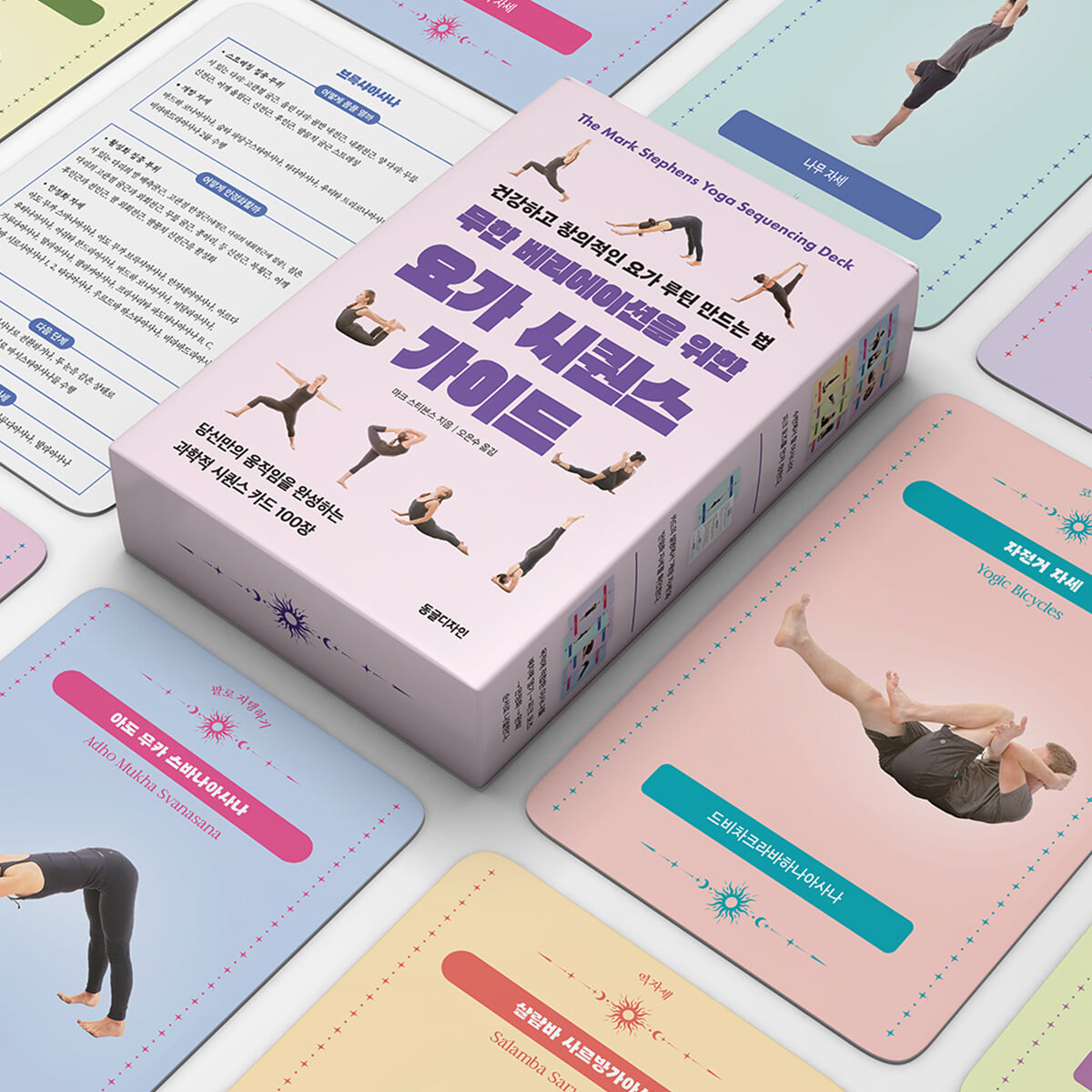
A total of 100 cards detail the alignment and practice effects of 125 movements (asanas).
Additionally, you can intuitively check the flow of movement with real photos and 8 colors distinguished by position.
The accompanying commentary provides an effective lesson design structure, a variety of themed sequences, and risk factors and variations for each asana, further enhancing the usability of the cards.
Author Mark Stevens is a world-renowned yoga instructor who has trained thousands of yoga teachers. He has practiced various yoga traditions for 30 years and has completed this card set.
If you're having trouble organizing your yoga flow, you can start by following the author's routine and gradually practicing it to get inspiration for your own sequence formula.
This set of cards helps you tailor your yoga flow to your goals. It's a great guide for instructors considering classes and for any yogi seeking a structured routine.
Amazon Yoga Bestseller Chosen by 100,000 People!
For designing yoga classes by theme and difficulty level
A set of 100 asana cards and commentary
There are countless movements I want to introduce to my students, but how should I combine them to create the most effective class flow? Designing a sequence is where most yoga instructors spend the most time and effort.
"Yoga Sequence Guide for Infinite Variations" is the perfect practical tool to address these concerns.
A set of 100 cards and a guidebook help you quickly, safely, and systematically organize lessons tailored to your target audience and theme, from beginner to advanced.
A total of 100 cards detail the alignment and practice effects of 125 movements (asanas).
Additionally, you can intuitively check the flow of movement with real photos and 8 colors distinguished by position.
The accompanying commentary provides an effective lesson design structure, a variety of themed sequences, and risk factors and variations for each asana, further enhancing the usability of the cards.
Author Mark Stevens is a world-renowned yoga instructor who has trained thousands of yoga teachers. He has practiced various yoga traditions for 30 years and has completed this card set.
If you're having trouble organizing your yoga flow, you can start by following the author's routine and gradually practicing it to get inspiration for your own sequence formula.
This set of cards helps you tailor your yoga flow to your goals. It's a great guide for instructors considering classes and for any yogi seeking a structured routine.
- You can preview some of the book's contents.
Preview
index
Entering
The Art and Science of Sequence
1.
The philosophy and principles of yoga sequences
2.
The Principle of Smooth Sequencing
Principle 1.
Moving from simple configurations to complex sequences
Principle 2.
From a dynamic introduction to an inner exploration
Principle 3.
Cultivating energy balance
Principle 4.
Integrating the results of the position
Principle 5.
Cultivating continuous self-change
3.
The structure of a yoga class
Arc-shaped deployment structure
Getting started with yoga
Warm-up and awakening
The process of reaching the peak
Peak pose
Integrating training
Deepening Asana Integration
Structure your lessons around themes
Internal and external sequencing of asana series
In conclusion
About the Author
Acknowledgements
The Art and Science of Sequence
1.
The philosophy and principles of yoga sequences
2.
The Principle of Smooth Sequencing
Principle 1.
Moving from simple configurations to complex sequences
Principle 2.
From a dynamic introduction to an inner exploration
Principle 3.
Cultivating energy balance
Principle 4.
Integrating the results of the position
Principle 5.
Cultivating continuous self-change
3.
The structure of a yoga class
Arc-shaped deployment structure
Getting started with yoga
Warm-up and awakening
The process of reaching the peak
Peak pose
Integrating training
Deepening Asana Integration
Structure your lessons around themes
Internal and external sequencing of asana series
In conclusion
About the Author
Acknowledgements
Detailed image

Into the book
'Why do this movement, and then why that movement?' Yoga sequencing boils down to this one question.
That is, the question is whether yoga postures, breathing techniques, and meditation practices are arranged according to any special principles or logic, or for any other reason.
When answering questions like these in our yoga classes and practices, we always think deeply about the interrelationships between asana, pranayama, and meditation, and how the arrangement of movements affects them.
We aim to respect the diversity of our trainees by composing sequences that are most meaningful to them.
---From "Entering"
As you progress through a series of integrated Pratikriyasanas and slowly release tension at the peak of your practice, you reach Savasana, the core of the asanas in a fully integrated practice.
The mental, physical, energetic and physiological state immediately before and after practicing Savasana provides optimal conditions for the practice of pranayama and meditation.
As you move beyond ujayi and into the deeper stages of pranayama, your body and mind will become more focused as you continue your practice.
The integrated effects of asana and deeper pranayama help us reach the sattvic state, which is optimal for meditation.
When you rise from your mat and step out into the world after completing your meditation, let's have a new mindset for the next vinyasa.
---「Principle 5.
From “Cultivating Continuous Self-Change”
The role of the instructor in organizing the yoga sequence is like that of a Sherpa.
The instructor guides the trainee on an adventure of self-reflection and personal development.
To fully experience the adventure, you must prepare your body and mind thoroughly, carefully plan a route suited to your individual characteristics and terrain, and create a route that allows enough time to reach the peak of the experience and a safe return to the beginning.
Only then can a complete and meaningful experience be realized.
This metaphor illustrates the wisdom of the arc-like structure of a yoga class.
That is, the question is whether yoga postures, breathing techniques, and meditation practices are arranged according to any special principles or logic, or for any other reason.
When answering questions like these in our yoga classes and practices, we always think deeply about the interrelationships between asana, pranayama, and meditation, and how the arrangement of movements affects them.
We aim to respect the diversity of our trainees by composing sequences that are most meaningful to them.
---From "Entering"
As you progress through a series of integrated Pratikriyasanas and slowly release tension at the peak of your practice, you reach Savasana, the core of the asanas in a fully integrated practice.
The mental, physical, energetic and physiological state immediately before and after practicing Savasana provides optimal conditions for the practice of pranayama and meditation.
As you move beyond ujayi and into the deeper stages of pranayama, your body and mind will become more focused as you continue your practice.
The integrated effects of asana and deeper pranayama help us reach the sattvic state, which is optimal for meditation.
When you rise from your mat and step out into the world after completing your meditation, let's have a new mindset for the next vinyasa.
---「Principle 5.
From “Cultivating Continuous Self-Change”
The role of the instructor in organizing the yoga sequence is like that of a Sherpa.
The instructor guides the trainee on an adventure of self-reflection and personal development.
To fully experience the adventure, you must prepare your body and mind thoroughly, carefully plan a route suited to your individual characteristics and terrain, and create a route that allows enough time to reach the peak of the experience and a safe return to the beginning.
Only then can a complete and meaningful experience be realized.
This metaphor illustrates the wisdom of the arc-like structure of a yoga class.
---From "Structure of Yoga Classes"
Publisher's Review
'The Teacher of Yoga Instructors', a world-renowned yoga guru
A universal sequence guide developed after 30 years of training
World-renowned yoga teacher Mark Stevens has spent 30 years researching various yoga traditions and training thousands of instructors to perfect his "Yoga Sequence Guide for Infinite Variations."
This set of cards and commentary is an Amazon yoga bestseller, chosen by 100,000 people, and its effectiveness has been proven by countless instructors and practitioners around the world.
Anyone who teaches yoga always thinks about 'how to connect individual movements (asanas) to effectively achieve the goal.'
Designed as a practical tool to address these concerns, these cards help you design safe, systematic, and fast yoga classes.
The 100 cards containing information about each asana are simple and intuitive, and the visualization process of arranging the cards yourself stimulates creative lesson ideas.
Another great advantage is that it can be freely arranged according to the practitioner's level and purpose, allowing for infinite applications and modifications.
It is made in a larger size than regular flash cards and comes in 8 different colors for each position, making it convenient to quickly find the necessary movements and use them immediately.
Still having trouble designing free-form sequences? No need to worry.
The accompanying commentary covers the principles of sequences, the effective structure of yoga classes, and pre-designed sequence examples, allowing you to solidify the flow of your yoga practice simply by following them.
It offers a wide range of variations, from beginner classes focused on recovery, intermediate classes focused on peak poses, to classes with specific themes such as healing and focus, so it is highly useful even if you don't design your own sequence.
Yoga expert Leslie Kaminoff recommends "The Yoga Sequence Guide for Infinite Variations" as "an essential resource for every yogi to help them create intelligent sequences."
As the name suggests, this card set is a tool that can ease the burden and worries of instructors who have to create new routines every time, and it is also a secret weapon that can provide a refreshing change to students.
While maintaining the overall flow of yoga, there are countless variations of the sequence that will serve as inspiration for deeper practice.
With the principles and anatomical analysis of yoga sequences
A highly efficient system that satisfies both instructors and trainees.
When doing yoga, if you don't have a big picture in mind, you often end up only repeating movements that you are confident in or good at.
To address these limitations, "Yoga Sequence Guide for Infinite Variations" presents a five-step, high-quality sequence flow from beginning to integration.
For example, by setting one central peak pose, it naturally guides you through the preparatory movements and flow required to perform that pose.
Users can easily complete a safe and balanced sequence of warm-up-main-peak pose-recovery-cooldown by simply listing the cards in the order presented.
Complementary postures are also provided to help you release any remaining tension after practice and return your body to neutral.
By understanding and utilizing this flow, you can move beyond simply listing movements and create an organic journey of sequences where your body and mind naturally connect.
"Yoga Sequence Guide for Infinite Variations" is a practical tool for yoga instructors to enhance their teaching competitiveness, and a guide for yoga students to harmonize body and mind.
It is a super-efficient sequence system in itself, as it helps anyone practice safely and effectively without trial and error.
All the flow in this guide is designed around the anatomical questions, “How do I open my body?” and “How do I stabilize it?”
For example, to maintain a stable plank, you need the intrinsic plantar fascia, knee extensors, abdominals, and shoulder stabilizers, while the downward dog pose affects the hip flexors/adductors/transverse abdominis/shoulder stabilizers.
This specific and practical muscle activation information helps practitioners pinpoint the core of alignment and achieve deep fulfillment without injury.
This flow and structure were not created by chance; they are based on sequencing principles developed over 30 years of research by world-renowned yoga instructor Mark Stevens.
Having consistently developed educational content used in yoga instructor training courses around the world and garnered attention from various media outlets, the materials he created can serve as tools to help the entire yoga community grow beyond individual practice.
Each class is new and never boring, as a variety of themes such as forward bends, backward bends, balance, and reverse postures are presented, allowing for countless variations from a single asana, and both instructors and students can deeply immerse themselves in the class.
This naturally creates a structure that improves the quality of classes, increases the rate of return for trainees, and promotes healthy circulation and growth in the community.
It is a practical and cost-effective tool for yoga studios and instructors, as it is suitable for everyday, repetitive use rather than workshops that cost hundreds of thousands of won.
A universal sequence guide developed after 30 years of training
World-renowned yoga teacher Mark Stevens has spent 30 years researching various yoga traditions and training thousands of instructors to perfect his "Yoga Sequence Guide for Infinite Variations."
This set of cards and commentary is an Amazon yoga bestseller, chosen by 100,000 people, and its effectiveness has been proven by countless instructors and practitioners around the world.
Anyone who teaches yoga always thinks about 'how to connect individual movements (asanas) to effectively achieve the goal.'
Designed as a practical tool to address these concerns, these cards help you design safe, systematic, and fast yoga classes.
The 100 cards containing information about each asana are simple and intuitive, and the visualization process of arranging the cards yourself stimulates creative lesson ideas.
Another great advantage is that it can be freely arranged according to the practitioner's level and purpose, allowing for infinite applications and modifications.
It is made in a larger size than regular flash cards and comes in 8 different colors for each position, making it convenient to quickly find the necessary movements and use them immediately.
Still having trouble designing free-form sequences? No need to worry.
The accompanying commentary covers the principles of sequences, the effective structure of yoga classes, and pre-designed sequence examples, allowing you to solidify the flow of your yoga practice simply by following them.
It offers a wide range of variations, from beginner classes focused on recovery, intermediate classes focused on peak poses, to classes with specific themes such as healing and focus, so it is highly useful even if you don't design your own sequence.
Yoga expert Leslie Kaminoff recommends "The Yoga Sequence Guide for Infinite Variations" as "an essential resource for every yogi to help them create intelligent sequences."
As the name suggests, this card set is a tool that can ease the burden and worries of instructors who have to create new routines every time, and it is also a secret weapon that can provide a refreshing change to students.
While maintaining the overall flow of yoga, there are countless variations of the sequence that will serve as inspiration for deeper practice.
With the principles and anatomical analysis of yoga sequences
A highly efficient system that satisfies both instructors and trainees.
When doing yoga, if you don't have a big picture in mind, you often end up only repeating movements that you are confident in or good at.
To address these limitations, "Yoga Sequence Guide for Infinite Variations" presents a five-step, high-quality sequence flow from beginning to integration.
For example, by setting one central peak pose, it naturally guides you through the preparatory movements and flow required to perform that pose.
Users can easily complete a safe and balanced sequence of warm-up-main-peak pose-recovery-cooldown by simply listing the cards in the order presented.
Complementary postures are also provided to help you release any remaining tension after practice and return your body to neutral.
By understanding and utilizing this flow, you can move beyond simply listing movements and create an organic journey of sequences where your body and mind naturally connect.
"Yoga Sequence Guide for Infinite Variations" is a practical tool for yoga instructors to enhance their teaching competitiveness, and a guide for yoga students to harmonize body and mind.
It is a super-efficient sequence system in itself, as it helps anyone practice safely and effectively without trial and error.
All the flow in this guide is designed around the anatomical questions, “How do I open my body?” and “How do I stabilize it?”
For example, to maintain a stable plank, you need the intrinsic plantar fascia, knee extensors, abdominals, and shoulder stabilizers, while the downward dog pose affects the hip flexors/adductors/transverse abdominis/shoulder stabilizers.
This specific and practical muscle activation information helps practitioners pinpoint the core of alignment and achieve deep fulfillment without injury.
This flow and structure were not created by chance; they are based on sequencing principles developed over 30 years of research by world-renowned yoga instructor Mark Stevens.
Having consistently developed educational content used in yoga instructor training courses around the world and garnered attention from various media outlets, the materials he created can serve as tools to help the entire yoga community grow beyond individual practice.
Each class is new and never boring, as a variety of themes such as forward bends, backward bends, balance, and reverse postures are presented, allowing for countless variations from a single asana, and both instructors and students can deeply immerse themselves in the class.
This naturally creates a structure that improves the quality of classes, increases the rate of return for trainees, and promotes healthy circulation and growth in the community.
It is a practical and cost-effective tool for yoga studios and instructors, as it is suitable for everyday, repetitive use rather than workshops that cost hundreds of thousands of won.
GOODS SPECIFICS
- Date of issue: November 11, 2025
- Page count, weight, size: 96 pages | 100*150mm
- ISBN13: 9791191925326
- ISBN10: 1191925323
You may also like
카테고리
korean


korean

![GQ KOREA Mark (Monthly): December [2025]](http://librairie.coreenne.fr/cdn/shop/files/8ef265dbbfbf186523ed75ba7319009d.jpg?v=1765340328&width=3840)


